Corporations and FIs will need to enter stablecoins to remain competitive
Cross border liquidity alone will be enough incentive to push them towards this
I have a feeling this Treasury report will be bullish for the industry.
Likely to have good insights on the benefits of blockchain & crypto adoption for institutions
#Treasury#crypto
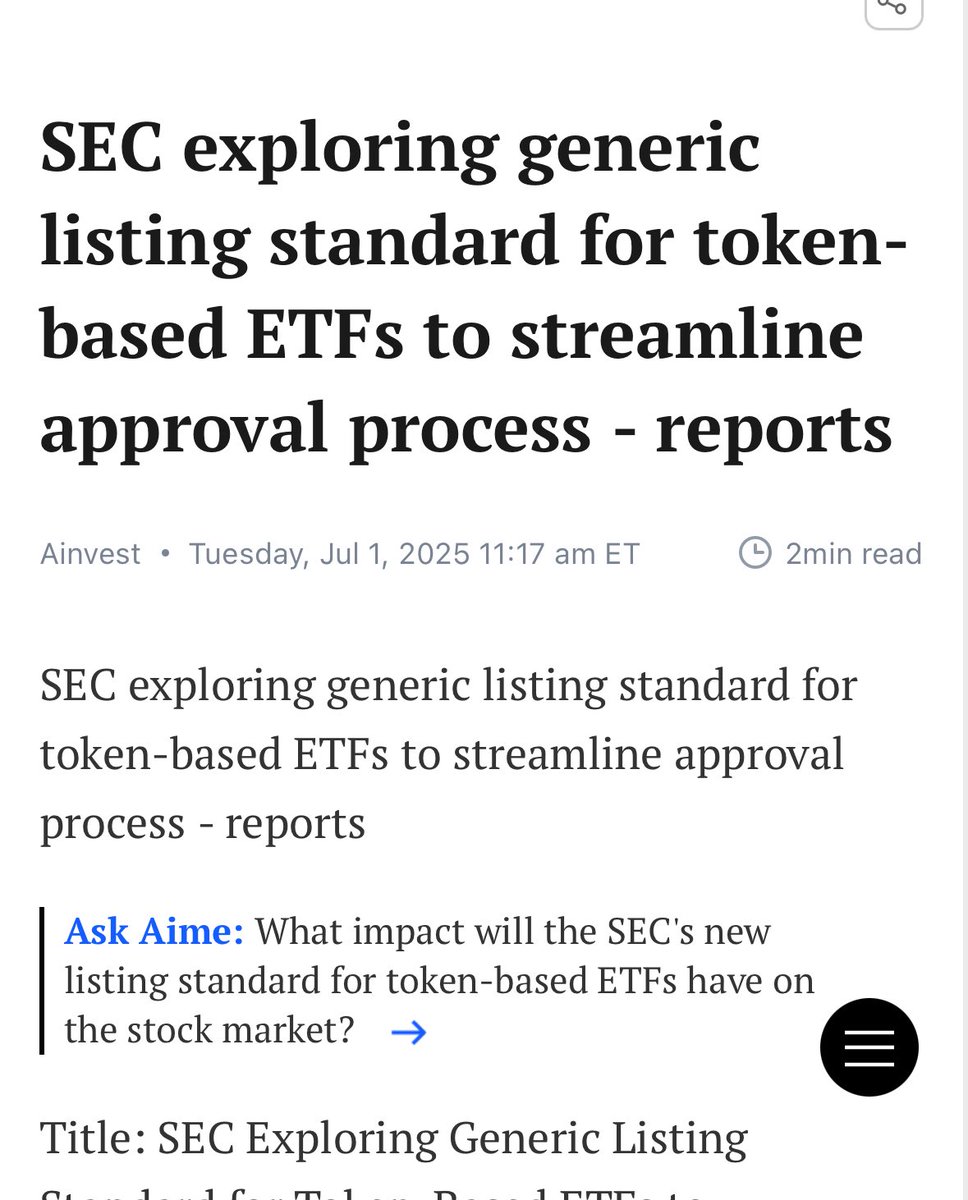
🚨WATCH: Chairman @RepFrenchHill speaks at @RulesReps on the three bills as part of "Crypto Week:"
✅CLARITY Act
✅GENIUS Act
✅Anti-CBDC Surveillance State Act
@theRWAguy but will banks actually share that yield with stablecoin holders?
That’s what made stablecoins pop off—people finally earning real yield vs deposit accounts. TradFi banks need those funds to lend, and I don’t see them cutting the public in like Circle or Paxos do
Thoughts?
Our co-founder, @mcagney, chatted with @business on yield-bearing stablecoins and how the financial landscape will change.
“Regulation will ultimately divide the market into three buckets: offshore coins, which Mike expects to be banned under U.S. rules; non-interest-bearing coins like USDC, which will stay within the banking perimeter; and yield-bearing coins, which are destined to be regulated as securities.”
Mike shared, “If these flows grow, it could pull liabilities out of traditional banks. That reshapes credit availability. It changes how banks function. It’s a form of narrow banking—not enabled by legislation, but by software.”
1/ Been reading through @austincampbell and @TuongvyLe12’s whitepaper.
The paper proves that crypto is not a solution looking for a problem, because the problem is capital markets are still running on 1970s infrastructure—built for a paper-based world, which doesn't fit in today digital age.
Here’s a breakdown of the first section which sets the stage for the argument:
Back in the 60s, brokers started recording securities in their firm’s name instead of the client’s. Why? Because their back offices literally couldn’t keep up with the paperwork.
Everything was still done on physical stock certificates. Each trade triggered a mess of signed documents, delivery flows, and manual transfers through a transfer agent. One trade could take 68 steps to settle.
By 1968, the NYSE had $2.6B in failed deliveries. By year-end? $4B.
Lehman Brothers lost track of $473M in client securities.
Firms weren’t just collapsing—they were losing people’s assets and forgetting to pay dividends. Merrill Lynch alone missed $21M in dividend payments.
It was so bad the NYSE had to shut down one day a week just so back offices could catch up.
To stop the bleeding, Congress passed the Securities Investor Protection Act (1970) and the Securities Acts Amendments (1975). That gave us today’s system—indirect ownership, SIPC, centralized clearing via DTC and NSCC.
But here’s the crazy part- the SEC saw all this as temporary.
They imagined a future with no paper, no middlemen—something closer to a direct, digital ledger of ownership. Even proposed a decentralized model (TAD) where transfer agents would be linked together.
But that was dismissed as a “utopian” idea. So instead, Congress locked in immobilization as the law.
What was supposed to be a temporary fix for the paper crisis ended up becoming the foundation of today’s market infrastructure. Which is riddled with inefficiencies.
Because of those decisions, today, we’ve got a market where every trade passes through a chain of middlemen—each with their own systems, fees, and points of failure.
And the inefficiencies are baked in.
CSDs like DTC hold legal title, not the investor. That means most shareholders don’t even show up on company records—making simple things like voting or communicating with investors way harder than they should be.
Central clearing added another layer—netting trades to reduce risk on paper, but introducing new risks in practice. It concentrated power in a few institutions and made the system more fragile during times of stress.
Brokers holding securities in street name made things easier operationally—but it also blurred the line between firm and client assets. You don’t really “own” what you buy.
This whole system was built to fix a paperwork backlog. But instead of building something better, we just added more layers—more regulation, more friction, and more rent-seeking.
Blockchain disrupts this whole model and builds whole new rails.
@austincampbell Great win for crypto and consumers! I believe that tokenization and stablecoins could be the key to breaking the banking system out of amber
We are NOT ready for tokenized real estate
Had a great convo recently with a commercial real estate professional on the topic of tokenization and we were both aligned that under current market conditions, tokenizing real estate doesn’t unlock much value.
Most of what we’re seeing today are just digital twins of existing assets. Sure, they’re on-chain, but the same legal, liquidity, and operational bottlenecks still exist off-chain. The tech hasn’t solved the hard parts yet—like standardized ownership structures, capital access, or property-level data transparency.
That’s why we’re not seeing real movement in the market, even as more tokenized real estate platforms launch. If the asset still trades like it’s offline, the token isn’t doing much.
Tokenization will have its moment, but it needs to solve friction, not just mirror form.
I made the case that once the right infrastructure is in place, change will come quickly. When local governments start issuing land rights directly on-chain, it unlocks new capabilities for property holders—loans, collateralization, instant verification, and more accessible capital flows.
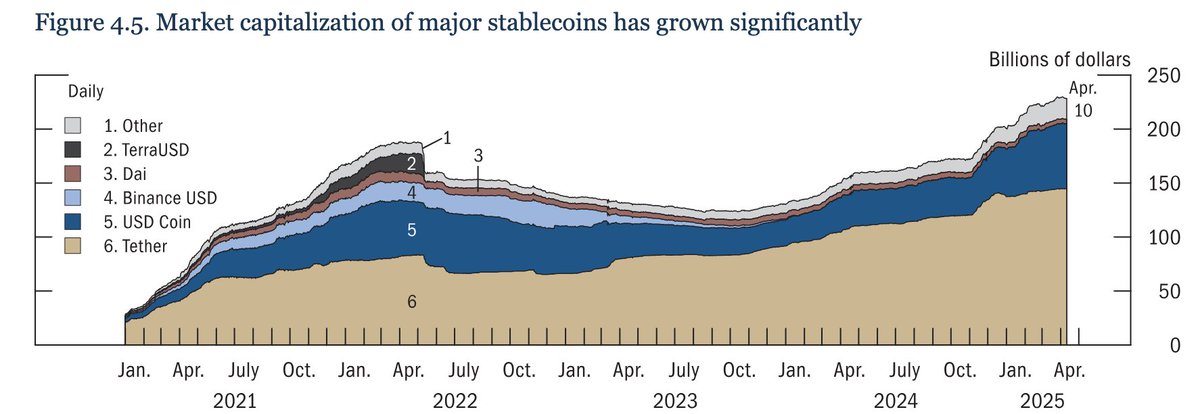
To make the point, I brought up stablecoins. In five years, the market grew from around 20 billion to over 247 billion. That explosion didn’t happen because of new tech, but because the right institutional and regulatory environment finally aligned.
Real estate is still early, but once the ecosystem catches up, the shift won’t be gradual. It’ll hit fast and change everything.
A lot of folks in TradFi still talk about stablecoins like they’re only a crypto-related product. Meanwhile, they’re quietly becoming one of the biggest threats to the way we think about bank deposits and the financial monetary system. The US Treasury flags this clearly in its latest TBAC report.
If stablecoins start offering interest, it’s not some niche DeFi upgrade. It’s a direct challenge to the $6.6 trillion sitting in checking accounts earning nothing. You want capital to flow? Watch what happens when treasurers realize they can get real-time liquidity and yield—without ever touching a traditional bank.
This doesn’t just hit deposits. It stretches M1. It chips away at the funding base for banks. And it puts stablecoin issuers—most of them structured like unregulated money market funds—on track to become some of the largest holders of U.S. debt. They’re already at $120 billion. At this pace, they’ll pass China.
#stablecoins #crypto #Finance
Been following the news on the stablecoin bill
What stands out most is how it dictates the playing field for who’s allowed to issue dollar-backed stablecoins.
If you’re a federally insured bank, you’re in—If you’re a fintech, there’s also a path for you—but it’s looking like it’ll be an uphill battle. You’ll need to become a non-depository trust institution, get chartered by a state banking supervisor, and register with the Fed.
But if you’re a Big Tech platform? The bill effectively blocks you from issuing. Think Apple, Meta, or Amazon—this is a “not your lane” moment.
The message is clear and it’s not pro BigTech. Issuing a payment stablecoin is being treated as a systemic privilege, not just a feature add-on. Strict rules like holding 1:1 reserves, and be prepared for charted regulatory oversight.
So I will say here I do not always disagree with @Cato, but on this one I do.
On big tech launching stablecoins: the BHCA exists. If we want to live in a world where @Meta can launch a stablecoin, we should also live in a world where @jpmorgan can be a social media platform, cloud service provider, or search engine.
If that's the debate we want to have, I'm fine with it, but the narrow confines of the stablecoin act are not the place to have them. That's a large discussion about the very existence of the BHCA itself and re-litigating the reasons that such a thing would exist.
Failing that, if you want to give bank-like privileges to stablecoins, it would definitely NOT make sense to privilege the non-banks over the banks in that way. Likewise, if you are believer in antitrust and preventing monopolies as a key to free markets (and a belief in free markets is something I'm sure I share with the Cato folks), then actually, wouldn't you want to stop a tech monopoly from bootstrapping that into a financial monopoly?
So, knowing what is in the bill, I simply find this unpersuasive. If we want to argue for a full on repeal of the BHCA, let's do it. Otherwise, it's pretty inconsistent to say tech can build into finance but finance can't build out? That is definitely a weird restraint of trade and un-level playing field. If we thought TBTF was bad now, wait until Apple requires you to use Apple Bank (no, not the one that currently exists, that's a real bank but not owned by @Apple) and Apple Dollars to use Apple Pay or the iPhone at all. BHCA restrictions and anti-tying exist for a reason!
Note that the prohibition is NOT specific to just big tech. This would also prevent, for example, Berkshire Hathaway or @Walmart from doing this. Again, I fail to see the problem unless we're just trying to get rid of the BHCA entirely.
On the Foreign Certification role and opposition to the Fed's involvement, I think this goes back to unfortunate problems that are, again, much bigger than this bill.
The first is the Eurodollar market and thus the necessity of the dollar swap lines in 2008. If we want the Fed out of this sort of activity, we should get them out of it. Not out of stablecoins. Out of all of it. But we also need to understand that means in a time of global crisis we might have a massive dollar move completely unrelated to anything happening in the US and a progressive shock through the banking system originating in FX markets because we decided to rug people who had been relying on the dollar's reserve currency status. Now, maybe we want that? Maybe we want massive inflation and less control over the financial system? But if that's the argument, again, we should say it. Saying we don't like this purely in stablecoins but we're fine with it when entities like @HSBC or @DeutscheBank or @BNPParibas (you may have heard of some of those) are involved is just inconsistent! Again, the bigger point here is if we want to relitigate the entire system (a valid concern if you have it), then uniquely mucking with stablecoins is not the place to do it.
Lastly, on the FinCEN things, I think this has it backwards. You don't want FinCEN blindly applying systems meant for account-based fragmented closed ledgers to an open source system. If you do that, you end up with things like Warren's bill that would brick DeFi because you have to have validators and self-custodial wallets KYC'ing everyone. Instead, you do want a study and new rules, and you want those rules to have to be reviewed by Congress and subject to the CRA.
So this one I think is backwards: if you want the system to improve, you don't want to tell them "no new rules and just apply the current ones", which is what the default would be.