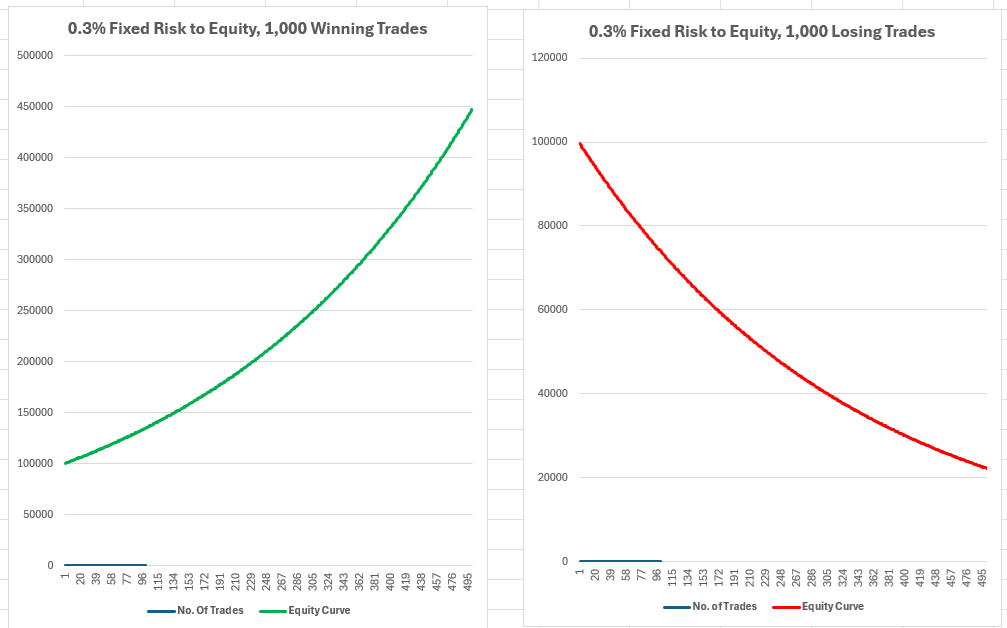
Your capital can grow even when you did the wrong thing.
Your capital can also decrease even when you did the right thing.
Short term changes in capital teach you nothing.
Do not use them as the measure of whether things are going well.
Every time you do that, you are only teaching yourself that short term results matter.
In other words, you are educating yourself to become a trader who cannot succeed.
The only things you should measure yourself by are whether you executed according to the rules, and whether those rules were properly prepared and have positive expectancy.
A quick diagnostic anyone can run on an options chain to spot when the model is lying to you.
The volatilities that come on these platforms are not gospel. They are a function of the quality of the model and how accurate the forward is in the model.
If you see implied volatilities that are significantly different between the same strike call and put on an asset with the same maturity, same strike, and those vols are different, don't believe that number.
Theoretically it doesn't make sense for the implied volatility to be different between the call and the put of the same strike. And that is due to something called put-call parity.
If the bid-offer spread is wide, the mid can drift and make the IV look different between calls and puts. But if the bid-offer is super tight and you still see the call IV and put IV diverge, then there's something up with the forward the model is using.
Same strike, same maturity, IVs should match. If they don't, you've spotted a model issue, not a real vol signal. Useful first check before you build a thesis on what the surface is "telling" you.
1/ Most traders know delta.
Some know gamma. Very few understand vanna.
Yet when markets make moves that seem disconnected from price action, vanna is often part of the explanation.
If you expect a lazy summer,
don't let the next few weeks deceive you.
positions in July are anything but normal
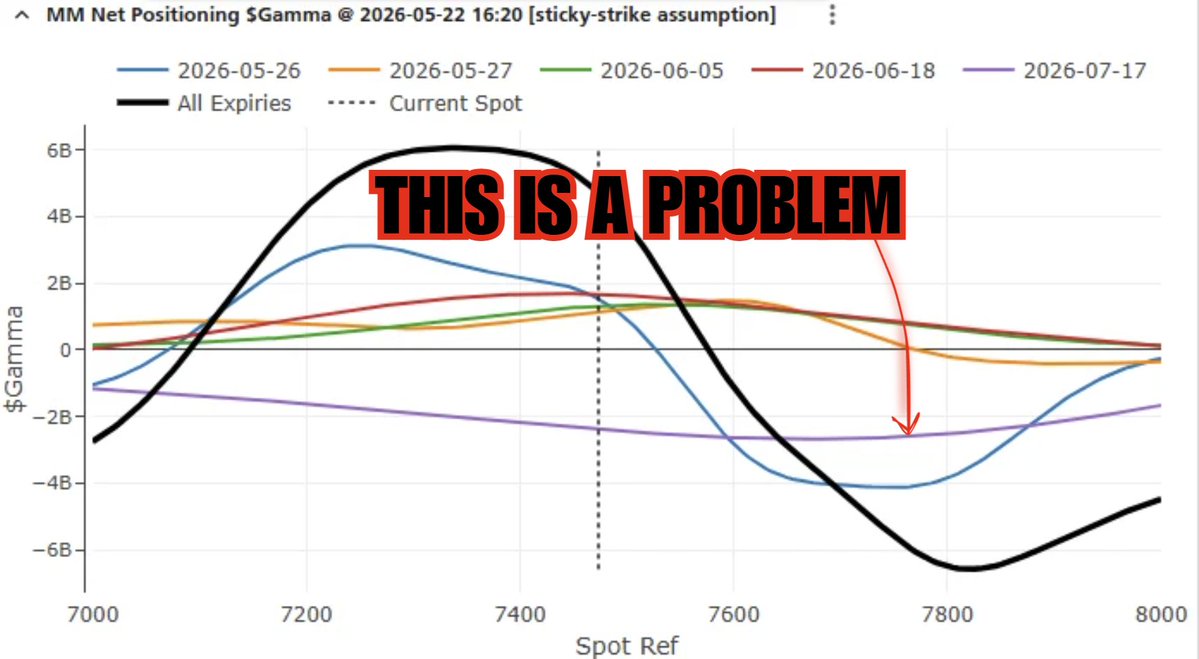
we're not only still stuck in spot-up vol-up regime
but each day brings us closer to chaos.
Here's what you need to know >>
THOUGHTS ON RISK MANAGEMENT
I started this discussion to make the point that risk management is far more nuanced than most on Twitter makes it seem.
Yes, part of great risk management is having rigid rules, discipline, and structure. But trading is also a game of uncertainty, changing context, and asymmetric opportunity. Not every situation cleanly fits inside a pre-defined box.
Good risk management isn’t just about protecting yourself. Good risk management also allows you to maximize pnl while minimizing unacceptable outcomes. For many conservative traders, the biggest weakness in their trading is actually NOT taking enough risk.
One needs to recognize that risk is inherent in our job. You can’t make money without it. In fact, many overlooked that sometimes even blowup risk should be an acceptable risk.
One question I pushed traders on in this discussion:
If you had a trade with a 98% chance of retiring your family forever… but it violated your risk rules… would you take it?
Many said no.
Personally, I think that for anyone out there grinding, you’d have to be out of your fucking mind not to take that trade.
Because the reality is: most traders already have some probability of blowup regardless. No matter what you think, you already probably have a .5% or 1% or 2% chance of blowing up over the course of a career.
Plus even if you didn’t, for many over the long run, strategies decay and edge disappear. Many traders will NEVER “beat the game” over a long enough horizon.
So if you truly had a massively asymmetric opportunity with overwhelming expected value… are you really going to pass on it because a rulebook said so????? Insanity.
At the same time, history is FULL of incredible traders who got overconfident, oversized, and eventually lost everything. So we also can’t fool ourselves into believing we are objective when emotions are involved.
In fact, the moments where we most NEED risk management are often the exact moments where we are the least capable of accurately handicapping expected value because we’re tilted, euphoric, desperate, exhausted, or emotionally compromised.
IMO, inaccurate handicapping of expected value is the biggest danger of any risk management system in practice.
Also… Risk management should always be subservient to goals. That’s why it’s personal.
If you have a $1,000 account and you’re young, maybe taking aggressive shots and occasionally blowing up is part of the learning curve.
If you’re managing 100% of your family’s net worth, the acceptable risk profile becomes completely different.
This is also where wiring out money and keep safe stashes of acorns is a whole other important discussion.
There is no universal framework. Only tradeoffs.
Many asked me my opinion on these topics. The truth is, I’ve broken risk management rules dozens of times. I’ve taken existential risk dozens of times. Sometimes intentionally so, other times not.
Should one be willing to violate their rules? Probably?
Should one be willing to take on existential risk? Depends the person.
I don’t have the answers, but I do think what is most important is recognizing that good risk management is:
1. Iterative
2. Never perfect.
3. Some level of rule-based.
4. Flexible enough to cover the complexity of trading as @Ksidiii mentioned as well.
Perhaps a topic for a future video.
Technical analysis doesn't make $$.
But good risk mgt & self-control does.
The difference between your market analysis versus what you actually do is often where the problem is.
Many traders mistakenly work on their technical analysis more when they're down .
Often, the answer is not in the charts, it's inside you.
Read this to why https://t.co/tf4JUwm5mO
#tradingpsychology #tradingsecrets #ES_F $SPX
$SPY $QQQ #NQ_F $ES_F #QQQ
39. If you’ve made it to Chapter 39 over here, I want you to truly internalize these four graphics, and their relationship to each other. They are intertwined and may offer you a new perspective, understanding, and belief that reshapes how to tune your current trading performance.
Below links are the expanded discussions. I highly urge you to go through all the comments and replies, they are high quality discussions you don't get from a trading course or service:
1. https://t.co/c6BrIKXrs0
2. https://t.co/SyUvcNg1Dt
3. https://t.co/VDezV3ZVEQ
4. https://t.co/VkCky2pPzU
5. https://t.co/8NpcyNE56d
APRIL ‘26 TOP OPPS
Another really active month with huge opportunities across oil, $CAR, and the all-time high breakouts in semis. $CAR and swing longs in semis were best IMO. As always these opportunities are dissected in detail as part of my course.
*$USO*
*$CAR*
*Semis*
4/2 $SBAC
4/6 $UNH
4/22 $FLYYQ
4/23 $SKLZ
4/27 $POET
We might spot numerous potential setups but prioritize using the principle of relative strength to refine and narrow down your list.
"Major Technical Princple 101: Relative Strength (RS) is a very powerful concept that facilities individual stock selection"
Something that came up on Friday's call worth sharing. Sounds simple. Amazing how few can do it.
If you are purely systematic and you have no real other way to read the market, you're just literally every day wanting to do the same thing, then typically being on the short side of options is where you're going to find positive P&L, right? But the flip side of that is you are going to experience horrible days where the market just screws you.
What I find personally over my time in trading is it's better to be flexible and be able to trade both ways. And surprisingly that's difficult.
I've probably met hundreds of traders over the years, and there were so many that were just only comfortable one way round. They just couldn't get their head around being able to both buy options and sell them.
A lot of those over the years got filtered out by the market. Like, they lost their jobs, they struggled to find other ones, they just didn't have great P&Ls.
The people who performed consistently through every regime were the ones who could say "you know what, it's just not a market to be short anymore" or "it's not a market to be long" and actually change behaviour.
Again. Sounds simple but amazing how few can do it.
Trends end when 1) a market comes into balance with 3 bars price overlap, or 2) there is a sharp V or wide range reversal. The Nasdaq has still been "one time framing" or pattern of higher highs and higher lows. One data point at a time....
If you are new to "GEX", or using dealer hedging requirements to predict price movement
Most of your trading improvement will come from understanding (cleanly and accurately) these things:
Gamma
Charm
Pinning
It's just easier to understand with a whiteboard >>
this is great, here are the direct links for all 17 chapters.
Chapter 1: Glossary – Terms and Expressions I Use https://t.co/HT7gaYgpv0
Chapter 2: Charting – My Approach Using TradingView
https://t.co/aoEqF6St1y
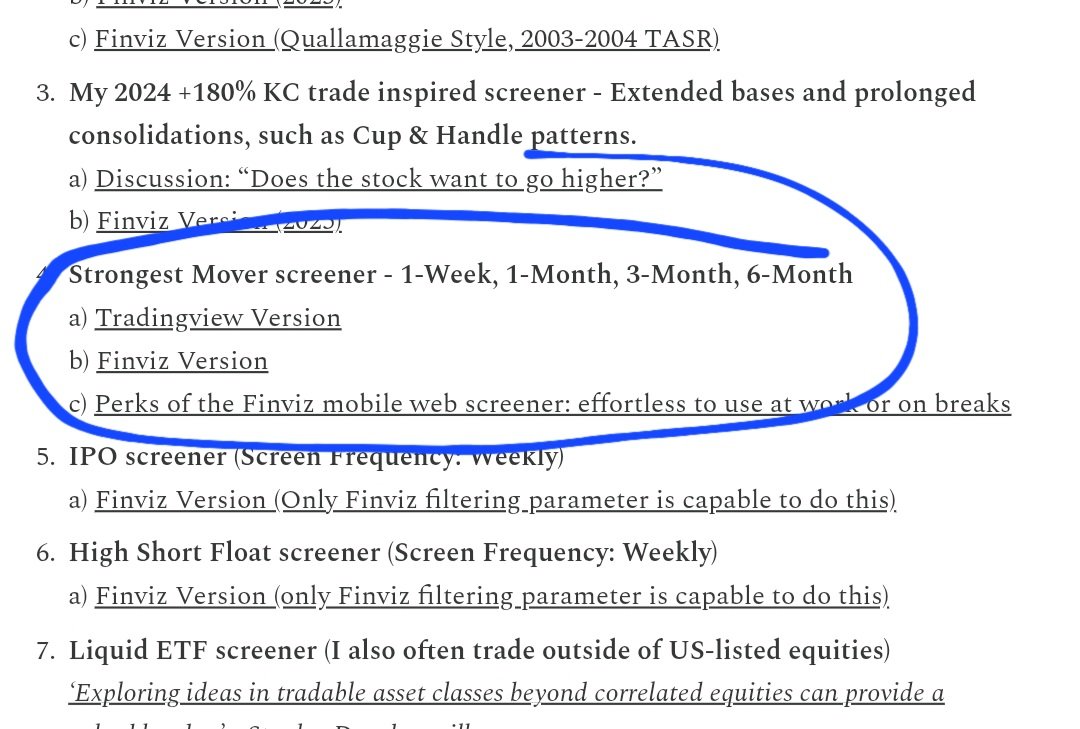
Chapter 3: My Screeners – Workflow of Finviz & Tradingview
https://t.co/acRkoHnyZE
Chapter 4: Process & Routine – Moving Ideas to the Focus List
https://t.co/WXHWxCbuot
Chapter 5: Pre-Market Routine – Situational Awareness
https://t.co/DhZzaqc7nF
Chapter 6: Proficient Execution– Trade Design, Stops, % Risk
https://t.co/myVjX2DczU
Chapter 7: Post-Execution – Trade Management
https://t.co/8AqqGgrf3u
Chapter 8: Journaling – Fine-Tuning to Improve YoY % Return
https://t.co/lFHXQh9VMu
Chapter 9: Conviction – Internalizing These 6 Graphics
https://t.co/03ITWPdS52
Chapter 10: Full-Time Trading – What Does It Takes
https://t.co/q3n5i6gBU9
Chapter 11: Five Books I Highly Recommend To Everyone
https://t.co/lBnNcUnYfi
Chapter 12: Free Productivity Tools & Websites I Rely On
https://t.co/BWeqHDsCnp
Chapter 13: How I Delayed My Own Progress by 3 Years
https://t.co/ZLZBPClIzt
Chapter 15: Reflections and Experiences for You to Relate To
https://t.co/aW5ytZincw
Chapter 15: Closing Remarks – A Call to Inspiration
https://t.co/K5pY8T3Gkp
Chapter 16: FAQ, Paired with Thought-Provoking Questions
https://t.co/BYzRNpBFzb
Chapter 17: Subtle Strategies to Attract Institutional Attention
https://t.co/DqDMR2S3dO
appreciate @KynaKosling for highighting
Low vol regimes don't mean revert as much. They persist.
After 3-4 weeks below VIX 22, the probability of staying low climbs to 80%.
The longer you've been in it, the harder it is to escape.
That's why fading a quiet market is tempting but rarely works.
VANNA tends to work in opposite directions for index versus single stocks.
Same mechanic. Different positioning leading to different outcomes.
𝗜𝗻𝗱𝗲𝘅 𝗹𝗲𝘃𝗲𝗹:
Clients buy puts off dealers. Dealers hedge by shorting futures. When vol gets crushed at FOMC or expiry, those short futures hedges get covered. Index rips. That's the VANNA rally we see regularly.
𝗦𝗶𝗻𝗴𝗹𝗲 𝘀𝘁𝗼𝗰𝗸 𝗹𝗲𝘃𝗲𝗹:
Clients buy calls into earnings. Dealers hedge by buying stock. When vol gets crushed post-earnings, those long stock hedges get sold. Stock dumps even on a beat, like many did last week.
Same vol driven-driven hedge unwind. One pushes the index up, one pushes the stock down.
If you can read which side the VANNA risk is building before the vol reset, you can see the move coming.
The setup is visible in the skew moves leading up to the event.
How closely do you watch the skew?
Two conditions that warn me away from theta trades:
VIX above 25.
Skew above the 75th percentile.
If either is true, you're not in a stable market so trying to earn theta is no better than a coin flip.
I see it as a survival rule.
What rules of thumb do you use to avoid bad trades?
When you run an options book with lots of positions it can get messy.
The way pros think about a portfolio is by aggregating the Greeks
𝗗𝗲𝗹𝘁𝗮 : your directional exposure. Longs vs shorts. Maybe some beta adjustment. You're paid to be right on direction.
𝗧𝗵𝗲𝘁𝗮 : your decay-harvesting trades. Calendars, flies, strangles. You're paid for time passing inside a range.
𝗩𝗲𝗴𝗮: your volatility exposures. VIX trades, dispersion, vol of vol. You're paid when implied moves a certain way.
Some times these Greeks can work in opposing directions.
For example, you might be bet NET long DELTA but you are also long VEGA, so in a rally the PNLs may work against each other. There will also be scenarios where they work in the same direction.
Understanding this interplay between how the Greeks are likely to behave across many scenarios it what allows you to capture edge over time.
The recent QQQ rally in second half of April was a good example where being long Vol and long Delta had a ton of alpha because you were protected in the sell off but crushed it on the rally because the vol performed so well in the move.
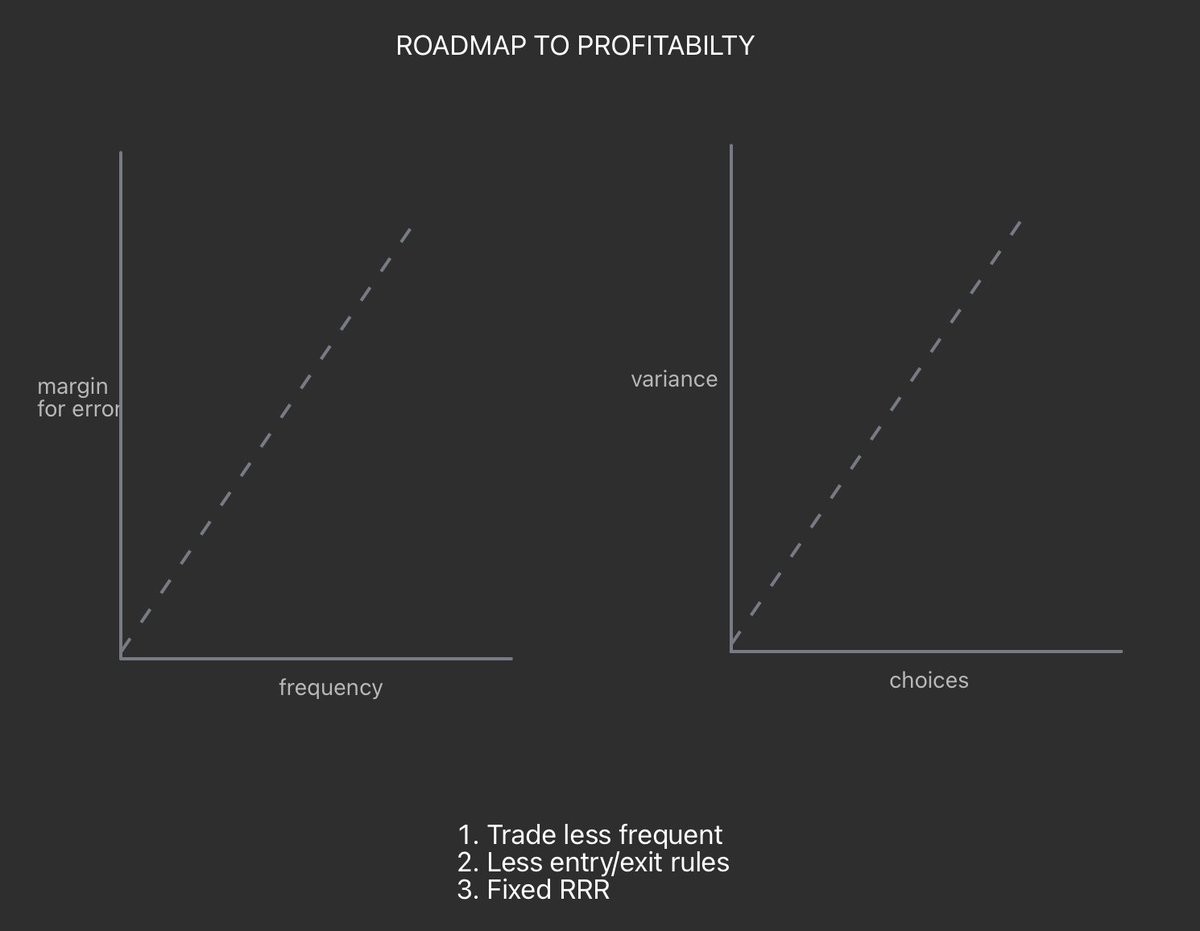
Yesterday I told a struggling trader who had nearly blown out his account late last week (80% drawdown) that the only way to avoid this is to trade just a few times a month (or less). In 2025 I went 4-5 weeks with zero trades. Hence, I’m going to share an article below by Austin Palmer, he says it all perfectly:
“Most retail traders believe they need more—more trades, more setups, more indicators, more signals. But in reality, the traders who survive (and thrive) do the opposite. They trade less frequently, reduce the number of decisions, and lock in a fixed risk-to-reward ratio that keeps their edge stable.
Here’s why simplifying your trading increases your chances of long-term profitability.
1. Trading Less Reduces Mistakes
Every trade is a decision.
Every decision carries emotional and cognitive load.
The more trades you take:
the more tired your brain becomes
the more emotional impulses creep in
the more likely you are to overreact to noise
the more commissions/spreads you pay
the more small errors compound into big losses
By reducing trading frequency, you automatically reduce the number of opportunities for mistakes.
Fewer trades → Higher quality → More consistency.
Elite traders don’t take every “okay” trade.
They wait for the A+ setups that align perfectly with their plan.
2. Fewer Choices = Lower Variance in Outcomes
When you have too many signals, too many strategies, or too many timeframes, your decision-making becomes inconsistent. Choice overload raises the variance in outcomes—you might catch a big win today and then give it all back tomorrow on impulsive trades.
Reducing choices tightens your performance curve.
When you:
trade one setup type
focus on one pair or market
use one timeframe
follow one clear trigger
Your results stabilize. The randomness disappears, and your edge becomes measurable. A stable edge is a profitable edge.
3. A Fixed RRR Protects You From Yourself:
Most traders blow accounts not because of strategy, but because of inconsistent risk-to-reward ratios.
Sometimes they take 1:3, sometimes they settle for 1:1, sometimes they hold for 1:6 and give it back. This inconsistency destroys expectancy.
A fixed RRR:
forces discipline
keeps losses small
standardizes wins
makes your edge mathematically trackable
creates predictable long-term performance
Your job is NOT to predict the market.
Your job is to control the asymmetry between risk and reward.
A consistent 1:2 or 1:3 turns even a 40%-win rate into profitability.”
Palmer nailed it. So, ask yourself this question. If you only took 10-12 trades in the entire YEAR but your ARR was 20-30% would that satisfy you?
Think of the time savings, less stress, higher compounding over time and less tax headache with wash rules etc.