Thank you, Afzal sir.
Discovering you and your work changed the way I trade and, honestly, changed the direction of my life.
I’m still just getting started. I have a lot more to learn, a lot more to prove, and a long way to go.
But one thing will never change — you’ll always be one of the most important mentors in my life.
Forever grateful
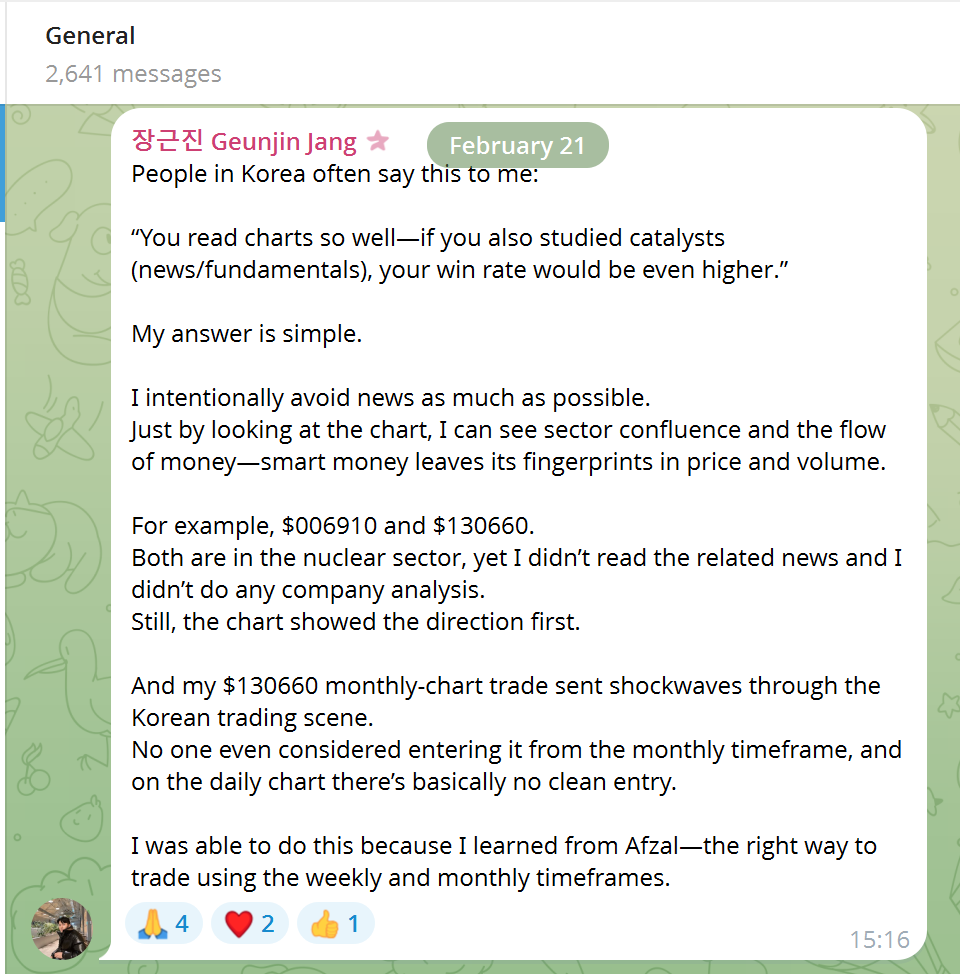
When you’re headstrong about something… there is no stopping you.
Here’s the story of Geunjin from Korea.
He joined the Champions Club last year. And he had it tougher than most. The videos are in English. And for him, that was a real barrier.
But instead of complaining… he did something insane.
He literally translated what I spoke , line by line, into Korean and then learnt.
Imagine learning trading like that… Frustrating for most.. but he was headstrong!!
He kept watching the videos again and again. Attended sessions like clockwork. Quietly did the work instead of complaining abt the language limitations..
And today? He’s making crazy trades.
His recent trade - 130660 - shot up 86% in less than a month.
To the point that there are traders in Korea who now look forward to what he’s doing.
This is the Champion Mindset!
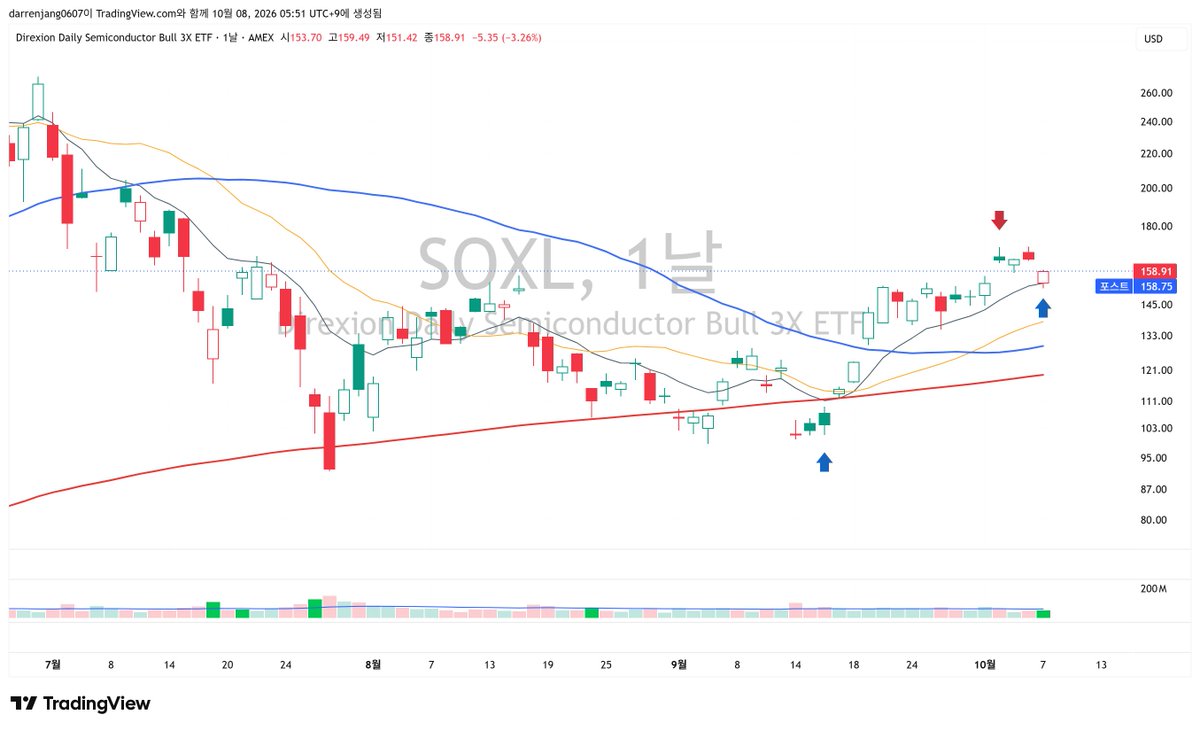
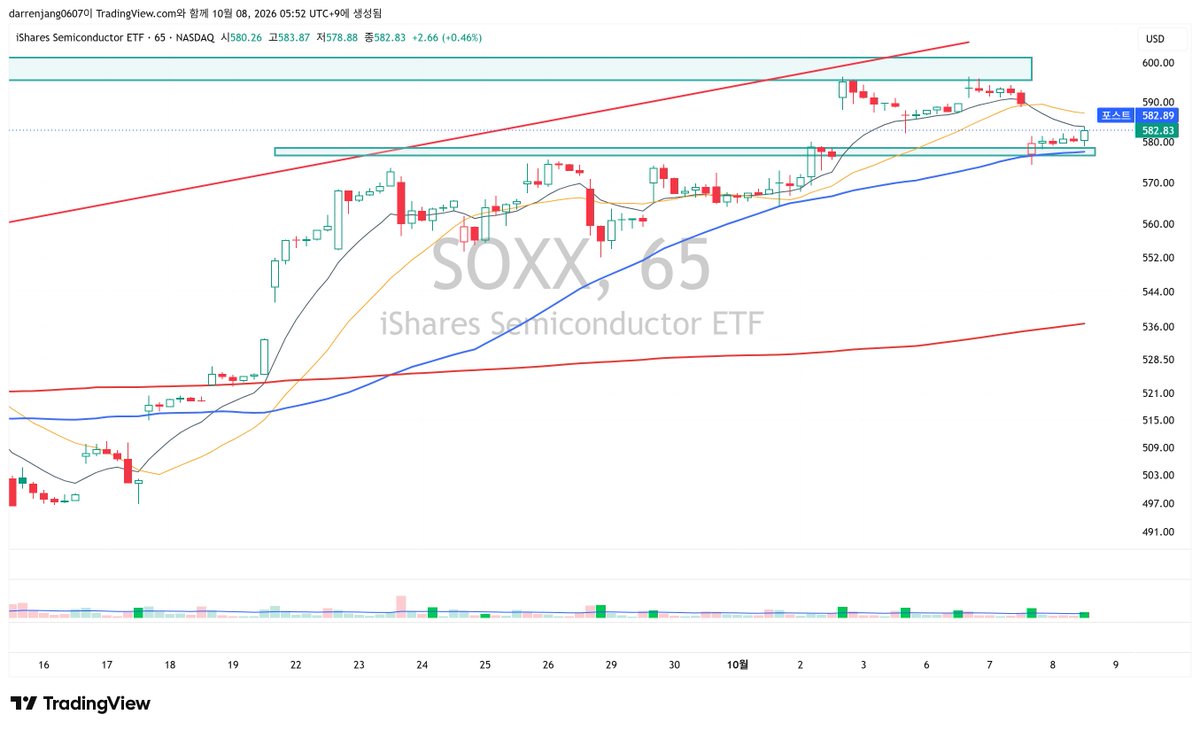
오늘 $SOXL 매수.
반도체 상승 추세가 아직 끝났다고 보지 않습니다.
기초자산인 $SOXX가 갭 하락하면서 10일선을 잠깐 이탈했지만, 장중 매수세가 들어오며 다시 회복했습니다. 65분봉에서도 M.E.T.A. 지지 구간과 겹치는 자리였습니다.
$SOXL 역시 10일선을 회복했고요.
최근 상승을 놓쳤더라도 이런 눌림에서는 다시 진입 기회를 찾을 수 있다고 봅니다.
물론 지지가 깨지면 생각을 바꿔야겠죠.
Cosmecca Korea (241710) — First Deep Pullback After a Major Breakout
I bought Cosmecca Korea, a Korean cosmetics ODM company, on October 7.
The weekly chart is what initially caught my attention.
The stock spent a long time struggling with resistance around KRW 100,000–106,000. It finally broke through that area in August and rallied toward KRW 155,000.
Then came a pretty deep pullback.
This week, price dropped back into that former resistance zone, briefly reaching KRW 102,900 before bouncing.
I liked the possibility of old resistance turning into new support.
The fundamentals were also improving. Q2 revenue grew around 40% YoY, with operating profit up 39%.
On October 7, the stock rallied nearly 6% and closed at KRW 117,000. I entered as the rebound developed.
It's not a perfect setup. There's still overhead resistance on the daily chart, and the pullback has been quite deep.
But I liked the weekly support area and the price reaction.
If the rebound fails, I'll respect my stop. If the stock continues to recover, I'll see how it behaves around the nearby moving averages and previous highs.
Sharing my thought process. Curious how you guys would approach this type of deep pullback.
Charts: Weekly and Daily
@mikulkal@marketsurge Great to see you looking outside the U.S. again. I recently wrote a Korean deep dive on your 2024 USIC run—focusing on progressive exposure, risk management, and the year-end drawdown. Thanks for sharing both the wins and mistakes so openly.
https://t.co/hpSbM5gw69
Market breadth is very weak, but that doesn’t necessarily mean the market is simply bearish.
In this kind of environment, stock selection and risk management become extremely important. I want to focus selectively on the strongest sectors and the strongest leaders. Position sizing and aggressive entries should also be more conservative.
Right now, the leaders are still holding up. If breadth improves, those leaders could potentially lead the market into a broader advance. But if the leaders start breaking down and we don’t see new leaders emerging, that’s when we need to become defensive.
I wrote a Korean deep dive on Christian Flanders’ trading approach 🇰🇷
What stood out to me:
• buying strength near highs
• pyramiding when trades work
• cutting size aggressively during losing streaks
• keeping monthly drawdowns under control
소개글:
https://t.co/O9WF5tFSw0
@CFlanders7
Leif, your 1995 / 2019 comparison got me curious enough to go digging through old Fed decisions and market charts 😂
I ended up turning it into a full article on rates, earnings, breadth, and why a strong index doesn’t always mean an easy trading environment.
Thanks for the spark, @LeifSoreide
https://t.co/0jz5ILzBpJ
High rates don’t rule out a rally. Rate cuts don’t guarantee one.
Leif Soreide’s discussion of 1995 and 2019 sent me back to the charts.
My notes on earnings, expectations and why a strong index isn’t always an easy market to trade. https://t.co/YiPZ1mmNJs
High rates don’t rule out a rally. Rate cuts don’t guarantee one.
Leif Soreide’s discussion of 1995 and 2019 sent me back to the charts.
My notes on earnings, expectations and why a strong index isn’t always an easy market to trade. https://t.co/YiPZ1mmNJs
@LeifSoreide That’s exactly how this tape feels to me: weak breadth, but not an absence of opportunity.
The strongest names are clustering in a few groups, so I’m staying selective—small pilots first, then adding only when the trade confirms.
The 2019 comparison is interesting.
@dennisc230 Better setups can appear before breadth confirms.
I’m seeing the same tension: stronger individual charts, but broader participation is still weak. Enough to build a focused watchlist—not enough to press exposure.
@jfsrev Grouping leaders by industry is much more useful than reading a ticker list.
The concentration in infrastructure software stands out. I’m watching whether that strength can persist and broaden before increasing exposure.
William O’Neil did not teach traders to wait for every loss to reach 8%. He called 7–8% an absolute maximum—and said average losses should be smaller. I traced the rule through his book, IBD and SwingTrader. https://t.co/cwn1RDegab
A 5% stop does not mean 5% account risk.
Monte Carlo does not prove that 2% is the correct risk per trade.
Stop distance, position size and account risk are different things. Here’s how they fit together. https://t.co/opEIrc3cEb
다른 트레이더들과 엣지, 진입, 포지션 사이징, 매매 루틴에 관해 이야기하는 걸 좋아합니다.
같은 차트를 보더라도 관점은 전부 다릅니다.
그 차이를 듣다 보면 제가 당연하다고 믿었던 기준을 다시 점검하게 됩니다.
트레이딩은 혼자 하지만, 발전까지 혼자 할 필요는 없습니다.
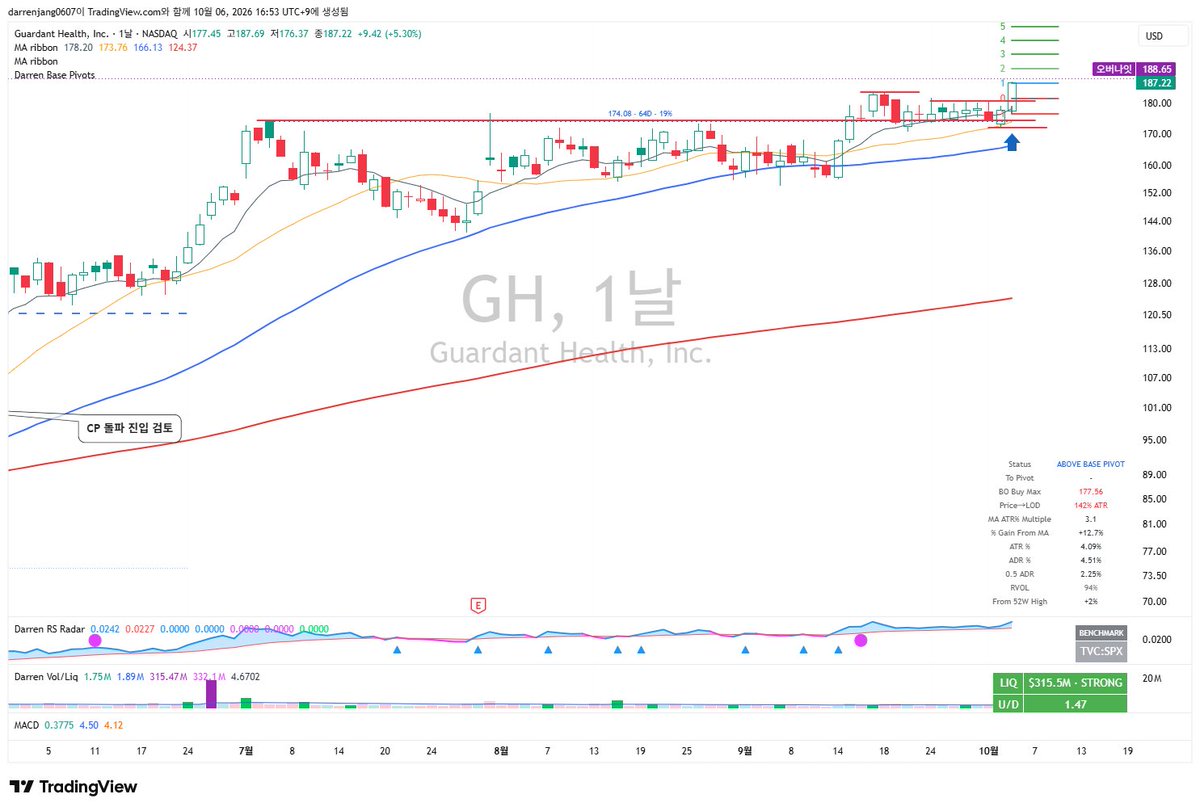
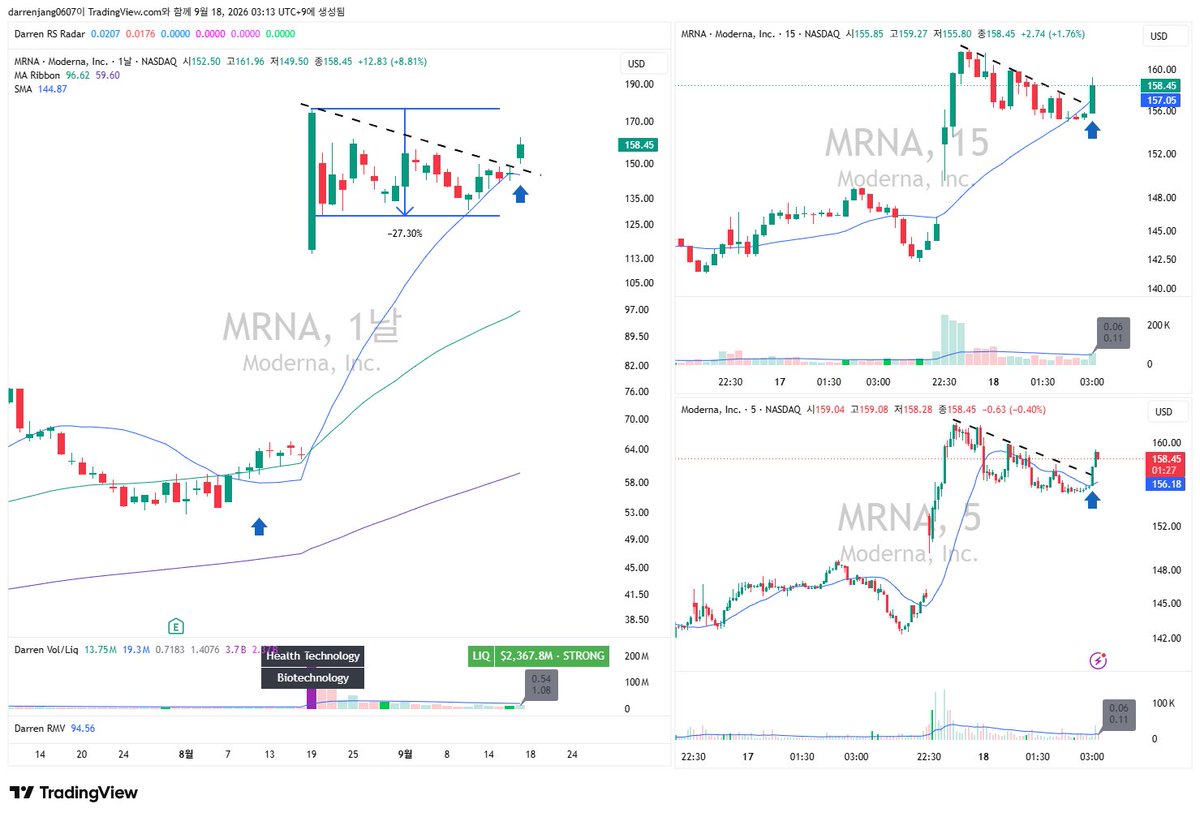
I bought $MRNA yesterday on a High Tight Flag setup.
It broke above both the DTL and the $150 level. Hopefully, we’ll see some follow-through from here.
@JLawStock I’m so glad your course is now available in English!
I enrolled when it was only offered in Chinese, but eventually gave up because of the language barrier. Your setups are truly incredible.
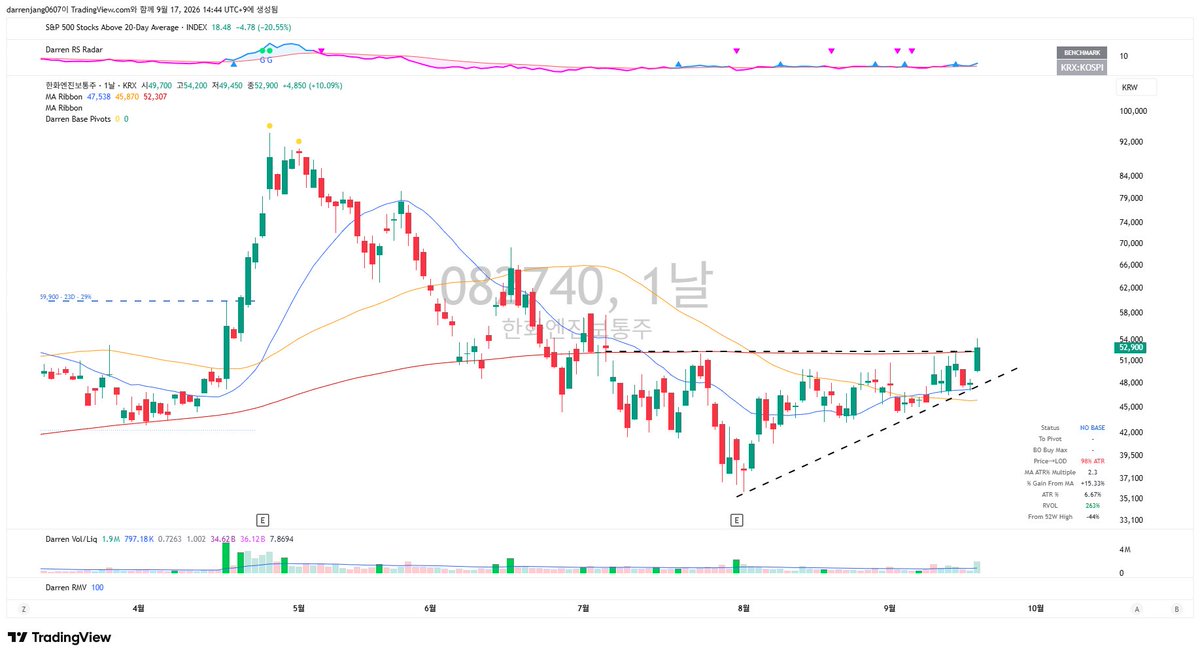
I viewed Korean stock Hanwha Engine ($082740) through the M.E.T.S. framework and initiated a position yesterday.
Looking forward to learning more from you!
@markminervini Thanks so much, Mark. That clears it up perfectly. Really appreciate the reply.
I’ll be in the U.S. soon — hope I get the chance to meet you and grab a photo together. 🙏
@markminervini Mark, I’m a Korean trader and a longtime student of your work.
I found your books at a time when I was completely lost about how to approach the stock market, and since then I’ve read your books—and many of the books you recommended—countless times.
I even tracked down Richard Love’s Superperformance Stocks, which was never translated into Korean and was surprisingly hard to find. I also read other books you recommended before Korean editions were available.
More importantly, you were the person who introduced me to trend following. That completely changed the direction of my life.
In a relatively short period of time, I was able to make enough money from trading to leave a job and corporate environment that had become extremely difficult for me. I don’t say that lightly—your work genuinely helped me change my life.
Funny enough, my English name is Darren, so I sometimes joke that even my English name sounds like someone trying to imitate you. 😂
I started by trying to follow your approach as closely as possible, and over time I’ve been gradually developing my own style while keeping your principles at the foundation.
I’m also really looking forward to your new book next year. I won’t be waiting for the Korean translation—I’ll be buying the English edition as soon as it comes out.
I wanted to ask you something about the Minervini Trend Template.
My interpretation has always been that the 8-condition Trend Template is a conservative, high-probability framework for identifying established Stage 2 uptrends, rather than an absolute rule that every single trade must satisfy without exception.
I also know you’ve used different Trend Template settings, including the 1-month, 5-month, and Wide versions.
And if I’m reading the chart correctly, your 2023 $LEN trade was entered while the 50-day SMA was still below the 150-day SMA.
The reason I’m asking is that many Korean traders treat the 8 conditions almost like immutable laws: if even one condition is missing, they believe the stock simply cannot be bought.
Is that really how you intended the Trend Template to be used?
Or was your intention closer to this: the Trend Template is a highly reliable framework for keeping traders on the right side of the trend, while an experienced trader may sometimes identify a valid setup before every condition is fully aligned?
I’d really appreciate your thoughts.
Much respect from Korea, Mark. Your work had a huge impact on the way I learned to trade—and on my life.