June has been a humbling month.
Out of my last 7 trades, 5 have been losses.
Today I took an $MSFT trade and finished the day down $260.
My account now sits at $1,189.
A few months ago, posting this publicly would've been difficult. I would've wanted to hide the losses and only share the good days.
But that's not the journey I'm documenting.
This account isn't a highlight reel.
It's a real trading journal.
The wins, the losses, the mistakes, the frustration, and hopefully the growth that comes from all of it.
Today marks the beginning of a challenge.
I'm going to document every trade I take from this point forward — including my executions, profits, losses, and thought process.
No deleting bad trades.
No hiding red days.
No pretending to be something I'm not.
The goal is simple:
"Turn this $1,189 account into a $10,000 account by December 31, 2026."
Maybe I get there. Maybe I don't.
But what I can control is showing up every day, following my process, learning from my mistakes, and staying in the game.
One day I'll look back at this post and remember exactly where the journey started.
Day 1.
$1,189.
Trading with 2 contracts.
Let's get to work. 📈
$AMD Trade Recap | -$239.66 💔
This was my biggest loss in the last couple of months, and reviewing it, both losses came from essentially the same execution mistake.
I stayed completely out of the market Monday through Thursday because nothing aligned cleanly with my thesis. Friday was the first day this week I finally saw something I wanted to trade.
Premarket Plan
Most stocks were inside their premarket ranges, while $AMD & $TSLA showed extreme strength.
My plan was simple:
Wait for the indices to establish direction → find the stock showing relative strength/weakness in that direction → wait for my B&R setup.
After the open, the indices started showing weakness. $QQQ pushed below PML with weak price action, and AMD became one of the weakest stocks intraday.
AMD had several things I look for on the downside:
• Opening Prints rejected
• Bearish market structure
• Relative weakness
• Indices moving lower
• PML breakdown
• Clear room toward PDL
The downside thesis made sense.
But I made two critical mistakes.
Mistake #1 — I Misread the PDH Liquidity Sweep
I initially believed AMD had swept PDH after the open and rejected it.
That gave me extra conviction that the next major liquidity target could be PDL.
Looking back, AMD had already interacted with/swept that area during the premarket move. The post-open rejection wasn't the fresh HTF liquidity sweep I thought it was.
I gave that piece of confirmation more weight than it deserved.
Mistake #2 — I Never Waited for the 5-Min Close
This was the BIG mistake, and I made it TWICE.
Entry #1 — 9:39
AMD broke below PML around 9:37.
9:38 continued lower.
Then 9:39 retested PML with upper wicks and formed what looked like a perfect inverted-hammer rejection.
On the 1-min chart, it looked like my ideal B&R.
So I entered.
But 9:39 was also the final minute of the 9:35–9:39 5-min candle.
I entered before knowing whether AMD could actually close the 5-min candle below PML.
It couldn't.
The candle reversed, reclaimed PML and closed back above the level.
Stopped out: -$120 Loss.
Entry #2 — 9:54
Then I made virtually the exact same mistake again.
AMD gave me what looked like a clean 84% reclaim/rejection setup around 9:54.
Again:
Breakdown → Retest → Upper wicks → Inverted hammer → Bearish confirmation.
And again, 9:54 was the final minute of the 9:50–9:54 5-min candle.
Instead of waiting for confirmation, I anticipated the close.
AMD reclaimed the level again.
Stopped out: another -$120 Loss.
Total: -$239.66.
Then the Actual Setup Appeared...
This is the painful part.
Around 10:04, AMD finally gave me what the first two trades were missing:
A confirmed 5-min close below PML.
Then around 10:07, price came back and gave the proper retest of PML.
That was the entry I should have waited for.
And from there AMD eventually moved roughly $6.50 lower, almost exactly toward the downside move I had originally anticipated.
By then, I had already lost ~$240 and didn't have the buying power to take a third attempt.
Biggest Lesson
My thesis was right.
My direction was right.
My timing was wrong.
I was so focused on getting the perfect 1-min B&R that I ignored the higher-timeframe confirmation.
Both entries looked clean on the 1-min chart.
Neither had the 5-min close confirming that PML had actually broken.
That's the rule I need to take from this:
When my setup happens during the final minute of a 5-min candle, STOP anticipating the close.
Let the candle close.
Confirm the level actually broke.
Then wait for the retest.
I'd rather enter slightly later with confirmation than take two early entries and lose $240 before the real move even begins.
And regarding Friday: I don't want to excuse these losses by saying "Friday is manipulation day." Friday may have different flows or expiration-related volatility, but the chart gave me an objective way to avoid both fakeouts:
Wait for the 5-min close.
That's on my execution.
One trade idea all week.
Two attempts.
August 21st 2026: -$239.66 🔴
The market eventually validated the thesis, but being right about direction means nothing if I can't execute it correctly.
Patience > anticipation.
Current account balance: $562.52
$PLTR Trade Recap | -$39.33 🔴
Today was a trade that should have been completely avoided.
Most stocks were inside their premarket ranges, while $PLTR & $MSFT showed weakness premarket.
My plan was simple: if buyers stepped in with strong price action and either stock developed relative strength, I would wait for a proper B&R at a key level.
After the open, the indices stayed inside the ORB 5-Min range and there was no clear directional move. SPY was slightly weaker and started basing toward the 5-Min Low.
Nothing on my watchlist was showing an A+ setup.
PLTR looked like the best opportunity at the time, but looking back, it was still a subpar setup.
Mistake #1 — Opening Prints Were NOT Respected
PLTR opened with a green candle, but that alone wasn't enough.
For my bullish setups, I want price to respect the Opening Prints, showing buyers are aggressive and controlling the move.
PLTR didn't.
Price rejected the Opening Prints and immediately pushed back below them.
That should have been my first warning:
No Opening Prints respect = No A+ setup.
The first 5-min candle was also indecisive rather than showing clean bullish control.
Mistake #2 — This Was NOT an 84% Reclaim
I entered around 9:37, thinking I was taking my 84% reclaim setup.
But reviewing the chart, the original move never created a valid B&R under my 3-candle rule.
There was:
❌ No proper breakout candle holding above the key level
❌ No proper retest candle
❌ No confirmed B&R structure
So there was technically nothing to reclaim.
My 9:37 entry was essentially a breakout entry, exactly the type of entry I'm trying to eliminate.
Instead, I should have waited for price to develop the complete setup.
And eventually it did.
Around 10:08, PLTR finally gave the cleaner B&R/reclaim structure I should have waited for, followed by roughly a $1.40 upside move.
What the A+ setups looked like today
Looking at the MU & SNDK setups Tony and Jack took made the difference even clearer.
Those setups had:
Opening Prints respected → Market Structure → Market Context → Key-level B&R → Proper Retest
That's the standard.
My PLTR trade didn't meet it.
Lesson:
The biggest mistake wasn't losing $39.
It was trying to find a trade on a day when the market wasn't giving me one.
I don't need to trade the best-looking setup available.
I need to trade only when the best-looking setup is actually an A+ setup.
No proper 3-candle B&R = No entry.
No Opening Prints respect = No A+ setup.
No clear market direction = Be patient.
Result: -$39.33 🔴
Completely avoidable loss.
Current account balance: $802
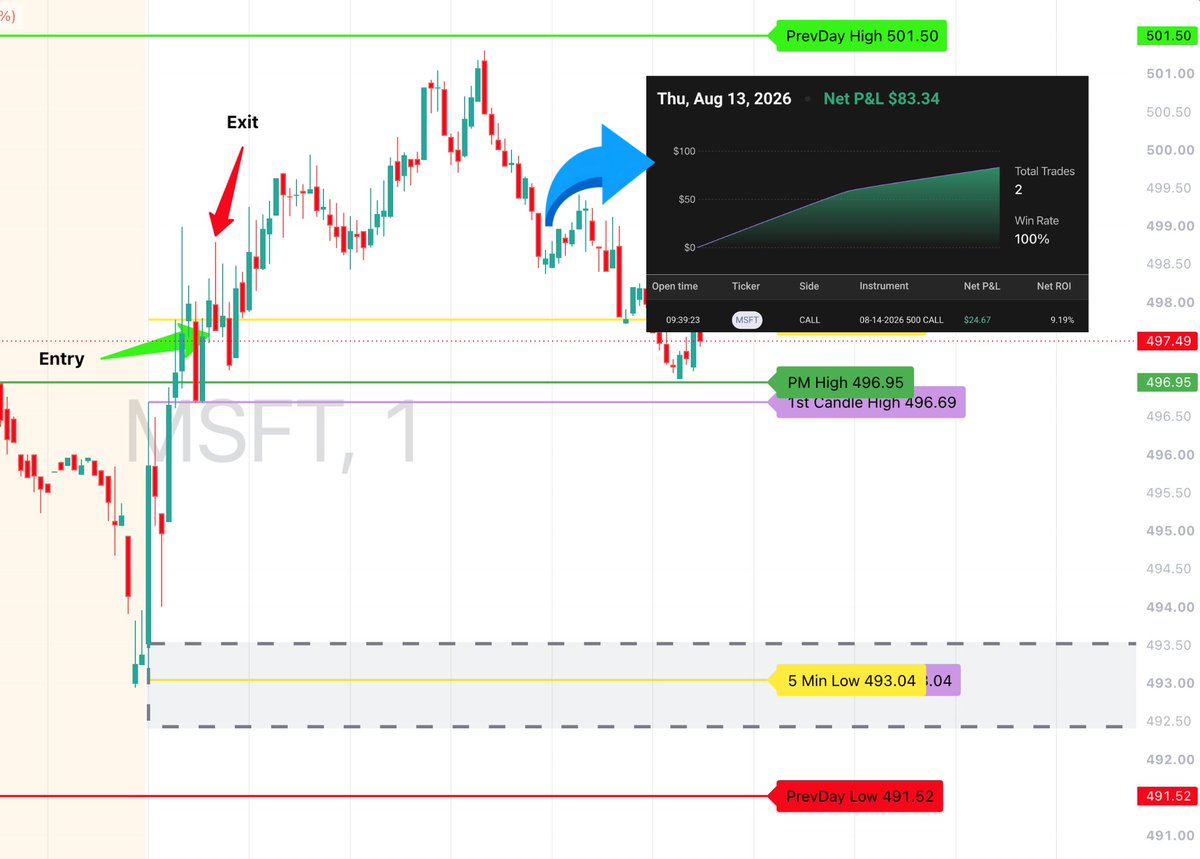
Trade Recap | TSLA + MSFT | +$83.34 💚
Finally a day that feels good.
Took 2 trades at almost the same time today and won both.
The overall market opened inside yesterday's range, so my game plan was simple:
If the market turns bullish → trade the strongest stocks that break & retest PMH first.
If bearish → trade the weakest stocks that break & retest PML first.
After the open, the market showed a bullish Dip & Rip, while TSLA, MSFT & AMD showed relative strength.
$TSLA — +$58.67
TSLA gave me the first clean B&R around 9:38 at PMH / ORB 5-Min High.
The 1-min opening candle was red, which initially made me hesitate, but the bigger picture supported the trade:
• Bullish market context
• Relative strength
• Bullish market structure
• 5-min green hammer
• Clean B&R of PMH / 5-Min High
• ~$6 of room toward PDH
Entered the 330C @ $3.40 and placed a hard TP at $4.00.
TP hit within about 2 minutes.
TSLA eventually retested the level again and continued all the way toward PDH. The contract eventually reached around $6.55.
A potential +$315 move, but I captured +$58.67.
$MSFT — +$24.67
MSFT was an even cleaner A+ setup.
• Bullish opening print
• Opening prints respected
• Relative strength
• Bullish market structure
• Market context aligned
• Clean PMH B&R
• Clear room toward PDH
Entered around 9:39 with the 500C @ $2.67.
At this point TSLA had already given me a solid win, while the indices had made a strong opening move and were becoming extended.
Instead of risking turning another green trade into a loser, I closed MSFT early around $3.00.
MSFT later continued toward PDH and the contract reached around $4.10.
Another trade where the thesis worked—I simply didn't capture the bigger move.
Biggest takeaway:
For the last couple months I've been struggling with confidence after watching good trades turn from +$50/+75 into losses.
Today I prioritized something different:
Execute the A+ setup.
Take the win.
Rebuild confidence.
Yes, I left a lot on the table.
But right now I'm okay with that.
My next step is improving trade management so I can start catching the BIG move—not the FULL move.
With only 1 contract, that part is difficult, but I'll improve it gradually.
2 trades.
2 A+ setups.
2 winners.
+$83.34. 💚
After the last couple months, this one feels good.
Current account balance: $841.51
Total Money Left on the Table: 315+143= 458$ (1con)
July 2026 Recap 📉
July wasn't the month I wanted.
14 trading days.
-$372.
And unlike some losing months, I can't simply blame this one on setups not working.
A lot of this was on me.
I took too many subpar setups instead of waiting for my A+ trades.
My biggest mistakes:
• Poor execution & timing
• Entering B/B+ setups instead of waiting for A+
• Breaking my own trading rules
• Letting previous losses affect my psychology
• Watching P&L instead of trading the chart
• Cutting winners around +$50 instead of allowing my setups to fully play out
The most frustrating part?
There were multiple times this month where my original thesis was right and the stock eventually reached my target.
I just wasn't there to capture it.
Either I entered too early, got stopped before confirmation, or closed a good trade prematurely because I was afraid of giving back profits.
That's not a strategy problem.
That's an execution and psychology problem.
There's honestly not much to celebrate about July.
It was disappointing.
But maybe months like this are necessary.
July showed me exactly where the holes are in my trading.
Going into August, I don't need a new strategy.
I don't need more trades.
I need to get back to what worked:
A+ setups.
Market context.
My rules.
Patience.
Proper execution.
July: -$372
Closing the chapter.
Taking the lessons with me.
Monday August 10th $MSFT Trade Recap | -$86 💔
Probably the biggest trade-management blunder I've made so far.
The frustrating part?
My entry wasn't the problem.
Overall market context was bullish, and $MSFT & $PLTR were the two stocks showing relative strength both pre-market and after the open.
$PLTR actually presented the first B&R opportunity around PDH/PMH.
The setup itself was valid, but $QQQ & $SPY were still indecisive and starting to move slightly toward LOD.
I didn't want to force a long without confirmation from the overall market.
So I passed on PLTR and stayed patient.
My attention shifted to MSFT.
I initially waited for a B&R around PDH/PMH, but the confirmation candle failed to hold those levels.
Again, I waited.
MSFT respected the Opening Prints, maintained bullish structure, and eventually gave me the PDH + PMH reclaim setup I was waiting for around 9:46.
Entry Model:
• Bullish market context
• Relative Strength
• Opening Prints respected
• Bullish market structure
• PDH + PMH reclaim
• Defined risk below the reclaim
• Target = HOD
I entered the 507.5C around 5.00.
Then I made the mistake.
The option had a wide bid/ask spread and barely moved even while MSFT held my entry.
My P&L immediately showed red.
And instead of watching the chart, I started watching the -$ number.
QQQ & SPY bounced from the ORB 5-Min Low and started making new highs.
MSFT hadn't broken my structure.
MSFT hadn't hit my stop.
My trade was still valid.
But when MSFT printed a red candle around 9:56, I started thinking about what my loss could become if my actual stop was hit.
I panicked.
Closed early.
-$86.
Literally one minute later, MSFT changed character.
It reclaimed momentum, reached my original HOD target within minutes and eventually ran from roughly $506 → $513.
The contract I bought around 5.00 eventually traded near 10.00.
But the money left on the table isn't the real lesson.
I had a predefined stop and ignored it because the P&L made me uncomfortable.
That's the blunder.
If my setup is valid and my risk is defined before entry, then either:
Target gets hit.
Stop gets hit.
Or the thesis becomes invalid.
A red P&L alone is NOT a reason to exit.
I need to stop trading my P&L and start trading the chart again.
Psychology.
Confidence.
Execution.
That's where the work needs to be.
Current account balance: $758
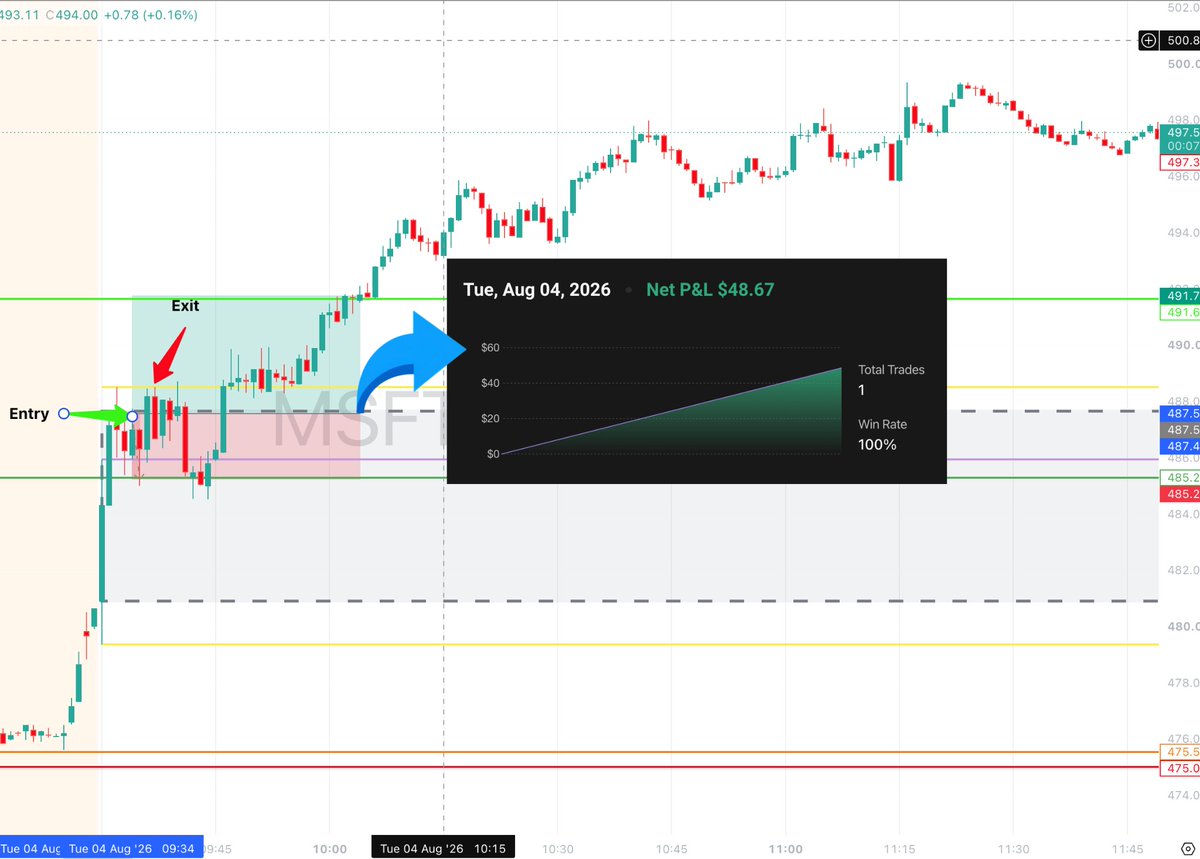
Green Day 💚
$MSFT - WIN | +$50
This was an A+ setup from my playbook.
During pre-market, most tech stocks were already above PDH.
MSFT and GOOGL were the only names consolidating near PMH, giving them room to reach their daily objective.
After the open, MSFT immediately stood out.
The second candle swept PMH, but sellers couldn't push it back below the level.
Buyers kept defending PMH, confirming the strength.
Entry Model:
• Bullish market context
• Relative Strength vs QQQ/SPY
• Opening Prints respected
• Liquidity sweep at PMH
• PMH Break & Retest
• Daily objective = PDH
I entered at 9:34 AM.
The only thing on my mind was the overnight gap fill sitting right around my entry.
Even though I believed MSFT could reach PDH, I decided to follow my trade management plan and locked in +$50 near the High of Day.
A few minutes later, MSFT pulled back, swept liquidity below PMH, and stopped out anyone still holding.
Then buyers stepped back in...
MSFT reclaimed the level, reached PDH, and eventually ran more than $8 from my entry.
The option contract I bought around 5.10 traded above 10.50.
That would've been a much bigger winner.
But here's the difference from my previous trades...
I didn't exit because I was scared.
I exited because I followed my plan.
Could my trade management improve?
Absolutely.
But I'd rather leave money on the table while following my rules than break my rules trying to catch every dollar.
One clean execution.
Another lesson.
Process > P&L 📈
Current account balance: $844
$MSFT Loss | -$107 💔
My main watch today was actually TSLA.
It gave an A+ Break & Retest setup around 9:42 AM and eventually moved almost $9.
I passed on it because $TSLA options were expensive ahead of earnings.
Instead, I shifted my focus to MSFT.
The setup looked decent...
But looking back, it was only a B+ setup.
My thesis:
• Relative strength vs the market
• 5-Min ORB High Break & Retest
• Bullish market structure
The problem was the context.
$QQQ was basing near the 5-Min Low.
$SPY was already below its 5-Min range and holding near PML.
The indices were clearly telling me buyers weren't in control.
Yet I was trying to buy a megacap.
Mistake #1
Both entries were taken right below PMH.
$MSFT kept rejecting that level.
I should've waited for a clean PMH break and retest before committing.
Mistake #2
My second entry didn't meet my confirmation criteria.
There was no meaningful lower wick or strong reaction candle.
I entered on the breakout candle instead of waiting for confirmation.
The result:
Two entries.
Two stop-outs.
-$107.
Today's biggest lesson:
"Never choose a B+ setup over an A+ setup."
Patience isn't just waiting for a setup.
It's waiting for the best setup.
Current account balance: $783
Trade #3 of July.
Another red day 💔
$GOOGL - Loss
This one was frustrating.
Not because I broke my rules.
Because I actually waited for my setup.
My thesis:
Overall market was weak except semiconductor names, but $MSFT & $GOOGL were showing the best relative strength.
The setup was there:
✅ Relative strength
✅ Clean price action & Market Structure
✅ Breakout & Retest setup
✅ Key level reclaim
I had both $MSFT and $GOOGL on watch.
Skipped MSFT because I didn't like the upper wicks around the 5-min high.
Took the GOOGL B&R setup instead.
Result?
$GOOGL stopped me out almost immediately and flipped downside.
$MSFT ended up playing perfectly and reaching my target.
That's trading.
Road to $10K continues 📈
Current account balance: $931.42
@HarlemOnnaWay Appreciate it! 💚 That's exactly what I'm working on now—trusting the thesis more and managing the runner better instead of cutting it too early.
Green Day 💚
$TSLA - WIN | +$55
This was one of the cleanest setups I've seen in a while.
The overall market was bullish before the open, but TSLA immediately stood out.
While most stocks were showing strength, TSLA was showing relative weakness.
The first candle told the story.
It swept both PDH and PMH for liquidity, then immediately rejected those levels.
That gave me my downside thesis.
Entry Model:
• Relative Weakness vs QQQ/SPY
• Liquidity sweep above PDH & PMH
• Opening Prints rejection
• Bearish market structure
• Break below PML
• Break & Retest entry
I waited patiently.
Once $QQQ started losing momentum, TSLA led the downside exactly as expected.
I closed my position around the 15-minute support for +$55.
The trade worked.
The thesis worked.
The execution worked.
The only thing that didn't...
...was my trade management.
I exited too early.
TSLA continued all the way below PDL, and my option contract moved from 2.74 → 6.30.
That was roughly a 300% move after I was already out.
Today's lesson wasn't about finding better setups.
It was about trusting the setup long enough to let it reach my original target.
Good execution got me into the trade.
Better trade management would've unlocked the full potential.
Another lesson added.
Current account balance: $890.11
Trade #6 of July.
Another red day 💔
-27.66$ on $MSFT
This trade reminded me how much psychology matters.
My initial thesis was bullish.
MSFT was one of the strongest names on my watchlist and showed a clean Break & Retest around the 5-min ORB High while QQQ was still weak and consolidating.
My first entry at 9:39 AM was stopped out almost immediately.
-$79.
Instead of giving up, I stayed with my thesis.
A few minutes later, MSFT formed another clean Break & Retest with a strong hammer candle around the ORB High.
I re-entered on the PDH reclaim at 9:47 AM.
This time the trade worked.
But the first loss had already shaken my confidence.
Instead of letting the trade play out to my original target, I took profits at PMH for +$52.67 because I wanted to protect the trade and avoid another loss.
Looking back...
MSFT continued almost another $8–9 and eventually reached my final target.
That would've been roughly a $450–500 winner.
The chart wasn't the problem.
My psychology was.
The lesson from this trade:
Don't let your first loss dictate how you manage your second opportunity.
One losing trade shouldn't change a good thesis.
Something I'll continue working on.
Current account balance: $956.10📈
$SPCX Trade Recap | -$7.33 ❤️
Today's loss wasn't frustrating because of the money.
It was frustrating because I had two stocks on watch.
SPCX and PLTR.
Both showed relative strength and clean Break & Retest setups after the open.
I chose SPCX.
My thesis:
• Relative Strength vs QQQ/SPY
• PM High reclaim
• Break & Retest setup
• Strong opening momentum
The setup was there.
But once SPCX reclaimed PMH, it couldn't attract enough buyers.
Instead, it started basing around the 5-min high while the indices remained choppy, rotating from HOD to LOD and back again.
Eventually, SPCX lost momentum and hit my stop.
Meanwhile...
PLTR was the better choice.
It followed through and reached my target PDH.
That's trading.
Sometimes it's not about having the wrong setup.
It's about choosing the wrong stock from two good candidates.
No regrets.
Current account balance: $983.76
Weekly Trading Journal
6-10 July 2026
STATS 🔴
Net P&L: -$176.66
Win rate: 25%
4 trades: 1W / 3L
Executed 1 out of 7 A+ setups (14%).
July 6th (Monday) 🔴
Trade: QQQ Calls – PMH Break & Retest
Entered on a PMH Break & Retest setup but was stopped out immediately. Although the execution followed my plan, the trade later recovered and reached my intended target without me.
Missed A+ Setups: AMD – 9:38 AM & PLTR – 9:43 AM
July 8th (Wednesday) 🔴
Trade: TSLA Puts – PML Break & Retest
Took a loss on the TSLA PML Break & Retest due to three execution mistakes:
The indices were still holding their upper equilibrium and basing near the 5-minute highs, providing no confirmation for downside continuation.
TSLA had already achieved its daily objective by breaking both PDL and PML, reducing the probability of further downside.
Entered late at 9:55 AM instead of the cleaner 9:52 AM entry, resulting in a compromised risk-to-reward profile before entering the trade.
Missed A+ Setup: NVDA – 9:36 AM
July 9th (Thursday) 🔴
Trade: GOOGL Calls – PDL Break & Retest
Took a loss on GOOGL despite having a valid thesis and a clean Break & Retest setup. The execution aligned with my trading plan, but the setup simply failed to follow through.
Missed B+ Setup: MSFT – 9:40 AM
July 10th (Friday) 🟢
Trade: MSFT Calls – PMH Reclaim
Executed a successful PMH reclaim setup on MSFT. The thesis, execution, and trade management were aligned with my trading plan.
Missed A+ Setup: NVDA – 9:43 AM
Total Missed A+ Setups :- 3
Total Missed A+ Setups :- 1
Looks rough and like everything is collapsing. It was uncomfortable, but it's ok. I understand what I need to improve.
Lots of lessons around respecting market delivery instead of trying to call reversals too early.
The biggest gap is not finding ideas. It's trusting the best ones and letting the weaker ones go.
The review gave me far more confidence than the week itself did.
Reminder:
If you're following this journey through the weekly P&L alone, it will probably look frustrating. I'm evaluating my progress based on the quality of my decisions, my reviews, and what I'm learning each week. That gives me plenty of confidence to keep going.
How was trading for you this week?
5/5
The biggest lesson this week wasn't about charts.
It was about discipline.
Every time I review a losing trade, I realize the market is usually giving me feedback.
Sometimes it's telling me to wait.
Sometimes it's telling me to respect my own rules.
And sometimes it's simply reminding me that losses are part of the business.
The journey continues.
See you next week. 📈
5 Things I Learned This Week 🧵
This week didn't go the way I wanted.
4 trades.
3 losses.
1 win.
But every trade taught me something.
Here are my biggest takeaways:
1/5
4/5
Small wins rebuild confidence.
After several red days, I didn't need a home run.
I needed one clean execution.
MSFT reminded me that following my process is enough.
One good trade can reset your mindset.