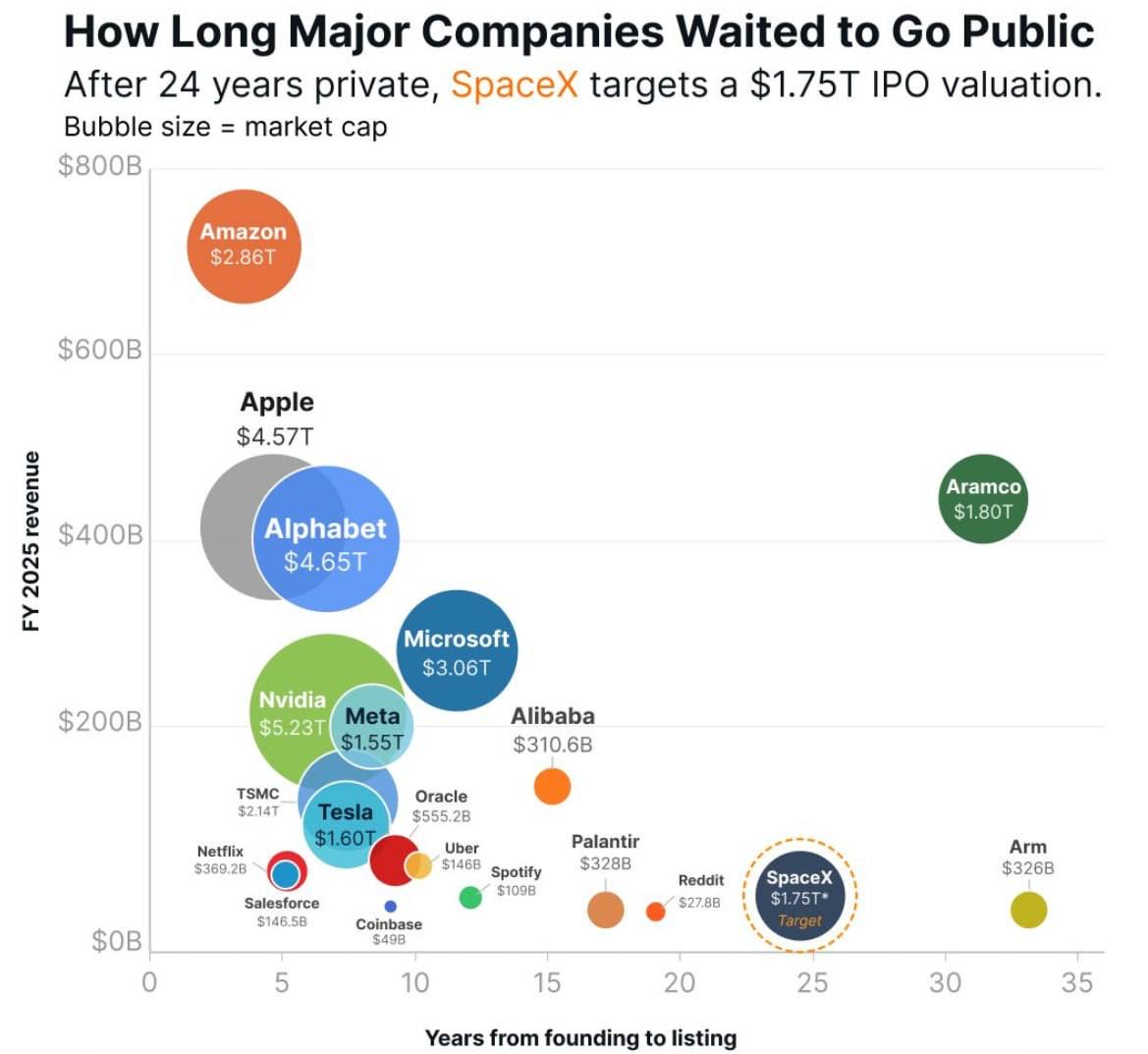
SpaceX IPO — June 12, Nasdaq, #SPCX#SpaceX is selling 555.6 million shares at a fixed price of $135, raising $75 billion at a valuation of $1.77 trillion.
That makes it the seventh-largest U.S. company by market capitalization, ahead of Tesla.
For comparison: the previous global IPO record belonged to Saudi Aramco at $29.4 billion, while the U.S. record was Alibaba at $25 billion.
2025 revenue: $18.67 billion.
Net loss: approximately $4.9 billion.
Valuation = 94× annual revenue ⚠️
Several unusual features stand out:
• 82.4% voting control with roughly 42% economic ownership = public shareholders have limited influence.
• Up to 30% of the offering is allocated to retail investors versus the typical 5–10%, significantly increasing retail participation.
• Around 5% of shares are reserved for friends and family without a lock-up. While Musk is locked up for 366 days, this portion (~$3.75 billion) can potentially be sold immediately.
• The Nasdaq-100 fast-track inclusion rule was adjusted for this offering, forcing index-tracking funds to buy shares regardless of valuation.
One of the most important lines in the S-1:
“May issue a significant amount of equity for future transactions.”
SpaceX stock is being positioned as acquisition currency, with Tesla viewed as a potential strategic target.
In other words, Musk may be able to expand influence over Tesla not through IPO cash proceeds, but through publicly traded SpaceX equity.
Conclusions:
The SpaceX IPO itself is unlikely to trigger a broad decline in U.S. indices. Limited float, forced index demand, and future lock-up expirations all support the stock in the short term.
The larger risk appears later.
Key periods to watch:
• Late 2026
• Mid-2027
That is when lock-up expirations could become a much more important factor than the IPO itself.
#SpaceX #SPCX #IPO #Nasdaq #StockMarket #Investing #Trading #Tesla #ElonMusk
Crypto ETF Overview
#Bitcoin ETF
Following a record wave of selling in late May and early June, the pressure is beginning to ease.
June 1: -$483.8M
June 2: -$519.1M
June 3: -$396.6M
June 4: +$3.2M
June 5: -$325.7M
June 8: -$91.4M
Total flow from June 1–8: -$1.81B.
The main source of outflows remains BlackRock IBIT. However, on June 8, part of the capital shifted into FBTC and ARKB.
#Ethereum ETF
After a prolonged period of outflows, the picture is starting to improve.
June 8: +$68–82M in net inflows.
The strongest inflows came through Fidelity FETH and BlackRock ETHB.
This marks the second consecutive day of positive flows.
#SOL and #XRP ETFs
Flows remain mixed, but there have been no major sell-offs.
#HYPE ETF
Capital inflows have remained steady since the first day of trading.
Assets under management have already grown to approximately $185M.
Capital Rotation
Some institutional capital is rotating from BTC into ETH and selected altcoins rather than leaving the crypto market altogether.
It is still too early to talk about a new bullish trend.
However, several key metrics are beginning to stabilize, increasing the probability that a local bottom may form during June.
#Bitcoin #BTC #Ethereum #ETH #Crypto #ETF #SOL #XRP #HYPE #Markets #Investing #Trading
Market Overview — June 8, 2026
Markets are starting the week in a challenging environment: high oil prices, rising rate expectations, escalating tensions between the U.S., Iran, and Israel, a downturn in AI and semiconductors, and ongoing outflows from crypto ETFs. The start of summer marks a seasonal reassessment of risk, the cost of capital, and capital priorities.
Key drivers:
Warsch shock. The market is now pricing in a more hawkish Fed policy.
Geopolitics. The 60-day truce has ended. A new escalation cycle is unfolding.
AI has taken the growth premium. Institutional capital is exiting crypto in favor of current narratives: AI, semiconductors, mega-cap IPOs, and cash.
Structural BTC buyers have reversed course. Strategy sold BTC for the first time since 2022, while ETF outflows reached record levels.
High leverage. The market remains overleveraged.
A strong U.S. labor market dealt the final blow to rate-cut expectations. With current data, the Fed has no urgency to ease policy.
Global capital is moving out of zero-coupon and long-duration assets and into 2Y Treasuries yielding 4.17%, the U.S. dollar, and defensive liquidity. The 10Y yield at 4.55% is once again pressuring valuations across long-duration assets. DXY is already at 100.
The AI narrative has taken a serious hit. Semiconductors sold off sharply: SMH -9%, QQQ -5%, SPY -3%. With high rates, future AI infrastructure cash flows are worth less. KOSPI plunged 8%.
CRYPTO
Total market cap fell to its lowest level since September 2024 at $2.06T. Over the past week: BTC -14%, ETH -11%.
Bitcoin faced pressure from the Strategy sell-off, $4.6B in ETF outflows, and a large transfer from an old Mt. Gox wallet. Despite that, BTC held $60K and bounced to $63K. Technically strong, but not a reversal.
BTC dominance: 58.4%.
Sentiment: extreme fear.
Market: liquidity squeeze mode.
The pressure has also hit Michael Saylor’s ecosystem. STRC fell below $95 against its $100 par value. MSTR is trading near yearly lows around $104 versus $450 a year ago.
Key formula of the week:
CPI + ETF flows + 10Y yield + Nasdaq/SOX + oil = crypto direction.
As long as BTC remains above $60K, the technical picture favors holding key support.
Key event of the week: CPI on June 10.
Consensus: +0.3–0.4% MoM. If CPI prints above 0.4%, the market will reinforce the “higher for longer” narrative, increasing pressure on crypto, gold, silver, and tech.
June 12 brings weekly BTC options expiry on Deribit: $2B notional, max pain around $68K, put/call ratio near 0.61.
The next major checkpoint is the June 16–17 FOMC meeting, updated SEP projections, and the first full test of the Fed’s new rhetoric after a sharp repricing of rate expectations.
Scenarios for the week:
Base case (45%): A heavy, volatile range as markets wait for the Fed. Geopolitical headlines continue amplifying volatility. S&P 500: 7,300–7,500. BTC: $58K–66K. ETH: $1,500–1,750. Gold: $4,250–4,450. Silver: $64–72. Conditions: no CPI shock, oil below $100, DXY below 100.
Bearish scenario (30%): S&P falls below 7,500. BTC closes below $60K amid negative ETF flows and rising yields. The next risk zone becomes $56K. ETH could fall toward $1,450 or lower. Conditions: hot CPI, WTI above $95–100, 10Y above 4.6%.
Relief rally (25%): De-escalation around Iran, lower yields, and positive ETF flows. BTC could return to $66–68K and then test $70–72K. ETH could rebound to $1,800–1,950. A full reversal requires sustained ETF inflows and a recovery in global risk appetite.
Core strategy: don’t buy narratives—verify the data. Monitor flows, positioning changes, and sentiment.
#Bitcoin #BTC #Ethereum #ETH #Crypto #Markets #Macro #FederalReserve #Nasdaq #AI #Trading #Investing
Crypto Market Overview
BTC is trading in the $66,000–68,000 range. ETH is holding around $1,800–1,900. The liquidity crisis is becoming more visible: institutional demand has weakened, ETF flows remain negative, and the Coinbase Premium is deeply in the red.
Key mechanics: ETF outflows → weak spot demand → support breakdown → long liquidations → forced selling. A classic sequence: support forms, leverage builds, then margin positions are liquidated and stop-losses are triggered.
Most of the liquidity below this spring’s critical levels has already been absorbed. New clusters are now forming as U.S. institutional investors reposition.
Key BTC levels: • $65K–67K — current battle zone • $64K–65K — nearest support • $60K–62K — capitulation zone • $70K — first level of regaining control • $72K–73K — rebound confirmation • $75K — scenario shift threshold • $78K–80K — return of momentum.
ETH is holding up better than many altcoins. The $1,820–1,900 zone remains critical. If ETH holds above $1,800, a rebound toward $2,000–2,150 is possible. For a genuine reversal, ETF inflows must improve, ETH/BTC must recover, and on-chain activity needs to accelerate.
Key ETH levels: • $1,820–1,900 — support zone • $1,750–1,800 — immediate support • $1,600–1,650 — deep correction • $2,000 — psychological level • $2,150–2,250 — recovery zone • $2,400–2,500 — strength confirmation.
BASELINE SCENARIO (55%): The market remains range-bound with elevated volatility but without an immediate V-shaped recovery. BTC: $64,000–74,000. ETH: $1,700–2,150. Conditions: ETF outflows slow, Coinbase Premium stays near zero, funding resets after liquidations, oil remains below $105, 10Y yields stay under 4.6%, the Fed avoids panic, and Nasdaq/AI avoid a deep correction. BTC may rebound toward $70K–72K, but without ETF demand it remains a technical bounce.
BEARISH SCENARIO (25%): BTC: $58,000–62,000. ETH: $1,500–1,700. Triggers: BTC below $64K, continued ETF outflows, new long liquidations, Brent above $105–110, rising yields, hawkish Fed rhetoric, and a Nasdaq correction. The biggest risk is losing confidence that ETFs are permanent structural buyers.
BULLISH SCENARIO (20%): BTC: $75,000–82,000. ETH: $2,400–2,700. Conditions: BTC reclaims $70K, breaks $72K–73K, Coinbase Premium turns positive, ETF inflows return, funding stays healthy, oil stabilizes below $100, and Nasdaq maintains a risk-on structure.
Monitoring: ETF flows, Coinbase Premium, funding rates, liquidation heatmaps, inflation data, and Fed signals.
The long-term crypto narrative remains intact: ETFs, corporate adoption, custody infrastructure, and tokenization still matter. Right now, the market is not asking: “Do you believe in Bitcoin and Ethereum?” The real question is: “When will spot demand return?” There is still no clear answer.
#Bitcoin #BTC #Ethereum #ETH #Crypto #BitcoinETF #Markets #Trading #Macro #FederalReserve #Nasdaq #AI
Market Overview — July 1, 2026
May began with hope and ended in disappointment.
At the start: BTC above $80k, a U.S.–Iran truce, progress on the Clarity Act.
At the finish: BTC at $72k, ETH below $2,000, record outflows from crypto ETFs, and fear dominating once again.
ETH/BTC ratio is at multi-year lows. Market cap fell from $2.75T to $2.45T.
What went wrong?
• The “Bitcoin as a hedge against inflation” thesis has been debunked. This narrative can officially be put back on the shelf until the next cycle.
• The “macro improvement = crypto rally” narrative has collapsed. May delivered nearly ideal conditions for a bullish reversal: oil was falling, the war premium was fading, the dollar was retreating, and stocks were hitting records. Yet crypto rose more often on short squeezes than on real demand.
• TON’s growth has stalled. Another marketing push from Durov in early May drove the token from $1.30 to $2.90 in 10 days. As has become an unfortunate tradition, most of the growth was quickly erased by insider selling.
• Bitcoin Treasury demand is in question. Strategy and Michael Saylor’s team have spoken about tactical sales for the first time since 2023. The average purchase price ($75,700) is once again above the market.
• Whale positioning was destroyed. Over two months, whales built record net long futures positions for 2026. Bitcoin, ETH, and SOL failed to break key levels and prices fell.
• Correlation with the Nasdaq is hitting rock bottom. The S&P 500 and Nasdaq made new all-time highs, while Bitcoin and Ethereum continued to decline. This is already a negative decoupling.
Patterns that still work:
Macro and the cost of capital. The 10-year yield surged to 4.6% and triggered a risk-off sell-off. High yields combined with a strong dollar continue to pressure assets without intrinsic yield.
Demand for AI infrastructure and computing power continues to grow.
Progress in crypto adoption and regulation continues.
Rotation from mega-caps into altcoins. BTC dominance fell to 58.8%.
Crypto with revenue and a strong narrative is receiving a boost: HYPE, ZEC, NEAR, and the RWA sector.
Stablecoins reached $320B, while DEX volumes continue to grow.
Commodities are likely to remain in trend, especially if the dollar continues to weaken.
Long-term holders are not selling. The share of BTC held by long-term holders is at a record high.
Conclusions:
In May, the crypto market lost roughly $300B in market capitalization, while U.S. equities added nearly $3T. This is a structural shift of capital within the risk asset universe.
Crypto has lost its position as the marginal beta trade. AI has taken that role.
We are entering the summer with an uncomfortable setup: stock markets are at record highs, while the emerging AI pillars are already beginning to struggle under the weight.
Crypto appears to be in late-stage distribution. The Fed remains trapped by stagflation dynamics.
This is not a market where you leave positions unattended and go on vacation.
This phase demands monitoring, hedging, discipline, and extreme caution.
Base case: a market defined by heightened nervousness and reduced liquidity.
It’s going to be a hot summer.
It’s too early to relax.
#Bitcoin #Ethereum #Crypto #BTC #ETH #Altcoins #Macro #Markets #Investing #Trading #FederalReserve #Inflation #AI #Stablecoins #DeFi
Market Overview — May 29, 2026
The U.S. stock market approached Friday’s session near its highs. Pre-market futures are trading slightly higher, and the S&P 500 and Nasdaq show no signs of panic following yesterday’s record close. The main reason: the extension of the truce between the U.S. and Iran and the possible lifting of restrictions on shipping through the Strait of Hormuz.
The engine is the same, but the gears have shifted. Although Brent fell below $100 per barrel, inflation is still at 4%, and this has rewritten the entire curve of expectations. The 10-year yield is at 4.4–4.6%, and the 30-year yield has retested its 2007 highs.
From May 26–28, spot Bitcoin ETFs saw a strong net outflow: $1.29 billion in total. In April, ETFs were the main buffer against drawdowns. Now, on the contrary, they have become a source of supply.
The expiration also played out as expected. Ahead of the May expiration on Deribit, the key zone was $75k max pain, with dense call positions above in the $80k–82k range. Bitcoin fell below $73k on massive long liquidations.
The rally in semiconductors and AI infrastructure is following the same trajectory as a week ago. First Micron at $1 trillion, now Snowflake +36.5% and Dell with 181% growth in the data center segment.
It’s the same story: capital freed from oil risk is flowing not into crypto, but into AI. This rotation is simply continuing.
The VIX is around 15–17—a low reading given the current news flow. I get the impression that volatility traders are being shaken out through a careful rotation between sectors.
The U.S. stock market, based on its internal fear metrics, is completely calm. These are short-term jitters driven by headlines, not structural fear.
#Markets #StockMarket #SP500 #Nasdaq #WallStreet #Investing #Trading #Macro #MacroEconomics #Economy #Inflation #Bonds #TreasuryYields #VIX #RiskOn #Oil #Brent #Iran #Bitcoin #BTC #Crypto #BitcoinETF #ETFs #Deribit #Options #AI #ArtificialIntelligence #Semiconductors #Micron #Snowflake #Dell #DataCenters #TechStocks
#SpaceX IPO Update
SpaceX (after merger with xAI) is preparing for an IPO in June 2026 with a target valuation of $1.5–2 trillion — potentially the largest in history.
2025 financials:
• Revenue ~$18.7B (+33% YoY)
• Starlink (connectivity): $11.4B (~61% of revenue) — main growth and profit driver
• Launches & government contracts: ~$4B
• AI/xAI: ~$3.2B (still unprofitable)
Starlink has >10M subscribers, but ARPU is declining as it expands into mass markets.
At $1.75T valuation, SpaceX would rank in the global top 10, close to Tesla (~$1.6T), but far behind Nvidia ($5T+), Alphabet, and Apple. The P/S multiple is extreme: 90–125x 2025 revenue.
**Bull case:** Starship succeeds, radically lowers launch costs, Starlink becomes a global monopoly with direct-to-cell, new markets (orbital data centers, point-to-point transport). Musk premium + AI/space hype could drive a massive initial pop.
**Bear case:** The valuation assumes decades of 40%+ CAGR — almost unprecedented. High capex, regulatory risks (FAA/FCC), competition (Amazon Kuiper, China), and AI losses could lead to a sharp correction.
For the valuation to hold post-IPO (and survive 2–3 month lock-up):
- Successful Starship tests + rapid reusability
- Starlink subscriber growth to 20M+ by end-2026 + margin stabilization
- Bullish tech/AI market sentiment, no recession
- Strong execution and clear “platform company” narrative
Conclusion: The IPO will likely be hype-driven (private market already values it at $800B–$1.25T). But sustaining it will be very difficult without concrete Starship progress. Classic high-risk “story stock” — huge upside if everything clicks, 30–50%+ downside if it doesn’t.
Focus on execution, not just vision.
#SpaceX #SPCX #Starlink #Starship #IPO #cryptocurrency
Market Overview – May 26, 2026
The crypto market continues to look weak while stock indices keep setting new all-time highs.
S&P 500, Nasdaq, and Nikkei are at records. The AI sector remains the main magnet for capital. Oil is the key intraday driver.
Oil premium is retreating on Iran negotiation signals.
Brent fell below $100, WTI below $90.
This eases some inflation fears, but doesn’t solve the rate issue — 10-year UST yields are still around 4.45–4.5%.
Markets got relief on oil, but are losing hope for cheaper financing. Capital is returning to risk assets very selectively — mainly into AI, semiconductors, data centers, and infrastructure with clear revenue, capex, and margins.
Crypto currently lacks such a broad narrative.
BTC is no longer seen as the marginal beta of the global portfolio — AI has taken that role.
The “macro hedge” narrative died in Q1 when BTC fell alongside tech during oil shocks.
BTC–Nasdaq 30D correlation dropped from +0.65 in April to near zero.
BTC–DXY returned to negative territory.
ETH/BTC at 0.0275 — lowest since summer 2023.
RENDER/BTC showing vertical breakout.
Stablecoin supply at $323B signals dry powder, but it’s not translating into buying.
MSTR holds 843,738 BTC at avg cost $75,700. Latest purchase was at a ~5% loss.
Bitmine cut weekly ETH buys by 74%. Institutional accumulation is slowing across the board.
Conclusion:
Crypto is not in a local correction — it’s undergoing a fundamental reevaluation of its place in major investors’ portfolios.
The “digital gold” and “high-growth tech asset” narratives have stalled. AI is taking the spotlight with real revenue and massive capex.
This reevaluation looks especially painful against new stock market records and will likely last longer than those who bought at the peaks would like.
#Bitcoin #Crypto #Markets #Macro #AI #Oil
Is DeFi Now Russian Roulette with AI Bullets?
OpenZeppelin co-founder Manuel Araoz (one of the most respected voices in Web3 security) publicly stated that he considers the entire DeFi space unsafe.
Privately, he has long advised friends and family to exit even “blue-chip” protocols like Aave, MakerDAO, and Compound.
Reason: AI coding agents have become superhuman at finding vulnerabilities. The asymmetry is deadly — defenders must secure everything, attackers need only one hole.
Against the backdrop of April–May 2026 (record $600–750M+ in losses, including Drift and Kelp DAO), his words hit hard.
**Strengths of Araoz’s position:**
- Real asymmetry exists
- AI dramatically accelerates bug discovery
- Even audited protocols remain exposed to composability, oracle, governance, and opsec risks
**Counterarguments:**
- Many major hacks were not pure code exploits but social engineering, key compromises, and bad configs
- Blue-chips have timelocks, circuit breakers, insurance, and continuous monitoring
- OpenZeppelin itself continues auditing and improving security
**Reality check:**
DeFi is still one of the riskiest segments in crypto. AI has raised the difficulty level significantly, but this isn’t a sudden apocalypse — the industry has survived worse.
**Key Takeaway:**
Don’t panic or go all-in on euphoria.
This is a serious insider wake-up call. Use it to reassess your risk, not to sell everything.
Rational approach:
- Conservative capital → BTC/ETH, stables, or off-chain
- Active users → diversification, monitoring, simpler designs, hedging
Security is no longer optional — it’s table stakes.
#DeFi #CryptoSecurity #AI #Aave #KelpDAO
#NEAR Analysis
**Fundamental Drivers**
1. AI PII Anonymization (May 19–20) — NEAR now automatically removes passwords, API keys and personal data from prompts before sending to Claude/ChatGPT/Gemini at framework level. Strong catalyst for the AI narrative.
2. AI Macro Tailwind — NVIDIA’s Q1 revenue +85% YoY gives positive backdrop to the entire AI sector.
3. Tokenomics Upgrade — Annual inflation cut from 5% to 2.5%. Protocol fees now go to NEAR buybacks — structural reduction in sell pressure.
4. “Agentic Web” Strategy — NEAR positioning itself as the execution layer for AI agents (payments, identity, cross-chain).
5. Key Integrations — Brave Nightly, OpenMind, Phala Network on NEAR AI Cloud.
**Technical Picture**
- Broke multi-year downtrend line (since Dec 2024)
- Supertrend flipped to bullish after long bearish phase
- Key trigger: weekly close above $2.20
Fibonacci extension targets:
$2.30 (123.6%) → $2.50 (138.2%) → $2.87 (161.8%) → 200 EMA
Resistance zones: $2.80–3.25, $4.20–4.60, $5.00–5.50
Looks like a shift from narrative play to real infrastructure positioning.
#NEAR #AI #cryptosub
Market Overview – May 25, 2026 (Memorial Day Edition)
The U.S. stock market closed its eighth consecutive green week.
Against $100+ oil, a new Fed chair, and the Iran conflict, this looks like “strength.”
In reality, it’s the momentum of an extremely strong earnings season, trend-following algos, and the perception that U.S. stocks currently offer the best risk/reward.
Q1 earnings were impressive:
• S&P 500 earnings growth +28.4% YoY
• Revenue growth +11.6%
• 84% of companies beat EPS estimates
• 81% beat revenue estimates
This is the best earnings growth since Q4 2021.
Capital is flowing into markets with good liquidity, regulation, hedging tools, and investor protection. In this environment, crypto falls short on almost every front. Bitcoin is trading as a classic cyclical risk asset with long duration and high sensitivity to real yields.
1/ Macro Pressure
10-year UST holding 4.55–4.70%.
DXY at 99.32 and heading toward 100.
This puts pressure on non-US assets and commodities.
Gold and crypto correlation is rising this spring — both are declining as the dollar strengthens.
2/ Bitcoin & Liquidity Narrative
The popular “BTC moves with liquidity” thesis is facing a reality check.
In January the market priced 3–4 Fed cuts in 2026. By March it was down to 2. By early May even one cut was in doubt.
Last week the market started pricing in the possibility of a rate hike for the first time since fall 2024.
On May 22 Kevin Warsh became the new Fed Chair. Trump is publicly pushing for rapid cuts, while Warsh has historically been more hawkish than Powell. This contradiction adds uncertainty.
3/ Low Volatility Illusion
VIX = 16.70 (historically should be 22–25 in such conditions).
Bitcoin realized volatility (BVIV) = 38% — 7-month low.
The market has entered a paradoxical consensus: institutions are selling volatility en masse to generate yield in a sideways market. This artificially suppresses VIX and crypto volatility, creating an illusion of safety. Low volatility encourages systematic funds to add leverage.
4/ Crypto Specifics
Coinbase Premium Index has been deep in the red since May 6 — US investors actively selling on spot.
Spot Bitcoin ETFs: 6 consecutive sessions of outflows (~$1.26B).
Strategy is preparing the market for potential BTC sales.
Sentiment has dropped back into the fear zone.
Paradox: BTC remains relatively stable despite all this pressure.
Conclusion:
The market is in a state of “apparent calm amid structural risks.”
Crypto was sold off last week even as stock indices rose because its main narrative (“Trump-friendly Fed cuts”) completely fell apart.
We are waiting for new narratives and drivers. They will appear soon.
#Bitcoin #Crypto #Markets #Macro #ETF #Fed #Oil
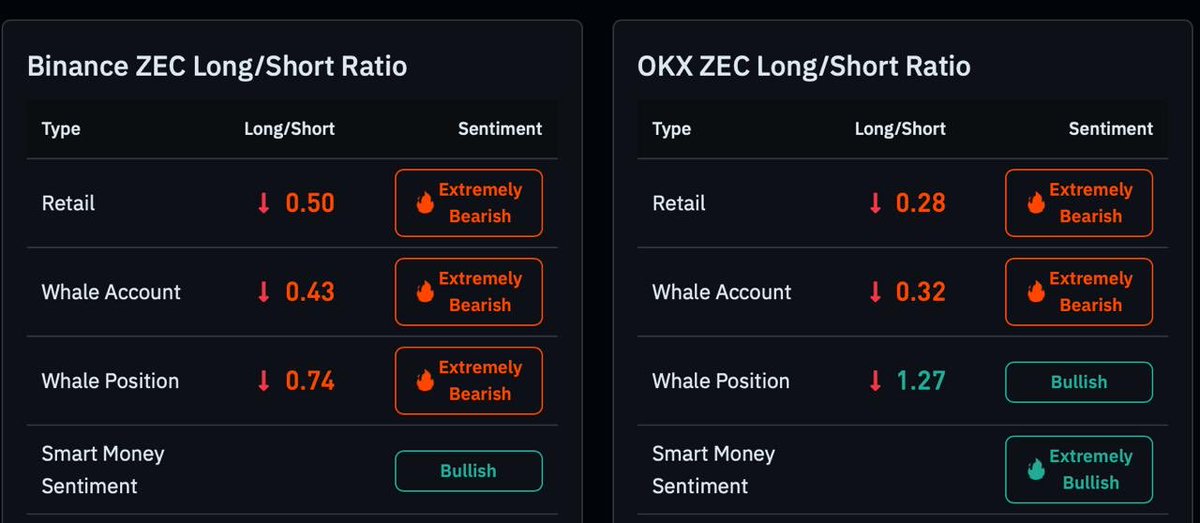
#ZEC Update
Sharp surge in trading activity:
• Futures Volume: $4.69B (+10.90%)
• Spot Volume: $375.98M (+18.44%)
Funding rate remains neutral.
This setup increases the probability of another short squeeze.
#Zcash#ZEC#Crypto#ShortSqueeze
Over $1.5 billion in long positions were liquidated over the past two days
Over 200,000 traders have been affected by this in the last 24 hours
The largest liquidation order occurred on
Bitget-BTC and amounted to $32.44 million
Meanwhile, U.S. stock indices closed in the green on Friday, near all-time highs.
The hunt for liquidity in the crypto market continues in the absence of new drivers.
I expect stabilization over the weekend
Trading ranges
BTC 74 - 77k
ETH $1,960 - $2,200
SOL $78 - $88
HYPE $50 - $60
BNB $620 - $680
XRP $1.28 - $1.42