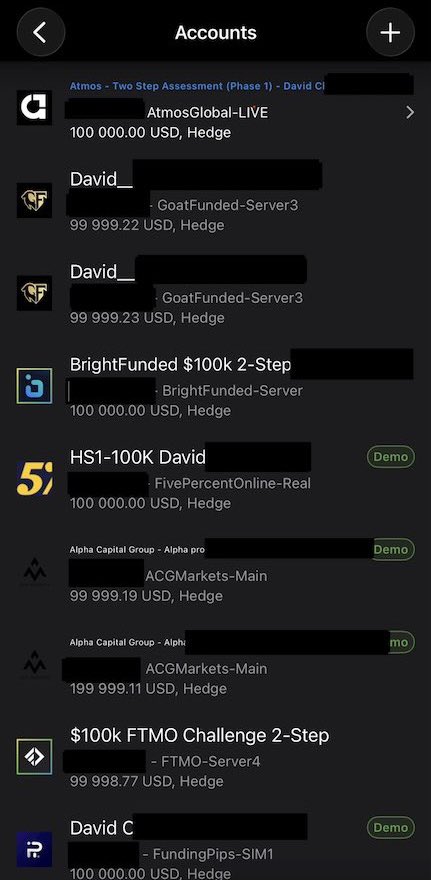
This poor guy on X posted his portfolio crashes $27m down to $600k in a few months!
What causes this is over concentration ( into overvalued/ overextended stocks) and over leverage of positions .
Many investors focus on “What to buy”, “when to buy” but fail to focus on the most important key… which is position sizing and portfolio allocation.
No point generating super high returns in the short term if they cannot be sustainable over the long run
1) I diversify across investment themes ( hyperscalers, AI capex enablers, cybersecurity, SaaS, military defence, fintech etc)
2) I diversify across sectors ( consumer discretionary, industrial , financials etc)
3) I avoid leverage
4) I only stay invested in the top 1% of high quality stocks and add when undervalued
5) I sell when stocks are extremely overvalued or when fundamentals deteriorate permanently. Cut losers ruthlessly
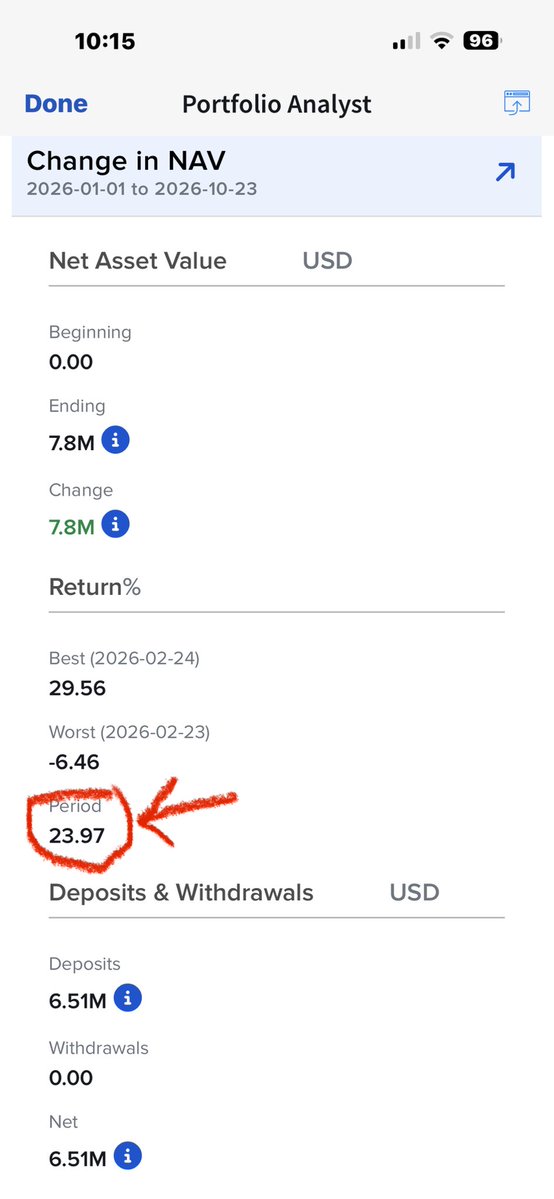
That’s how my UIP portfolio is still up + 23.96% ( US$1.29m net gain) year to date, when many other’s portfolios were wiped out
every profitable trader I know does the same thing before the market opens
the traders who blow accounts skip it every single day
it takes 30 minutes. it's boring. it's repetitive
there's nothing exciting about it
but it makes money
nobody will ever post it on their Instagram story
and it's the single highest-ROI activity in all of trading
higher ROI per minute than any strategy, any course, any indicator, any Discord alert
the 30-minute pre-session protocol:
PHASE 1: daily chart analysis
open the daily chart. one candle. one question: are we sweeping highs or lows today?
expansion signs: strong close through a key level,clean displacement candle
reversal signs: wick rejection the previous day, external liquidity swept and closed back in the range.
can't tell?
that's your first and most important signal of the day
if the higher timeframe is unclear, you sit that day out
you just saved yourself $200-500 in bad trades
this happens roughly 2 days per week
accept it
PHASE 2: external liquidity marking
mark previous day high (PDH) and previous day low (PDL)
mark the weekly high and weekly low
mark swing highs and swing lows on the 4H chart
these are your buyside and sellside liquidity levels
where liquidity rests is where the market will reach
this is your "where will price go FIRST" map
PHASE 3: internal target marking
mark fair value gaps price has not yet filled
these are your "where will price deliver AFTER the sweep" targets
the sequence is always: raid external liquidity THEN deliver into internal arrays
that's the foundation of the model on every timeframe
PHASE 4: the pre-market candle read
check the 6 AM candle (4 or 6-hour timeframe)
did pre-market sweep a liquidity pool you marked?
if yes, the morning move may already be in play
did price start expanding towards your draw on liqudity?
did it expand through and hold? (continuation signature)
this 2-minute read gives you a hypothesis before the session even opens
PHASE 5: write the plan in ONE sentence
"looking for longs into the 15-minute FVG if we sweep the overnight sellside first"
"looking for shorts if price raids PDH buyside liquidity and gives a bearish reversal signature on the lower timeframe"
ONE sentence.
if you can't write your plan in one sentence, you don't have a plan
if you are not 100% certain and confident, do not take that trade.
PHASE 6: set alerts and hard rules
set price alerts at the liquidity levels you marked
your phone buzzes when price reaches them
you don't need to watch
write your hard rules for the day:
max 2 trades a day
risk: 1% maximum
done at 12:00 PM
these aren't guidelines
now they're non-negotiable
you wrote them
after that?
do nothing, just sit with your plan.
don't adjust it. don't second-guess it. don't open Twitter to see what someone else thinks about the market.
your analysis is done. your levels are marked. your alerts are set. your rules are written.
close the charts until 9:15 AM. no staring. no adjusting. no "let me just check one more time." no Discord. no Twitter. no YouTube. no one else's opinion between your preparation and your execution.
your plan was written before the open. your alerts are set
there is literally nothing productive you can do between now and 9:15, except contaminate your own analysis with noise.
it's 30 minutes of work that nobody wants to do
because it's not exciting enough to post about
which is exactly why it works
I teach this exact strategy, the full model in my FREE discord. everything you just read is what we do every single morning. link in bio.
Real Trading Truths:
1) The best traders have a 40% to 60% win rate
2) Most profitable traders have a 1, 2 or 3 RR, not a 10 RR
3) Losing streaks are normal and common.
Oct 23 Recap: 2 entries, 2 wins, precise hits.
Starting next week, I’ll do weekly summaries. Commit to A+ grade execution, no manual order interference. My strategy is simple: flip-the-coin, place pending orders and let them fill. Currently running a dual track:small live account
$50K Account Closed 2 Days After Purchase, After 4 Months of Clean Payouts
I bought a $10K account, passed both phases, received 5 payouts in 4 months, and made 23.5%. That account is still live. KYC was never questioned in all that time.
Two days ago I bought a $50K account with @fundingpips . Now it's closed, with the reason given as "KYC is not a one-time thing."
If my KYC was a problem, why did nothing come up during 4 months and 5 payouts? Why bring it up only after I paid for a bigger account?
I completed KYC myself, and I'm happy to redo it right now if they want. I was never given the chance. Instead of a request, I got a closure.
At the very least, I should get a refund for an account that was closed 2 days after purchase. Closing it and keeping the money is not acceptable.
@fundingpips@Khldfx please review my case, let me re-verify or refund the $50K. 🙏
Thank you to everyone who takes the time to read and share this. I appreciate it. ❤️
2020: I had $1.19 in my bank account when I started trading
2022: I cried when I breached my first 5k @MyForexFunds funded account
2024: I lost 400K in funding overnight and had to start at 0 again
2026: Full time trader, 200+ payouts, 6 figures in profit, $2.4 in funding
through all the pain, god built a warrior…
and a profitable trader
Study why 90% of traders lose money
Study why the 10% all trade between 9:30 and 11:00am
Study why prop firms give away $100,000 in capital for $200
Study why every profitable trader you find only uses one strategy
Once you understand the psychology behind each of these, trading becomes embarrassingly simple
Let me break each one down because most people read lists like this and never actually think about the answers:
"Why do 90% of traders lose money?"
Not because the market is rigged. Not because you need a finance degree. Because 90% of traders do the same three things: they overtrade (taking 10+ setups a day when 1-2 quality setups is optimal), they risk too much per trade (betting 5-10% of their account instead of 1%), and they switch strategies every week instead of mastering one over 6 months. Remove those three behaviors and you've eliminated 90% of the reasons people fail. It's not a talent problem. It's a behavior problem. And behaviors can be fixed
"Why do the top 10% all trade between 9:30 and 11:00am?"
Because that's when institutional money moves. The first 90 minutes after the market opens is when the largest volume of the day flows through. Banks, hedge funds, pension funds. They're all executing orders at the open. This creates predictable patterns. Specifically: price spikes in one direction to grab liquidity (sweeping stop losses), then reverses aggressively as institutions fill their real orders. This happens almost every single morning. The pattern is predictable because the behavior causing it is structural and repeating. After 11:00am, volume drops. The patterns become less reliable. The edge shrinks. That's why professional traders close their laptops by 11. They're not lazy. They're efficient. They know the edge exists in a specific window and they trade that window exclusively
"Why do prop firms give away $100,000 for $200?"
Because they make money from the 90% who fail. Think about it: 100 people pay $200 each. That's $20,000 in revenue. 90 of them fail. 10 pass and get funded. Of those 10, maybe 5 blow their funded accounts within 3 months. Now the firm has collected $20,000 from failures, and they're splitting profits with 5 remaining traders. It's pure math. The firm wins no matter what. Your $200 challenge fee is subsidized by everyone else's inability to follow rules. The firm isn't being generous. They've built a business model that profits from human psychology. You just have to be on the right side of that model
"Why has your financial advisor never mentioned prop firms?"
Because financial advisors make money by managing YOUR money. They charge 1-2% annually on assets under management. If you have $500k invested with them, they make $5,000-$10,000/year from you. If you discover prop firms, you stop investing through them. You start managing funded capital yourself. You don't need their services anymore. They have zero financial incentive to tell you about an alternative that makes their business model irrelevant. This isn't a conspiracy. It's just economics. People don't promote things that eliminate their income
"Why does every profitable trader only use one strategy?"
Because depth beats breadth in every skill-based profession. A surgeon doesn't perform 15 types of surgeries. They specialize in one and become world-class at it. A lawyer doesn't practice every type of law. They pick corporate, criminal, or IP and go deep. Trading is identical. One strategy traded 1,000 times gives you pattern recognition, intuition, and edge refinement that five strategies traded 200 times each never will. After 1,000 repetitions of the same setup, you see things the strategy's creator didn't even notice. You know instinctively when it'll work and when to sit out. That level of mastery only comes from obsessive depth on one concept
Every answer above points to the same conclusion: trading is a skill business where the majority fail because of psychological errors, not informational gaps. The information is free. The edge is real. The only variable is whether YOU can control your own behavior long enough to let the math work
Study these five questions deeply and you'll understand more about making money from markets than 95% of traders who've been doing this for years
I teach all five principles inside my Discord with live examples every morning. You'll watch the 9:30am liquidity sweep happen in real time. You'll see the R:R math play out trade by trade. You'll understand why one strategy is enough
free access in bio. Come learn how to make your first $10,000/month trading