Do you know nexacoin:native ?
It is becoming the most advanced L1 blockchain with several tools to support your project.
It's fast, it's secure, it's easy to use via NEXA Ai Skills.
Read about it at https://t.co/UHE8t7g5zI
📒 VotePeer 1.2: Open Elections for Everyone
Elections and voting must be fair and transparent, and cryptographic signatures and public verifiability make the blockchain a powerful engine for organizing any election.
You can choose the type of voting you need, open or anonymous, depending on what your group or organization requires.
After the initial release of VotePeer, we are glad to present VotePeer 1.2, now available on the Apple App Store and Google Play. The application is open source and permissionless, so anyone can use it.
Every vote is a Nexa transaction, permanently written on the blockchain. Anyone can check the results, so nobody has to trust the election organizer.
Read more and find all the details on the Nexa Forum below. 👇
@yuzbirokeyplus Elimde harika bir oyun var . 101 in yorumlanmış hali. Kurallar düzen herşey hazır oynanabilir halde. Çevremde yüzlerce kişiye oynatım. Çok beğendiler. İsterseniz iletişime geçip daha detaylı bilgi verebilirim.
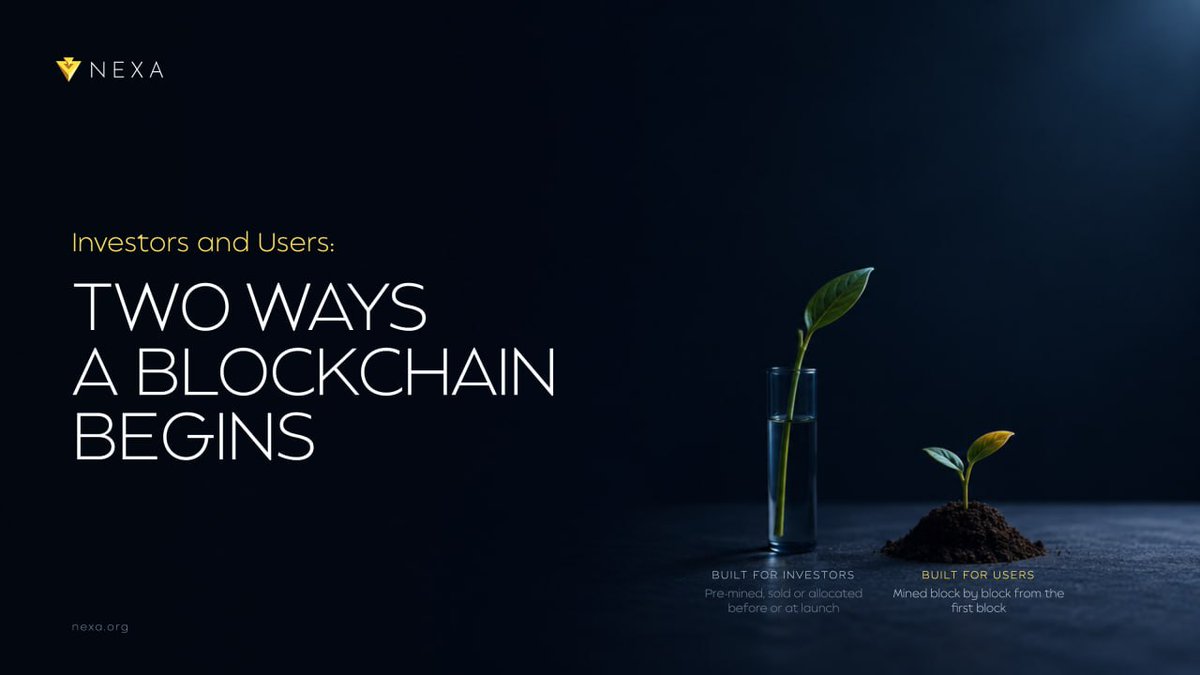
📒 Investors and Users: Two Ways a Blockchain Begins
The decentralized nature of blockchain makes it an open and permissionless global network. However, there are several types of projects in the field, and each one embodies its own rules, community and use cases.
The most important difference between them is who they are built for. Some projects are built to raise money from investors. Others are built for users and are run by the people who secure them.
Read the full article on the Nexa forum below 👇
📒 Nexa AI Skills: Now Includes Wally Wallet and Local Regtest
AI-assisted development, or “vibe coding”, is getting more popular, giving non-technical people the ability to experiment and realize their first application idea. It also boosts developers' performance, covers a range of tests, and helps with documentation and other tasks.
Nexa developer David Thibodeau (@DPTib) already introduced Nexa AI Skills with a video guide and starter application that covers how to set up and use these skills with Claude or any other compatible agent, creating a working application from a single prompt.
In the most recent update, the team added a Wally Wallet (@WallyWalletOrg) development skill, and a Local Regtest skill to support development from local machines when faucets or testnets aren't available.
Read the full article and find out more on the Nexa forum below. 👇
Paul LeRoux is #Satoshi 🔏 However the amazing $Nexa #Nexa team has advanced this vision with an upgraded hardware chips that are far superior and specific than GPU $NVDA eh Liner thinkers at Core cannot program a card game let alone Bitfoin hardware optimizers eh
📒 Nexa October Highlights: Progress That Compounds
This month, the Nexa ecosystem stayed active and it made progress on many important projects, including Tailstorm improvements, hardware acceleration, the BRAM-ring bounty, the Nexa Programming Language review, and the VotePeer application release.
Developments and progress are going well, but slowly, on the upcoming second hard fork and finalizing Tailstorm implementation. Overall, the protocol functions as designed; however, many small details remain to be finalized and require time and attention.
Peter Rizun announced an exciting bounty on 6 October 2026 on X with a 0.2 BTC prize pool (around $16,000) for anyone beating the FPGA’s efficiency. The bounty is open for everyone until 4 November 2026, 23:59 Pacific Time.
Bitcoin Unlimited released a new application on Nexa. VotePeer is an open, fair voting system for holding elections on-chain. It leverages the blockchain’s permanent records and immutable state, and was one of the first ideas envisioned for blockchains as fitting use cases.
Find all the details and more on the Nexa forum linked down below. 👇
An average and not very useful cryptocurrency will not be used as money either.
For example, it is practically impossible to use Bitcoin as a medium of exchange.
The network is too weak to handle it.
On the other hand, Nexa is being built exactly for that.
@NexaMoney
⚡ **NOT JUST SOFTWARE. SILICON.**
What if blockchain infrastructure could move beyond traditional CPUs?
NEXA is exploring hardware acceleration with FPGAs, bringing specialized silicon into the world of decentralized networks.
⚙️ Faster verification
⚡ More efficient computation
🔗 Infrastructure built for scalability
The long-term vision? A dedicated microchip capable of running an entire cryptocurrency node, with greater efficiency and a smaller hardware footprint.
This is where **Proof of Work meets hardware engineering.**
Not just another blockchain running on computers. A new approach to building decentralized infrastructure.
🟡 **NEXA. BUILT DIFFERENT.**
📖 Read the full article:
https://t.co/dsGOio5WA3
nexacoin:native
📒 Hardware Acceleration: Nexa Node on an FPGA
In the last article we met Blitz, the card that takes signature checking off the CPU. We closed with a bigger question: what happens when you put the whole node inside an FPGA?
We don’t like running a node on our main desktop machine, especially when it is bogging down all cores, the fans are blazing and the office is heating up. We want to run it on a tiny little node that we plug into the router and just SSH into when we need to.
That is the long game of this series: building a microchip for cryptocurrency, a microchip that can do the same thing as your software node, but is faster, more reliable, uses less energy, and can be built for a fraction of the cost.
That chip is still ahead of us, but there are a lot of useful things we can do directly in hardware in the meantime.
Read more on the Nexa forum below. 👇