Part of this “getting ready for tokenised securities “ is abolishing the trade through rule. Crypto exchanges tech is extremely crappy, and liquidity in these TS is even more crap. Part of the CLARITY act is a rule that “if you want to trade TS, you need to be regulated as an exchange and follow all the existing securities regulations, like reg NMS, reg T, reg SHO, etc
There is no way Coinbase , Binance, etc will be able to do that and compete with Nasdaq / Arca, BATS et all, and they would have to route all that flow away to the incumbents.
To prevent that and keep the flow to themselves, it looks like they convinced the regulators to give up the price protection rules for investors. I am worried there will be a lot of abuse of this exemption. (PFOF anybody?)
Let’s wait and find out more detail of what exactly is the plan here.
SEC Developing Framework for Tokenized Securities Trading Under “Innovation Without Arbitrage” Principle
SEC Trading and Markets Director Jamie Selway said the agency is developing a framework for the listing and trading of tokenized securities under the principle of “Innovation Without Arbitrage.” He also said the SEC and CFTC are coordinating on rules for derivatives and evaluating new products, including perpetual futures, while seeking to prevent regulatory arbitrage and excessive retail leverage.
@Merstradamous@amirhaleem@helium It was either go bankrupt or sell for scraps. It’s more a face-saving solution, they burned through a few 100 million dollars with not much to show for.
My friend, who owns and runs several mega farms in south east Oz and Tasmania, told me nobody in the region seeded for new crops due to the fertiliser shortage.
I’m starting to get that Feb 2020 feeling again where the western world (and markets) are asleep as to what’s about to happen.
Lurking below the surface in the equatorial Pacific is possibly the most impressive blob of above average ocean temperatures we've ever recorded since we've had the ability to measure this stuff. When that enormous concentration of bath water reaches the surface over the coming weeks and months, it's going to release devastating consequences around the globe throughout the second half of the year. Get ready for severe droughts in parts of South America, Africa, and Australia, devastating monsoons in southern China, and a roaring southern jet all winter long in North America. When you combine this with the fertilizer crisis bubbling as a byproduct of current global events, there's going to be crop failure on a level most of us have never seen during the closing months of 2026. Hard to see how we avoid widespread deadly famines across multiple stretches of the planet at this point.
@robbezdjian So I will set up the conversion and lend my shares out to you at 90% borrow fee, and you are willing to take the other side? Is that what you are saying?
The DEFI sector is in serious trouble. The returns just don’t justify the risks anymore. I already see specialised DEFI funds retreating from ‘public’ DEFI platforms to more specialised permissioned investments.
@HyperliquidX is still holding the fort, but it’s probably the #1 target of every hacker out there.
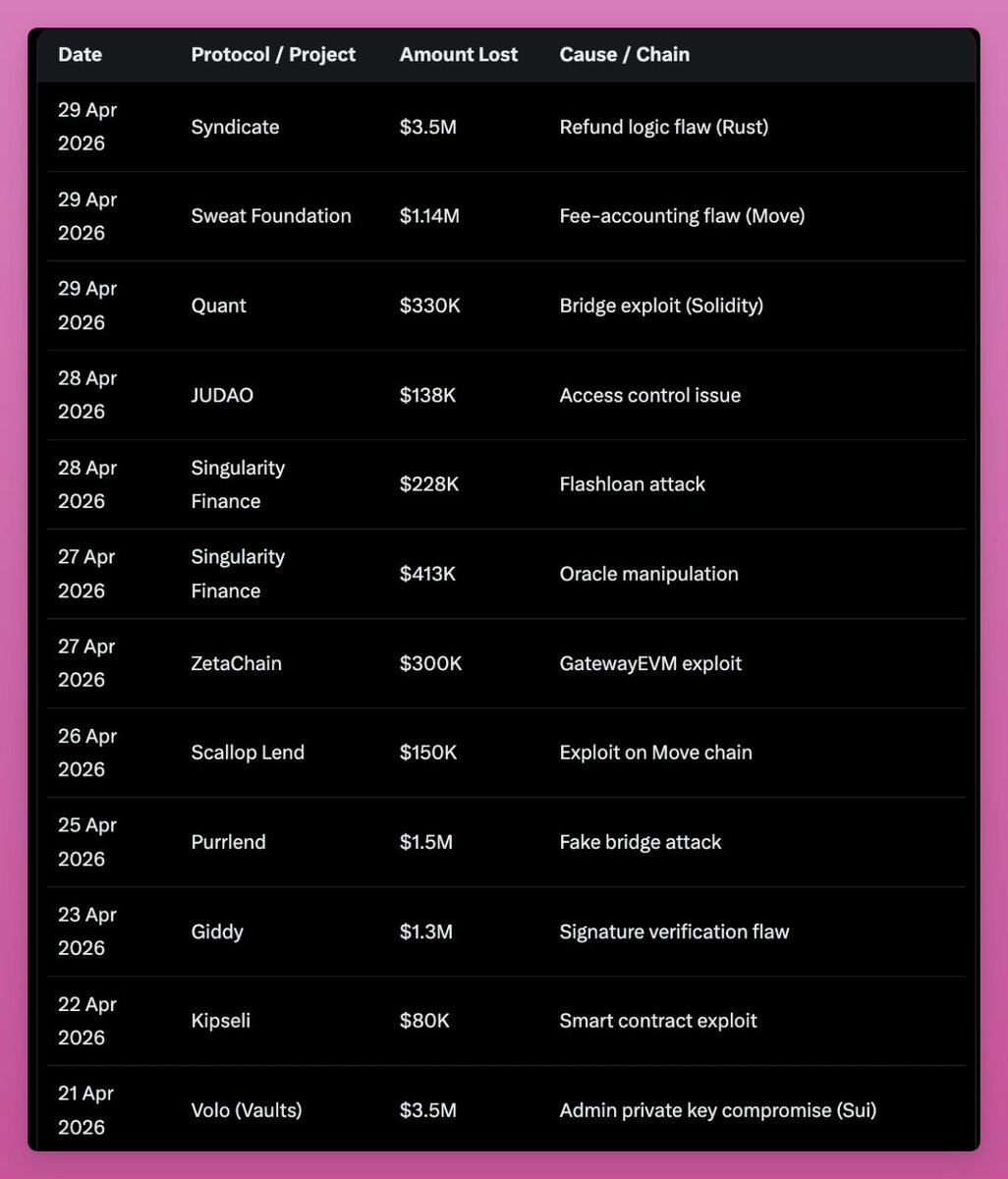
Multiple hacks per day in crypto.
Many recent hacks involve (1) small amounts, (2) niche sectors, and (3) relatively older protocols.
Sweat, for example, launched in 2022 as a walk-to-earn app.
The exploit targeted the SWEAT token contract on NEAR. Their GitHub update history shows they weren't actively maintaining their public repositories before the hack.
Their core DeFi/growth feature was last updated 7 months ago.
I bet other hacks share similar patterns.
Just like I look for protocols to farm for airdrops that fit my criteria, hackers likely use the latest AI models to target protocols that are:
• rarely updated
• share similar vulnerabilities as previously hacked projects
• have $100k+ in their contracts
Using AI lowered the effort needed to find these targets.
This will likely last until old, unmaintained projects are milked out of their last cents or the industry improves security.
I beg to differ. From what I can see @CantonNetwork is winning the war of the chains. Every large financial institution is now building on Canton Solana is not even an option for them for their core infrastructure.
The exception is stablecoin payments where Solana is seeing some traction. DEFI is dead for now.
Today we announced an agreement with @computershare, the World's Largest Transfer Agent, that manages close to 60% of the S&P 500, including companies like Apple, Tesla, Microsoft, Nvidia, Disney, Coinbase, etc., to become their tokenization partner to bring stocks on chain natively in the US and abroad, retaining the same rights and economics and allowing them to trade and borrow on chain.
Tokenize the world!
This is potentially the end of the structural advantage of stablecoins and the whole reason they are cheaper to operate than payment systems/bank transfers today. It won't remove many of the benefits of stablecoins but the whole system now effectively has to have a central brain to do the AML/sanctions/KYC logic -
Much of the compliance logic is too big to run on a blockchain meaning that every transaction needs to be authorised off chain/against an oracle which is running off chain.
https://t.co/VXLk80HyQ7
Our friends at Slow Traders hired another banker to lead (part of) the firm. When will they learn they need to hire visionary HFT leaders instead of bankers and sales guys to run their business?
@FlowTraders
Lots of alpha drops from @ScottPh77711570 , and then I don’t mean the strategies.
Also, this guy runs an unlicensed unregulated hedge fund , and markets it across the globe into jurisdictions that definitely see it as a crime to do so.
In his own words, “if you see crime in crypto you got to run towards it!” 😂
"Crypto is the dumbest market in the world"
Scott Phillips (@ScottPh77711570) runs HyperTrend — $20M of his own capital, one losing year in six.
His edge? Picking the table big firms can't sit at.
"There's no second-best counterparty in crypto. You see crime, you run towards it — crime is the foundation of edge."
We cover:
- Why crypto still has edge in 2026 — even when your uncle is talking about Bitcoin at Thanksgiving
- The simple rules (buy 20-day highs, top-20 coins) that print through any market
- Why stacking trend + momentum + carry gets you there from a spreadsheet — no automation required
- Price-insensitive buyers (Saylor), price-insensitive sellers (North Korea) & why both are permanent alpha
- The 90-day Binance listing short — an edge hiding in plain sight in market maker contracts
- Why most shit coins trend to zero — and how to trade the ones that don't
- Building a tokenized, permissionless DeFi hedge fund on hyperliquid — 2 & 20, fully on-chain
- Why the best quant firms are run by near-non-verbal autists with one translator
Thank you so much @ScottPh77711570 for coming on the pod!
Highlights:
01:04 Table selection and the math of competitive alpha
06:21 Why basic trend following yields outsized Sharpe in crypto
08:49 Why market inefficiency persists despite institutional inflows
14:58 Price insensitive buyers: Cults, VCs, and North Korean hackers
17:17 Factor analysis and the size-decay effect in shitcoins
25:40 The structural edge in mid-frequency crypto strategies
32:43 Tokenized DeFi vaults and on-chain hedge fund governance
40:43 Designing a robust portfolio: Equal weighting vs. MVO
44:21 Sourcing alpha from ghost chains and VC exit liquidity
49:58 Exploiting market maker contracts and post-listing drift
53:55 Operational alpha: Managing margin and manipulated funding rates
01:01:13 Shifting from quant to CEO
01:11:28 How to bridge the mentorship gap with elite traders
01:22:38 Building network triads: The secret to compounding social capital
01:29:23 Why 10x goals require total identity transformation
@wmiddelkoop Or they just executed a loco swap so they didn’t need to physically ship the gold with all the costs, risks, and complexities involved? Simple, quick, easy, no conspiracies involved.
Networking at conferences is going to be a whole different experience now. Guess we need to adapt to maffia-style “friends of mine” / “friends of ours” introductions now to be able to build trusted relationships.