The lie about Africa was not a small lie carelessly told.
It was a structural lie, deliberately constructed, institutionally maintained, academically defended.
It required the renaming of things. Egypt became, in the Western imagination, not quite African. The pyramids became a "mystery," because the alternative was crediting Africans with their construction, which the framework could not accept.
It required the discrediting of Arab and African scholarship about African history.
It required the dismissal of oral traditions as legend rather than history.
It required deciding that writing on paper counted as "civilization" and other forms of knowledge transmission did not.
It required, essentially, redesigning the criteria for what counted as "civilization" so that the places being colonized would fail the test.
The test was not neutral.
The test was written to produce a specific result.
And that result was: "Africa has no history worth the name."
Therefore what colonialism destroyed was not civilization. Therefore what colonialism did was not destruction.
This is not an accusation of individual ignorance.
This is a description of institutional architecture, built over centuries, maintained by people who understood exactly what it was for.
Photo: Benin City, 18 February 1897.
Three British soldiers stand inside the burned royal compound of the Kingdom of Benin, present-day Nigeria. In the foreground lie bronze plaques from the royal palace, amid the destruction left by the British punitive expedition.
Thousands of royal and sacred artefacts were looted and dispersed into Western collections, including the British Museum.
Before they became museum exhibits, they were spoils of colonial conquest.
Photograph: Reginald Kerr Granville, 1897.
The Benin bronzes are in the British Museum.
More than 900 of them.
They were taken in 1897, when a British punitive expedition burned the royal palace of the Kingdom of Benin, a kingdom with which Britain had diplomatic and trade relations, and whose metalwork was among the most technically sophisticated on the planet.
Taken. As loot. During a raid.
They are still there.
The British Museum has had decades of requests for their return.
The responses have involved long conversations about legal frameworks and cultural heritage law and the logistics of preservation and the importance of these objects being seen by international audiences.
The objects have seen international audiences.
From inside Britain.
The argument is, essentially: we took these things, we built an institution around the taking, the institution now benefits from housing them, and their presence here proves their importance, which justifies our continued possession of them.
This is not a difficult argument to identify.
It is the colonial argument in miniature, running in the present tense.
The history was removed.
The evidence of the history was also removed.
Sometimes to museums.
Photo: Gold coin bearing the bust of King Kaleb of Aksum, ancient Ethiopia, sixth century CE.
Royal portraits. Greek inscriptions. Sovereign currency. International trade.
Aksum had been minting its own gold coins since the late third century, more than 1,500 years before Hegel's lectures.
An African civilization was literally striking its history in gold centuries before European philosophers presumed to deny it.
Hegel, the philosopher, the foundational figure of Western intellectual tradition, the man whose ideas shaped how generations understood history and progress and civilisation, said Africa had no history.
Literally.
In "The Philosophy of History," published posthumously in 1837, he described Africa as "the land of childhood, which lying beyond the day of self-conscious history, is enveloped in the dark mantle of Night."
No history. No development. No participation in the movement of human civilization.
This was not a fringe opinion.
These were the intellectual assumptions that would help legitimize European colonial domination and, decades later, the partition of an entire continent.
Now.
While Hegel was writing this, the Oyo Empire in West Africa governed millions of people through a sophisticated constitutional system with checks on royal power.
While Hegel was writing this, the Kingdom of Dahomey had a standing army, a complex taxation system, and active diplomatic relationships with the European powers who were simultaneously, in their salons and academies, insisting the continent they were negotiating with had no civilization worth the name.
While Hegel was writing this, the Asante Empire operated under legal codes that European jurists would have recognized as sophisticated if they had been written in a language those jurists were willing to read.
While Hegel was writing this, the manuscripts of Timbuktu, hundreds of thousands of texts on mathematics, astronomy, medicine, theology, history, were being preserved by African scholars in the city his tradition insisted had produced no thought worth preserving.
And while Hegel was writing that Africa had no history, Ethiopia already had one that stretched back more than four thousand years.
Egyptian pharaohs, themselves African rulers, had been sending fleets to trade with the Land of Punt, in the Horn of Africa, as early as 2500 BCE.
Gold, frankincense, myrrh, ebony, ivory.
By the third century CE, the Kingdom of Aksum was minting its own coinage, trading across the Red Sea and Indian Ocean, and commanding such international recognition that the religious teacher Mani counted it alongside Rome, Persia and China as one of the great kingdoms of the world.
Its written literary tradition in Ge’ez carried scripture, philosophy, law, and royal chronicles that predated most of the nations doing the accusing by centuries.
The darkness was not in Africa.
It was in the theory that needed Africa to be dark.
They taught African children, in colonial schools, that their continent had no history before Europe arrived.
Let that sit for a moment.
They took children whose grandparents had lived in functioning kingdoms, whose oral traditions carried the history of empires spanning centuries, whose communities had legal systems and agricultural science and trade relationships and philosophical frameworks for understanding the world.
And they sat those children in European-designed classrooms and taught them that their past was darkness.
That their ancestors had been waiting. Waiting without direction or achievement or meaningful civilization. Waiting to be found.
That the story of their people began when Europeans arrived to begin it.
This is not ancient history.
The generation of Africans who received this education are alive. Their children are alive.
The psychological work required to recover from being taught that your people had no history.
To excavate your own past not from lived memory but from archives that were often kept by the people who had the strongest interest in what was and wasn’t in them.
That work is ongoing.
And the people who created the need for that work are still explaining that colonialism, on balance, was not so bad.
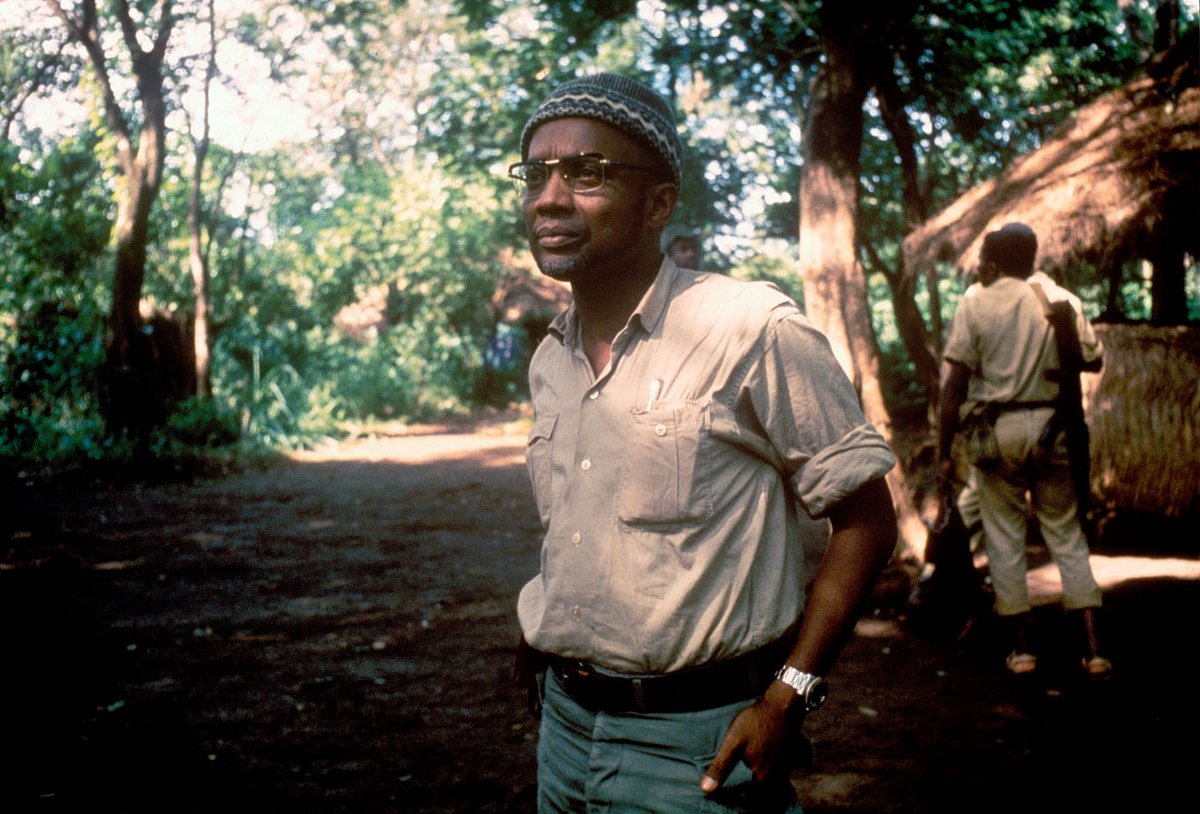
Photo: Amílcar Cabral (1924–1973), agronomist, revolutionary thinker and co-founder of the PAIGC, led resistance to Portuguese colonialism in Guinea-Bissau and Cape Verde.
For him, liberation meant more than independence. It meant reclaiming history, culture and dignity.
There is a reason the first thing serious liberation movements do is address education.
Amílcar Cabral said it.
Frantz Fanon said it.
Amílcar Cabral said the colonized must "return to the source," must recover historical identity not as nostalgia but as the specific foundation on which genuine independence becomes possible.
They were not being romantic.
They were being precise.
They understood that a people who do not know their own history cannot draw on it.
Cannot point to it and say:
We built things before you arrived. We will build things after you leave.
Cannot look at the condition the colonizer created and say with full confidence:
This was done to us. It is not what we are.
A people without that knowledge accepts the condition.
Does not demand the transformation.
Waits for permission from the people who designed the situation to fix it.
And the people who designed the situation are not going to fix it.
They taught the colonized child to see the world through the colonizer’s eyes.
And then, when the colonized child grew up and looked through those eyes and saw themselves...
They saw what the colonizer saw.
"Backward." "Primitive." "In need of development." Behind on a timeline whose destination was someone else’s present.
This is the wound that outlasts the empire.
The guns go. The administrators go. The flags come down.
But the curriculum stays in the mind.
The habit of measuring yourself against a standard that was designed without you.
The reflex of looking at your own culture and asking, involuntarily, what the colonizer would think of it.
The deep, persistent, half-conscious belief that modernity is something you are still catching up to rather than something you were always building in your own way.
This is why independence was necessary but not sufficient.
You can remove the occupier without removing the occupation of the mind.
Decolonizing the curriculum was not a symbolic act.
It was the harder and more fundamental liberation.
The liberation of the internal landscape.
The recovery of the right to know what you knew before they told you it didn’t count.
As for equating "local families" with "scholars," notice what just happened.
European monks preserving manuscripts in medieval abbeys: scholars.
African scholars preserving manuscripts in Timbuktu: local families.
Same activity. Different vocabulary. Applied by the same framework that decided, in advance, which category each group belonged to.
George, you did not disagree with my point about Timbuktu.
You Hegeled it.
"People are the same regardless of geography and time."
This is the most interesting thing you’ve said, and I don’t think you’ve noticed what it does to your previous position.
If people are the same regardless of geography and time, if the drive to build, organize, expand, and dominate is universal, then the specific claim that Africa produced no civilisation, no history, no self-conscious development becomes not just wrong but incoherent.
By your own logic, Africans were doing exactly what everyone else was doing.
Building. Governing. Trading. Fighting. Preserving knowledge. Passing it down.
Which is precisely what the evidence shows.
Which is precisely what Hegel denied.
You have just accidentally agreed with the argument you came here to counter.
The most revealing thing about this exchange, George, is the direction of the burden of proof.
You challenged the Timbuktu claim without checking it.
You confused Kant and Hegel in the first reply.
You’ve moved, in the span of a few messages, from a factual challenge to a philosophical position to a kind of civilizational shrug.
None of this is unusual for this kind of conversation.
What’s worth examining is why the instinct, when confronted with documented evidence of African intellectual and civilizational achievement, is to challenge first and verify second.
Why the default is skepticism toward the evidence rather than toward the assumption the evidence is challenging.
Hegel did not verify either.
He assumed. He theorized. He constructed a philosophy of history that placed Africa outside history without consulting the archives of Timbuktu, the chronicles of Aksum, the legal codes of the Asante, or the constitutional architecture of the Oyo.
The assumption that there was nothing worth consulting preceded and produced the conclusion that there was nothing.
That pattern, assuming absence, finding confirmation of the assumption, treating the confirmation as evidence, did not end with Hegel.
It is worth noticing when it appears in smaller forms.
Consider the geography of American military bases.
Bases in Germany. In Italy. In Spain. In Turkey.
Bases in Bahrain. In Qatar. In Djibouti.
Bases in Japan. In South Korea. Throughout the Pacific.
Now ask: are those bases there to protect the host country?
Or are they there because the host country is in a location that serves American strategic interests?
And if the answer is the latter, which the geography strongly suggests, then the protection is not the point.
The protection is the rent.
The service rendered in exchange for the base.
For as long as the base is useful.
At which point the rent review happens.
And the terms are set by the party with the aircraft carriers.
This is not a secret. Military strategists write about it openly.
The only people for whom it sometimes comes as a surprise are the populations of the host countries who were told a different story about why the bases were there.
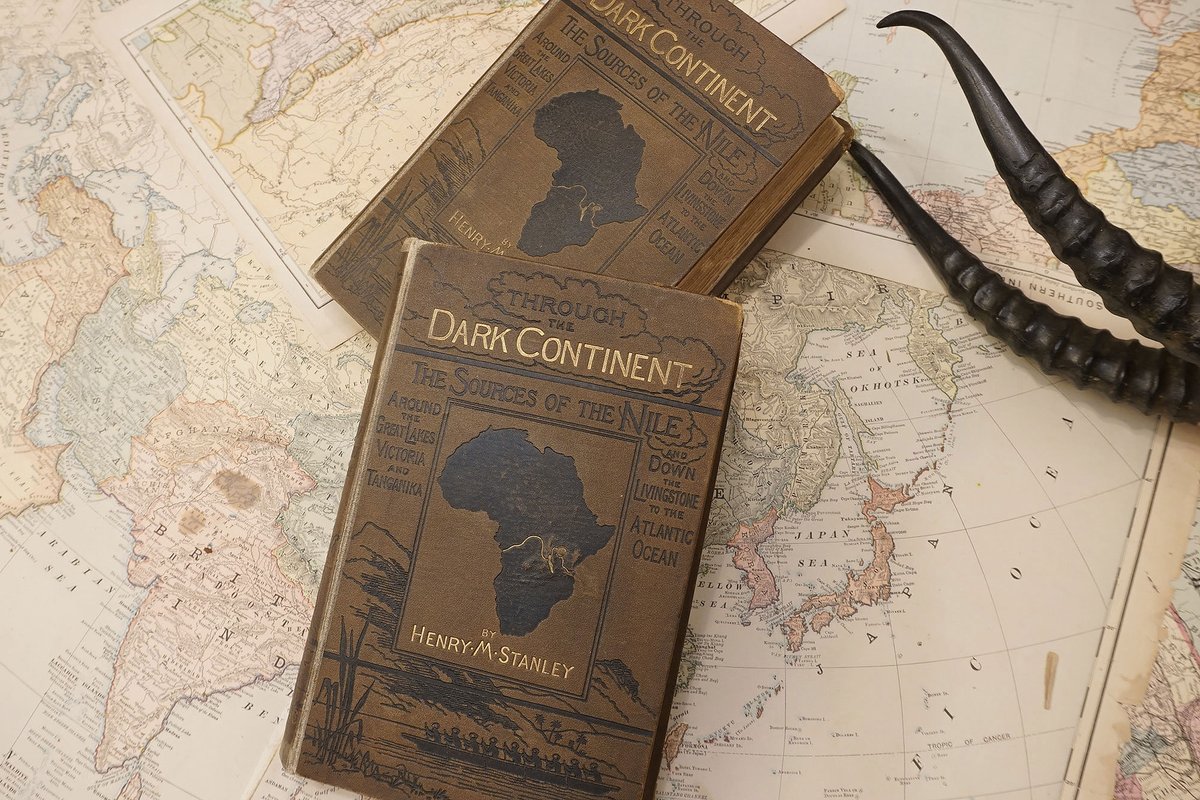
Photo: Henry Morton Stanley, "Through the Dark Continent" (1878). A revealing example of how nineteenth-century European exploration literature portrayed Africa as a land of darkness, despite its ancient civilizations, kingdoms and intellectual traditions.
They called it the "Dark Continent."
Understand what that phrase was doing.
It was not a geographic description. European cartographers had been trading with coastal African kingdoms for centuries. Arab scholars had mapped the interior. Timbuktu was a name known across the medieval world.
The darkness was not in Africa.
The darkness was what Europe needed Africa to be.
Because a continent of kingdoms required a justification for conquest that a continent of kingdoms could not provide.
So the kingdoms were removed from the map.
Not literally. Rhetorically. Historiographically. From the textbooks and the lectures and the philosophical frameworks that decided what counted as "civilization" and what counted as nature waiting to be claimed.
They didn’t arrive in darkness.
They brought it.
And called it light.
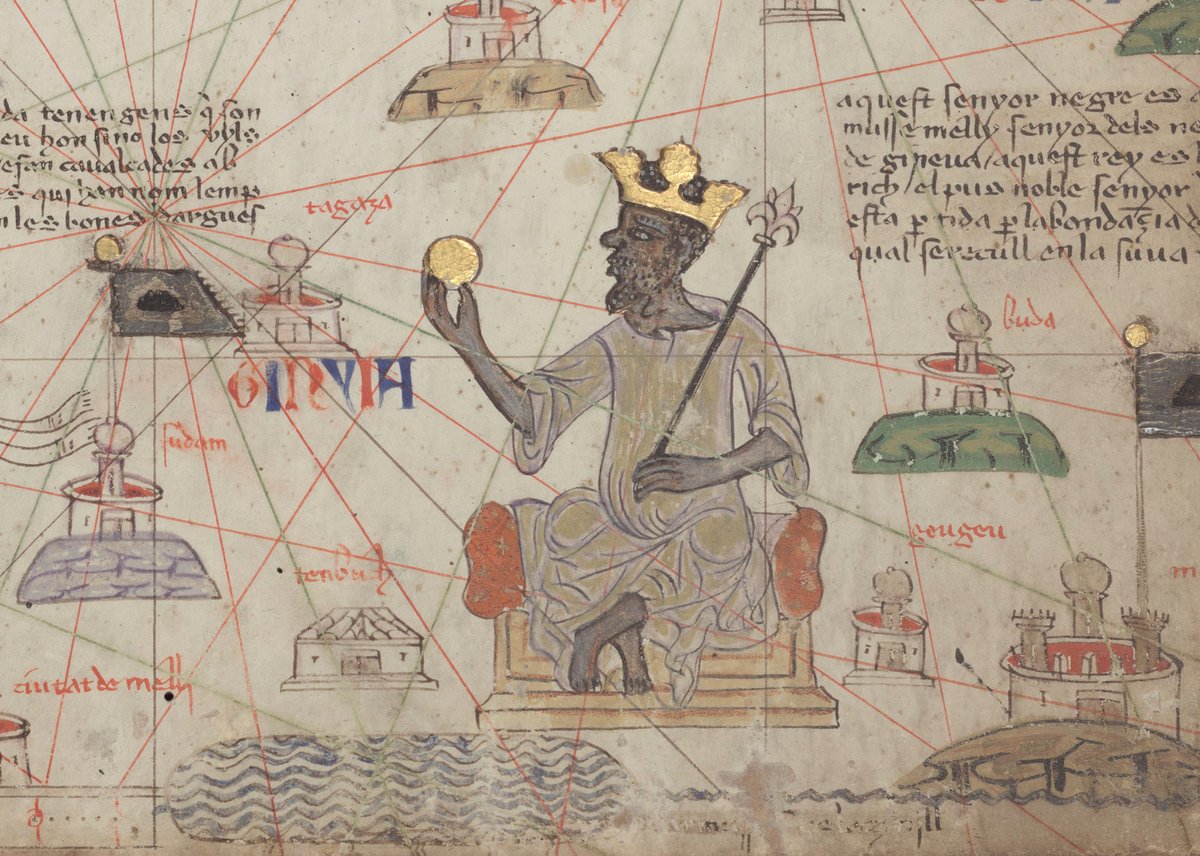
Photo: Mansa Musa, Emperor of Mali (c. 1312–1337), depicted in the Catalan Atlas of 1375, attributed to the Majorcan cartographer Abraham Cresques.
Seated on his throne, holding a golden orb and sceptre, Mansa Musa is described in the original medieval Catalan inscription as "the richest and noblest ruler of this whole region because of the abundance of gold that is found in his lands."
Medieval Europe knew of Africa’s wealth and powerful civilizations centuries before European colonial conquest.
Source: Catalan Atlas, c. 1375. Bibliothèque nationale de France, Paris, MS Espagnol 30.
In 1324, Mansa Musa of Mali made a pilgrimage to Mecca.
He traveled with 60,000 people and 100 camel-loads of gold.
He gave away so much gold in Cairo that he collapsed the regional gold market for a decade.
A decade. From generosity on a journey.
His empire covered more territory than Western Europe. His capital, Niani, was a center of scholarship, trade, and governance sophisticated enough that visiting Arab historians wrote about it with undisguised admiration.
This was not a primitive society waiting for civilization to arrive.
This was a civilization.
One of the great ones. By any measure that wasn’t specifically designed to exclude it.
The colonizers who arrived in West Africa centuries later did not bring civilization to a void.
They dismantled something that was already there.
The textbooks that don’t mention Mansa Musa at all, not once, not a paragraph, are not gaps in education.
They are a decision. Made deliberately. Maintained consistently.
Because his existence changes the sentence.
The University of Sankore in Timbuktu was operating in the 12th century.
At its peak it had 25,000 students.
It held between 400,000 and 700,000 manuscripts on mathematics, astronomy, medicine, law, literature and theology, many of which are still being catalogued today.
Seven hundred thousand manuscripts.
In a city that European maps labeled "terra incognita."
Unknown land.
Not unknown to the scholars studying astronomy inside it.
Not unknown to the merchants who traveled thousands of miles to reach its markets.
Not unknown to the students who came from across the continent and the Arab world to study there.
Unknown only to the people who needed it to be.
Because 700,000 manuscripts changes the sentence.
Because a university operating a thousand years ago in sub-Saharan Africa changes every assumption that colonialism was ever built on.
And the assumptions needed to survive.
So the manuscripts were not taught.
And the "terra incognita" remained, in the minds of those who needed it to, incognita.
Great Zimbabwe was built between the 11th and 15th centuries.
Massive stone enclosures. Walls 11 meters high. 250 meters in circumference. Built without mortar, with such precision that the walls have stood for centuries.
A thriving city that at its height housed 18,000 people. A trading hub connected to Swahili Coast networks that moved gold, ivory, and goods as far as China.
When European explorers encountered it in the 19th century, they did not ask: who built this?
They asked: who built this that wasn’t African?
The theories came quickly. Phoenicians. Arabs. A lost white civilization. King Solomon. The Queen of Sheba.
Literally anyone except the people who had been living in and around it for centuries and whose oral histories described exactly who built it and when and why.
It took until the 20th century, and a British archaeologist named David Randall-MacIver working against enormous institutional resistance, to formally establish what the people who lived there had never forgotten:
Africans built it.
Africans built it.
The refusal to accept that was not ignorance.
It was integral to the colonial narrative that justified ruling and dispossessing Africans while declaring them incapable of the very achievements their ancestors had left standing in stone.
The ruins were African. The myth that denied their origins was colonial.
The history was removed because history is never just about the past.
History is the story a civilization tells about why it deserves what it has.
If Africa had no history before Europe, no kingdoms, no universities, no philosophy, no science, no architecture, then colonialism brought civilization to a void.
And bringing civilization to a void is not a crime.
It is, in the logic of the story, a service.
But if Africa had kingdoms and universities and philosophy and science and architecture, then colonialism did not bring civilization.
It destroyed it.
And the wealth that built the banks and the factories and the museums and the universities of Europe was not generated by European genius operating on empty land.
It was taken.
From specific people. In specific places. Who had built specific things that were then burned.
Those two sentences cannot both be true.
The colonial project needed one of them to disappear.
So the history disappeared.
Textbooks were written. Curricula were designed. Hegel was assigned. The word "tribe" was chosen over the word "kingdom". The libraries of Timbuktu were not mentioned.
And a world was taught a story about itself that required the removal of most of the world from the story.
That removal was not scholarship.
It was self-defense.
And the return of the history, the real, documented, academically rigorous, stone-and-manuscript and city-and-empire history, is not an accusation.
It is just the rest of the sentence.
The part they needed you never to hear.