Let's join @Port3Network social mining, contribute data to the #Port3 Data Layer and earn gemstones for future airdrops.
Repost now to get 1000$ from me.
Every proposed answer to quantum risk so far has asked the same thing of you: move your coins.
Millions of holders, custodians, ETFs and treasuries, all migrating to new addresses before a deadline nobody can name. That's not a solution, it's a systemic event with a countdown on it.
@MehowHacks at BASS @Stanford on why we built the version where you do nothing at all.
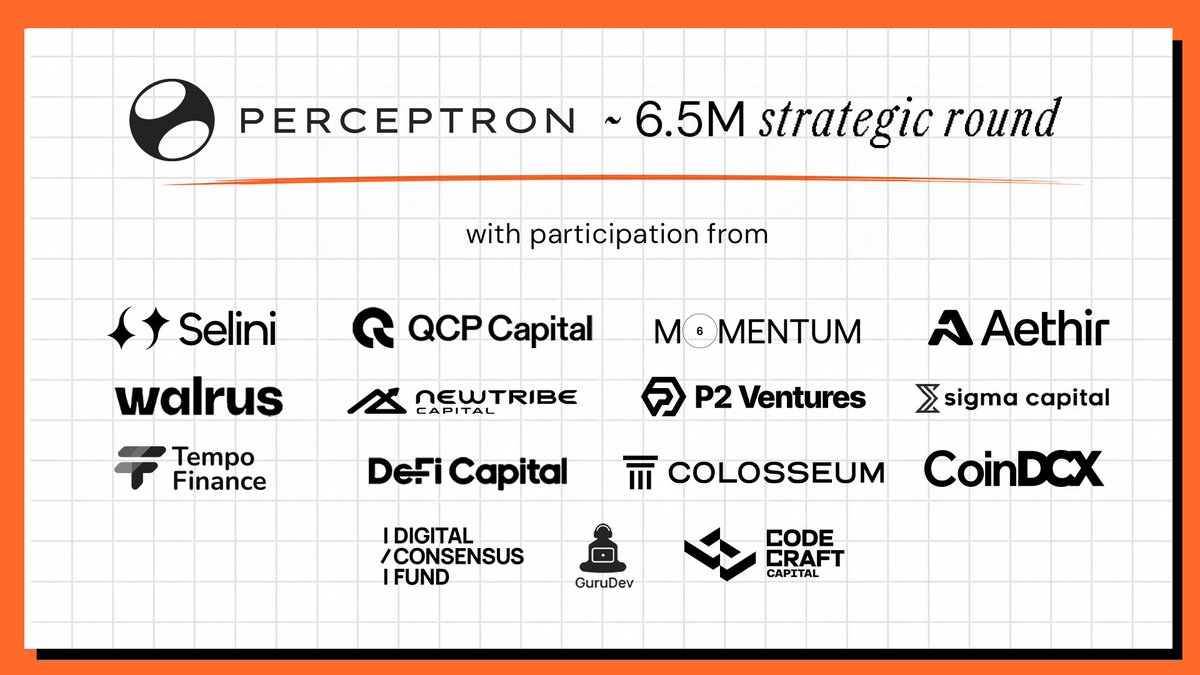
We're thrilled to announce that Perceptron has closed a $6.5M strategic round.
Centralized scraping is hitting diminishing returns on cost and quality. Closed data partnerships are out of reach for most AI teams. The real bottleneck for AI right now sits at the data layer.
Perceptron compresses global data collection into one mesh: idle bandwidth, unique datasets, and domain expertise from a network already live across 800K+ nodes in 150+ countries, with 300K+ daily active contributors.
This round funds our data-questing platform, letting AI companies commission specific, high-value datasets directly from that network and cutting the timeline from request to delivered dataset down to days.
The network continues to expand.
Join us.
→ https://t.co/nXcXB5JrxY
The Litecoin ecosystem now has its own identity layer.
Claim your @name.lite
One name replaces every address you’d otherwise copy,
paste, and triple-check:
→ Patented Send-to-Name™ - no address poisoning
→ One-time stealth address for every pair of users - no public wallet exposure
→ Quantum-resistant cryptography - built into system
Get yours using the link below.
Quick breakdown of how stealth address systems actually work:
1. Someone sends to a human-readable name
2. Their wallet computes a brand new receive address that has never existed before
3. Only the sender and recipient can derive that address
4. The address is never reused
5. It works across every chain and every token
To an outside observer, every payment appears to go to a completely different wallet.
Because cryptographically, it does.
Most DeAI projects launch with a roadmap.
Perceptron has a live network.
800K+ nodes. 150+ countries. Built in months, one contributor at a time.
That kind of distribution can't be bought overnight.
Data freshness gets the headlines.
Data verification is the harder problem.
Anyone can collect a dataset.
Proving where it came from, who collected it, and whether it holds up takes a network, not a script.
That's the part most AI data pipelines skip.
Post about us tagging @quipnetwork. Depending on the content quality and engagement quality, you will be receiving additional points & $QUIP rewards from the mindshare leaderboard.
Ask a room of crypto users how many addresses they use regularly.
Most say one or two.
Every transaction, every counterparty, every balance, all tied to the same handful of permanent identifiers.
Privacy guidance has said "use a new address every time" since 2009.
Almost nobody does, because almost no wallet makes it automatic.
Your transaction is on-chain. Your identity often isn't.
It's in the RPC endpoint that broadcast it. The wallet provider that built it. The node that relayed it.
Every one of those sees your IP, your timing, your device.
The chain forgets nothing. The infrastructure around it remembers even more.
76% of major crypto losses this year came from just two attacks.
Not a wave of breaches.
Two.
Totaling over $570M.
Attackers don't need volume.
They need one nine-figure vulnerability and the patience to reach it.
The industry defends against many small attacks.
The damage comes from a few enormous ones.
The Vangrid economy is now fully onchain.
Every capture verified. Every sale settled in USDC. Every payout onchain.
Live on @base.
The grid is inevitable.
Claimed my Vault777 Founders Pass and honestly it's a no-brainer.
30 seconds to get on the launch waitlist, and early claimers are in line for up to $10K in launch bonus.
You dont want to sit this one out
https://t.co/WzJWp7XjS7
For over 20 years, our CEO @MehowHacks has been finding security flaws before they become global problems.
From hacking electronic voting machines for the U.S. government to building one of crypto's most ambitious security companies, his mission has stayed the same: fix the infrastructure before it fails.
Read his latest profile by @Entrepreneur UK on why he believes crypto's biggest vulnerability isn't the blockchain, it's how people actually use it.
For years, trading RWAs and crypto meant jumping between platforms, brokers, and accounts. That changes today.
Canborsa DEX is officially live!🚀
★ New assets, including $MSFT, $META, $GOOGL, $AMZN, $AMD and more
★ Higher leverage across all markets, now up to 30x
★ Maximum position size is now $10,000
★ New points multipliers for holding and trading volume
★ Improved UX/UI across the platform
We built a single interface that brings tokenized stocks, commodities, and crypto together, decentralized, safe, and without intermediaries.
Start trading→ https://t.co/nRI6ex4ST7
Code is the right action interface.
NVIDIA’s SpatialClaw = agents that write their own code, inspect results and adapt on the fly.
That’s the reasoning layer.
Vangrid builds the decentralized perception grid – the sensors and real-world data these agents need.
Reasoning + Perception.
The grid is inevitable.
Robots earning, trading, and working autonomously on-chain is no longer sci-fi. 🤖⚡ @konnex_world is building the machine economy with AI, Proof-of-Physical-Work, and crypto payments powering real-world automation. The future of labor is autonomous. $KNX #AI#Web3#Robotics