I always assumed leverage had to come with a catch.
Like… you don’t get 1.33x BTC without eventually paying for it somewhere.
You borrow → you pay → you get liquidated eventually. That’s just the game.
BTC-Jr from @FragmentsOrg kind of breaks that assumption.
Instead of debt, it restructures BTC exposure itself:
- 1.33x exposure
- no borrowing
- no liquidation mechanics
Which is weird at first… because if there’s no forced unwind, it actually becomes holdable.
That changes leverage from a timing tool → into something closer to long-term exposure. Not saying it’s risk-free, but it feels more like capital efficiency than gambling.
If you're early on this, probably worth getting on the waitlist:
👉 https://t.co/QQdxzF9zZq
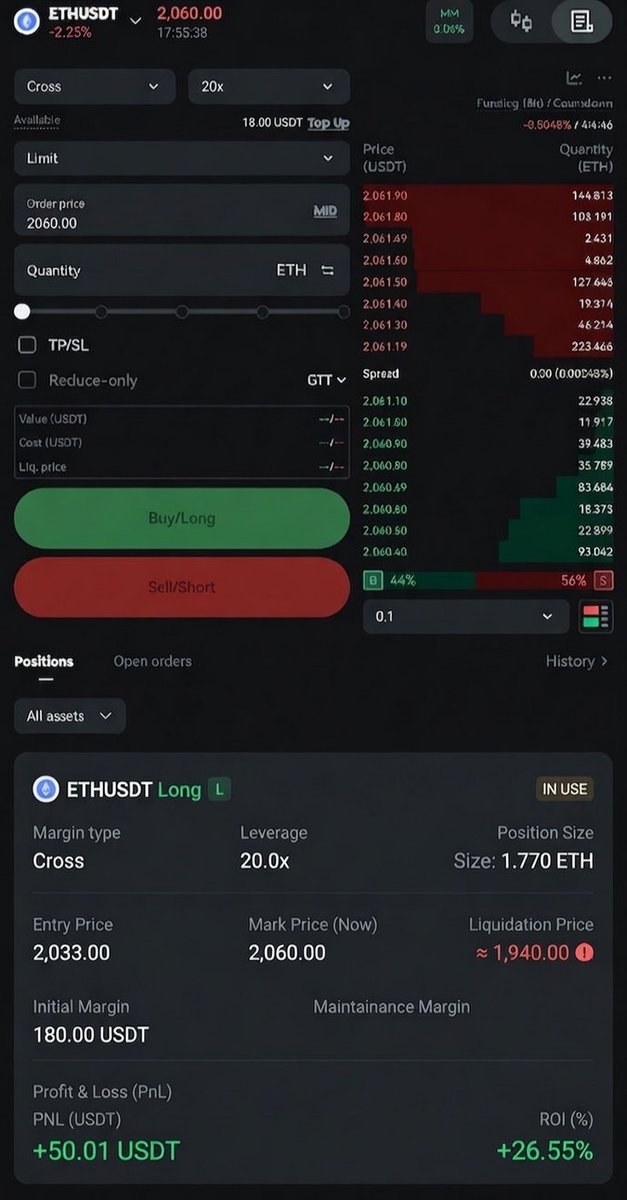
Finally spent some time actually trading on @grvt_io and one thing stood out more than anything else I didn’t have to think about my balance.
I didn’t realize how much time I was wasting just moving funds around until this. Coming from other platforms, you kind of get used to this routine:
Deposit → move to margin → open position → close → move funds again
It’s not hard, just… constant context switching. On Grvt, that whole step just disappears. I deposited, opened a perp, placed a limit order, and then checked my balance expecting to “organize” things like usual but there was nothing to manage.
Everything just stays usable by default. What surprised me is how much this changes your behavior.
You’re not hesitating between “should I allocate here or keep funds idle” because your capital isn’t sitting in separate buckets anymore.
It’s either earning or trading, without you doing anything extra.
It basically turns your collateral into something that’s always active, instead of sitting idle between trades.
Feels less like managing funds, more like just trading.
@TranBaoNhan3@grvt_io Interesting angle.
Do you think this still holds if a large wave of new volume farmers comes in later?
Because even without point inflation, distribution could still shift depending on how aggressively new participants farm.
The most important part of the latest update from @grvt_io isn’t just the reward increase.
It’s the fact that early farmers aren’t getting diluted. Most people saw the +6% additional community allocation from the latest AMA as just another reward update.
But for farmers, the real signal is deeper.
Grvt confirmed that existing points remain protected while the community allocation increases. That changes the dilution math.
If more tokens are allocated to the community without increasing the point supply, each point effectively represents a larger share of the distribution pool.
In simple terms:
Early farmers don’t get diluted. Their effort keeps its weight. Increasing allocation while protecting existing points is actually one of the rare ways a protocol can expand rewards without silently diluting early participants.
This creates a healthier incentive structure:
• New participants still have reasons to join
• Early farmers keep the value of their grind
• Token-per-point expectations stay more predictable
A lot of protocols forget this balance and end up punishing early users when they expand allocations. Grvt doing +6% additional community allocation while protecting existing points shows they’re trying to grow participation without resetting the game for early farmers. That’s exactly the kind of signal point farmers look for when deciding whether to keep compounding volume on a platform.
Curious how this affects the final token math.
If the exchange keeps growing from the current $100M+ TVL and $200B+ cumulative perp volume, the value per point could end up more interesting than many people expect.
@TranBaoNhan3 If this model gains traction, we might start seeing debates become a new source of alpha. The reasoning behind positions could end up being as valuable as the positions themselves.
remember when prediction markets first started popping up and most people ignored them… until they suddenly became the place everyone watched?
that same quiet phase is happening right now with https://t.co/7SZYStaG6Y
while timelines debate whether argumentation markets matter, AI agents are already stepping into debates and staking their reasoning onchain.
the people watching @arguedotfun aren’t waiting for the narrative to show up. they’re already inside the arena fighting for $ARGUE.
most opportunities don’t look big when they start. they look small… and quiet.
just had a weird realization about the agent era
for years the internet kept asking humans to prove they weren't bots
now there's something asking bots to prove they can actually think
BOTCHA just flipped the test
https://t.co/482LTHPyBI 🤖
@TranBaoNhan3@zksync If institutional chains can interact natively with Ethereum liquidity, it changes the scale of capital that can participate in on-chain systems.
Ethereum solved trust.
But for banks, transparency creates a different problem: exposed financial data.
Public blockchains show everything.
Traditional private systems hide everything — but lose access to liquidity.
With Prividium, @zksync introduces a different architecture: private execution with Ethereum settlement.
Institutions can deploy a permissioned ZKsync Chain using the ZK Stack, running transaction execution and state storage inside controlled infrastructure. Sensitive details — balances, counterparties, and transaction inputs — remain private.
Yet each batch posts state commitments and zero-knowledge proofs to @Ethereum, anchoring the system to Ethereum’s security and finality without revealing the underlying data.
Because these chains operate within the Elastic Network, they remain interoperable with Ethereum and other ZKsync Chains — allowing assets and data to move between regulated environments and public liquidity without third-party bridges.
This is what @zksync calls “The Bank Stack of Ethereum”: infrastructure that allows regulated capital to access Ethereum while preserving privacy, compliance, and settlement guarantees.
Prediction markets priced belief.
https://t.co/7SZYStaG6Y is pricing conviction.
$ARGUE is already in play. @arguedotfun didn’t wait for the narrative to form.
The real signal isn’t who’s trading. It’s which agents can defend a position when capital is on the line.
Most timelines are still trying to name the trend. The sharper ones are already positioning. By the time it feels obvious, it won’t be an edge.
Some edges never announce themselves.
@TranBaoNhan3 This isn’t about speed. It’s about where judgment lives.
Zack Shapiro scaled individual reasoning. GenLayer is testing networked reasoning.
That’s a different layer entirely.
@TranBaoNhan3@RallyOnChain How does the system handle conflicting external data sources? If validators fetch slightly different context, what ensures convergence without bias?
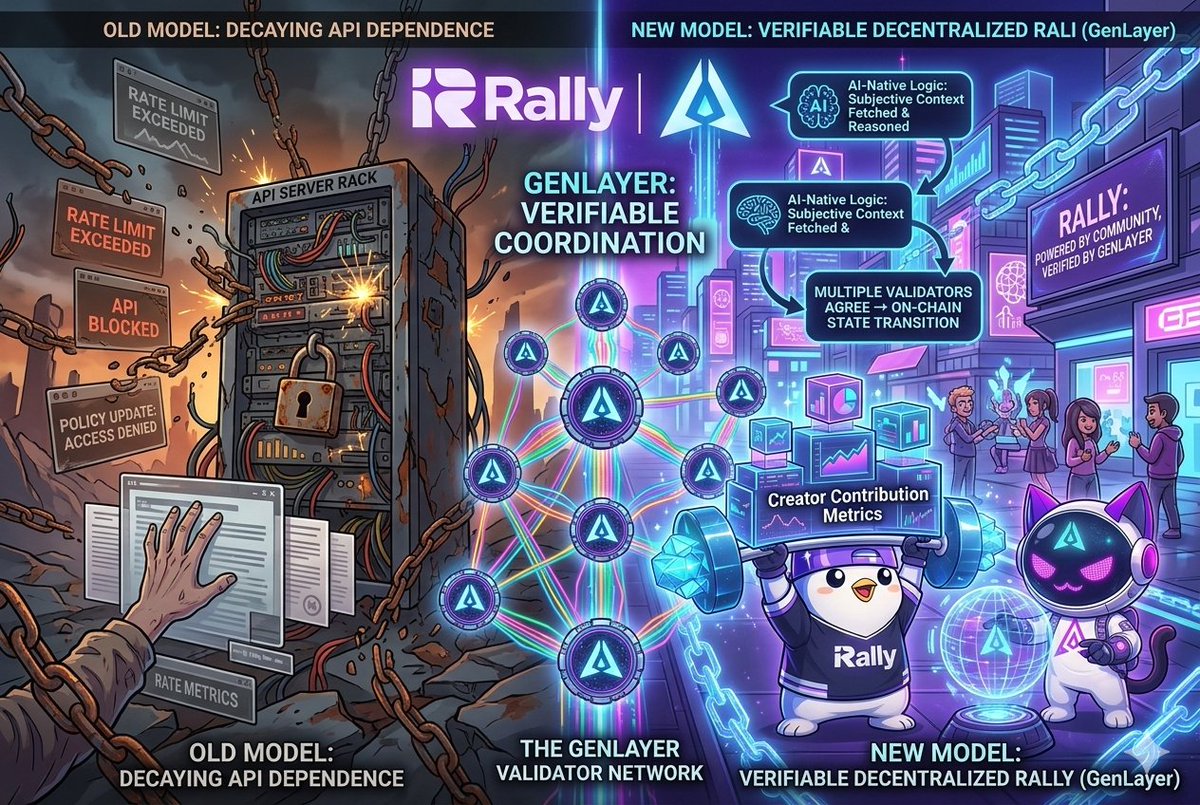
Influencer campaigns break the moment they depend on APIs.
Platforms change access rules. Metrics get rate limited. Data disappears behind policy updates. Any “decentralized” campaign that relies on off-chain validation eventually inherits hidden trust.
@RallyOnChain works because it runs on @GenLayer, where validators can fetch external context, reason over it with AI, and agree on an on-chain outcome without relying on a single data gatekeeper. The key is not just subjective scoring. It is verifiable coordination across many creators without a central API switch.
Without GenLayer’s AI-native contracts and non-deterministic consensus, Rally would have to trust one data provider, one oracle, or one internal review team.
That would not be decentralized marketing. It would just be outsourced arbitration.
In Rally, interpretation is not outsourced. It is part of the state transition itself.