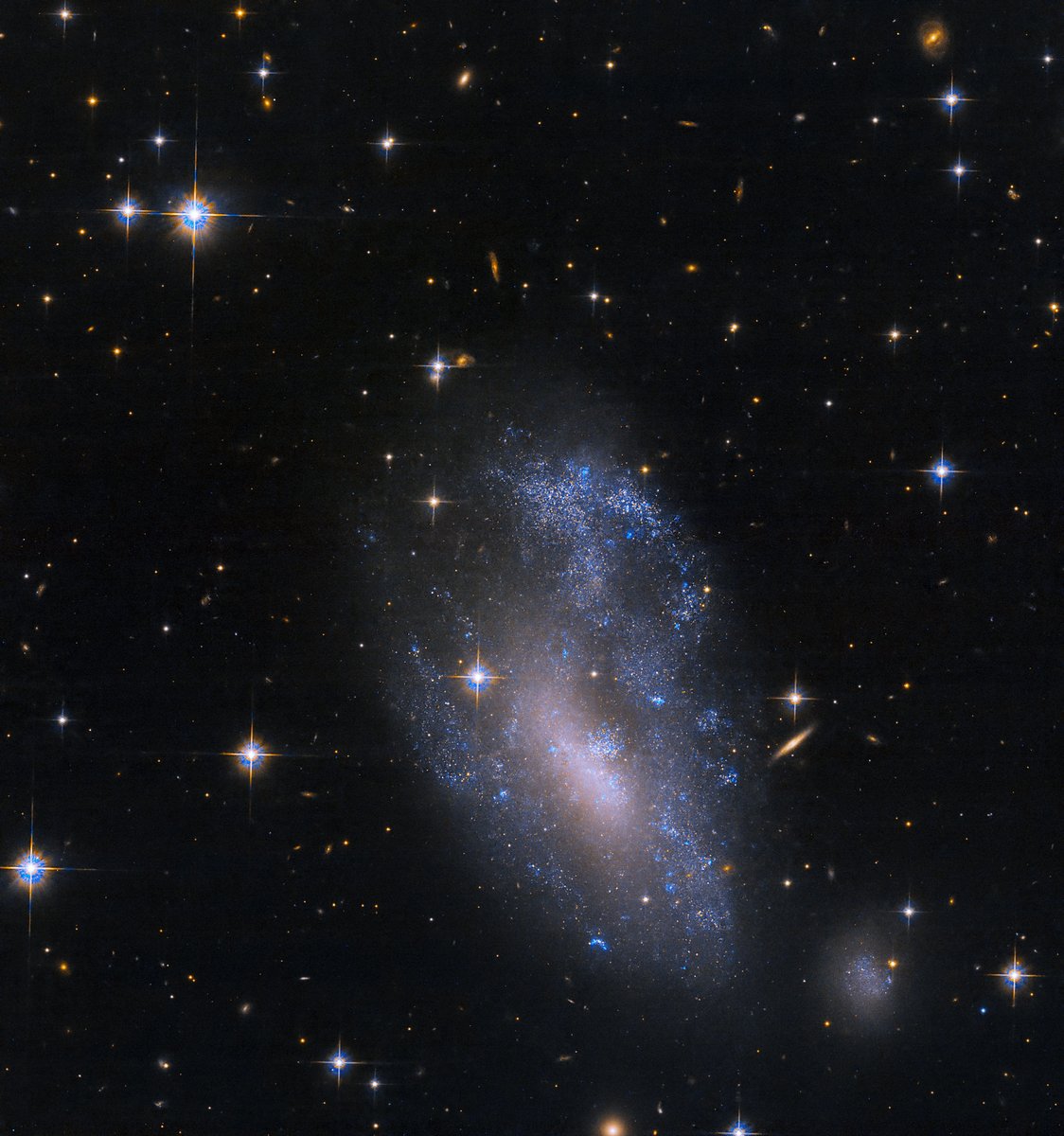
UGC 3912 offers an intriguing case where a gravitational brush has bent its spiral shape but left its stellar population intact.
Credit: NASA, ESA, and C. Kilpatrick (Northwestern University); Processing: Gladys Kober (NASA/Catholic University of America)
Venus is a very dangerous planet—going there is like playing a video game on “Hell Mode.”
In the 1960s and 1970s, the Soviet Union sent robotic probes called Venera to explore it. The probes survived on the surface for less than an hour because the pressure was 90 times stronger than Earth and the temperature was hot enough to melt metal.
But even in their final moments, while they were overheating and breaking apart, they still managed to take the only real photos ever captured from Venus’s surface. Photos from a place no human could ever survive.
An astonishing spectacle: the Vela Supernova Remnant, a nebula rich with colorful gas strands, evidence of a star's explosive end nearly 11,000 years ago.
(Credit: CTIO/NOIRLab/DOE/NSF/AURA / T.A. Rector, M. Zamani & D. de Martin)
Spot the supernova! 💥
In the top right corner, it's so bright that it could be mistaken for a foreground star located in our galaxy, but its home is in the outskirts of a galaxy located 11 million light-years from Earth: https://t.co/SYye2JViCS
NEWS 🚨: Astronomers have detected sugar in interstellar space for the first time ever
The molecule was found in a gas cloud near the center of the Milky Way
This outstanding image was processed from NASA's Juno Cam Image - PJ35 JET S3 2021-07-21 08:47 UT I Mission Phase: PERIJOVE 35.
And also a little side note: It’s been long overdue for me, so I am taking off for a few days of vacations. I’ll be back online next Thursday. I’ll probably do the same next week. In the meantime, have a great weekend, be good (right …) and revisit your favorite posts on PL! Goodnight from Jupiter, Earthlings!
Image Credit: NASA / Southwest Research Institute / MSSS / Tracy Prell