10 payouts from @ProprXYZ so far, $19.6k total.
Number 45 on the Leaderboard going for 1st
Grateful for the shot — not many places will hand a retail trader size and actually pay out on time.
Your life is boring because it has no side quests.
You wake up, work, scroll, sleep. Repeat. No stakes, no story, nothing to tell anyone about.
Here are 34 side quests to complete before October. Pick five. Actually do them.
INSTEAD OF WATCHING NETFLIX TONIGHT.
Spend 1 hour with this.
Claude AI FULL COURSE that teaches you how to BUILD and AUTOMATE anything.
The people who watch this tonight will wake up tomorrow with a skill that most people will not have in 2 years.
The people who skip it will still be watching Netflix next year wondering why nothing in their life has changed.
Your call.
I wrote a report to the SEC👇
Note: I love memecoins and i think they’re here to stay but we have to fix what’s broken first.
Back in October and November 2024, I started getting this gut feeling that something was off in the Solana memecoin space. It wasn’t just the usual market chaos—it felt controlled, like there was some invisible hand orchestrating the whole thing.
By mid-December, after digging through on-chain data, tracking connected wallets, and mapping out the key players, I found more than enough proof of collusion. It wasn’t just random farmers and botters—it was a coordinated system. The same groups controlled everything: the pumps, the dumps, the narratives. It made me completely rethink the idea that memes were this organic, free-market phenomenon.
But here’s the catch: unless you’re in the inner circle, you’re getting dumped on. Plain and simple. Retail traders, newcomers, even experienced memecoin traders who aren’t part of these insider networks? They’re just exit liquidity. And it’s not like a casino where the house has the edge—this is more like getting robbed at gunpoint outside the casino.
I put together a report breaking down exactly how this system operates—the wallets, the transactions, the pump cycles, the off-chain coordination. One week later, the SEC charged Pump fun. But here’s the problem: they went after them for the wrong reasons. Instead of addressing the massive manipulation and cartel-like control over the market, they focused on the mechanics of how it operated. They missed the bigger picture—how a handful of insiders are systematically siphoning money out of the space.
Look at some of these recent meme coin plays: the Milei memecoin in Argentina, the Trump coin, the Dave Portnoy coin—these aren’t about crypto. These people don’t care about decentralization, innovation, or community. They’re pure value extractors using crypto as a tool to move money from retail to their own wallets. I’d argue 99% of memecoins are just extraction schemes—nothing is being built, nothing is progressing. It’s just a game of passing the bag to the next sucker.
This is the reality of memecoins right now. It’s not “degen culture.” It’s not “fair markets.” It’s a rigged system where the winners are predetermined. And until regulators and the space itself address that, nothing changes.
P.S I’m doing my part to help make the space better in a few ways. At the end of the day, I still believe we are building something meaningful in crypto. For now, we have to clean up this mess of memecoins value extractors.
Correlation is Too Cheap
How can the behavior of one stock throw the price of risk for every asset in the world out of whack?
Well it starts with something called a dispersion trade.
See, when you buy an option on an individual stock, the price you pay is connected to the implied (or expected) volatility of that asset. Higher vol, higher price for options.
When you buy an option on a basket of stocks ((like the S&P500, a portfolio of 500 market-cap weighted stocks) it turns out not only are you betting on the volatility of the underlying stocks, but you are also betting on their correlation.
Think of a basket of two stocks, Exxon and Apple. Say you split $1m across both of them evenly. Everyday Exxon and Apple come in and they can do one of two things: they can go up 1% or they can go down 1%.
Now imagine how the volatility of your portfolio changes as the correlation between these stocks moves from positive 1 to negative 1.
At positive 1, they always do the same thing. Every day Exxon goes up, Apple will go up as well. Everyday Exxon goes down 1%, so does Apple.
In that case it’s like you don’t have $500k in two stocks, it’s like all of your money is in one stock, and that stock either goes up 1% or down 1% every day. Let’s call that a vol of 16.
No imagine a separate scenario where everything is the same apart from the correlation. Assume they are perfectly negatively correlated. Every day Exxon goes up 1%, Apple goes down 1%. Every day Exxon is up, Apple is down. To the point where your profit on one leg of the trade is perfectly canceled by the other. What’s your volatility? Well, how much does the portfolio move a day? 0!
This is a practical example whereby you a can see how if you had positive exposure to the volatility of the portfolio (say in the form of a call OR put) you would actually root a bit for correlation. Which is confusing at first, but makes sense! If you are buying a put option on the stock index, to some extent what you are hedging is the day all the stocks go down a lot at the same time.
What we see in markets, is that you can actually make this bet. In fact, the very people who buy and sell equity options FOR you, the market makers, are forced into some version of this bet, by the very nature of their business.
How? Well, these market makers are in the business of buying and selling options on both individual names and the index as a whole. Usually these are actually two different traders/desks/teams, which as we will see plays into the issue here.
Anyway, by applying that formula above we can see that a trader can take a synthetically long or short position in correlation owing to their positioning in volatility across index vs individual name equities.
Options are weird like that. A lot of time you get a more specific slice of risk by chopping off or trading something ‘beneath it.’
Usually we think of trading ‘delta’ (aka the stock itself) as a way to get exposure to the difference between implied and realized correlation.
In this case we have some of that risk, but by taking opposing positions in the individual names and the index, we get exposure to correlation.
The easy way to think of it is from the perspective of the equity index. If you are short volatility on the index (and long volatility on the underlying names) you are betting that the stocks won’t all move the same way. That the correlation that is realized, ends up being much less than what was implied by the market pricing of your equity option.
Which is where I finally show you where implied correlation is.
The reason that concentration is doing this requires a little bit of puzzling but makes intuitive sense if you reason it out. As those three or ten stocks or whatever drive more and more of the index outcome, the average correlation between the index and each of the individual stocks goes down. Because less and less of their returns are ending up in the final output. It’s all NVDA, MSFT, and AAPL anyway, so all of a sudden the index becomes less representative of the performance of the average stock. Which is indeed what is happening by some measures.
That’s the mechanic by which concentration drives down realized correlation, there are also issues having to deal with feedback between how these trades are implemented and the actual pricing of implied correlation, but they are a bit too complicated, and it’s a bit too late to go into them tonight. I’m sure @dampedspring will fill in some of the gaps I missed later this week.
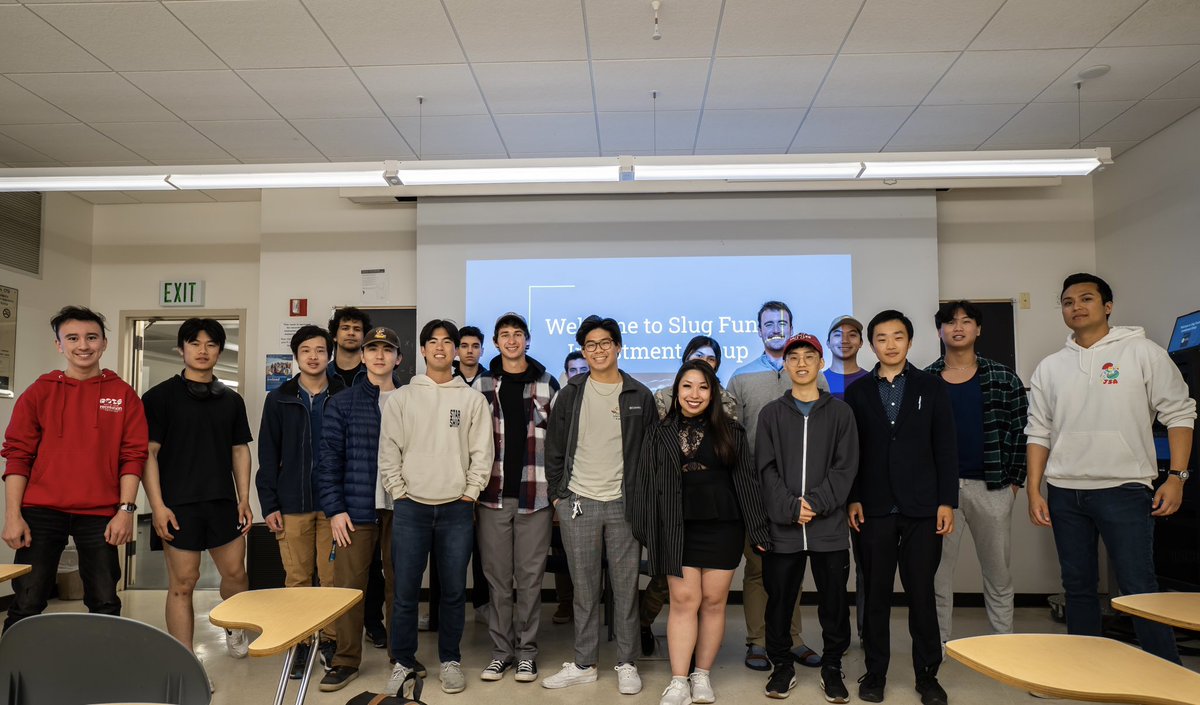
The pandemic almost killed this club, but we survived, and came back stronger than ever.
Thanks to a great year everyone!
Goodbye to the Seniors, you will be missed @CarterKoWang @XBTsteven Jackson, Thiago, and Tim 🫡.
Stanley Druckenmiller
I have been doing this 45 years and between the pandemic and the war and the crazy policy response in the US and worldwide, this is the hardest environment I have ever encountered in trying to forecast 6 - 12 months ahead.
@ 13:10
https://t.co/A9COKWvwrQ
I've worked 15+ years in Finance and am an expert in Microsoft Excel, here are 12 Excel tips & functions that will increase your productivity and make you feel like an expert:
Don't use Excel again without knowing these 12 tips & functions:
Your iPhone is about to receive a new update on Monday.
And it's going to transform how you experience your phone forever.
Here are 9 new features that will change everything:
No gym access and looking for a solid workout?
Try this 👇
20 squats
1 push up
19 squats
2 push ups
18 squats
3 push ups
17 squats
4 push ups
Keep going until you get to 1 squat and 20 push ups
That's 210 push ups and 210 squats
Aim for 15 minutes or less 🤝
A Crash Course on How To (Properly) Trade Options
90% of investors don’t trade options out of a misunderstanding that they’re “too complicated.”
The system brainwashes us w/ “options are too risky” BS, then spews out shit learning material so that ofc u lose money.
🧵/
👇
Aim to be great in 10 years.
Build health habits today that lead to a great body in 10 years.
Build social habits today that lead to great relationships in 10 years.
Build learning habits today that lead to great knowledge in 10 years.
Long-term thinking is a secret weapon.
Nine habits to avoid:
1) reacting without understanding
2) talking without being calm
3) growing without meaning
4) reading without thinking
5) writing without knowing
6) judging without doing
7) eating without fasting
8) lifting without resting
9) living without loving
In 10 years, will you be:
- Commuting to work
- Fast food for dinner
- Falling asleep watching TV
Or, will you be:
- Financially free
- Strong and energetic
- Doing whatever you want
Build habits now for the future you want 10 years from now