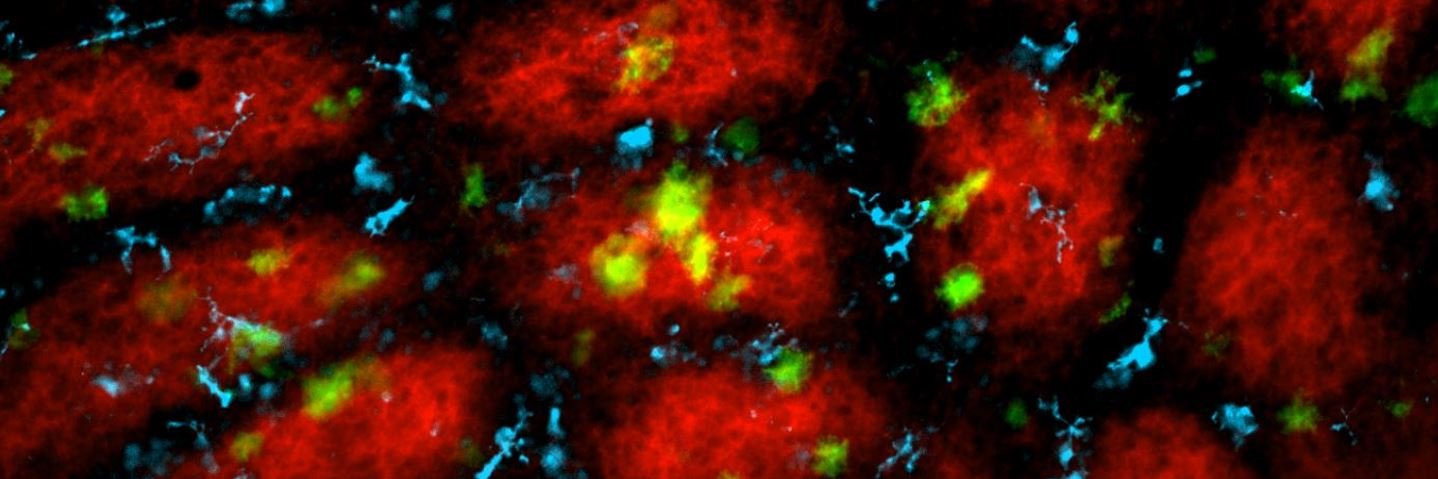
Thrilled to share our new paper in @CellCellPress:
“Microglia–astrocyte crosstalk regulates synapse remodeling via Wnt signaling”
This work demonstrates the necessity of glia–glia communication and cooperation.
https://t.co/roG9LUmrkp
Faust et al., Cell 2025
#Neuroscience#Glia
Applications are now open for our 2027 Fellows-to-Faculty Award! This program helps early-career neuroscientists and autism researchers transition into tenure-track faculty positions through funding, career development & mentorship.
Read more and apply: https://t.co/CLBPk2fum8
#science #neuroscience
Excited to receive a BBRF Young Investigator Grant to study how astrocytes and microglia shape synapse development, and how this may go awry in schizophrenia. Grateful to @BBRFoundation and its donors for their support! Congratulations to Caitlyn Edwards, too!
Two @UMassChan early-career scientists—Caitlyn Edwards, PhD, and Travis Faust, PhD—are 2026 Brain & Behavior Research Foundation Young Investigator grantees: https://t.co/dTyWpqu3g2
The awards are designed to assist talented young investigators as they extend their research training or begin careers as independent research faculty.
#neuroscience @TravisFaust2@SchaferLabUMass@BBRFoundation
Excited to share this story from @UMassChan about my @SimonsFdn Fellows-to-Faculty award!
I'm incredibly grateful for the support as I work toward establishing an independent research program studying microglia-astrocyte regulation of synaptic remodeling and brain plasticity.
Travis E. Faust, PhD, is one of 15 early-career scientists to be selected for a Fellows-to-Faculty award. The $600K @SimonsFdn award will support his transition to an independent faculty position and research on brain development and autism: https://t.co/iTXyEkWazA @TravisFaust2
A new study of congenital epilepsy found that depressive psychiatric symptoms—but not seizures—are caused by antioxidant imbalance in brain-supporting astrocyte cells and reduced neuronal activity. @TravisFaust2 https://t.co/KWjN1kHHKN
@ScienceAdvances Thank you for highlighting our work! ALDH7A1 loss produced separable seizure- and mood-related phenotypes through the liver and astrocytes. More on how we untangled the mechanisms here:
ALDH7A1 mutations cause congenital epilepsy (PDE)—but astrocyte-specific loss in mice caused mood-related behaviors, not seizures. Seizure risk traced to the liver.
1 gene. 2 tissues. 2 phenotypes. Neither begins in neurons.
@ScienceAdvances: https://t.co/bGRgGr6aHt 1/9
I began this as a PhD student. Completing the story took an extraordinary team at Johns Hopkins. I’m deeply grateful to Akira Sawa, Dwight Bergles, and all our co-authors for their persistence, insight, and collaboration.
@Lindsay_4c@Agarwalneurolab@AdrianaRamosAm@jedosan 9/9
ALDH7A1 mutations cause congenital epilepsy (PDE)—but astrocyte-specific loss in mice caused mood-related behaviors, not seizures. Seizure risk traced to the liver.
1 gene. 2 tissues. 2 phenotypes. Neither begins in neurons.
@ScienceAdvances: https://t.co/bGRgGr6aHt 1/9
Beyond PDE, psychiatric symptoms commonly accompany epilepsy, but need not be caused by seizures.
Because astrocyte redox controlled prelimbic activity independently of seizure susceptibility, redox/ion homeostasis may also shape mood-related circuits in other conditions. 8/9
Grateful to see our Cell paper highlighted in a new Targetome commentary by Zhao, Agarwal & Bai on microglia→astrocyte Wnt signaling and glial coordination in synaptic pruning.
https://t.co/4sso0Jc7q5
Thrilled to share our new paper in @CellCellPress:
“Microglia–astrocyte crosstalk regulates synapse remodeling via Wnt signaling”
This work demonstrates the necessity of glia–glia communication and cooperation.
https://t.co/roG9LUmrkp
Faust et al., Cell 2025
#Neuroscience#Glia
A study by Dorothy P. Schafer, PhD, and Travis E. Faust, PhD, published in @CellCellPress explains how different cell types in the brain communicate in response to changes in sensory input to the connections between neurons: https://t.co/4eysDrOFXm @SchaferLabUMass@TravisFaust2