Forget gold or diamonds — the true king of value is antimatter, the rarest and most powerful material ever created by humans. Estimated at $62.5 trillion per gram, it’s not mined but manufactured atom by atom inside massive particle accelerators like CERN’s Large Hadron Collider.
Antimatter is the mirror opposite of regular matter. When the two meet, they annihilate each other completely — releasing 100% of their mass as energy, according to Einstein’s famous equation, E = mc². That’s far beyond the efficiency of nuclear power, making antimatter the ultimate energy source — at least in theory.
Right now, scientists can produce only a few nanograms per year, and storing it is nearly impossible. A single mistake or contact with normal matter causes instant disappearance. Still, researchers at NASA and CERN believe antimatter could one day power deep-space missions or even revolutionize medical imaging.
It’s a glimpse into a future where energy itself becomes priceless — and humanity learns to hold the universe’s most explosive secret in its hands.
Reference
CERN & NASA. (2024). Antimatter research and production efficiency in particle accelerators. Journal of High-Energy Physics and Space Science.
🚨 This is the strongest evidence yet of biological activity on a planet outside our solar system…
Astronomers using the James Webb Space Telescope have identified traces of dimethyl sulfide (DMS) in the atmosphere of K2-18b, an exoplanet located 124 light-years from Earth. On our own planet, this specific gas is exclusively produced by life, primarily microscopic marine organisms like phytoplankton. This Hycean world, which features a hydrogen-rich atmosphere and potentially vast surface oceans, sits within the habitable zone of its star, making it a prime candidate for hosting alien biology.
While the findings carry a high level of statistical significance, researchers remain cautious, noting that unknown chemical processes could still explain the presence of these gases. However, the detection of DMS alongside previously discovered methane and carbon dioxide strengthens the hypothesis that K2-18b could support life. Future observations are already planned to confirm these results, potentially moving the discovery from a strong hint to a confirmed scientific breakthrough in the search for our place in the universe.
Source: University of Cambridge. Strongest hints of biological activity outside the solar system. University of Cambridge Research News.
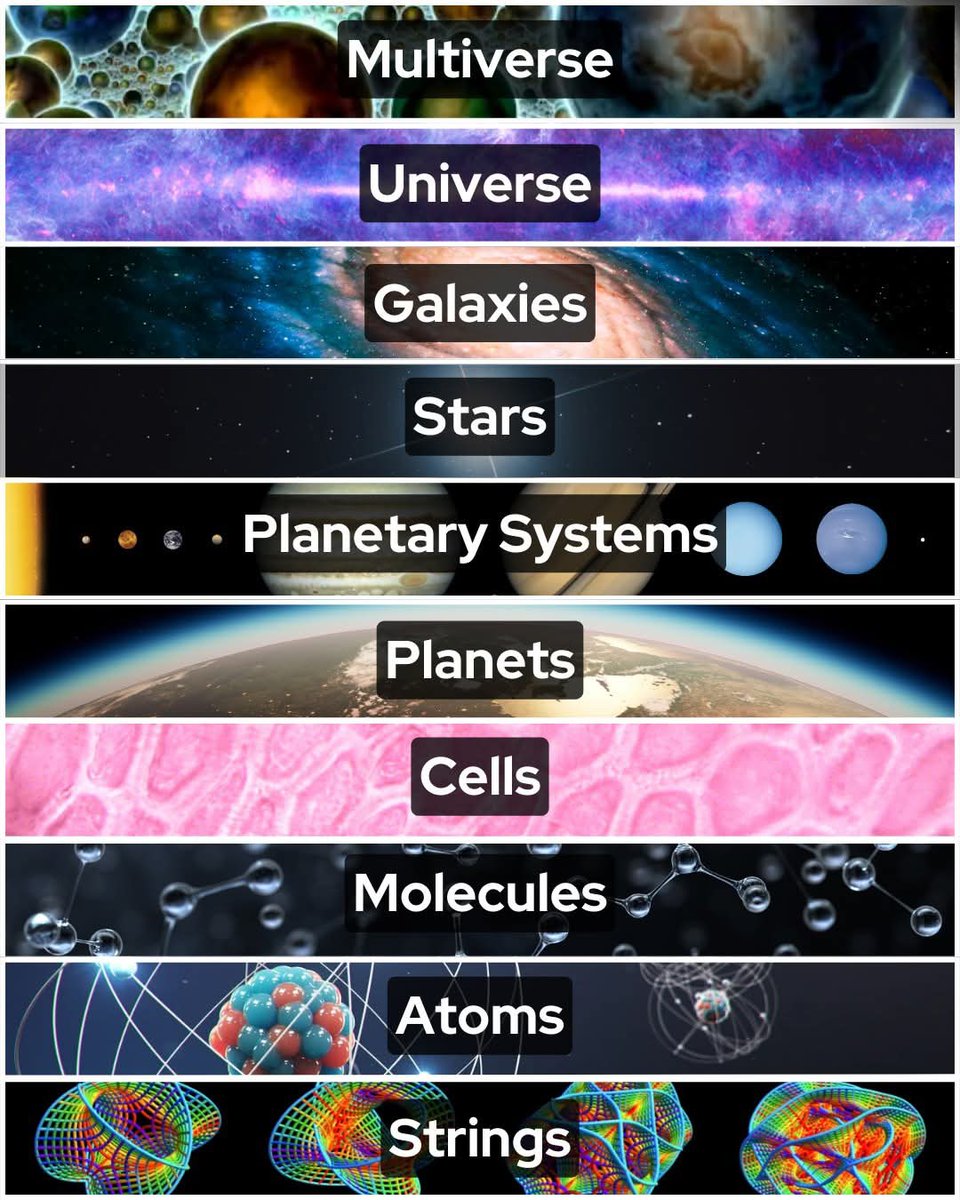
A journey from the smallest to the biggest things in the cosmos:
At the smallest level, String Theory proposes that all matter is made of minuscule, vibrating strands of energy — shaping the fundamental particles and forces that govern reality.
Atoms, molecules, and cells build up the structure of life, which in turn resides on planets orbiting stars.
Stars are nested within vast galaxies that form the visible architecture of the cosmos.
Yet even galaxies are just part of something bigger.
Galaxies group into superclusters, which are woven into immense cosmic webs stretching across the universe.
And beyond that? Some theories suggest our universe may be just one in a multiverse — a collection of countless universes, each potentially with its own laws of physics.
From quantum fields to galactic superstructures, every layer we peel back reveals an even grander one, reminding us how vast — and layered — reality truly is.
Image: From Quarks to Quasars
⏳ What If Time Is Lying to You… and the Past Isn’t Fixed at All?
We grow up believing time only moves one way, past gone forever, future not yet written. Tick. Tock. End of story.
But new quantum research is quietly shaking that belief… and what it suggests is unsettling.
Scientists are now finding hints that time doesn’t flow straight forward. Instead, it may fold in on itself—like a crumpled map where “now” can brush against “then.” At the smallest levels of reality, particles don’t seem to care about before or after. In some experiments, choices made later appear to influence what already happened. Let that sink in for a second.
This isn’t sci-fi. In quantum labs, researchers have observed effects where light and particles behave as if the future is reaching back, gently shaping the past. Not changing memories. Not rewriting history like a movie. But quietly adjusting probabilities—deciding which version of the past becomes real.
Think about it: what if your actions today aren’t just building tomorrow… but also locking in yesterday? What if certain “mistakes” only become mistakes because of how things turned out later? In this strange view of time, the past isn’t a solid wall—it’s more like wet cement, slowly setting as the future unfolds.
That eerie feeling of déjà vu. Those moments where life feels like it “loops.” The sense that some events only make sense after they happen. Quantum physics may be hinting that time itself is part of that mystery.
For everyday life, nothing suddenly breaks. Clocks still tick. Cause and effect still work. But underneath it all, reality might be far more flexible than we were taught—less like a straight road, more like a woven fabric.
And if that’s true… then every choice you make now matters more than you think. Not just for where you’re going—but for where you’ve already been.
Time may not be watching you move forward.
It may be watching you fold it.
💥 The 13.8-Billion-Year History of the Universe in One Image:
In just a few seconds, the universe was born in a monumental burst of energy known as the Big Bang — a moment that created space, time, and matter.
What followed was a rapid expansion called cosmic inflation, which flung the newborn universe outward faster than the speed of light.
As this expansion slowed, energy cooled into matter and radiation, giving rise to a chaotic, hot plasma of particles. In the universe’s first minutes, simple atomic nuclei began forming.
But light couldn’t escape this dense fog for hundreds of thousands of years — until recombination occurred, when atoms finally captured electrons and allowed light to travel freely. This ancient light, the cosmic microwave background, still glows today, offering a glimpse into the universe’s infancy.
From these early beginnings, gravity pulled matter into dense pockets, igniting the first stars and galaxies.
These massive, bright stars transformed the universe’s structure and began reionizing the gas around them, allowing light to pass through once more. For billions of years, the universe expanded, and scientists assumed this would eventually slow.
But in 1998, astronomers discovered that this expansion is accelerating, driven by a mysterious force now called dark energy. If this trend continues, the universe will grow increasingly cold, vast, and empty — an eternal expansion with no end in sight.
Forget gold or diamonds — the true king of value is antimatter, the rarest and most powerful material ever created by humans. Estimated at $62.5 trillion per gram, it’s not mined but manufactured atom by atom inside massive particle accelerators like CERN’s Large Hadron Collider.
Antimatter is the mirror opposite of regular matter. When the two meet, they annihilate each other completely — releasing 100% of their mass as energy, according to Einstein’s famous equation, E = mc². That’s far beyond the efficiency of nuclear power, making antimatter the ultimate energy source ��� at least in theory.
Right now, scientists can produce only a few nanograms per year, and storing it is nearly impossible. A single mistake or contact with normal matter causes instant disappearance. Still, researchers at NASA and CERN believe antimatter could one day power deep-space missions or even revolutionize medical imaging.
It’s a glimpse into a future where energy itself becomes priceless — and humanity learns to hold the universe’s most explosive secret in its hands.
Reference
CERN & NASA. (2024). Antimatter research and production efficiency in particle accelerators. Journal of High-Energy Physics and Space Science.
Researchers analyzing crimson auroras over Japan found the glowing displays stretched hundreds of miles higher into Earth's atmosphere than expected, challenging long-held assumptions about the strength of geomagnetic storms. https://t.co/BTwmjkFxcM
A century-old insight from Albert Einstein may be shaking the very foundations of how we understand the universe’s birth. In a daring new model, scientists from Spain and Italy suggest that the rapid expansion of the cosmos after the Big Bang wasn’t driven by the mysterious “inflation” theory we’ve long accepted — but by gravitational waves, the ripples in spacetime Einstein first predicted in 1916.
Unlike inflation, which depends on an unproven “inflaton” field, this revolutionary idea builds entirely on known physics — blending Einstein’s general relativity with quantum mechanics. According to the team, gravitational waves could have sculpted the infant universe itself, stretching and shaping spacetime in a way that naturally led to the formation of galaxies and cosmic structure. In this view, gravity wasn’t just holding the universe together — it was driving its earliest, most explosive expansion.
Grounded in the mathematical concept of De Sitter space, the model provides a simpler, testable alternative to inflation — one that doesn’t rely on exotic or hypothetical forces. Simulations suggest that gravity and quantum effects alone might explain how the universe evolved in those first, crucial moments. It doesn’t replace the Big Bang, but it could rewrite what happened right after — a profound shift that may finally bring us closer to uniting the great pillars of modern physics into one elegant theory of everything.
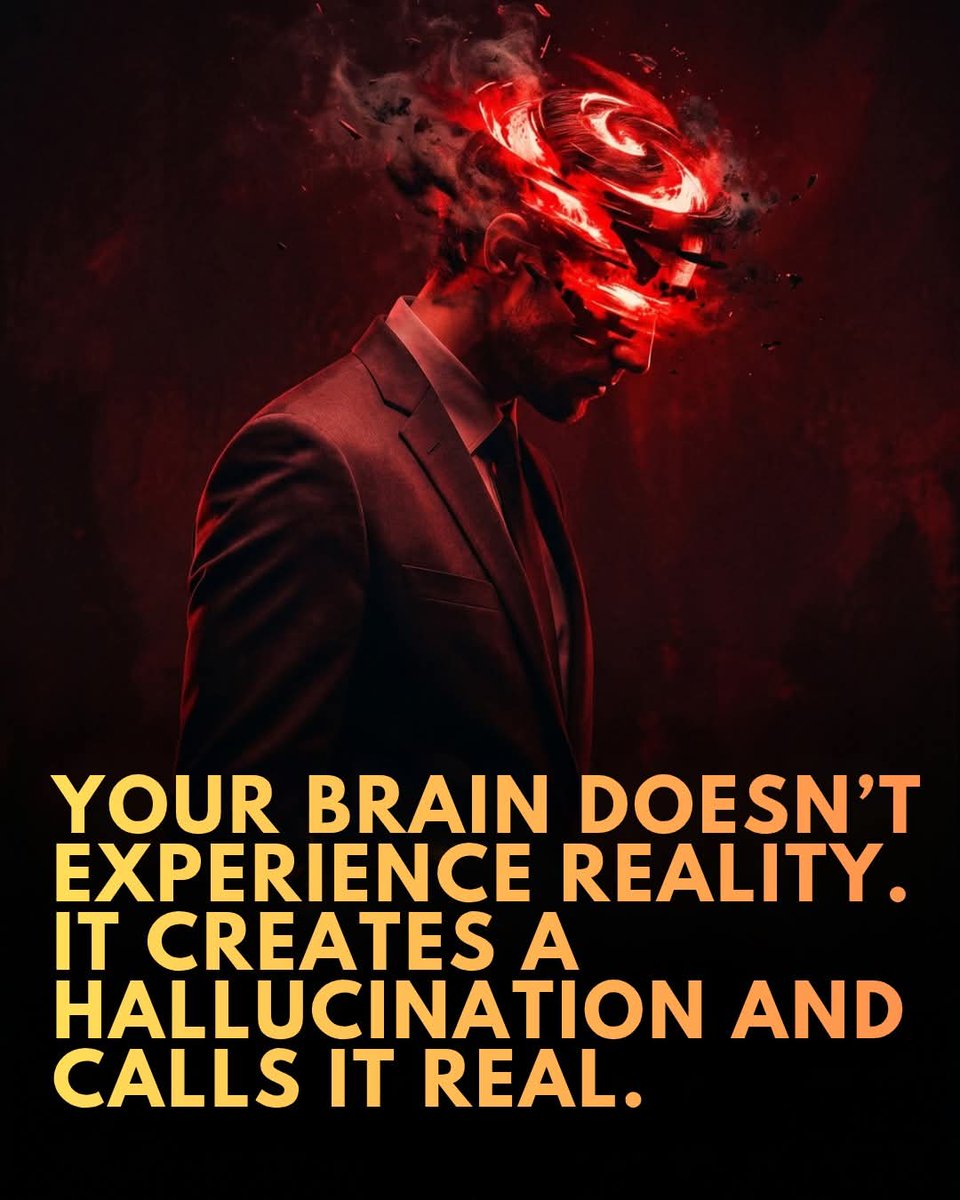
Recent neuroscience reveals that what we call "reality" is actually a hallucination.
One that is constructed by the brain to make sense of the world.
Everything you see, hear, and feel is a mental construction rather than a direct transmission of the physical world. According to neuroscientists like Anil Seth and Karl Friston, the brain engages in "predictive processing," essentially creating a best-guess simulation based on limited sensory data. While the universe consists of raw wavelengths and particles, your brain invents the concept of color and seamlessly fills in your optical blind spots with fabricated pixels. This internal model runs on a slight delay, showing you a version of the "now" roughly 100 milliseconds after it has already occurred, meaning we are effectively living in a reconstructed past.
This biological storytelling extends deep into our personal history and physical sensations. Research by experts like Elizabeth Loftus demonstrates that memories are not static recordings but are rebuilt every time we recall them, often incorporating new distortions. Similarly, pain is recognized as a brain output rather than a simple body signal, a protective mechanism highlighted by researchers like Lorimer Moseley. Ultimately, our experience of life is a sophisticated fabrication—a shared hallucination that allows us to navigate a complex environment we never actually see in its raw form.
source: Seth, A. (2021). Being You: A New Science of Consciousness. Dutton.
Want to fly a CubeSat aboard a future Artemis mission?
The Space Launch System rocket provides an opportunity to deploy science and technology investigations into space.
Interested organizations should respond to NASA's request for information by June 1: https://t.co/7w4daZQbAC
Only focus on what’s in your control
“The chief task in life is simply this: to identify and separate matters so that I can say clearly to myself which are externals not under my control, and which have to do with the choices I actually control...”
“Behave not as though thou hadst ten thousand years to live. Thy doom hangs over thee. While thou livest, while thou mayest, become good.” —Marcus Aurelius
🚨 NASA's Nancy Grace Roman Space Telescope is ahead of schedule and now launching as early as Sept. 2026
The new flagship observatory is designed to investigate dark energy, dark matter, and exoplanets
It also has a field of view 200x greater than Hubble!