As businesses grow, their treasury requirements become increasingly complex. Multiple entities, banking relationships, currencies, funding facilities and financial risks all require specialist expertise, reliable technology and effective controls.
Traditionally, corporates have responded by expanding their internal treasury teams, investing in Treasury Management Systems and developing the processes needed to manage these activities.
But is this always the most effective approach?
Maintaining an in-house treasury function comes with costs that extend beyond salaries and technology. There is the challenge of recruiting and retaining specialist skills, ensuring operational continuity and keeping pace with increasingly complex treasury requirements.
And while finance teams are occupied with daily treasury administration, valuable opportunities to improve liquidity, reduce borrowing costs and manage financial risks may be overlooked.
What if your business could access an established treasury operation without having to build and maintain every component internally?
At TreasuryONE, our Corporate Treasury Outsourcing Services combine experienced treasury professionals, proven processes and world-class treasury technology to manage the agreed treasury activities on behalf of our clients.
From daily cash and liquidity management to cash-flow forecasting, debt, investments, foreign exchange and treasury reporting, we provide the operational capability and expertise that corporates need.
Importantly, outsourcing does not mean giving up control. Your organisation retains its treasury policies, financial decision-making authority and governance responsibilities while TreasuryONE manages the agreed operational activities.
Our experience supporting corporates such as Metair, Motus, Thungela and Valterra Platinum demonstrates how businesses can establish and manage treasury capabilities without necessarily building an entire function from scratch.
And outsourcing does not have to mean outsourcing everything. For corporates with established treasury teams, selected activities can be outsourced to improve capacity, continuity and access to specialist expertise.
The real question for CFOs is not whether treasury is important enough to invest in. It is whether managing everything internally remains the best operating model for the business.
If you were designing your treasury function today, would you still choose to manage every activity in-house?
https://t.co/0ZncDOMYNQ
#TreasuryONE #TreasuryOutsourcing #CorporateTreasury #CFO #TreasuryManagement
The Dollar remains on the front foot, buoyed by rate hike expectations and safe-haven demand. Today's Fed FOMC minutes are likely to confirm the Fed's resolve to combat high inflation and reinforce higher-for-longer interest rates. Increased geopolitical tensions in the Middle East, with the US and Iran exchanging missile strikes, and the Houthis continuing to hit Saudi infrastructure targets, have increased safe-haven demand for the Dollar. Risk aversion in equity markets, driven by AI jitters, has also pushed investors back to the Dollar, although Wall Street futures are positive this morning after Nvidia earnings beat market estimates.
The Rand is sitting just below the R17.00 level this morning on the back of a stronger Dollar, and as traders await domestic CPI numbers. Analysts are expecting a higher inflation print due to the recent fuel price increases, putting pressure on the SARB to hike rates at tomorrow's MPC meeting. The Rand also remains vulnerable to negative moves as concerns over the stability of the GNU mount, and the Gold price falls below $3,800.
Gold is down over 1.6% at $3,788 this morning as sustained pressure from anticipated Fed rate hikes weigh on the metal. Platinum and Palladium are both down near 2.0%, while Copper, Aluminium, and Zinc have fallen quite sharply. Global inflation fears persist, with both the UK and Eurozone expected to release high CPI numbers today. Brent crude is trading slightly lower at $92.70 after US crude inventories jumped unexpectedly.
#MarketUpdate #ForexTrading #InterestRates #GlobalEconomy
A cash flow forecast can be accurate on the day it was compiled and already out of date by the time someone uses it.
When finance teams spend days chasing inputs and consolidating spreadsheets, they have less time to understand what has changed. A large customer payment moves into next week, a supplier payment comes forward, and suddenly the business needs funding sooner than expected. The later treasury sees that gap, the fewer options it has to manage it.
Forecasting performance should be measured by how early the team can spot a change as well as how closely the numbers match actual cash flows. A forecast that gives treasury a few extra days to act can change the funding decision.
Explore TreasuryONE’s cash flow forecasting solutions: https://t.co/Bp61CtadFK
#CashFlowForecast #TreasuryManagement #FinancialPlanning #CashFlowManagement #FinanceTeam #ForecastingSolutions #FinancialForecast
The dollar is holding near multi-month highs after a fifth straight daily gain, its longest run since September. Markets are waiting for US retail sales and a string of Fed speakers, and Waller’s comments will be watched closely after he said a half-point hike may be needed in December. The 10-year Treasury yield is steady at 5.13%. The euro is under pressure near 1.10, the yen is weak near 159.50 and the New Zealand dollar is at a six-year low.
Global shares fell for a third day. A new US rule requires licences to export advanced AI chips to data centre operators in Singapore, Malaysia, Thailand, Indonesia and Brazil, which adds to worries about Nvidia’s leadership. On Monday, the S&P 500 fell 1.9%, the Nasdaq fell about 2.5% and chip shares sank 5.3%. Asian shares hit their lowest close since early April, with Taiwan and South Korea hit hardest. Nvidia reports earnings today and Anthropic’s market debut is expected later this week, so both could move the AI trade.
The rand is testing R17.00, its weakest since April, and is down more than 3% since the 4 November municipal elections. Dollar strength, a hawkish Fed, local politics and weaker emerging-market sentiment are behind the move.
Some ANC leaders are questioning the party’s coalition with the DA in the national government after the ANC’s poor election result. A reshuffle could rattle investors, because the DA is seen as pushing business-friendly policies. Councils have until 27 November to elect new leadership, leaving only 11 days for coalition deals. One-week rand volatility jumped to 11.13%, its highest in more than a month. Some market analysts say this is no longer a market to fade rallies in the dollar until there is investor-positive political alignment.
The 10-year government bond yield has risen 20bp in a week to 8.77%, its highest close since 30 October. Today’s R1.95bn bond auction will test demand, and inflation (Wednesday) and the SARB decision (Thursday) follow. A petrol price cut is expected in December, although a weaker rand could shrink it.
#MarketUpdate #ForexTrading #DollarStrength #RandCurrency #SouthAfricaEconomy #EquityMarkets
The rand has weakened against the dollar and the euro ahead of this week’s Reserve Bank decision. With US inflation coming in hotter than expected, markets are pricing in a Federal Reserve rate increase in December. If the Fed raises rates and the Reserve Bank holds, the gap between US and South African rates could narrow, adding to pressure on the rand.
In this week’s TreasuryONE and ETM Analytics market review, we discuss the case for holding rates or raising them by 25 basis points, and why municipal coalition talks are another factor for businesses watching the rand.
Watch the full market review: https://t.co/duB8ls3396
#RandExchange #ForexMarket #ReserveBank #FederalReserve #SouthAfricaEconomy #InflationImpact
Most South African businesses keep a cash buffer: for payroll, VAT, provisional tax, supplier payments or the next big purchase.
Usually that money sits in a business current account or a call account, because it feels safe and it’s easy to get to.
But when did you last check what that account is actually paying you?
https://t.co/iDo5IMtK0U
#CashManagement #TreasurySolutions #MoneyMarketFund #BusinessCashFlow #InvestmentReturns
The Dollar has opened the new trading week on a firmer note, holding near 19-month highs, as geopolitical tensions rise in the Middle East. Iran launched strikes on US radar installations in Bahrain over the weekend, the US has sent another aircraft carrier to the Gulf, while there are reports of an LNG carrier hitting a sea mine in the Strait of Hormuz. This week's FOMC minutes will hopefully provide some further clarity to the Fed's monetary policy outlook, with the current higher-for-longer stance being the main driver for Dollar strength. This week also sees a host of Fed officials speaking, led by Fed Chair Kevin Warsh's address at the San Francisco Fed this afternoon. US bond yields remain elevated, putting pressure on the Euro and Pound, which have fallen to 1.1010 and 1.3205 respectively. The Yen is trading flat at just below 160.00 after weaker-than-expected Q3 GDP data dimmed further rate hike expectations.
The Rand is trading around R16.97 this morning, weighed by the stronger Dollar, Fed rate hike expectations, and growing political uncertainty over the make-up of municipal coalitions. Talk of the ANC excluding the DA from any proposed coalitions has raised fears about the future of the national GNU. Markets will also be watching local CPI data out on Wednesday, along with the SARB MPC interest rate decision on Thursday.
Gold has extended last week's steep losses, falling 0.6% to $3,870 this morning. Bullion remains under pressure from the still-hot US inflation numbers and subsequent Fed rate hike expectations, as well as the firmer Dollar. Oil prices have edged lower this morning, with improved oil exports out of the Middle East offsetting escalating military tensions. The International Energy Agency is forecasting a surplus of 1.7 million barrels in Q4 this year, reversing earlier forecasts of a deficit.
#MarketUpdate #ForexTrading
Investors continue to pile into the Dollar
The current market focus on Fed rate hike expectations, persistent US inflation, and surging US bond yields is driving the strong demand for the Dollar. The greenback is trading near 19-month highs ahead of today's US PPI data, with the forward looking wholesale number expected to have declined slightly. Markets are anticipating the Fed to tighten at a faster pace than its major peers, driving further rotation into the Dollar.
The Rand lost ground against most currencies yesterday as it succumbed to Dollar strength, EM weakness, and sliding commodity prices. The local currency is trading near the R16.80 level, with a break above this level open up further possible weakness to R16.90.
Gold recovers from 1-year lows
Gold is trading a touch firmer on bargain hunting, but is still heading for weekly losses. The yellow metal is trading at $3,900 this morning after having touched a low of $3,852 yesterday. Longer-term Fed rate hike expectations, along with volatile Oil price movements, are likely to limit Gold's gains in the short term. Brent crude is trading over 1.0% higher at $95.95 as it gains on Trump's comment that the US does need a deal with Iran.
#DollarStrength #FedRateHike #USInflation #CurrencyMarket #RandCurrency #GoldPrices
Dollar surges as Fed hawkish sentiment grows
The Dollar continues to make gains on the back of hotter inflation, strong labour market data, and more importantly increasing hawkish rhetoric from Fed officials. Markets are now fully pricing in a 25bps rate hike in December, while calls for a 50bps hike continue to grow, with a further two more hikes in 2027 now also being priced in. The Dollar's 3 major peers all came under pressure, with the Euro and Pound falling to 1.1075 and 1.3255 respectively, while the Yen is just below the 160.00 mark. The Euro's fall to an 18-month low has been exacerbated by political uncertainty ahead of France's presidential elections and softer ECB rate expectations.
The Rand remains fairly resilient
The Rand is remaining fairly resilient despite the stronger Dollar and weaker Gold price. The local currency is currently trading at just above R16.60 against the Dollar, while still holding firm against the Euro, Pound, and Yen. There is some support for the Rand from a slightly lower Oil price and some decent exporter inflows.
Gold falls below $4,000 on Fed rate hike expectations
Continuous inflation pressures causing the Federal Reserve to maintain its tightening bias are weighing on the Gold price. US Treasury yields remain elevated, putting pressure on non-yielding assets like Gold. Brent crude is a touch lower at $91.85 on renewed diplomatic efforts to end the conflict in the Middle East. Talks between Russia and Ukraine in Abu Dhabi have also eased some geopolitical risk sentiment.
For many growing businesses, cash management still revolves around the monthly finance report. Balances are reviewed, commitments are checked and surplus funds remain where they were placed weeks or months earlier.
Yet cash positions change throughout the month as customers pay, suppliers are settled and operating requirements shift.
A more active approach gives businesses the opportunity to review surplus funds regularly, assess available investment options and make informed decisions about how long money can be invested.
TreasuryONE's Money Market Fund platform simplifies this process by bringing fund comparisons, online investments, withdrawals and reporting into a single platform.
Businesses can review their available options without having to approach multiple fund managers individually, saving administrative time and improving visibility. As businesses grow, managing cash efficiently becomes increasingly important. Having the right information readily available makes that responsibility easier to manage.
Discover TreasuryONE's Money Market Fund platform: https://t.co/WfXUDikj8m
#TreasuryONE #MoneyMarketFunds #FinanceManagement #BusinessGrowth #CashOptimisation
Tuesday’s hotter US inflation report set off a fight at the Fed. Governor Waller said a 0.3% core reading could justify a half-point hike in December, and that is exactly what came in. Dallas Fed President Logan then said at least two more hikes are needed, possibly at a faster pace. Chicago Fed President Goolsbee called the report “borderline disturbing”. Markets fully price a quarter-point hike in December, and Fed Chair Warsh has also warned about persistent inflation.
One strategist argues the report is noise and a half-point hike is unlikely. Underlying inflation has been easing since its August peak, once you strip out volatile items like rent, healthcare and transport. The report is also “stale”, because the October figures still reflect the oil spike that has only reversed over the past 10 days. He also thinks the Fed’s recent hawkish turn was partly political and will fade after the Republicans’ midterm losses. This is one analyst’s view, and the Fed officials above clearly disagree.
Brent is back near $92 a barrel, and WTI is below $87, after sliding 7% in the first two sessions of the week. Brent is still up more than 50% this year. Persian Gulf exports are close to prewar levels despite attacks on ships, and traders are betting on a US-Iran deal. Talks have shown little progress, though, and an analyst expects any deal to be messy. What matters for oil is that the Strait of Hormuz stays open. Trend-following funds also cut their Brent long positions sharply, from 45% to 9% in one day, which exaggerated the fall.
Gold is near $4,030 an ounce after falling 2.6% on Tuesday, because higher rate expectations hurt an asset that pays no interest. It has held above $4,000, which shows haven demand and central-bank buying are still there. Silver bounced 1% to about $52 after a 3.5% drop.
The dollar was steady after Tuesday’s jump, and it is on track for a second straight monthly gain. State Street says global investors have cut their protection against dollar falls to the lowest since 2014, because hedging costs more when US rates rise. The risk is that the dollar can fall together with US shares if the AI sell-off continues, as happened last Friday. That would hurt foreign investors twice.
Cheaper oil helps the rand, as does any chance that the Fed hikes less than feared. A stronger dollar, a Fed that keeps hiking and weaker gold are the main risks. The inflation debate at the Fed will keep driving the rand until the 9 December meeting.
#MarketUpdate #InflationReport #FedWatch #InterestRates #InvestmentInsights
TreasuryONE’s Dealing Desk provides a Daily Market Report which includes analysis and commentary on the currency and commodity markets.
Please subscribe to get the commentary delivered to your Inbox every weekday.
SUBSCRIBE HERE: https://t.co/NOvBnuh8Yj
#DailyMarketReport #CurrencyMarkets #CommodityMarkets #MarketAnalysis #ForexTrading #FinancialMarkets #MarketCommentary
Currency, commodity, and equity markets recovered some of the previous week's losses on the back of improved risk sentiment. Easing geopolitical tensions in the Middle East, with Donald Trump downplaying any further military strikes on Iran, and ongoing mediation efforts by Qatar, have seen the Oil price drop sharply toward the $91.00 level. Wall Street staged a strong rebound yesterday, with all three major indices closing over 2.0% higher. The Dollar retreated against most currencies, however, markets have failed to advance much further this morning as today's US CPI comes into focus. A higher-than-expected print would put pressure on the Fed to hike rates sooner, especially after last week's strong labour market data.
The stronger precious metal prices and drop in the price of oil have given EM and commodity-based currencies a boost, with the Rand now testing the key 200-day and 100-day moving averages at around R16.40 and R16.36 respectively. A sustained break through this level could open the way for the Rand to move to the R16.25 area, although the local currency has retreated from these levels previously.
Gold is trading around 0.6% softer this morning as markets turn to caution ahead of the key US CPI data. Both the headline and Core month-on-month numbers are expected to be marginally lower, while the headline year-on-year number is forecast to have climbed to 3.9% from the previous month's 3.7%.
#CurrencyMarkets #CommodityTrading #EquityMarkets #RiskSentiment #OilPrices #WallStreet #USCPI
The rand came through election week on a steady footing. It strengthened modestly after the US midterm results and held up through South Africa’s municipal vote. This week, US inflation data will help shape expectations for a possible Federal Reserve rate increase in December.
In our latest market review with ETM Analytics, we look at how a sell-off in AI shares could spill into currency markets and why stable coalitions in South Africa’s major metros could support investor confidence.
Watch the full weekly market review: https://t.co/SS4ejdVUoK
#CurrencyMarkets #RandStrength #SouthAfricaElections #USMidterms #AIStocks
Brent fell toward $97 after losing more than 16% last week, its biggest weekly drop since April 2020, and WTI is near $91. Mixed signals continue. Rubio called Iran’s demands “outrageous and ridiculous,” while Trump said more strikes are “highly unlikely” if talks make progress. A tanker was hit in the Strait of Hormuz over the weekend, and Houthi rebels damaged Saudi Aramco offices in Riyadh. Gulf supply is recovering, with OPEC output back to 88% of February levels.
Gold rose 1.3% to about $4,122, erasing Friday’s dip, as oil fell, the dollar eased and a probe into Nvidia’s CEO weighed on tech stocks. Strong US jobs data had stalled the rally late last week because it keeps a December Fed hike in play. China’s central bank added 25.8 tonnes in October, its 24th straight month of buying, which supports prices. Gold still ended October almost 7% lower and is down more than 20% since the war began.
October CPI is out Tuesday and is expected at 0.3% month-on-month, down from 0.6%. A hot print would lift US yields and the dollar and weigh on the rand. PPI follows on Friday, and nine Fed speakers are due, led by Waller on Tuesday. A US holiday on Wednesday may thin trading.
#MarketUpdate #OilPrices #BrentCrude #EconomicOutlook #OPEC
The Dollar is trading firmer once more this morning as inflation concerns come into play as Oil trades above the $100 mark again. US bond yields are slightly higher, while stock markets have taken an absolute hammering, with tech stocks leading the way. Concerns over tighter AI regulations and possible restrictions on data-centre buildouts. The Dollar continues to gain support from Fed rate hike bets, with today's nonfarm payrolls and unemployment numbers likely to provide further impetus to the greenback.
Rand weighed by the stronger Dollar, higher Oil price, and lower Gold price
The Rand has opened back above the R16.50 level this morning on the back of the recovery in the Dollar, the higher Oil price, and a drop in Gold. The local unit is currently trading at R16.53. with traders taking a cautious stance ahead of the US labor data later today. Results from Wednesday's municipal elections continue to be tallied, with the picture emerging of a future made up of predominantly coalition politics.
Gold has eased back down to $4,040 as the Dollar and Oil rebound, once again raising inflation concerns and higher-for-longer interest rate expectations. Oil prices have recovered from this week's midterm election rout, with Brent crude back around the $100 mark. While hopes of a diplomatic resolution to the US-Iran war remain, attacks on shipping in the Gulf continue, and bottlenecks are still limiting crude flows.
#MarketUpdate #DollarStrength #StockMarketNews #FinancialMarkets
The US midterm elections delivered a decisive win for the Democrats, exceeding what markets had priced in going into the vote; betting markets had assigned only around a 70-78% probability of a clean Democratic sweep, so the scale of the result caught some positioning off guard. The Dollar has dropped sharply as a result.
Why does this matter for the dollar? A stronger-than-expected Democratic showing raises the odds of political gridlock in Washington over the remainder of Trump’s term, meaning less scope for major new fiscal spending, but also a higher risk of fresh standoffs over the debt ceiling and government funding down the line. Markets tend to read this combination as modestly dollar-negative, less fiscal stimulus reduces inflation and bond-supply concerns, while heightened political risk chips away at the dollar’s safe-haven appeal. Attention now shifts to how a Democratic-controlled chamber might approach US trade policy and AI regulation as areas like data-center permitting and AI infrastructure guardrails return to focus, though no immediate policy changes are expected given the gridlock.
Importantly, this isn’t a one-way dollar story. The Fed is still widely expected to hike rates again in December, which should provide some underlying support and cap how far the dollar falls from here. Tomorrow’s US non-farm payrolls and unemployment data will be the next key test, giving markets fresh clues on whether that December hike stays on track.
Oil has collapsed more than 10%, dropping to around $94, on growing hopes that the US-Iran conflict is moving toward resolution. This has stripped a large chunk of the “risk premium” built into oil prices and, by extension, into the dollar as fears of a supply disruption from the conflict fade.
Gold has surged to around $4,116 an ounce, boosted by the weaker dollar and reduced safe-haven demand. With US bond yields also easing, gold has a double tailwind: a softer dollar makes it cheaper to buy, while lower yields reduce the opportunity cost of holding a non-interest-bearing asset.
The rand has strengthened to around R16.35 to the dollar, its best level in two weeks, supported by the weaker dollar, firmer gold, and improved risk appetite across emerging markets and commodity currencies. If sustained, lower oil prices and a stronger rand could translate into cheaper fuel and a better inflation outlook ahead. On the local front, yesterday’s municipal election results won’t be finalised until the weekend, with coalition negotiations then taking centre stage.
When a business holds R5 million in surplus cash, even a small difference in the interest earned can have a meaningful impact. For finance teams, that makes comparing investment options an important part of managing company funds.
Money market and income funds offer different yields, fee structures, investment profiles and withdrawal arrangements. Understanding these differences helps businesses make decisions based on their cash requirements rather than choosing a fund solely because it is familiar.
TreasuryONE's Money Market Fund platform allows businesses to compare funds from six established South African asset managers, with information on returns and fees available in one place.
Compare available funds: https://t.co/WfXUDikj8m
#TreasuryONE #MoneyMarketFunds #InterestOptimisation #CorporateFinance #CashManagement
Election results will draw market attention this week, but coalition negotiations and developments in the Middle East could have a more lasting influence on the rand.
In our latest market review with ETM Analytics, we examine how the US midterms could affect spending decisions, bond markets and the dollar. Locally, the focus is on municipal coalitions, service delivery and what these arrangements could mean for investor confidence.
The near-term outlook points to the rand remaining within its established trading range, with some room to strengthen. A further escalation in the Middle East and a rise in oil prices remain key risks to that view.
Watch the full weekly review: https://t.co/zq7KvGw7WH
#MarketReview #ElectionResults #RandCurrency #CoalitionNegotiations #InvestorConfidence #MiddleEastRisks
Managing corporate surplus cash should be simple. Yet many finance teams still spend valuable time contacting investment providers, comparing rates, completing paperwork and arranging investment placements or withdrawals.
What if you could compare investment rates and manage your surplus cash from one online platform?
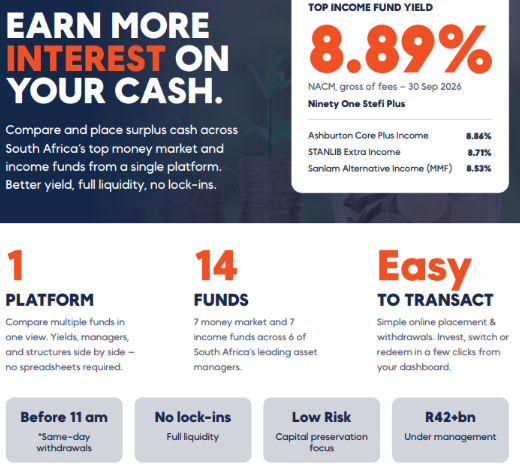
TreasuryONE's Money Market Funds platform gives businesses access to 14 money market and income funds across six of South Africa's leading asset managers, making it easier to identify competitive returns without the administrative burden.
The platform allows finance teams to compare yields, select suitable funds and submit investment, switching and withdrawal requests electronically, all from one dashboard.
Why should your business consider the platform?
🔷Competitive returns: Compare yields across multiple funds to find attractive investment opportunities.
🔷Easy online transactions: Submit investment and withdrawal requests electronically, without unnecessary paperwork.
🔷Access to your cash: No fixed investment terms, with same-day withdrawals available on money market funds for qualifying requests submitted before 11:00.
🔷Less administration: Manage investment requests across multiple funds from one convenient platform.
🔷No platform fees: Businesses can access and use the platform at no cost.
Even a 0.5% improvement in annual returns on R20 million in surplus cash could generate an additional R100,000 in interest income, assuming the balance remains invested throughout the year.
For CFOs and finance teams, the opportunity is clear: better visibility of investment options, easier transactions and the potential to earn more on cash already sitting in the business.
Your surplus cash should be working harder, without creating more work for your finance team.
Explore TreasuryONE's Money Market Funds platform:
https://t.co/WfXUDikj8m
Minimum investment R1 million. Returns are variable and subject to fund-specific risks and fees. Past performance does not guarantee future returns.
#TreasuryONE #CashManagement #CorporateTreasury #MoneyMarketFunds #CashOptimisation