🎁 FİNBOSOFT’TAN 3 KİŞİYE PRO ÜYELİK HEDİYE!
Bir şirket düşünün:
* Net kârını son 3 yılda her yıl %40 artırmış.
* F/K oranı 10
* PD/DD oranı 1,5.
* Özkaynak kârlılığı %25.
* Ancak şirketin faaliyetlerinden yarattığı nakit akışı, açıkladığı net kârın oldukça gerisinde kalıyor.
Sizce bu şirketin hissesi ucuz mu, yoksa piyasada haklı bir iskontoyla mı işlem görüyor?
Asıl merak ettiğimiz: Yatırım kararı vermeden önce olmazsa olmaz dediğiniz finansal gösterge nedir? Hangi veriye bakmadan hisse seçmem dersiniz?
Finbosoft: Hisse analizlerinizi uçtan uca yapabileceğiniz bir analiz platformudur.
🏆 Yorumlar arasından 3 kişiye Finbosoft PRO üyelik hediye ediyoruz!
Katılım şartları:
1️⃣ @Finbosoft hesabını takip et.
2️⃣ Bu gönderiyi beğen.
3️⃣ Gönderiyi RT yap.
4️⃣ Soruya yanıtını ve gerekçeni düşünceni yorumlara yaz.
📅 Hediye kazananlar 16 Kasım tarihinde açıklanacaktır.
Bakalım yatırımcılar hangi finansal verilere/göstergelere bakıp hisse tercih ediyor👇
#Borsa
#BorsaIstanbul
#BIST
#BIST100
#BIST30
#Hisse
#HisseSenedi
#Yatirim
#SermayePiyasasi
#Finans
#TemelAnaliz
#TeknikAnaliz
#PortfoyYonetimi
#Temettu
#TemettuYatirimciligi
#HalkaArz
#KureselPiyasalar
#Ekonomi
🎁 FİNBOSOFT’TAN 3 KİŞİYE PRO ÜYELİK HEDİYE!
Bir şirket düşünün:
* Net kârını son 3 yılda her yıl %40 artırmış.
* F/K oranı 10
* PD/DD oranı 1,5.
* Özkaynak kârlılığı %25.
* Ancak şirketin faaliyetlerinden yarattığı nakit akışı, açıkladığı net kârın oldukça gerisinde kalıyor.
Sizce bu şirketin hissesi ucuz mu, yoksa piyasada haklı bir iskontoyla mı işlem görüyor?
Asıl merak ettiğimiz: Yatırım kararı vermeden önce olmazsa olmaz dediğiniz finansal gösterge nedir? Hangi veriye bakmadan hisse seçmem dersiniz?
Finbosoft: Hisse analizlerinizi uçtan uca yapabileceğiniz bir analiz platformudur.
🏆 Yorumlar arasından 3 kişiye Finbosoft PRO üyelik hediye ediyoruz!
Katılım şartları:
1️⃣ @Finbosoft hesabını takip et.
2️⃣ Bu gönderiyi beğen.
3️⃣ Gönderiyi RT yap.
4️⃣ Soruya yanıtını ve gerekçeni düşünceni yorumlara yaz.
📅 Hediye kazananlar 16 Kasım tarihinde açıklanacaktır.
Bakalım yatırımcılar hangi finansal verilere/göstergelere bakıp hisse tercih ediyor👇
#Borsa
#BorsaIstanbul
#BIST
#BIST100
#BIST30
#Hisse
#HisseSenedi
#Yatirim
#SermayePiyasasi
#Finans
#TemelAnaliz
#TeknikAnaliz
#PortfoyYonetimi
#Temettu
#TemettuYatirimciligi
#HalkaArz
#KureselPiyasalar
#Ekonomi
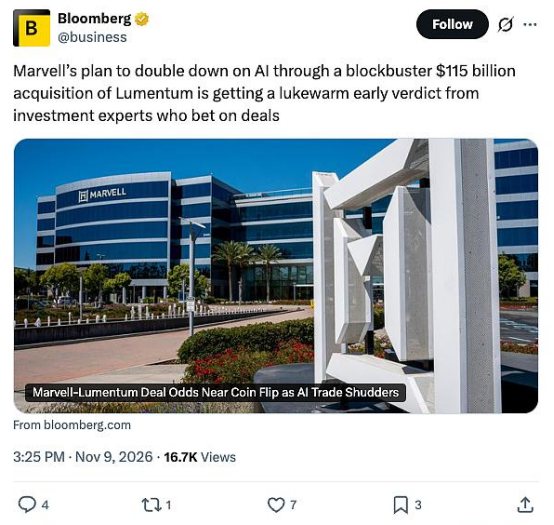
$MRVL’s $115B all-stock deal for $LITE still carries a huge spread. The fixed 4.5-to-1 exchange ratio ties the final value directly to Marvell’s share price. Add a 2028 closing date and a long regulatory review, and the market’s caution makes sense.
The strategic fit is clear. Lumentum brings lasers, InP manufacturing, optical transceivers, and optical switching. Marvell brings chips and interconnect technology. Together, they could build a full electrical-to-optical platform for #AI data centers.
The strategy looks solid. The real bet is whether the deal actually closes.
This pullback in optical-module names such as $COHR and $AAOI does not mark the end of the cycle, in my view. It may mean the cycle is stretching out.
The underlying demand is still growing. Anthropic and OpenAI are both moving toward the public markets, while TPUs, NPUs, XPUs, and GPUs are all ramping. More compute requires more optical connectivity, so the demand base remains strong.
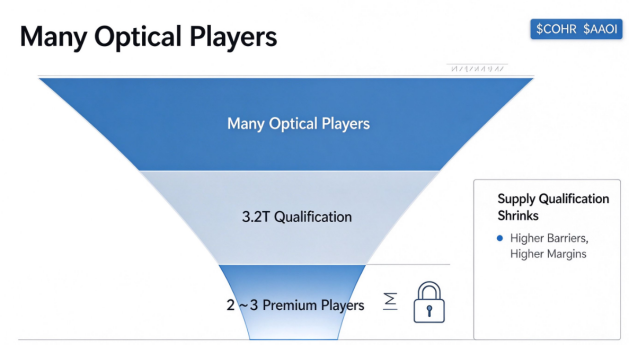
At the same time, geopolitical and compliance barriers keep getting tougher. By the time the industry reaches 3.2T, fewer suppliers may qualify to ship. That could leave the highest-margin parts of optical networking concentrated among a small group of companies.
It could end up looking a little like the smartphone market, where Apple has historically captured most of the industry’s profit. If this trend continues, optical networking may also become a market where only a few suppliers take most of the economics.
The rebound in AI hardware looks more like a recovery in companies backed by real earnings. Optical networking is sending one of the clearest signals.
Both $LITE and $COHR reported sequential growth in quarterly revenue and gross margin. Based on the midpoint of their November guidance, next-quarter revenue would rise about 27% for Lumentum and 12% for Coherent. Those forecasts still need to be delivered, but rising revenue expectations are supporting the rebound alongside the results already reported.
At $AMZN, AWS revenue grew 39.3% year over year in Q3 while infrastructure spending remained heavy. Cloud revenue is not entirely tied to AI, but one of the industry’s largest customers is still expanding and has not stepped back from capital spending. That does not line up with the idea that hardware demand has already rolled over.
These earnings reports and forecasts were available before the rebound started, so they were not sudden new catalysts.
Strong results can support share prices without making valuations cheap after a rally. Smaller companies without firm orders or profits do not deserve the same valuation as the industry leaders.
Appreciate it! Thanks for the support!$CRWV ripped 25%
$LITE and $COHR got pulled up with it!
Funding pressure on cloud players is easing, and GPU cluster buildouts should keep driving 800G and 1.6T module orders.
$LITE is ramping capacity faster, and demand for OCS and lasers is still strong. Next thing to watch is order delivery.
$COHR has already doubled its InP capacity for this phase. I think the fundamentals can back up part of the valuation.
I'm a little worried about $MRVL. Data center revenue was $2.172B for the quarter (and $115B to buy LITE is no small price).
Microsoft is lobbying the White House not to ban Chinese optical transceivers.
An industry group warns it could “grind” data center rollout “to a halt.”
So here’s the question:
National security or AI dominance, which comes first?
👇 Which side are you on?
The ASP jump in AI data-center CW lasers shows how quickly value is moving upstream. Industry estimates range from USD 3–4 for 70 mW lasers to USD 15–20 for 120–150 mW NPO products and as much as USD 50–75 for 400 mW UHP lasers used in CPO. Traditional telecom laser chips once sold for only USD 0.20–0.50. Some CPO laser products may carry gross margins above 60%.
Among the main names, $COHR offers the most balanced setup, supported by its new USD 20B long-term agreement. $LITE still has strong fundamentals, although the proposed $MRVL acquisition has created a valuation overhang.
$AAOI has strong order visibility, but delivery and DSP supply remain the main concerns. Its three-year 1.6T agreement could generate USD 1B–1.5B, depending on customer demand and execution. $SIVE is targeting annual capacity of more than 100M CW DFB lasers by Q4 2027, but qualification and management communication are still holding back the valuation.
Demand is real, but most AI optical stocks are still moving together. Execution will decide which names eventually break away from the group.
I keep thinking about $MRVL's plan to acquire $LITE.
I agree with the strategy, but I was a little disappointed by the CEO's letter to employees.
Matt spent a lot of time explaining the stock move and pointing out that the shares were still up 66% this year. I wanted to hear more about the long-term strategy and the integration plan.
The heart of the deal is what Marvell calls Extreme Co-design: owning laser manufacturing so the chips, light sources, and packaging can be designed together much earlier. The goal is to have more control over the next generation of AI interconnects.
But an all-stock deal brings dilution, and running factories and combining teams will not be easy.
The deal is not expected to close until 2028, while customers are choosing their next-generation architectures right now.
I like the potential synergies. Whether the $115 billion price pays off will come down to execution. AI is not going to wait for Marvell to finish the deal.
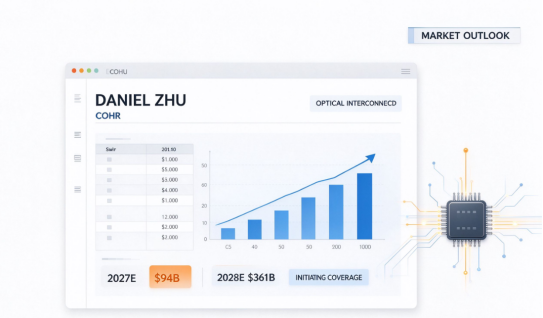
I went through Bernstein analyst Daniel Zhu's numbers on Coherent's multibillion-dollar optical-interconnect opportunity.
The starting point is Coherent's own PhotonLink figure: about $15,000 of optical content for every 100 Tbps.
For a 576-GPU Rubin Ultra pod, Bernstein estimates about $5.4 million of optical content, more than five times the roughly $1 million in the prior architecture.
Based on Bernstein's model, the potential market from Rubin Ultra alone could reach $9.4 billion in 2027 and $36.1 billion in 2028. Across the full Nvidia ecosystem, the 2028 figure could reach $46.8 billion.
One reminder: these are sell-side estimates, not company guidance or booked orders.
Three things stand out to me:
1. $COHR can already see demand into 2028, and the PhotonLink long-term agreements are starting to ramp.
2. CPO becomes necessary in Rubin Ultra because copper cannot handle the bandwidth and distance requirements.
3. Pluggable optics will not disappear overnight. 800G and 1.6T should keep growing, so CPO and pluggables can both take a share of the opportunity.
Bernstein rates Coherent Outperform with a $350 price target.
En büyük sorun zamanlama: Anlaşmanın 2028'e kadar tamamlanması beklenirken AI müşterileri yeni mimarilerini şimdiden belirliyor.
Yatırım tezi: Sinerji potansiyeli yüksek, fakat 115 milyar dolarlık bedelin haklı çıkması uygulama başarısına bağlı. AI pazarı MRVL'nin birleşmeyi tamamlamasını beklemeyecek.
MRVL–LITE birleşmesinin stratejik mantığı güçlü. Marvell, lazer üretimini de kontrol ederek çip, lazer kaynağı ve optik paketlemeyi birlikte tasarlamak istiyor. Ancak 115 milyar dolarlık hisse bazlı anlaşma ciddi seyreltme ve entegrasyon riski taşıyor.
#StockMarket#Stocks #WallStreet #Trading #Investing #SP500 #SPX #Nasdaq #NDX #DowJones #DJIA #Russell2000 #Fed #FOMC #Inflation #Economy #Earnings #IPO #Dividends
#endeks #borsa #bist
I keep thinking about $MRVL's plan to acquire $LITE.
I agree with the strategy, but I was a little disappointed by the CEO's letter to employees.
Matt spent a lot of time explaining the stock move and pointing out that the shares were still up 66% this year. I wanted to hear more about the long-term strategy and the integration plan.
The heart of the deal is what Marvell calls Extreme Co-design: owning laser manufacturing so the chips, light sources, and packaging can be designed together much earlier. The goal is to have more control over the next generation of AI interconnects.
But an all-stock deal brings dilution, and running factories and combining teams will not be easy.
The deal is not expected to close until 2028, while customers are choosing their next-generation architectures right now.
I like the potential synergies. Whether the $115 billion price pays off will come down to execution. AI is not going to wait for Marvell to finish the deal.
Bro, let's look at $AAOI from a different angle.
That $600M ATM isn't ripping people off. It's real expansion.
Q3 just came in as the sixth straight record quarter at $270M, up 127% YoY. Q4 guidance got pushed all the way up to $385M to $420M.
All the money is going into 800G/1.6T lines in Texas and Taiwan. Capacity is already at 330K units a month, with a year-end target of 500K+. Without this raise, there's no way they could take on hyperscaler orders.
The Chinese competitors are strong for sure (Innolight has higher margins). AAOI's moat is vertical integration plus U.S. manufacturing.
In-house lasers (made in Texas) plus U.S. assembly hit right on Chinese customers' need for a "non-China supply chain."
The Tier 1 1.6T multi-year LTA they just signed locks in at least 10% share, expected to bring in $1B to $1.5B through 2029. That kind of visibility is tough for Chinese suppliers to get.
AI data center optics is a structural gap this time. Over the past two years the stock ran to $200+. Now it's pulled back to around $50, which actually makes more sense.
Execution is getting better, and profits are back.
Distributed AI is driving another wave of network investment outside individual data centers. That is good for optical transport, with $CIEN and $NOK worth watching.
The logic is simple. AI workloads no longer stay inside one building. Moving compute across data centers and clusters requires stronger long-distance links, which supports demand for ZR/ZR+ modules, ROADMs, coherent optical engines, and amplifiers. Even customers that are not building new data centers still need to upgrade the equipment running on existing fiber.
$COHR offers a good example. Its scale-across and data-center interconnect revenue topped $200 million, roughly quadrupling from a year earlier. Management expects quarterly revenue from this area to roughly double from the Q1 level by the end of calendar 2027, with Multi-Rail products beginning to ramp in the March 2027 quarter.
The stocks are different:
$CIEN is highly exposed to optical transport. Optical Networking represented more than 70% of its latest quarterly revenue, so it offers the most direct upside and downside.
$NOK is also seeing strong optical growth and expects its combined Optical and IP Networks business to grow 25% to 30% in 2027. The company is much more diversified, so the impact on the whole business is less direct.
The risk is that strong demand does not guarantee equal gains for every supplier. Coherent can sell integrated solutions directly to cloud customers and may compete with traditional system vendors for part of the opportunity. This thesis applies to optical transport, not automatically to wireless or carrier spending.
What I am watching next: order delivery, available capacity, and Coherent's Multi-Rail ramp in the March quarter.
High-power lasers are becoming more important in CPO and NPO, but growth in externally sourced EMLs may eventually face a ceiling. The two main names I am watching are $LITE and $MRVL.
The basic logic:
CPO needs a reliable external source of high-power continuous-wave laser light. Lumentum already has a mature high-power laser portfolio and recently won a second major NPO/CPO program backed by more than $5 billion in purchase commitments.
$COHR's PhotonLink platform is another example. It uses high-power CW lasers, including 400 mW products. Coherent expects PhotonLink revenue to exceed $100 million in the March 2027 quarter and reach more than $250 million per quarter before the end of calendar 2027.
There is one possible headwind for outside suppliers: Coherent is expanding its own InP laser capacity.
If Coherent's internal laser output grows faster than its own module demand, it may need fewer lasers from outside vendors. Even if the optical-module market keeps growing, that could limit some of the incremental demand available to other suppliers. The size of that impact cannot be measured yet.
What matters for each stock:
$LITE: High-power lasers and external light sources are core strengths, and CPO orders are already in place. Its stock is also tied to the proposed $MRVL acquisition at a fixed exchange ratio of 4.5 Marvell shares for each Lumentum share, so the value depends on Marvell's stock and whether the deal closes.
$MRVL: Buying Lumentum would add optical manufacturing and bring the electrical and optical sides of the design closer together.
Long term, this market will not be decided by shipment volume alone. Power, reliability, packaging, and integration all matter. Some customers may prefer the combined Marvell-Lumentum platform. Others may want an independent supplier such as Coherent, which makes InP optical chips and lasers but does not compete with Marvell in switch and DSP silicon. There may not be one clear winner.
What I am watching next: Coherent's CW laser shipments in the December quarter, the PhotonLink ramp, and Lumentum's integrated-optics shipments.
MRVL’nin LITE’ı 115 milyar dolarlık hisse karşılığı satın alma planı stratejik açıdan güçlü olsa da 4,5’e 1 sabit değişim oranı nedeniyle nihai değer Marvell hissesinin fiyatına bağlı. Birleşme, Lumentum’un lazer, InP ve optik teknolojilerini Marvell’in çip ve bağlantı çözümleriyle birleştirerek AI veri merkezlerinde güçlü bir optik-elektronik platform oluşturabilir. En büyük risk stratejik uyum değil; 2028'e kadar anlaşmanın düzenleyici engelleri aşarak tamamlanıp tamamlanamayacağı.