@AstonVilla You are just a lame club that Jorge Mendes used as a tool during Leao transfer just a make it expensive for Gala. You'll find out what a great club is soon enough.
@GalaMercato 12+3 tende daha fazla paraya gelmis dogru mu? Bu kadar verdiysek niye bu kadar surdu. Boyle bol keseden transfer yapmak kolay. Yaziklar olsun
@HeroAssange He was recently asked about what will become of warrants. His response was I can't comment on that. After the follow up push from the host. He said people who invest in him makes money. Well we will lose money if he doesn't simply extend.
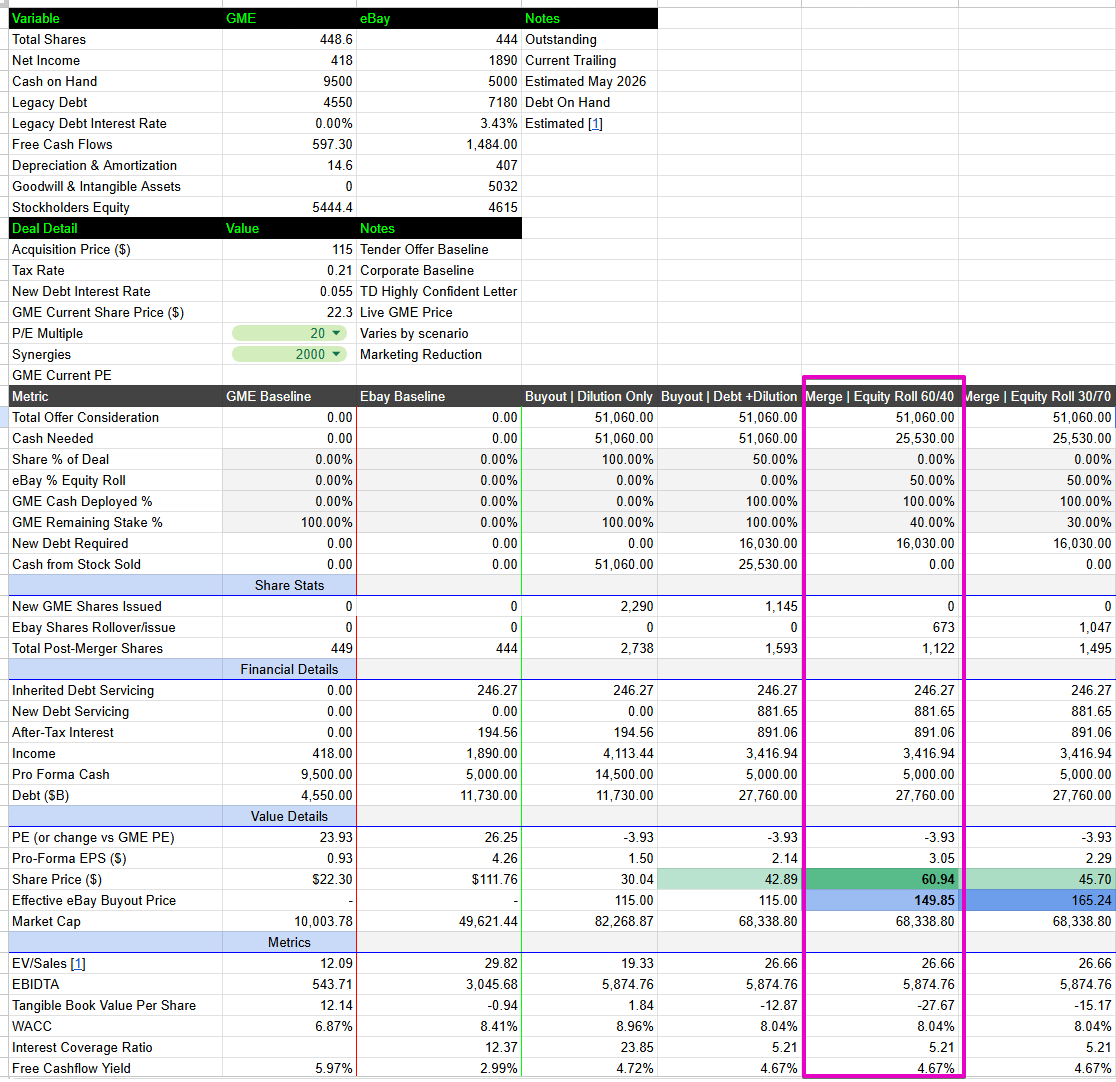
~$78/share for the combined company, including all debt and dilution according to AI-driven financial modeling 👇
Comprehensive Post-Acquisition Valuation of GME Shares (Combined GME + eBay Entity)
This assessment assumes the non-binding proposal announced by GameStop on May 3, 2026, succeeds and closes on the exact terms disclosed. All figures are drawn directly from GameStop’s and eBay’s public filings, earnings releases, and the proposal letter as of May 2026 (post-Q1 2026 for eBay and post-FY2025 / Q4 for GameStop). I explain every input, assumption, and calculation step-by-step so the logic is fully transparent and replicable. No “meme premium,” Bitcoin re-rating, or heroic growth assumptions are included; only the explicit $2 billion annual cost synergies cited by Ryan Cohen, conservative capitalization multiples, and the full pre-deal capital structure (convertibles, warrants, and Cohen’s performance options).
1. Pre-Deal Stand-Alone Snapshots (as of latest filings, May 2026 context)
GameStop (GME) –
Pre-Deal:
• Basic common shares outstanding: 448,375,157 (as of March 18, 2026).
• Market capitalization: ≈ $11 billion at recent trading levels of ~$24–$25 per share.
• Revenue (FY2025): $3.630 billion.
• EBITDA / operating profit: Near breakeven to low positive (SG&A already cut aggressively; core retail is cash-flow neutral after restructuring).
• Cash & liquid investments: $9.4 billion (proposal explicitly cites this figure as of Jan 31, 2026; Q4 close was $9.0 billion; minor timing difference).
• Existing debt: $4.2 billion principal of 0% Convertible Senior Notes due 2030/2032. Conversion price ≈ $28–$29 → 144 million potential shares if fully converted.
• Warrants: 59 million (pro-rata distribution to shareholders in 2025; exercisable into common shares, expected to be exercised post-deal for cash inflow of ≈ $1.9 billion depending on exact strike).
• Ryan Cohen performance options: 171,537,327 stock options at $20.66 strike. These vest only upon aggressive hurdles (market-cap scaling to $100 billion + cumulative EBITDA targets). Not earned/issued as common shares at closing; treated as out-of-the-money for base case.
• Authorized shares: current 1 billion (sufficient with amendment if needed; up to 2.5 billion considered).
• Pre-deal fully diluted potential (excluding Cohen options): 448M + 144M + 59M = 651 million.
eBay (EBAY) – Pre-Deal
• Undiluted shares outstanding: 444 million (exactly the figure used in the proposal for the $55.5 billion equity value).
• Revenue (TTM / FY2025): ≈ $11.1–$11.6 billion.
• EBITDA (2025 / TTM): $2.68–$2.86 billion.
• GAAP net income (TTM): ≈ $2.0–$2.04 billion (diluted EPS $4.33–$4.41).
• GMV: ≈ $79–$80 billion (platform scale that GME aims to leverage).
• Net debt position: Already reflected in the $125/share equity offer (no separate adjustment needed).
1/
"It's run by a bunch of losers..."
EXCLUSIVE: GameStop CEO Ryan Cohen hits out following his failed $56 billion takeover bid to eBay.
📺 https://t.co/qsJO5FBsv8
@piersmorgan | @ryancohen
@APompliano@ryancohen I have been looking at this deal and it does look accretive to everyone involved. Ryan is simply trying to generate shareholder value in $EBAY and $GME.
Skip to 21:38 to hear it from @ryancohen himself.
Down with the Hollow Men! https://t.co/JRvNxRgUvQ
@AustinTobitt The only problem I see is the current valuation between ebay and gme. If we take out the cash, the market is pricing GME at 1-2 billion. GME's valuation doesn't seem fair for GME holders compared to ATH with premium for Ebay. It looks like GME holders will lose vs ebay holders.
@APompliano@ryancohen What is the fair valuation of ebay and gme in this deal? How will he make sure GME shareholders don't lose in fair valuation ratio against ebay holders thru market manipulation of stock price?
@foxenflask Easy with the insults dude. I'm a long term shareholder. I liked your posts that's why I commented here. What is inaccurate? Ebay is at ATH and it will be acquired with big premium. That's a fact. Yes Ryan will make it work but it should have been a better entry for GME holders.
@ryancohen@Venturinglist This is hilarious. 😁 @ryancohen. Now it is obligatory to buy @eBay no matter what and then post the board and management's termination letters for bidding on @eBay.
The Hollow Men
American capitalism is rotting from the head down. We have replaced the "Owner-Operator"—the risk-taker-with a new, parasitic class of corporate bureaucrat: The Risk-Free Insider.
By "Insider," I am not referring to a specific title. I am referring to the entire administrative state that has captured the modern corporation. This includes the Directors who exist solely to collect fees, the Executives who exist solely to collect bonuses, and the Managers who exist solely to hire consultants.
These are the hollow men of the boardroom. They are masters of PowerPoint. They wear the right suits. They say the right buzzwords about "governance" and "ESG." But they are mercenaries fighting a war with someone else’s ammunition.
In a functioning economy, authority is tied to liability. If you make a bad decision, you lose your own money. That fear of loss is the only thing that keeps a business honest. It forces you to cut waste, obsess over the customer, and stay late to fix what is broken.
Today, we have severed that link.
We have rigged the game so that heads, the Insider wins; tails, the shareholder loses.
If the stock goes up, the Insider collects a massive performance bonus. If the stock crashes due to their own incompetence, they are fired with a "Golden Parachute" worth tens of millions. They are gambling with the house’s money, and they never leave the table poorer than they arrived.
This looting starts in the boardroom.
We have normalized a "Country Club" culture where directors are selected based on social profiling rather than their ability to build a business. The modern board member is often a professional tourist—paid an average of $350,000 a year.
Let’s be brutally honest about what that number represents. The average director is paid nearly five times the GDP per capita of the United States. They earn more for attending four quarterly lunches than the vast majority of Americans earn in five years of hard labor.
And for what?
Most of these directors are "over-boarded," sitting on three or four boards simultaneously. They treat directorships as a gig economy for the elite. They fly in, rubber-stamp a compensation package they didn't read, and fly out. They collect checks from companies they do not understand, do not use, and certainly do not love.
They are not there to ask hard questions. They are there to be collegial. They are there to protect the other Insiders.
And what happens when these boards hire executives who also have no personal capital at risk?
We get the Delegation Economy.
When a Risk-Free Insider faces a crisis—bloated expenses, a broken supply chain, or a stale product—they do not roll up their sleeves. They hire a consultant. They pay a strategy firm millions of shareholder dollars to produce a 100-page deck telling them what they already know.
This is not management. It is intellectual money laundering.
They use shareholder capital to buy an insurance policy for their own careers. If the plan fails, they can blame the consultants. They delegate the work because they are terrified of the responsibility. They would rather preside over a slow, comfortable decline than risk a bold mistake.
While American Insiders are busy optimizing their severance packages, our global competitors are optimizing their products. They are not slowed down by bureaucracy. They are not waiting for a slide deck. They are outworking us.
If we continue to fill our C-suites with administrators instead of operators, we will lose our edge. We will see iconic American franchises hollowed out by fees, managed for the benefit of the Insiders, while the true owners—the shareholders—are left holding the bag.
The time for polite governance is over.
If we want to save the American economy from mediocrity, we must demand a return to the "Owner’s Mentality." We need leaders who treat shareholder capital with the same reverence they treat their own savings. The era of the Risk-Free Insider must end.
The Hollow Men
American capitalism is rotting from the head down. We have replaced the "Owner-Operator"—the risk-taker-with a new, parasitic class of corporate bureaucrat: The Risk-Free Insider.
By "Insider," I am not referring to a specific title. I am referring to the entire administrative state that has captured the modern corporation. This includes the Directors who exist solely to collect fees, the Executives who exist solely to collect bonuses, and the Managers who exist solely to hire consultants.
These are the hollow men of the boardroom. They are masters of PowerPoint. They wear the right suits. They say the right buzzwords about "governance" and "ESG." But they are mercenaries fighting a war with someone else’s ammunition.
In a functioning economy, authority is tied to liability. If you make a bad decision, you lose your own money. That fear of loss is the only thing that keeps a business honest. It forces you to cut waste, obsess over the customer, and stay late to fix what is broken.
Today, we have severed that link.
We have rigged the game so that heads, the Insider wins; tails, the shareholder loses.
If the stock goes up, the Insider collects a massive performance bonus. If the stock crashes due to their own incompetence, they are fired with a "Golden Parachute" worth tens of millions. They are gambling with the house’s money, and they never leave the table poorer than they arrived.
This looting starts in the boardroom.
We have normalized a "Country Club" culture where directors are selected based on social profiling rather than their ability to build a business. The modern board member is often a professional tourist—paid an average of $350,000 a year.
Let’s be brutally honest about what that number represents. The average director is paid nearly five times the GDP per capita of the United States. They earn more for attending four quarterly lunches than the vast majority of Americans earn in five years of hard labor.
And for what?
Most of these directors are "over-boarded," sitting on three or four boards simultaneously. They treat directorships as a gig economy for the elite. They fly in, rubber-stamp a compensation package they didn't read, and fly out. They collect checks from companies they do not understand, do not use, and certainly do not love.
They are not there to ask hard questions. They are there to be collegial. They are there to protect the other Insiders.
And what happens when these boards hire executives who also have no personal capital at risk?
We get the Delegation Economy.
When a Risk-Free Insider faces a crisis—bloated expenses, a broken supply chain, or a stale product—they do not roll up their sleeves. They hire a consultant. They pay a strategy firm millions of shareholder dollars to produce a 100-page deck telling them what they already know.
This is not management. It is intellectual money laundering.
They use shareholder capital to buy an insurance policy for their own careers. If the plan fails, they can blame the consultants. They delegate the work because they are terrified of the responsibility. They would rather preside over a slow, comfortable decline than risk a bold mistake.
While American Insiders are busy optimizing their severance packages, our global competitors are optimizing their products. They are not slowed down by bureaucracy. They are not waiting for a slide deck. They are outworking us.
If we continue to fill our C-suites with administrators instead of operators, we will lose our edge. We will see iconic American franchises hollowed out by fees, managed for the benefit of the Insiders, while the true owners—the shareholders—are left holding the bag.
The time for polite governance is over.
If we want to save the American economy from mediocrity, we must demand a return to the "Owner’s Mentality." We need leaders who treat shareholder capital with the same reverence they treat their own savings. The era of the Risk-Free Insider must end.
@Buchi_Laba I can't believe you haven't heard it before. It's a rule that only applies to Gala in the FIFA book of rules. Here is graphic from the rule book.