The @BostonCollege Investment Committee (an LP and my beloved alma mater) asked for a few thoughts on what's happening in AI. I recorded a test run yesterday morning and then shared it with my partners, who encouraged me to share it more broadly... so here you go!
This is not a sales pitch, it's just a reflection on what we're seeing. And it wasn't intended to be shared, so please pardon the rough edges.
https://t.co/AuZqHMSSxD
Here is a potential roadmap to reversing aging by 2040, created by GPT-6 Pro with Image 2.5.
It is important to point out that we will already reach longevity escape velocity by around 2035, so if you can make it to then, you are very likely to live for hundreds of more years!
Today, we launched the world’s first automated production line for advanced general‑purpose humanoid robots, using robots to mass‑produce robots, autonomously.
This was uncharted territory, and we solved it from scratch. The commissioning of our production line means humanoid robots are now ready to scale up and step into the real world.
What touched my heartstrings most was watching our very first advanced general‑purpose humanoid robot complete assembly and walk off the line on its own. To me, this is not just about a smarter tool or a commodity. I hope it gains true generalization ability to take on dangerous, repetitive, or undesirable tasks, and ultimately make life better. Perhaps one day, robots may become our companions, friends, or part of family.
Grateful to every colleague on this momumental mission. And a warm welcome to IRON!
Multiple patients at a Nashville hospital are paralyzed after staff accidentally gave them the wrong drugs.
The hospital says they are "sorry" after injecting potassium chloride into the spines of people getting routine joint replacement surgeries.
Hospital staff noticed something was off when multiple patients went into cardiac arrest.
Does anyone remember this amazing story? On July 2, 1982, a truck driver from California flew 16,000 feet into the sky in a lawn chair. Larry Walters, 33, from San Pedro, had dreamed of flying his whole life. He bought 42 eight-foot helium weather balloons, tied them to a regular Sears lawn chair, strapped on a parachute, packed a BB gun to pop balloons to descend, a CB radio, sandwiches, and a six-pack of beer.
He expected to float a few hundred feet above his backyard. He cut the rope and shot up like a rocket — to 16,000 feet. He drifted directly into the main approach path for LAX. Two airline pilots radioed the tower: they had just passed a man in a lawn chair holding a gun at 16,000 feet. For 45 minutes, he floated over Los Angeles, freezing cold, too scared to shoot balloons because he might fall. Finally, he started popping balloons one by one and slowly descended.
He landed tangled in power lines in Long Beach, California, causing a blackout. When police arrested him, they asked why he did it. He said, "A man can't just sit around." The FAA fined him $4,000. He became a national folk hero — Lawnchair Larry — and inspired the movie Up.
Thanks for this great post @rickyho_1989 So much investment wisdom in this single post for the average retail investor; even myself who is a professional private equity investor find myself not heeding these wisdoms most of the time in the public market because you don’t have time, get caught up in a narrative, etc.. great reminder to check yourself every time u think u have some “edge”
The most surprising thing about this chart is not that the average retail investor is down nearly 13% in a year when many headline indices have performed reasonably well. The surprising part is that this pattern repeats itself across almost every major market cycle.
Retail investors do not lose money because they lack intelligence. They lose money because they systematically buy narratives instead of cash flows, momentum instead of valuation and excitement instead of probabilities.
That is why the average portfolio often bears little resemblance to the index. Market-cap weighted indices naturally allocate more capital toward companies whose earnings and market values continue growing. Retail portfolios, however, are often concentrated in whatever is trending on social media, discussed on Reddit, promoted by influencers or viewed as "the next NVIDIA." The result is that retail investors frequently end up owning the most crowded trades at the richest valuations.
Ironically, the stocks people are most excited to buy are often the ones that already embed the highest expectations.
Another structural problem is concentration. Many retail investors own five to ten individual stocks that they believe have the potential to become the next ten-bagger. Unfortunately, the probability distribution works against them. Even if one position performs exceptionally well, one or two catastrophic losers can overwhelm the gains because high-beta portfolios compound losses much faster than diversified portfolios compound gains.
Behavioral finance also plays an enormous role. Professional investors typically begin with a valuation framework and then determine whether expectations are too optimistic or too pessimistic. Retail investors frequently reverse that process. They fall in love with a story first and only afterwards look for reasons to justify the investment. Confirmation bias then reinforces every bullish headline while dismissing evidence that contradicts the original thesis.
There is also a timing problem that receives far less attention. Retail investors tend to buy after strong performance because rising prices create confidence and social validation. Conversely, they often sell after significant declines because losses create fear. In other words, they systematically buy when expected returns have fallen and sell when expected returns have improved.
This behavior creates a negative feedback loop. The better a stock performs, the more capital retail investors allocate toward it. The worse it performs, the more likely they are to capitulate near the bottom. Professional investors attempt to exploit precisely this behavioral asymmetry.
There is another lesson hidden in this chart. The average retail portfolio is not necessarily a reflection of the average company. It is a reflection of the average stock selection process.
If investors disproportionately chase speculative software companies, unprofitable AI names, meme stocks, leveraged ETFs or fashionable themes while underweighting profitable compounders with durable earnings growth, it is entirely possible to lose money despite a healthy broader market.
This is one reason why investing is often counterintuitive. The objective is not to buy the company everyone is talking about. The objective is to buy the company whose future is better than what the market has already priced in.
Ultimately, the market is an expectations machine rather than a popularity contest. Great companies can produce poor investment returns if expectations become unrealistic, while boring companies can generate exceptional returns if expectations are excessively pessimistic. The average retail investor often confuses a good business with a good investment, and that distinction has probably destroyed more wealth than almost any other mistake in investing.
In December 2007, a Barcelona newspaper ran a charity raffle to pick a local baby for a UNICEF calendar shoot.
The winning family brought their 5-month-old son.
The 20-year-old Barca player assigned to bathe him was Lionel Messi.
The baby was Lamine Yamal.
Nobody thought about the photo for 15 years.
Then the baby debuted for Barcelona at 15. Won the Euros at 16 while still doing homework. Took over Messi's number 10 shirt.
On Sunday they meet in the World Cup Final.
Messi is 39. It's likely his last one.
Yamal turned 19 two days ago. It's his first.
The baby Messi held in his hands is now trying to take the trophy out of them.
100%. @zanehengsperger .. build a culture of manufacturing and make people who manufacture #1.. then build everything - energy, capacity, supply chain…. There is nothing unique about what shenzhen does, they just done it a a few thousand times with 10 million people in the last 2 decades…
The Nasdaq fell 78% from 2000 to 2002. But that's not how anyone experienced it.
They experienced this:
– A 35% rally. Then new lows.
– A 12% rally. Then new lows.
– A 25% rally. Then new lows.
– A 41% rally. Then new lows.
– A 45% rally. Then the bottom, 30 months after the top.
Five times the market screamed "it's over." Five times it lied.
Former colleagues of mine lived through it on a trading floor. They told me what the routine became: by Thursday, you started praying for Friday afternoon. Not for the weekend. For the close. Two days where you couldn't lose money.
Then you walked out of the office with your head down.
That is what a real bear market does. It doesn't scare you out at the bottom. It exhausts you out, one false dawn at a time.
Bear markets don't end when the sellers are done. They end when the buyers are.
FULL timeline of the campaign to bring Balogun back, according to a half dozen U.S. government & soccer officials:
- Wednesday after U.S.-Bosnia match: Andrew Giuliani alerted Trump to the red card (Trump & Giuliani had been talking multiple times/week since start of World Cup and regularly before that.)
- Wed night: Giuliani, Lutnick and U.S. Soccer officials began activating on plans to challenge red card
- That kicked off 4 days of coordinated lobbying, legal maneuvering & diplomacy that stretched from Oval Office to Zurich
- On *Thursday* Trump dialed Gianni Infantino and asked abt FIFA’s rules around the red card decision and grounds for suspension. (They’ve known each other for 8 yrs.)
- FIFA declined to confirm any specific discussions but reiterated to POLITICO that the decision to suspend the one-match ban was made by an independent disciplinary committee.
- As U.S. Soccer’s legal team formally prepared & submitted its appeal to FIFA, Giuliani + Lutnick offered to make White House attorneys available to assist
- At the same time, Giuliani and Scott Goodwin — a hedge-fund manager who had helped pay the salary of Mauricio Pochettino — zeroed in on the officiating history of referee Raphael Claus
-Articles examining previous controversies involving Claus circulated among senior gov officials as they evaluated every argument that could bolster the appeal
- On FIFA side, Emilio García, who oversees the legal affairs of FIFA, advised Infantino on the available procedural options
- García + other FIFA officials worked to determine whether the circumstances of Balogun’s tackle met the narrow standards that would allow the disciplinary decision to be revisited
- By Sunday, FIFA announced that Balogun’s one-match suspension would be suspended
- FIFA insists that the decision was an independent one made by its 18-person disciplinary committee, but it would not say whether the decision was decided through a vote, and it has not published a report on the decision.
https://t.co/eXOOUkza6N
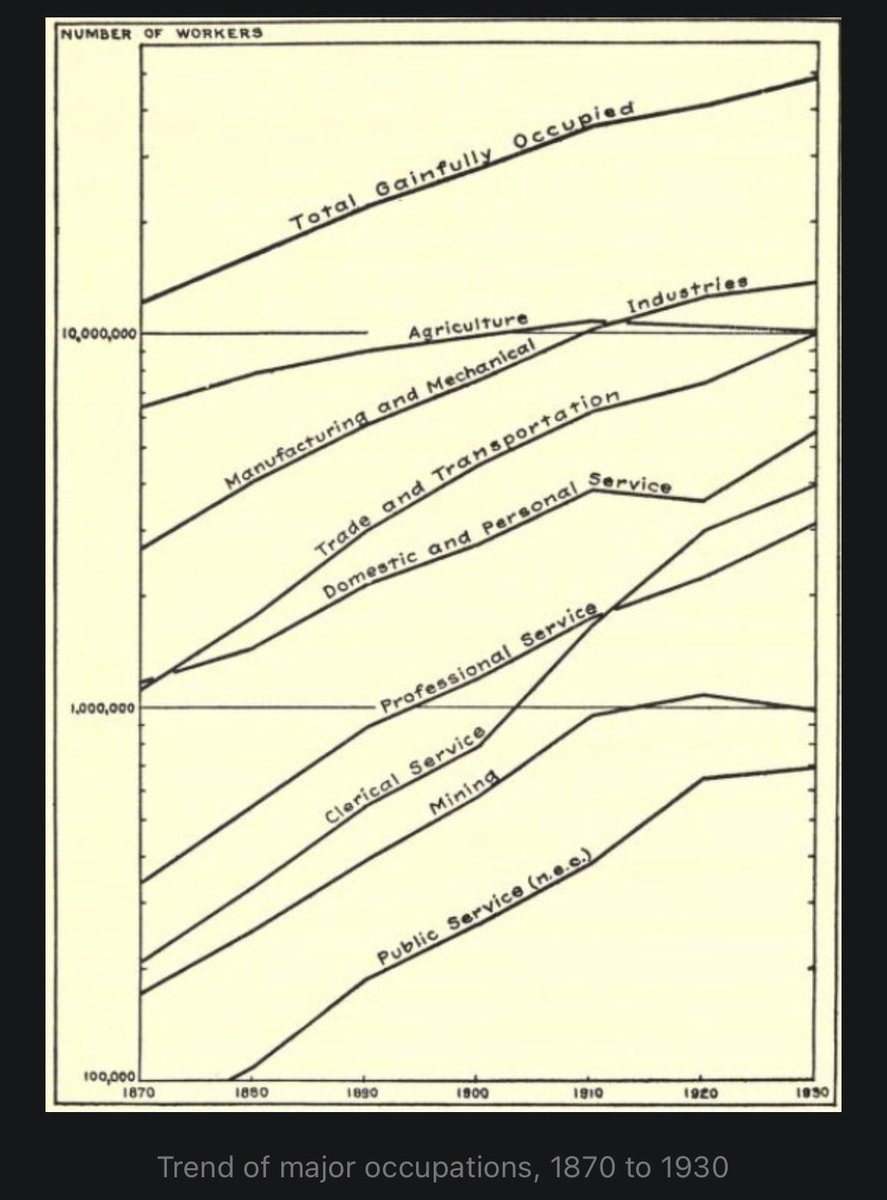
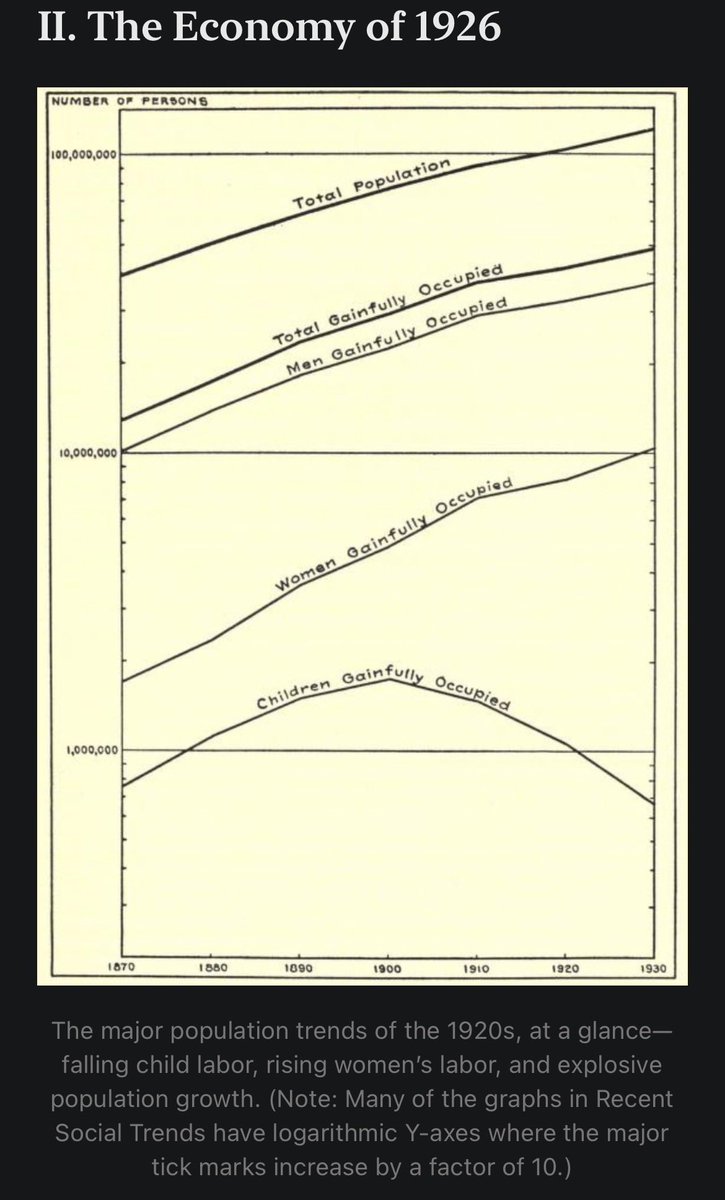
New newsletter: AMERICA, 1926. WHAT LIFE WAS LIKE 100 YEARS AGO ON AMERICA’s 150th BDAY
Hands down, the most fun I had writing a historical essay this year. I went through a widely forgotten, chart-filled 1,500 page report on life in the 1920s commissioned by Hoover just before the depression, to paint a picture of how much and how little has changed in the last century. Feat.:
- the booming auto and radio industries
- the rise of early female empowerment and decline of child labor
- familiar fears of technological disemployment alongside unprecedented growth
- rapid urbanization, horrific agrarian deflation, and the demise of America’s farming identity
- manufacturing is booming but nothing is growing faster than wholesale transportation and retail sales jobs
- a golden age for print
- familiar anxieties about declining birthrates and too much immigration
- and half the country still has no electricity or indoor plumbing
… all illustrated with gorgeous 100-year old graphs on yellowed paper.
https://t.co/mHvm0NxglC
Feeding cows BEER and NUTS - guess what they taste better!!! What about massages and classical music à la Kobe Beef? Someone needs to do an A / B test on this .. #beef
Mark Zuckerberg reveals he's feeding his cows beer and macadamia nuts
“On the ranch, one of my projects is I'm trying to create the highest quality beef in the world”
“It's very low stakes, I’m not selling it but I'm very into the genetics of the cattle. We're trying to figure out how do you make it so that you basically can deliver the highest density diet to them”
“We started growing macadamia trees because that kind of nut is extremely dense and they will eat a lot so they will put on weight and become fat quicker and become delicious”
“The macadamia nuts have a lot of oil so you need to actually roast that. So now we need to design this whole process to roast the nuts so that way you can give them to the cows”
“You want them to eat more. So then it's like how do you get them to eat more? Well it turns out alcohol is great for that because alcohol induces appetite”
“That's actually why very high-end beef, they're fed beer. But okay, what's the right balance of beer versus water? I don't know. Let's let them choose. They get either as much cold beer as they want or as much room temperature water”
“So now we're brewing all this beer and we're putting it out”
Mark Zuckerberg reveals he's feeding his cows beer and macadamia nuts
“On the ranch, one of my projects is I'm trying to create the highest quality beef in the world”
“It's very low stakes, I’m not selling it but I'm very into the genetics of the cattle. We're trying to figure out how do you make it so that you basically can deliver the highest density diet to them”
“We started growing macadamia trees because that kind of nut is extremely dense and they will eat a lot so they will put on weight and become fat quicker and become delicious”
“The macadamia nuts have a lot of oil so you need to actually roast that. So now we need to design this whole process to roast the nuts so that way you can give them to the cows”
“You want them to eat more. So then it's like how do you get them to eat more? Well it turns out alcohol is great for that because alcohol induces appetite”
“That's actually why very high-end beef, they're fed beer. But okay, what's the right balance of beer versus water? I don't know. Let's let them choose. They get either as much cold beer as they want or as much room temperature water”
“So now we're brewing all this beer and we're putting it out”
the cpi print is irrelevant for real inflation. t10 listed equities have become the only realistic store of value, and the white house will not let that fall, so if your wealth is in labor or property instead of mag7, you've been repriced 90% down in less than a decade.
@Contrary_Res Great article.. As a board member on one of your up and coming neoclouds, I believe the time window to grow up is actually 12-18 months.. if you are not established (first major contracts (GW+), etc) by then it will be too late.
A very reasonable approach to better wealth distribution; Step #1 deal everyone into the game. As an investor and entrepreneur, I m a strong believer that everyone in a company should own a piece of it.. @Scaramucci nice paper
I have read approximately 3,000 10-Ks in my life. I have read my wife’s emotional state correctly maybe 11 times. This is troubling because the skills should transfer. Both require you to look past the headline. Both require you to read the footnotes. Both require you to notice what was said last quarter that is not being said this quarter.
I can spot a goodwill impairment from 40 pages away. I cannot spot that my wife has been quietly furious since Tuesday. In a 10-K I notice when management changes the word “challenging” to “dynamic” and I correctly interpret this as a warning. In my marriage my wife changed the word “fine” to “fine.” and I did not notice the period. The period was the entire disclosure.
I missed it. I read a footnote last week in a packaging company’s annual report that disclosed a related-party transaction worth $400,000 and I caught it in 90 seconds. My wife told me three times this month that she was tired and I interpreted this as “tired” when in fact it was a Level 3 disclosure requiring immediate management response. I have a system for 10-Ks. I read the MD&A first, then the risk factors, then the cash flow statement, then the notes. I have no system for my wife. She is a company that does not file. She reports continuously and without warning and the format changes every quarter. Her risk factors are not enumerated.
Her MD&A is delivered through sighs of varying length and I have not yet developed the ear. Last week she said “do whatever you want” and I did whatever I wanted and it turns out the correct interpretation of “do whatever you want” was “do not do that specific thing” and I have no idea how I was supposed to know that, and yet, looking back, the signals were all there. The signals are always there. I have been trained to find signals. I find them in companies I will never meet. I miss them in the person I have lived with for nine years. My wife has started saying things like “you would notice this if I were a stock” and she is correct. She is correct. If she had a ticker I would have already built a 6,000-word model on her. I would know her seasonality.
I would know her capex cycle. I would know which quarters historically run hot. Instead I treat her like a private company and I am surprised every time the auditors arrive. I am going to bed now. She said good night in a tone. I do not know what the tone meant. I will find out in the morning. Or I will not. The 10-K of my marriage is filed in real time and I am, as always, three quarters behind.