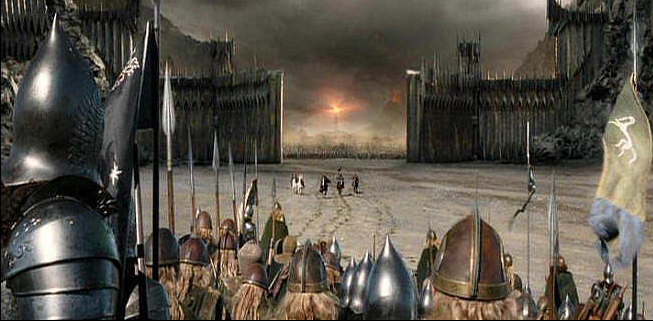
Biblically, when immigrants enter a new land, they are always expected to assimilate, and assimilation is measured in two keys ways: language and laws.
First, if your nation comes to be filled with people speaking another language, it is a sign of God’s judgment (Deuteronomy 28:49, Isaiah 28:11). National identity in the Bible has a linguistic core.
Second, Torah required immigrants to live as guests. They had to abide by the religion and way of life of the land they entered (Exodus 12:49, Numbers 15:29; cf. Deuteronomy 13:1ff). There was to be one law for the homeborn and the stranger in the land. There were other restrictions in certain cases. For example, in the case of immigrants coming from nations that had a history of enmity with Israel, various citizenship rights could be restricted or withheld for several generations to allow time for the immigrant to prove he was assimilating (cf. Dueteronomy 23:3-4).
These are wise principles that any coherent and self-respecting nation would take seriously and apply. Most nations do. Only Western progressives reject these principles — and of course, they reject all kinds of other wise and natural principles found in Biblical law as well, including God’s design for sexuality and family, work and prosperity, etc. This is because for progressives, rejecting God’s truth is their whole project. Progressivism is just the mirror image of God’s law. Progressivism is really just humanism — the inversion of all that is good, true, and beautiful. What to know what progressives will do about an issue? Look what God says about it, and be assured they will do the exact opposite.
You've probably heard this before, but it's always worth repeating. Something extremely cool about the "Star-spangled Banner," the American national anthem, is that it asks a question, and it's the question at the heart of everything in the American worldview.
"Oh, say, can you see
By the dawn's early light
What so proudly we hailed
At the twilight's last gleaming..."
So the anthem begins with a question and a scene. One man, a patriot, is asking another man, another patriot, "can you see it?" at sunrise after a long, dangerous night.
The "it" in question is going to be revealed to be the flag, our "star-spangled banner," which they had last fully recognized and honored as the sun set, daylight failed, and night crept over them the evening before.
Can you see it? Say! Can you see it?!
IS IT STILL THERE?!
"Whose broad stripes and bright stars
Through the perilous fight
O'er the ramparts we watched
Were so gallantly streaming..."
Here we find that the "it" is in fact the flag, our star-spangled banner, and we learn why the question is being asked.
The flag is described as having flown and streamed gallantly over ramparts of war through a perilous fight. All could have been lost. The flag, and even the fledgling country for which it stands, one nation under God and indivisible.
Say! Can you see it? Now that the light is back?
IS IT STILL THERE?!
"--And the rockets' red glare,
The bombs bursting in air,
Gave proof through the night
That our flag was still there!--"
They could see it through the battle in the light of the rockets and bombs that threatened them, here and there in quick glimpses. But it was still there throughout! But now? At dawn?
Say! Can you see?
IS IT STILL THERE?!
"Oh, say, does that star-spangled banner yet wave
O'er the land of the free
And the home of the brave?"
The urgency is palpable with every refrain. They have to know. It's the first thing they must know as the sun begins to light the sky, even before it rises.
IS IT STILL THERE?!
Say! Say!! Can you see? Can you see it?!
At the heart of every American beats the fundamental truth and reality that what we have here is precious, that it's worth fighting for, to the death if necessary, and that it's fragile. That at any moment it can be lost. That we have to remember to look for it because last night might have been the night in which it failed.
Every day, every year, every generation.
The American fight for freedom, to live in self-governance within ordered liberty, is ongoing and never-ending. The price of the land of the free is that it must be the home of the brave. We have to defend it, defend it, and defend it again, against all enemies foreign and domestic, because what we have is amazing, rare, fragile, and worth every cent of treasure, every drop of blood, and every risk to our sacred honor to protect it.
Our anthem is not a declaration. It is not a proclamation. It is not a statement.
It is a question.
Every time we sing our wholly unique national anthem, we as American ask the question again. IS IT STILL THERE?! Are we still America? Does that star-spangled banner yet wave?
Because it's a question, the answer is not known. It is not a guarantee. It cannot be taken for granted and isn't. And what an honor to ask and take up our part in the story, in the American Experiment, in the greatest country the world has ever known.
For tonight, the last night of our first 250 years, as the sun gave way to twilight's last gleaming and darkness overtook our land once again, the answer was still yes. We can see it even tonight in the red glare of rockets, with small bombs bursting in air, fill the sky with the noble tribute of fireworks once again.
And we all ask ourselves, will it still be flying at dawn?
This is what it means to be an American.
Happy 250th, America! Now for many happy returns!
🇺🇸🇺🇸🇺🇸🇺🇸🇺🇸🇺🇸🇺🇸🇺🇸🇺🇸🇺🇸🇺🇸🇺🇸🇺🇸
Reminder that if you are fully vaccinated and up to date on boosters, you are allowed to celebrate the Fourth of July.
Those vaccinated are even permitted to have a very small backyard barbecue. Five person maximum.
@stcowden@_Theopolis Interesting perspective I've not encountered, however if Paul was being purely sarcastic and not concerned with coverings I'm not sure he'd go into as much detail as he does chasing all the particulars and distinctions
If that addict on your street were your own son, what would you do? That is the defining question that guides my 5 step plan to fix the homelessness problem in LA. We *must* end this evil racket of corrupt politicians and NGOs who profit off the misery of these poor souls. They launder money and feed them more drugs, so they can keep their customers locked in this hell on our streets. We have a moral obligation from God to help them and make our city safe and clean for everyone. Karen Bass and Nithya Raman have forsaken this city. Time for real leadership. Time for real compassion.
You want your boys to be dangerous.
They are squires. Knights in training.
This doesn’t mean that they only know how to physically fight. It means they can face danger when it is called for, in whatever form it happens to take.
A boy who is not dangerous will not be able to protect anything. He will not be able to ascend to any sort of manhood.
How do you raise sons that will grow up to be dangerous men?
Here are 11 ways:
The difference between the two views is that for the modern individualist, it tends toward community by consent— he can choose his own identity, community, associations, norms, allegiances, and stations.
The old American communitarian model saw the individual as cherished and dignified, yet downstream of his heritage and ancestors. And there was a duty to uphold and fight for the well-being of this community. He was bound by blood to its continuation and integrity. He represented them and not just himself. Norms and allegiances and associations preceded him, and therefore he had the obligation to structure his own life within it.
Often times there were expectations and obligations of station and career path as well. The individual was important, but the individual existed for the continuation of the story of that individual’s God given heritage. As my father taught me, I don’t just represent my first name. I represent my last name as well. It pushes back on the narcissistic cult of the individual that is prominent since the 60s.
And that is what Barry Shain is after.
Let me address the common objection: “But, 'ashes to ashes, dust to dust,' the body is going to dirt anyway, it doesn't matter how it gets there, whether cremation or composting."
This is a category error. Genesis 3:19 tells us what happens to the body after death, it breaks down. That statement is about a physical process, not a normative claim about the body’s value. The objection make s category error by collapsing those two.
In the Christian view, the body is not a disposable shell, but part of who we are--an ensouled body, and embodied soul created by God and belonging to Him. Decay/corruption happens because of the Fall, not because the body is meaningless, has lost its dignity, or purpose.
When we treat the body as if it no longer matters once life departs, we are committing the old Gnostic error that the church rejected, claiming that the material body is insignificant compared to the “real” self.
In 1 Corinthians 15, Paul teaches that we are resurrected, not replaced. The resurrection is a transformation with continuity, not a replacement of the body.
He compares the body to a seed: what is planted is what grows; it changes, but it is still the same life. When he says “spiritual body,” he does not mean non-physical. He means a body made perfect by God’s Spirit. That's why the Church Fathers, like Irenaeus, Tertullian, and Augustine, all insisted that the same body that dies is the one God raises. If there is no continuity, then it is not resurrection, but replacement, which historic Christianity has always rejected.
This is the key difference: passively/naturally letting the body return to the earth under God's judgment vs. active reduction of the body, treating it as usable material to be processed or commercialized.
Burial accepts that the body will return to dust, but it still treats it with honor because it has derivative dignity as the body of someone created and owned by God and destined for resurrection.
Treating the body as someTHING to be processed and repurposed vs someONE to be honored and buried confuses and devalues human dignity. The objection confuses these ideas. Yes, the body decays, but that does not mean it is ever just “matter.”
The question, again, comes down to, "What is the human body?"
A man-centered, paganized view says the body is ours to define, use, discard, and commercialize once life departs; a God-centered view says the body belongs to its Creator, created by Him, owned by Him, and destined by Him for resurrection, and therefore never merely ours to reduce to material.
It’s what they do.
“In my studies of communist societies, I came to the conclusion that the purpose of communist propaganda was not to persuade or convince, not to inform, but to humiliate; and therefore, the less it corresponds to reality the better.
When people are forced to remain silent when they are being told the most obvious lies, or even worse, when they are forced to repeat the lies themselves, they lose once and for all their sense of probity.
To assent to obvious lies is in some small way to become evil oneself. One’s standing to resist anything is thus eroded, and even destroyed. A society of emasculated liars is easy to control.”
-Theodore Dalrymple on propaganda
John 18–21 is loaded with intentional allusions to the OT, showing the reader that Jesus Christ has come to defeat Satan and undo all that Adam (and his posterity) have done.
After his high priestly prayer (John 17), Jesus crosses the Kidron Valley on his way to the garden of Gethsemane (John 18:1). The Kidron Valley is first mentioned in 2 Samuel 15, when David is forced to flee after one of his own betrays him. In addition to exile, the Kidron Valley is later associated with death (2 Kgs. 2:35–38) and the destruction of detestable things, like idols (1 Kgs. 15:12–14; 2 Kgs. 23:4–5).
Already in the first verse of John 18 we can see that the author is setting the stage for what Christ is about to do: he will follow in David’s footsteps, after being betrayed by one his own, on his way to deal with detestable things.
Back to the garden in verse 1. John tells us that “Judas, who betrayed him, also knew the place, for Jesus often met there with his disciples” (John 18:2). Judas is not alone when he meets Jesus—and I’m not talking about the soldiers and temple officers and chief priests (18:3). Shortly after the devil put the idea of betrayal into his heart (John 13:2), we read that “Satan entered into him” (John 13:27).
This means that in John 18, via a possessed Judas, Jesus is facing Satan in a garden. If that reminds you of Adam facing the satanic serpent in Genesis 3 (cf. Rev. 20:2), then you’re tracking with me. John is showing us that Jesus has come to succeed where the first Adam failed.
Jesus then asks the soldiers and chief priests, “Whom do you seek?” (18:4). After they reply, “Jesus of Nazareth,” Jesus says to them, “I am he” (18:5). Only the word “he” isn’t there in the Greek. It just says Ἐγώ εἰμι (Egō eimi). Though this is the normal way to say, “It is I” (Matt. 14:27) in Greek, it is also the same phrase Jesus uses to say “Before Abraham was, I am” ( John 8:58). (The same goes for every other “I am” statement in the Gospel of John.)
So there is a double meaning in Christ’s words: he is Jesus of Nazareth, the one they are looking for… but he’s a lot more than that. He is the Son of God, the Second Person of the Trinity, the one who existed before Abraham and who revealed himself to Moses in the burning bush, saying, “I am who I am” (Ex. 3:14)—which, in the Greek translation of the OT, uses the same words Jesus uses here (Ἐγώ εἰμι).
That is why the soldiers “drew back and fell to the ground” after Jesus says, “I am [he]” (18:6). No one stumbles to the ground when you say, “That’s me.” But when the God who made the world speaks the name that reveals his divine identity, even unbelievers can’t help but fall down. (Every knee will bow, and every tongue will confess…)
Next Jesus says to them, “If you seek me, let these men go” (John 18:8). This is an echo of the gospel, a picture of the very thing he had come to do: offer himself in our place so that we might be “let go,” that is, be forgiven (same word in Greek: ἀφίημι / aphiēmi) for the sins we have committed. As the high priest Caiaphas had said, “It would be expedient that one man should die for the people” (John 18:14). Caiaphas didn't realize the implications of what he said, but John did (John 11:49–50).
Simon Peter famously grabs a sword at this point, and, probably swinging for one man’s head, only manages to cut off his ear (John 18:10). Jesus tells him, “Put your sword into its sheath.” This is not a prooftext for pacifism, by the way. Jesus is not against the proper use of force for protection and self-defense. (He is the same God who told Israel to conquer the land, who enabled David to defeat Goliath, etc.). But on this occasion, Peter’s actions were inappropriate. “Shall I not drink the cup that the Father has given me?” Jesus asks him.
And we know the answer. The “cup” he speaks about is the cup of God's wrath (Ps. 75:8; Isa. 51:17; Jer. 25:15–16; 49:12; Rev. 14:10; 16:19). Jesus would drink this by paying the penalty for sin, which is death (Rom. 6:23), atoning the fury of God’s anger against all unrighteousness so that we might be forgiven and raised to life. And Jesus did drink that bitter cup, down to the dregs, so there’s no condemnation left at the bottom for those who are united to him (Rom. 8:1).
That’s quite a lot in eleven verses. Let's put it all together:
It was in a garden where Satan first tempted humanity to sin against God (Gen. 3:6–7), and now—in another garden—Christ has begun his final triumph over sin and Satan (Col. 2:13–15).
In the first garden Adam and Eve hid themselves from God (Gen. 3:8), but in this garden God reveals himself in Jesus to all with eyes to see and ears to hear (John 18:4–6).
The first garden was a place of life (Gen. 2:7, 9) that ended in death (Gen. 2:17) and exile (Gen. 3:23), but this garden has become a place leading to death that will ultimately end in eternal life for the world (John 6:51).
After humanity was cast out of the first garden, it was guarded by a flaming sword (Gen. 3:24) so that we might not live forever in a state of cursed exile. But in this garden, Peter’s sword is put away (John 18:11) so that Christ might die and bring his people back into the paradise of God (Rev. 2:7).
And Christ will do all this by following the footsteps of the man who first crossed the Kidron Valley before him (2 Sam. 15), after being betrayed by one of his own kinsmen, before he went on to defeat the ringleaders of the rebels (2 Sam. 18), pardon the rest of his enemies (2 Sam. 19), and restore peace to his kingdom (2 Sam. 22). Yet, unlike David, the peace that Christ secures for us is an everlasting one (Rom. 5:1) that nobody, not even Satan, will ultimately be able to undo (Rom. 16:20).
That’s all for now. Lord willing, I’ll write something on the rest of John 18, 19, etc. very soon. Stay tuned.
The "prophetic office" of the pastor, regarding addressing civil authorities, is not a political act but spiritual judgment. You, the congregant, must follow up with political action.
It is too easy for us to think that, in hearing the prophetic act, we're taking part in some political act. It has a pacifying effect: we think we're somehow being political in that moment. And then we can go home and sit on the couch. "That evil politician really got it good this morning." No, he doesn't care; he's not going to download the sermon from the church website.
It's on you to be political.
Ever notice how the Constitution was utterly powerless to stop everything from COVID lockdowns to the explicitly anti-White/anti-Male DEI regime of the last dozen years, but it's now constantly being invoked to defend everything from giving citizenship to the children of illegals and CCP spies to sending unlimited sums of taxpayer money to the Progressive NGO complex?
In the Late American Republic, Congress became a vestigial organ. While legislative power was still nominally vested in this body, the high degree of consensus required to pass any legislation, combined with the roughly even and increasingly hostile division of the populace into the Reds and the Blues, prevented any major reforms from being enacted. The only true power remaining in the body rested in its ability to veto the President's military expenditures as well as his choice of ministers. To keep the government from failing completely, exceptions to the usual high vote threshold were carved out for the appointment of ministers. But the veto power over military expenditures was increasingly exercised.
For historical reasons, military expenditures had to be approved by Congress yearly. This was in marked contrast to the vast majority of the government's actual expenditures (cash, food, and other in-kind payments to the poor and elderly), which were funded in perpetuity and thus elevated above the annual machinations of this fickle body. The controversy around military expenditures typically centered around the border troops and internal security forces. The Blues enjoyed marked support from the Mesoamericans who had recently migrated into the empire, and thus wished to minimize the number and efficacy of these troops in order to allow more such foreigners to slip through the empire's porous borders. Meanwhile, in public, the Reds supported drastically increasing spending on these border guards. But privately, many were beholden to the large landowners who employed these new arrivals on their plantations. Because of this dynamic, by the end of the 2020s, between 1 in 10 and 1 in 5 Americans were descended from ancestors who had managed to evade these border guards (their descendants were granted full citizenship by virtue of having been born on American soil).
This dynamic continued until tensions between the Blues and the Reds boiled over. The power base of the Blues consisted of recently arrived Mesoamericans (as stated previously), but also the learned class of Europeans that constituted the administrative layers of the governmental and corporate bureaucracies, in addition to the descendants of freed African slaves. All of these groups were overwhelmingly urban. In contrast, the power base of the Reds consisted of the vast European rural peasantry that still constituted the plurality of Late Republican society, in addition to the commercially-minded merchants, traders, and plantation owners who were wary of the growing tax power of the administrative class. There was also a marked sex divide: women tended to favor the Blues, while men favored the Reds.
The Blues were reformists and revolutionaries, the Reds conservatives and traditionalists. The aim of the Blues was the creation of a powerful state with wide-sweeping powers to tax the commerce of rich Reds in order to fund the distribution of food, shelter, medicine, and cash payments to their core base of poor urban Mesoamericans and Africans. This state was (of course) to be administered by the learned class of Blue bureaucrats. The aim of the Reds was divided. Their core rural base wished to return to the social and political arrangements of the Middle Republic. They especially harkening back to what they saw as the era of America's greatest prosperity, the 1950s (when America had emerged as the only major power whose lands were largely unscathed from the Second European War). Meanwhile the rich Reds sought primarily to tighten their monopoly on the Late Republic's land and commerce, and resist the encroachments of the Blue-backed administrative state.
Demographic momentum was on the side of the Blues. However, in the mid-2020s, the Reds swept to power across all government bodies, riding a wave of anti-Blue sentiment. Yet, due to the aforementioned Red divide and the previously stated high vote threshold required to enact major reform, the Reds only managed to stall the momentum of the Blues, not reverse it. The porous border was closed, many migrants were rounded up in the interior of the republic, but no major laws were enacted that could've consolidated the Reds' power. And the rich Reds undermined their own power base by continuing to push for more migrants to be allowed into the republic to serve as cheap labor in their enterprises. A dissatisfied and fickle populace swept the Blues back into power.
The tactics the Reds had used to round up migrants in the interior of the republic had shocked the power base of the Blues, and even many of those who normally supported the Reds came out against it. This became the Blue's pretense for doing away with the high vote threshold required to enact major reform (the threshold had only ever been a technicality based on governing norms, and was easily dispensed with once those norms were no longer seen as sacred).
Suddenly Congress became not only powerful, but nearly all-powerful. The number of judges in the highest court was increased. The new appointees were all Blues, they served for life, and could not be removed. This ensured perpetual Blue control of judicial functions. A Mesoamerican protectorate was elevated into a State and given representation in Congress. The capital city, highly urban and Blue, was also turned into a State and given representation. This ensured perpetual Blue control of the legislative functions. And the Blue legislative majority then enacted voting reforms that heavily favored Blue Presidential candidates. These reforms were rubber-stamped by the Blue judiciary, ensuring perpetual Blue control of the executive function as well.






![dougponder's tweet photo. John 18–21 is loaded with intentional allusions to the OT, showing the reader that Jesus Christ has come to defeat Satan and undo all that Adam (and his posterity) have done.
After his high priestly prayer (John 17), Jesus crosses the Kidron Valley on his way to the garden of Gethsemane (John 18:1). The Kidron Valley is first mentioned in 2 Samuel 15, when David is forced to flee after one of his own betrays him. In addition to exile, the Kidron Valley is later associated with death (2 Kgs. 2:35–38) and the destruction of detestable things, like idols (1 Kgs. 15:12–14; 2 Kgs. 23:4–5).
Already in the first verse of John 18 we can see that the author is setting the stage for what Christ is about to do: he will follow in David’s footsteps, after being betrayed by one his own, on his way to deal with detestable things.
Back to the garden in verse 1. John tells us that “Judas, who betrayed him, also knew the place, for Jesus often met there with his disciples” (John 18:2). Judas is not alone when he meets Jesus—and I’m not talking about the soldiers and temple officers and chief priests (18:3). Shortly after the devil put the idea of betrayal into his heart (John 13:2), we read that “Satan entered into him” (John 13:27).
This means that in John 18, via a possessed Judas, Jesus is facing Satan in a garden. If that reminds you of Adam facing the satanic serpent in Genesis 3 (cf. Rev. 20:2), then you’re tracking with me. John is showing us that Jesus has come to succeed where the first Adam failed.
Jesus then asks the soldiers and chief priests, “Whom do you seek?” (18:4). After they reply, “Jesus of Nazareth,” Jesus says to them, “I am he” (18:5). Only the word “he” isn’t there in the Greek. It just says Ἐγώ εἰμι (Egō eimi). Though this is the normal way to say, “It is I” (Matt. 14:27) in Greek, it is also the same phrase Jesus uses to say “Before Abraham was, I am” ( John 8:58). (The same goes for every other “I am” statement in the Gospel of John.)
So there is a double meaning in Christ’s words: he is Jesus of Nazareth, the one they are looking for… but he’s a lot more than that. He is the Son of God, the Second Person of the Trinity, the one who existed before Abraham and who revealed himself to Moses in the burning bush, saying, “I am who I am” (Ex. 3:14)—which, in the Greek translation of the OT, uses the same words Jesus uses here (Ἐγώ εἰμι).
That is why the soldiers “drew back and fell to the ground” after Jesus says, “I am [he]” (18:6). No one stumbles to the ground when you say, “That’s me.” But when the God who made the world speaks the name that reveals his divine identity, even unbelievers can’t help but fall down. (Every knee will bow, and every tongue will confess…)
Next Jesus says to them, “If you seek me, let these men go” (John 18:8). This is an echo of the gospel, a picture of the very thing he had come to do: offer himself in our place so that we might be “let go,” that is, be forgiven (same word in Greek: ἀφίημι / aphiēmi) for the sins we have committed. As the high priest Caiaphas had said, “It would be expedient that one man should die for the people” (John 18:14). Caiaphas didn't realize the implications of what he said, but John did (John 11:49–50).
Simon Peter famously grabs a sword at this point, and, probably swinging for one man’s head, only manages to cut off his ear (John 18:10). Jesus tells him, “Put your sword into its sheath.” This is not a prooftext for pacifism, by the way. Jesus is not against the proper use of force for protection and self-defense. (He is the same God who told Israel to conquer the land, who enabled David to defeat Goliath, etc.). But on this occasion, Peter’s actions were inappropriate. “Shall I not drink the cup that the Father has given me?” Jesus asks him.
And we know the answer. The “cup” he speaks about is the cup of God's wrath (Ps. 75:8; Isa. 51:17; Jer. 25:15–16; 49:12; Rev. 14:10; 16:19). Jesus would drink this by paying the penalty for sin, which is death (Rom. 6:23), atoning the fury of God’s anger against all unrighteousness so that we might be forgiven and raised to life. And Jesus did drink that bitter cup, down to the dregs, so there’s no condemnation left at the bottom for those who are united to him (Rom. 8:1).
That’s quite a lot in eleven verses. Let's put it all together:
It was in a garden where Satan first tempted humanity to sin against God (Gen. 3:6–7), and now—in another garden—Christ has begun his final triumph over sin and Satan (Col. 2:13–15).
In the first garden Adam and Eve hid themselves from God (Gen. 3:8), but in this garden God reveals himself in Jesus to all with eyes to see and ears to hear (John 18:4–6).
The first garden was a place of life (Gen. 2:7, 9) that ended in death (Gen. 2:17) and exile (Gen. 3:23), but this garden has become a place leading to death that will ultimately end in eternal life for the world (John 6:51).
After humanity was cast out of the first garden, it was guarded by a flaming sword (Gen. 3:24) so that we might not live forever in a state of cursed exile. But in this garden, Peter’s sword is put away (John 18:11) so that Christ might die and bring his people back into the paradise of God (Rev. 2:7).
And Christ will do all this by following the footsteps of the man who first crossed the Kidron Valley before him (2 Sam. 15), after being betrayed by one of his own kinsmen, before he went on to defeat the ringleaders of the rebels (2 Sam. 18), pardon the rest of his enemies (2 Sam. 19), and restore peace to his kingdom (2 Sam. 22). Yet, unlike David, the peace that Christ secures for us is an everlasting one (Rom. 5:1) that nobody, not even Satan, will ultimately be able to undo (Rom. 16:20).
That’s all for now. Lord willing, I’ll write something on the rest of John 18, 19, etc. very soon. Stay tuned.](https://pbs.twimg.com/media/HGr8fsDWIAASfnQ.jpg)