Rwanda kingdom succession conflicts (From Rwogera Mutara II to Yuhi V Musinga)
Like statehouses in republics, monarchies do not operate in a vacuum and may face internal wrangles that can consume the entire kingdom. Before strongly expressed categorisation of Rwandans as Hutu, Twa and Tutsi (largely motivated by Belgian Free State issuance of Identity Cards, People in Rwanda were identified by two large categories of clans – Abasangwabutaka and Ibimanuka.
Ibimanuka clans: Abanyiginya (the royal dynasty after Gihanga), Abega, Abashambo, Abatsobe, Abakono, Abaha, and sometimes Abasindi or Abahondogo. These are tied to the Kigwa/Sabizeze–Gihanga who fell from heaven after a conflict there.
Abasangwabutaka clans: Abazigaba, Abagesera, and Abasinga. The Abazigaba lived in Mubari under Kabeja; Abagesera lived in Gisaka. The Basinga lived in other territories. Other Basangwabutaka include Ababanda and Abacyaba.
The Ibimanuka shared roles in running the Rwandan kingdom. The Banyiginya produced kings, and Abega (sometimes Abakono) produced wives for the kings (queens). This galvanised the king's protection from both Banyiginya and Abega, strengthening the rule of both ibimanuka and abasangwabutaka clans. From the late eighteenth century, the Abega, especially the Abakagara lineage of Makara, became the dominant kings’ partners. Six of the eight queen mothers after Rujugira came from this group. The system worked when a strong adult king and a cooperative queen mother balanced each other. It broke down when the king was a child, and the queen mother and her brothers ran the court. That pattern defined the nineteenth century.
Part I of this story starts with Rwogera Mutara II (reigned1845–1867) to Musinga Yuhi V). Rwogera inherited a Rwanda that was already expanding under his father Yuhi IV Gahindiro. He conquered Gisaka after its princes split, and defeated a Burundian raid known as Igitero cya Rwagetana. Those campaigns used elite armies and helped the kingdom reach a high point of power together with the next reign.
Rwogera had a central political problem - his mother, Queen Mother Nyiramavugo II Nyiramongi of Abega. She refused to step back when he came of age and built a powerful akazu (inner network). Rwogera spent years trying to break her hold. His last decision was the one that shaped everything that followed. On his deathbed, Rwogera ignored the expected heir, his own son Nyamwesa, and named instead the young Sebizoni, the future Kigeli IV Rwabugiri, a child he had adopted from his brother Nkoronko, mothered by Nyirakigeri Murorunkwere. The choice by Rwogera to sideline his biological son Nyamwasa and bring in Rwabugiri, an adopted son, was to block Nyiramongi’s lineage. It did the opposite. It produced a long, bloody regency under the new Queen Mother Murorunkwere and immediately triggered massacres of rival nobles (the Abagereka slaughter).
Rwogera Mutara II was succeeded by Rwabugiri Kigeli IV, inheriting court terror. Once he took personal power, Rwabugiri ruled by the same methods: repeated purges of great families, execution of close relatives (including his own mother), and almost constant military campaigns. The violence that began as a succession fight under Rwogera became the normal style of government. Murorunkwere left Nkoronko and remained unmarried, co-ruling with Rwabugiri as queen mother. Later, Murorunkwere tricked her king-son Rwabugiri into marrying the daughters of her brother Nzirumbanje a Mukono by clan. One of these girls was Nyiraburunga, mother of future Rwabugiri’s successor Rutarindwa (Mibambwe IV). Other daughters were Baryinyonza, Karara and Nyiramparaye.
In December 1889 Rwabugiri made a similar mistake to his predecessor Rwogera. Instead of taking on Musinga, his son with a living mother (Kanjogera) of the Abega clan (designated to produce queens), he formally installed Rutarindwa (son of the late Nyiraburunga) as co-ruler. Rutarindwa took the reign name Mibambwe and shared ritual and political duties with his father until Rwabugiri’s death in September 1895—a period of nearly six years.
Remember that Murorunkwere (daughter of Nzirumbanje) was a mother to Rwabugiri and grandmother to Rutarindwa. When court factions accused Murorunkwere of an affair with Seruteganya, Nyiraburunga and her sisters initially sided with those who wanted the queen mother removed. After Murorunkwere was killed, Rwabugiri launched a campaign of revenge against everyone he held responsible. Nzirumbanje and his three daughters—including Nyiraburunga—were put to death. Rutarindwa and his brothers were spared and remained Rwabugiri’s adopted sons.
The violence in Nyiraburunga’s house (Abakono) that ended her life allowed her co-wife Kanjogera from Abega to shine. She was made a substitute queen mother when Rwabugiri made Rutarindwa, late Nyiraburunga’s son, a co-ruler in December 1889. Kanjogera's appointment broke two customary rules: an adoptive queen mother was supposed to come from the same clan as the dead mother (Abakono), and she was not supposed to have a living son eligible for the throne; yet, she already had her own young son, Musinga (Umwega), by Rwabugiri. The choice made by Rwabugiri was a political compromise intended to bind the Abakono and Abega lineages together. Kanjogera therefore became Rutarindwa’s official umugabekazi while her own son waited in the background.
At the time of taking power, Rutarindwa had no mother and no strong clan leaders to protect his kingdom. He survived only when his father Rwabugiri was still alive. After Rwabugiri’s death, Kanjogera took advantage and, with her brothers, plotted to overthrow Rutarindwa and replace him with her own son Musinga. After Rwabugiri died in September 1895, Rutarindwa became sole king. Kanjogera and her brothers Kabare and Ruhinankiko immediately began to isolate him.
Kabare was a leading Abega chief, son of Rwakagara. Under Rwabugiri, he was already a prominent warrior; the king gave him command of the Abashakamba militia, a major cattle herd (Impeta-Umuhozi), and marriage to one of his own daughters, Kamarashavu.
In September 1895, Rwabugiri was on a military expedition to Bunyabungo (Bushi, present-day eastern DRC). He was poisoned on Iyamabini Island in Lake Kivu. Sailors tried to rush him back to his residence at Nyamasheke, but he died in the boat before landing.
His body was received at the Nyamasheke palace (in present-day Nyamasheke District, near Lake Kivu) and later taken to Rutare in Gicumbi District for burial. Nyamasheke was one of his main lakeside residences and the last place he had celebrated Umuganura the previous year.
After Rwabugiri died, Kabare became the military organiser of the plot to replace Mibambwe IV Rutarindwa with Kanjogera’s son Musinga. They encouraged Rutarindwa to engage in a disastrous attack on a Belgian post at Shangi that killed many of his best warriors and damaged his prestige. They also quietly recruited chiefs and armies while removing or intimidating Rutarindwa’s remaining supporters.
In December 1896, Rutarindwa moved the Nyamasheke palace to an unfinished residence on Rucunshu hill. Kabare launched a sudden assault. When the fighting turned against him, Rutarindwa set fire to the house; he, his wives, children and the royal drum Kalinga perished in the flames. Kabare then lifted the adolescent Musinga onto his shoulders and proclaimed him Yuhi V. Kanjogera became queen mother again. After the royal drum Kalinga was destroyed in the fire, Kabare is remembered for the remark “We have the Umwami; we can make the drum.”
In the following years, Kabare formed part of the ruling triumvirate with Kanjogera and their brother Ruhinankiko. The two brothers soon competed for influence over the young king and the queen mother. After several years of factional fighting Kabare emerged dominant around 1905; Ruhinankiko lost most of his domains and was largely excluded from court. Kabare remained a powerful territorial chief and military figure into the early German colonial period, helping to consolidate the new regime while Kanjogera exercised overall political control.
Wait for Part II
🎬 50 BEST SERIES (Selected Edition) 🔥🍿
1. Game of Thrones
2. Breaking Bad
3. Prison Break
4. Peaky Blinders
5. Vikings
6. Money Heist
7. The Walking Dead
8. The Wire
9. The Sopranos
10. Better Call Saul
11. Chernobyl
12. Stranger Things
13. Narcos
14. The Boys
15. Band of Brothers
16. True Detective
17. Dexter
18. Mr. Robot
19. Lost
20. Black Mirror
21. The Crown
22. Squid Game
23. The Witcher
24. Lucifer
25. Westworld
26. Homeland
27. Ozark
28. Sherlock
29. Sons of Anarchy
30. Succession
31. Fargo
32. Dark
33. The Mandalorian
34. House of Cards
35. The Office
36. Friends
37. How I Met Your Mother
38. Modern Family
39. Brooklyn Nine-Nine
40. Avatar: The Last Airbender
41. Death Note
42. The Handmaid’s Tale
43. American Horror Story
44. Spartacus
45. Supernatural
46. The Last Kingdom
47. Fallout
48. 3 Body Problem
49. Baby Reindeer
50. Ripley
Study in Germany!
DAAD Doctoral Scholarship Programmes in Germany 2026 | Fully Funded
Host Country: Germany
Benefits:
⭐Full Scholarship and €17,260 Stipends
✅Travel Allowance
Category: Postgraduate Study
Eligible Country: All Countries
Deadline: September 24, 2026
Click the link below to apply📌
https://t.co/TQbVLiJXfx
Kindly share with your friends who might be interested
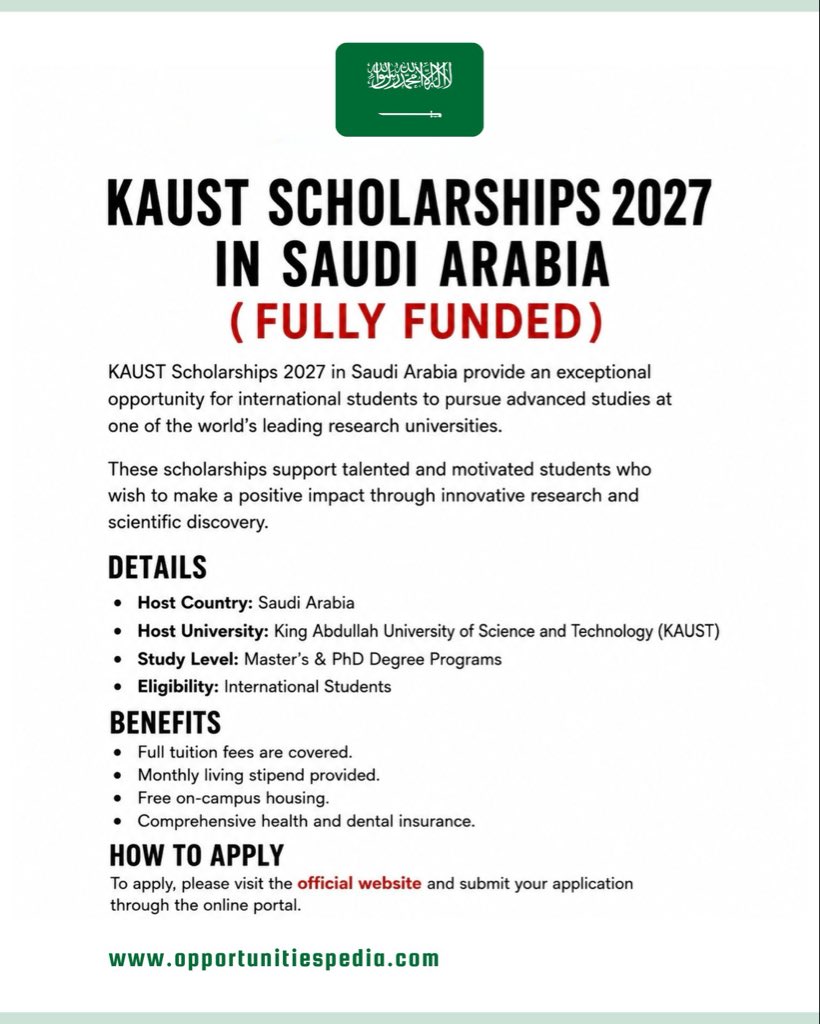
🇸🇦 KAUST Scholarships 2027 in Saudi Arabia | Fully Funded
Study at King Abdullah University of Science and Technology (KAUST) with comprehensive financial support.
✨ Benefits:
✅ Full tuition fee coverage
✅ Monthly living stipend
✅ Free on-campus housing
✅ Health & dental insurance
🎓 Study Level: Master’s & PhD
🌍 Eligibility: International Students
Details link: https://t.co/jVXjbP7mJx
📅 Deadline: 3 January 2027.
#KAUST #KAUSTScholarship #StudyInSaudiArabia #Scholarships2027 #OpportunitiesPedia
FRIAS Fellowship Programmes 2027/28 in Germany (Fully Funded)
Duration: 3–10 Months (depending on the fellowship programme)
🔗 Link: https://t.co/Pk2IFBq3yH
Benefits
• Monthly living allowance
• Accommodation allowance
• Mobility allowance
• Office space at FRIAS
• Access to University of Freiburg facilities
• International research environment
📅 Deadline: 18 September 2026
Credit: Freiburg Institute for Advanced Studies (FRIAS), University of Freiburg
The RIOT IQ Test is officially here in early access! We've developed the first professional, purely online IQ test.
First 2,000 users get 50% off with code: EARLYACCESSRIOT
Redeem at the Full RIOT test checkout: https://t.co/vkRWlyeWIl