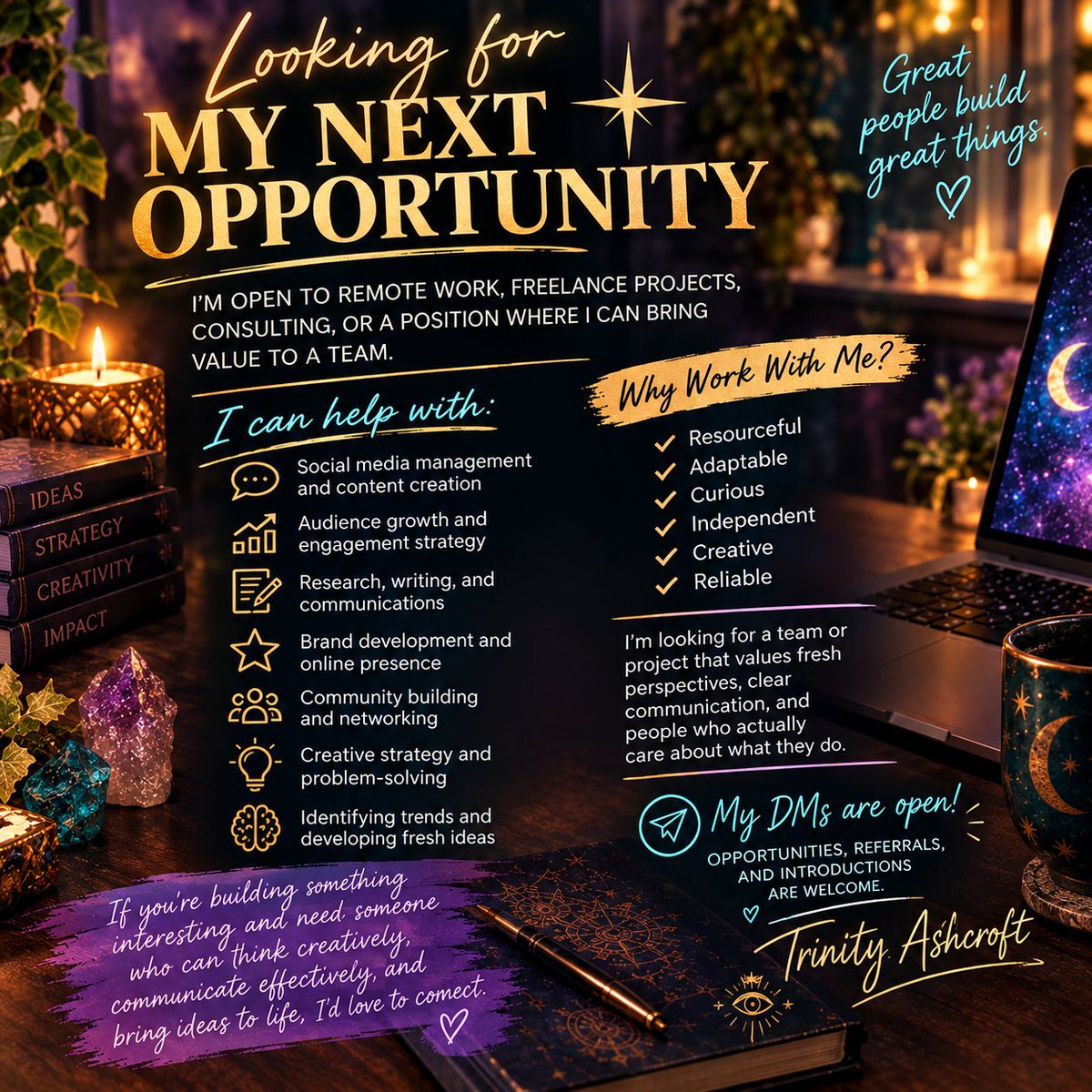
I'm looking for my next opportunity! I'm open to remote work, freelance projects, consulting, or a position where I can bring value to a team.
My strengths include:
• Social media management and content creation
• Audience growth and engagement strategy
• Research, writing, and communications
• Brand development and online presence
• Community building and networking
• Creative strategy and problem-solving
• Identifying trends and developing fresh ideas
I'm resourceful, adaptable, curious, and comfortable working independently. If you're building something interesting and need someone who can think creatively, communicate effectively, and bring ideas to life, I'd love to connect.
My DMs are open. Opportunities, referrals, and introductions are welcome!
I've been using X for 85 years, and i'm only just discovering that you can make dumb posts about screenshot copy link options over and over again and people just love it.
💋 A little reminder, 👑💎
If you’ve been wondering how to impress me, I’ve made it delightfully easy. Pick something that catches your eye, make it mine, and earn yourself a place in my thoughts. 💋 https://t.co/NmTH8LLfGa
Instead of asking whether crypto will go up or down tomorrow, ask what would have to change for today's valuations to become obsolete.
What if the infrastructure is evolving faster than the market understands? What if the risks are larger than acknowledged, or the opportunities are being underestimated?
Either way, the biggest shifts happen when the assumptions everyone relies on stop holding.
One of the most underrated forms of security is the ability to leave.
The ability to leave a bad investment without destroying your finances. The ability to change service providers without losing essential information. The ability to walk away from a business arrangement that no longer serves you. The ability to disagree with a group without losing your entire support system.
Options create leverage.
When you have alternatives, you can evaluate an arrangement based on its merits. When you have no alternatives, even an unfavorable arrangement can become difficult to challenge.
This is true in finance, technology, work, relationships, and institutions.
I think people sometimes focus so heavily on acquiring more that they overlook the importance of preserving flexibility.
A position can look valuable on paper while leaving you with very few practical choices.
That's why I pay attention to exit conditions, switching costs, dependencies, and the resources required to regain independence.
Security isn't only about protecting what you have.
It's also about making sure you aren't trapped by it.
11:11 gets all the attention.
But what about the numbers that appear repeatedly when nobody else is looking?
The ones you notice on receipts.
Clocks.
Addresses.
Random timestamps.
What's your recurring number?
Most people experience the world through its visible surface.
They see the product, not the supply chain. The payment, not the settlement infrastructure. The application, not the layers of software beneath it. The headline, not the incentives and relationships that shaped the story.
That's understandable. Nobody has time to investigate every system they use.
But I think there's value in occasionally stepping back and asking what makes the visible experience possible.
What has to happen behind the scenes? Which components are essential? Where are the dependencies? What happens if one of those components stops working?
These questions can reveal why seemingly small changes sometimes have consequences that are much larger than expected.
They can also help us understand where the real leverage exists in a system.
The visible part is often only the interface.
If you want to understand how something really works, start looking at what has to happen behind the scenes for it to work at all.