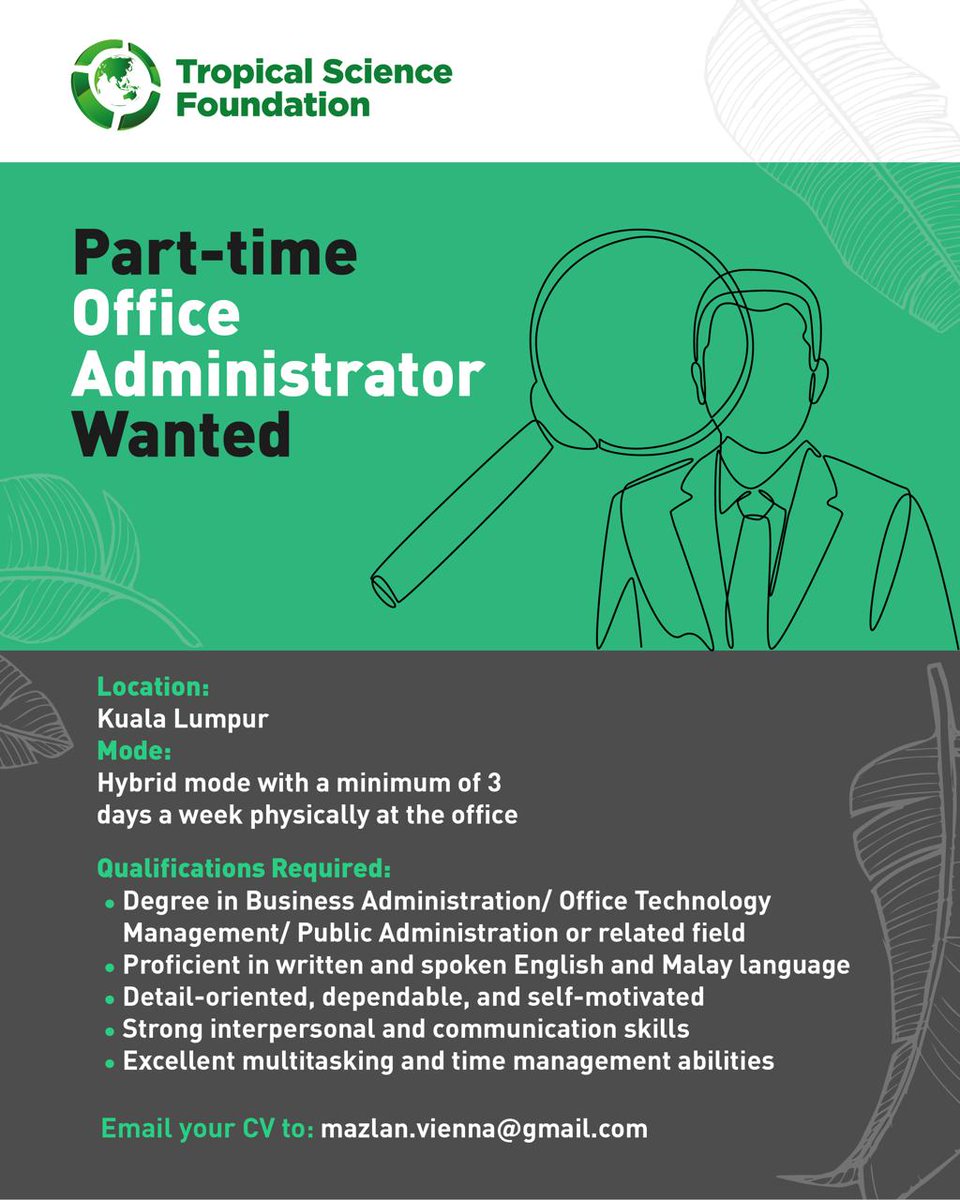
𝐓𝐫𝐨𝐩𝐢𝐜𝐚𝐥 𝐒𝐜𝐢𝐞𝐧𝐜𝐞 𝐅𝐨𝐮𝐧𝐝𝐚𝐭𝐢𝐨𝐧 𝐢𝐬 𝐡𝐢𝐫𝐢𝐧𝐠!
We're looking for a Part-Time Office Administrator with admin experience and strong management skills.
📩 If you are interested, drop your resume at [email protected].
Sejak penubuhannya pada 1995, ASM telah membudayakan sains, membentuk dasar berasaskan bukti serta memperkasa ekosistem STIE. Sambutan 30 tahun ini memperkukuh komitmen ASM ke arah masa hadapan yang inklusif, inovatif dan mampan. Tonton video perjalanan 30 tahun ASM!
#MOSTI #ASM30Tahun #ASM30Years #ASM3Dekad #JaringanPakarASM
This International Mountain Day 2024 (IMD 2024) focuses precisely on the capacity and needs of its people through a triple approach: “Mountain solutions for a sustainable future – innovation, adaptation, and youth.”
https://t.co/wod7MvF8y4
🌄 Join Us for International Mountain Day 2024!
📅 11 Dec 2024 | ⏰ 3 PM | 💻 Online
🌍 Theme: Mountain Solutions for a Sustainable
🎓 E-Certificates Provided
🔗 Register now or Scan Qr Code below: https://t.co/r27tE7FPn0
📢 Like & Share to support mountain sustainability!
Innovation is essential for addressing complex mountain-related issues. It encompasses technological advancements as well as creative problem-solving such as climate-smart agriculture.
They promote sustainable practices such as regenerative agriculture and agroforestry, which not only preserve trees and enhance soil and water quality but also support local communities.
Highlighting diverse ecosystems and animal life, the awards celebrate nature's resilience and diversity, emphasizing the need for conservation. This annual competition encourages photographers to inspire global awareness through powerful visuals.
The 2024 Nature’s Best Photography Awards showcase stunning images capturing the beauty of wildlife and landscapes from around the world.
https://t.co/1pOSkVRXZH
The integration of indigenous and local knowledge (ILK) has recently emerged as a method to improve understanding of wildlife in socio-ecological landscapes. However, wildlife conservation studies rarely consider the ethics or efficacy of integration.
By shifting the conceptual framework around ILK and increasing equitable indigenous and local participation, wildlife conservation projects can move towards knowledge co-production to achieve shared goals for the benefit of both people and wildlife.