Your New Identity In Christ
📖 Matthew 4:3 KJV
“And when the tempter came to him, he said, If thou be the Son of God..”
🎺 YOU are forgiven forever.
Colossians 1:14 KJV
“In whom we have redemption through his blood, even the forgiveness of sins:”
🎺YOU are accepted by God.
Ephesians 1:6 KJV
“To the praise of the glory of his grace, wherein he hath made us accepted in the beloved.”
🎺YOU are justified by faith.
Romans 5:1 KJV
“Therefore being justified by faith, we have peace with God through our Lord Jesus Christ:”
🎺YOU are made alive with Christ.
Ephesians 2:5 KJV
“Even when we were dead in sins, hath quickened us together with Christ, (by grace ye are saved;)”
🎺YOU are free indeed in Christ.
John 8:36 KJV
“If the Son therefore shall make you free, ye shall be free indeed.”
🎺YOU are kept by God’s power.
1 Peter 1:5 KJV
“Who are kept by the power of God through faith unto salvation ready to be revealed in the last time.”
🎺YOU are God’s workmanship.
Ephesians 2:10 KJV
“For we are his workmanship, created in Christ Jesus unto good works, which God hath before ordained that we should walk in them.”
🎺YOU are sealed until redemption.
Ephesians 4:30 KJV
“And grieve not the holy Spirit of God, whereby ye are sealed unto the day of redemption.”
🎺YOU are complete in Jesus Christ.
Colossians 2:10 KJV
“And ye are complete in him, which is the head of all principality and power:”
🎺YOU are new creature in Christ.
2 Corinthians 5:17 KJV
“Therefore if any man be in Christ, he is a new creature: old things are passed away; behold, all things are become new.”
🎺YOU are an heir of God.
Romans 8:17 KJV
“And if children, then heirs; heirs of God, and joint-heirs with Christ; if so be that we suffer with him, that we may be also glorified together.”
🎺YOU are no longer condemned.
Romans 8:1 KJV
“There is therefore now no condemnation to them which are in Christ Jesus, who walk not after the flesh, but after the Spirit.”
🎺YOU are seated in heavenly places.
Ephesians 2:6 KJV
“And hath raised us up together, and made us sit together in heavenly places in Christ Jesus:”
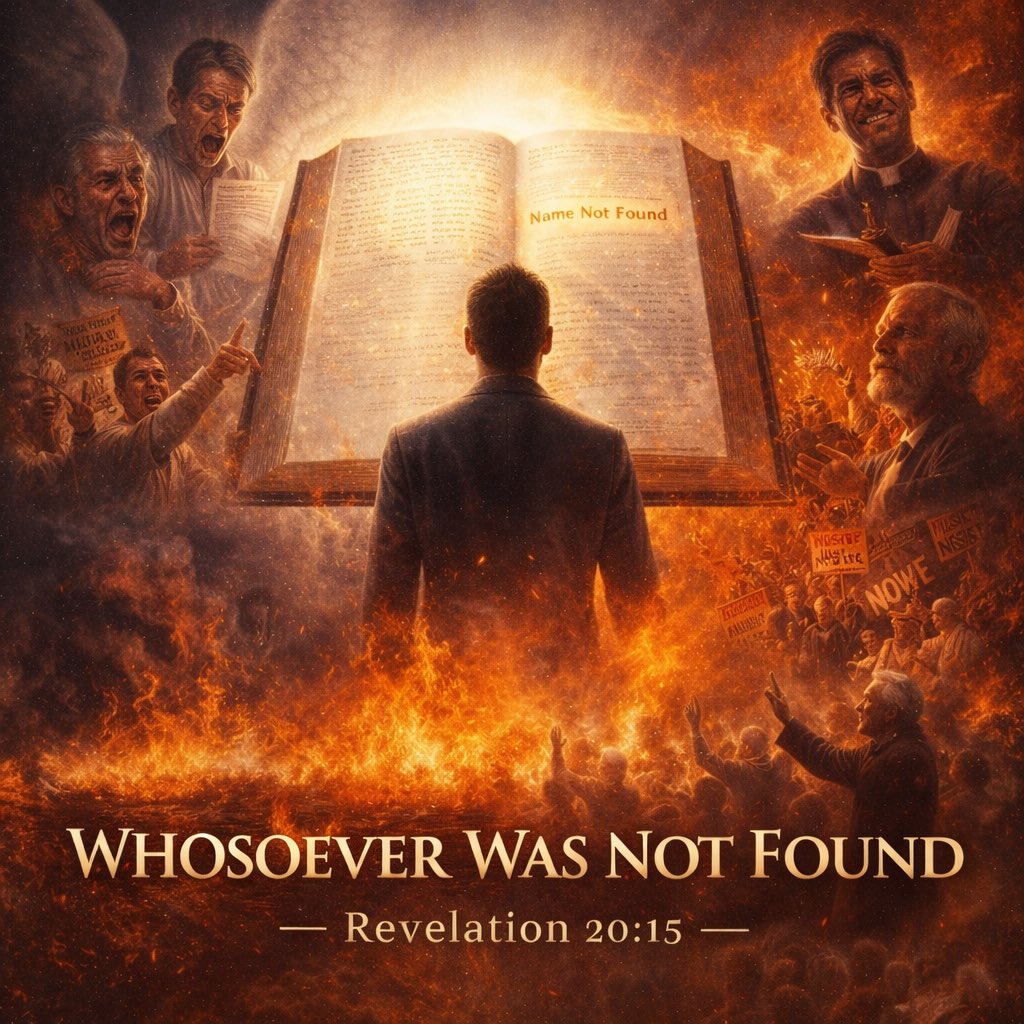
Whosoever Was Not Found - Revelation 20:15
Individual Accountability - Not Group Condemnation
Introduction
Revelation 20 ends with a sentence so plain a child can read it, yet so heavy it can crush a man’s pride like wet paper. “And whosoever was not found written in the book of life was cast into the lake of fire” (Revelation 20:15). That is not poetry. That is not symbolism. That is not a devotional thought to print on a coffee mug. That is a courtroom verdict followed by an immediate execution. It is the last word of God on the last judgment of the lost, after a thousand years of Christ’s reign, after Satan’s final revolt, after the last deception, after the last fire from heaven. When you reach this verse, you are not dealing with religion anymore. You are dealing with the Judge.
The modern pulpit hates this verse because it destroys the two idols of the age: sentimental theology and collective excuses. The first idol says God is too “loving” to judge. The second idol says guilt is always somebody else’s fault, society’s fault, your parents’ fault, your church’s fault, your trauma’s fault, your government’s fault, your “system’s” fault. Revelation 20:15 does not argue with your sociology. It does not care about your narrative. It does not consult your therapist. It does not check your denominational paperwork. It says “whosoever.” It says “was not found.” It says “written.” It says “book of life.” It says “cast.” It says “lake of fire.” That verse will not bend for you.
And the fear of it is not that God will condemn people in groups like a tyrant with a quota. The fear of it is the opposite. The fear is that He will deal with you as an individual, with your own name, your own record, your own light rejected, your own conscience violated, your own sins committed, your own Christ refused. “So then every one of us shall give account of himself to God” (Romans 14:12). You can hide in a crowd on earth. You cannot hide in a crowd at the great white throne. You will not be “one of the unfortunate masses.” You will be you, standing there with nothing but the truth.
1. The Last Line of the Last Courtroom
Revelation 20:11 tells you the setting. “And I saw a great white throne, and him that sat on it, from whose face the earth and the heaven fled away” (Revelation 20:11). In that moment, the props are removed. Whatever men used to distract themselves, the sky, the lights, the seasons, the rhythms, the horizons, the noise of life, the commerce, the entertainment, the politics, it is all gone. There is no hiding behind the created order when the Creator takes the bench. The creation itself steps aside. You are left with God and the truth. That alone should make a man stop joking about judgment.
Then the Holy Ghost says, “And I saw the dead, small and great, stand before God” (Revelation 20:12). There is no “VIP section” at this throne. There is no rich man’s exemption, no poor man’s sympathy card, no celebrity pass, no academic loophole. Small and great stand there the same way, dead and exposed, and the Judge does not ask them what the polls said. He does not ask them what their friends thought. He does not ask them how sincere they were in their delusion. He judges them with books. “And the books were opened” (Revelation 20:12). When God opens books, the talking stops.
That is why Revelation 20:15 is the final nail. It is not God losing His temper. It is God closing the case. People talk about “harshness” as if this is some outburst. It is not. The sentence comes after evidence, after records, after every mouth is stopped. Romans 3 tells you how it ends: “that every mouth may be stopped, and all the world may become guilty before God” (Romans 3:19). The great white throne is not group condemnation. It is the end of every excuse.
2. “Whosoever” Means Your Name, Not Your Crowd
The word “whosoever” is a sword. Men love “whosoever” when it is in the invitations. “For whosoever shall call upon
🚨🚨 NOW LIVE on VerseQuest! 🚨🚨
Escaping Messianic Judaism Error – 25-Part Exclusive Series
https://t.co/KsopbhKKP2
This series pulls the mask off a movement that LOOKS biblical while quietly shifting believers from Christ alone to Christ plus Torah. Calendar pressure, Sabbath fear, feast guilt, Hebrew-word mysticism, and “restoration” propaganda are dragging sincere Christians back under a yoke God never gave the Church. We walk straight through Acts 15, Galatians, Romans, and Colossians 2 from a rightly divided King James Bible perspective to answer one question: Are we complete in Christ, or must we perform like Israel to be “truly obedient”?
You’ll learn how to spot the bait-and-switch, answer the common arguments, and recover real New Testament discipleship without legalism. This is for believers being pressured, families being divided, and saints who feel guilty for living in the liberty of Jesus Christ. The gospel is not a Hebrew identity project, it is the finished work of the Son of God.
Stand fast therefore in the liberty wherewith Christ hath made us free (Galatians 5:1).
#VerseQuest #KJV #RightlyDivided #GraceNotLaw #HebrewRoots #MessianicJudaism #Acts15 #Galatians #PaulineDoctrine #FinishedWork #ChristianLiberty #SoundDoctrine
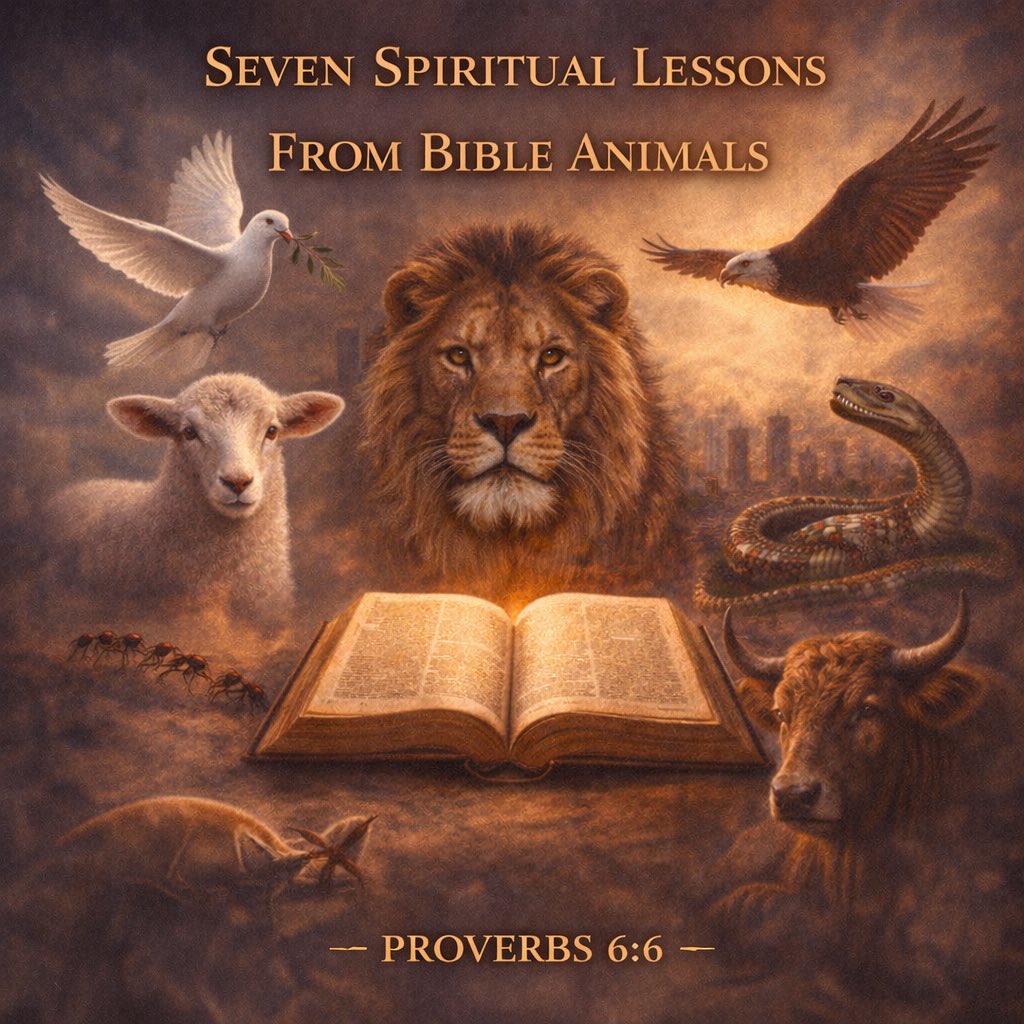
Seven Spiritual Lessons From Bible Animals
INTRODUCTION
God did not fill His Book with animals just so a Sunday School teacher could keep the kids quiet with a coloring page. The Lord uses animals like living parables because a man can argue with doctrine, but he can’t argue with a picture that stares him in the face. A sheep doesn’t pretend to be a wolf. A serpent doesn’t apologize for being subtle. An ant doesn’t complain about working while the sluggard sleeps. The Bible says, “Go to the ant, thou sluggard; consider her ways, and be wise” (Proverbs 6:6). That is God telling a grown man to sit down and learn from a bug.
The problem with modern Christians is they want “deep” truth while ignoring the plain truth sitting right in front of them. They want to chase charts, podcasts, and personalities, while God is saying, “Look at the lamb. Look at the lion. Look at the dove. Look at the ox.” There is nothing shallow about God’s object lessons. The Holy Ghost can teach you more through a sheep and a shepherd than a seminary professor can teach you in a year of lectures if that professor doesn’t believe the Book. Jesus Christ Himself preached with animals and nature because truth is not impressed with your vocabulary.
So this is for the Bible believer who wants practical spiritual instruction with teeth in it. These seven animals are not random. Each one is a mirror. Each one exposes something in you. Some of them comfort you, some of them rebuke you, and some of them warn you. And if you are honest, you will find yourself in every one of them at some point. God’s creatures become God’s classroom, and the man who refuses to learn from the Lord’s lessons stays childish, proud, and easily deceived.
1. THE LAMB AND THE LESSON OF SUBSTITUTION
The first animal God uses to teach you is the lamb, and the lesson is substitution. A lamb is innocent, harmless, and defenseless, and that is exactly why God chose it as the picture of the Saviour. When John the Baptist saw Jesus, he did not say, “Behold the philosopher,” or “Behold the moral example.” He said, “Behold the Lamb of God, which taketh away the sin of the world” (John 1:29). That is blood doctrine, not sentimental religion. God’s solution for sin was not education. God’s solution for sin was sacrifice.
All through the Old Testament, the lamb is tied to the blood. At Passover the Lord said, “Your lamb shall be without blemish” (Exodus 12:5), and then He commanded the blood to be applied, because the issue was not sincerity, it was satisfaction. God said, “When I see the blood, I will pass over you” (Exodus 12:13). He didn’t say, “When I see your good intentions.” He didn’t say, “When I see your church membership.” He said, “When I see the blood.” That is substitution. Something dies in your place so you can live.
That lesson will keep you from two deadly traps. It will keep you from pride, because you can’t brag about being saved when your salvation required a slaughtered Substitute. And it will keep you from despair, because if the blood paid for all your sin, then the devil’s accusations are just noise. “In whom we have redemption through his blood, the forgiveness of sins” (Colossians 1:14). The lamb teaches you that God does not forgive by pretending sin is small. He forgives by judging sin in a Substitute, and that Substitute is Jesus Christ.
2. THE LION AND THE LESSON OF AUTHORITY
The second animal is the lion, and the lesson is authority. The modern world tries to turn Jesus into a tame religious mascot, but the Bible presents Him as a King with a roar. The Scripture says, “Behold, the Lion of the tribe of Juda, the Root of David, hath prevailed” (Revelation 5:5). That Lion is not begging for votes. He is not running for office. He is not asking permission from culture. He has prevailed. That is authority.
A lion does not negotiate with prey, and Jesus Christ does not negotiate with truth. He speaks with final authority, and that it’s
Seven Books of the Bible to Read If You’re Struggling
INTRODUCTION
When a man is struggling, he does one of two things: he runs to God or he runs from God. The world runs to noise, busyness, entertainment, pills, bottles, and counselors who charge by the hour to tell you what Solomon already told you for free. But a Bible believer has something better than therapy vocabulary. He has the living words of the living God. The Lord didn’t leave you down here with nothing but your own thoughts, because your thoughts will kill you if you keep them long enough without light. “Thy word is a lamp unto my feet, and a light unto my path” (Psalm 119:105). When you are stumbling, you don’t need more darkness in your head. You need light.
The devil loves to isolate a Christian in his own mind. That is where the accusations get loud and the hopelessness gets heavy. He will whisper that you are the only one who has ever felt this way, the only one who has ever failed like this, the only one who has ever been that weak. It’s a lie. The Book is full of God’s people struggling, trembling, weeping, doubting, and groaning, and the Holy Ghost put it there so you would not feel alone. “For we have not an high priest which cannot be touched with the feeling of our infirmities” (Hebrews 4:15). God knows what you carry, and He wrote a Book that meets you in the valley.
So this is not a cute list for people who want a devotional thought with a cup of coffee. This is for the Christian who is fighting through grief, fear, temptation, depression, exhaustion, spiritual dryness, or discouragement. You don’t need seven man-made slogans. You need seven places in the Book where God speaks with authority and comfort. Here are seven books of the Bible to read if you’re struggling, and why each one will hit the exact nerve the devil keeps poking.
1. PSALMS - WHEN YOUR HEART IS BLEEDING
If you are struggling in your emotions, Psalms is where you go first. Psalms is the prayer book of a man who knew betrayal, fear, guilt, pressure, and sorrow, and still kept his eyes on God. David wasn’t writing polite religious poetry. He was writing with tears on the page. “Why art thou cast down, O my soul? and why art thou disquieted within me?” (Psalm 42:5). That is the language of a man struggling inside, not acting for church folks outside. When you read that, you find out the Bible doesn’t pretend.
Psalms gives you permission to speak honestly to God while still staying reverent. David says, “I poured out my complaint before him; I shewed before him my trouble” (Psalm 142:2). Notice the balance: complaint, but before God; trouble, but showed to God. A struggling Christian often feels guilty for feeling what he feels. Psalms teaches you to turn the feeling into prayer instead of turning it into bitterness. When you can’t explain your pain to people, you can pour it out to the Lord.
And Psalms keeps dragging your eyes back up when your soul keeps dragging them down. David will start in the pit and end with praise, because the Lord doesn’t always change the circumstance first, but He changes the spirit in the circumstance. “The LORD is nigh unto them that are of a broken heart” (Psalm 34:18). When your heart is broken, Psalms is not theory. It is oxygen.
2. JOB - WHEN YOU DON’T UNDERSTAND WHY
If your struggle is confusion, loss, and “Why is God allowing this?”, Job is the book you need. Job teaches you something the modern church doesn’t like to admit: sometimes God lets a righteous man hurt. Job wasn’t suffering because he was backslidden. He was suffering because there was a battle in the unseen world that he could not see. Satan had to ask permission, because he couldn’t touch Job without it. That alone ought to settle some fear. The devil is not free. He is limited.
10 THINGS THAT BRING YOU FASTER INTO THE ANSWER TO YOUR PRAYER:
1
Clarity of desire — heaven responds to precision, not vagueness
2
Agreement with God’s Word — faith doesn’t debate what God already said
3
Thanksgiving before manifestation — gratitude treats the answer as real
4
Consistency of faith — not repeating the request, but rehearsing the answer
5
Right words — declarations shape outcomes (Proverbs 18:21)
6
Forgiveness — unresolved offense blocks spiritual flow (Mark 11:25)
7
Expectation — faith anticipates, it doesn’t merely wish (Mark 11:24)
8
Obedience to small instructions — movement unlocks momentum (John 2:5)
9
Giving — sowing accelerates reaping (Luke 6:38)
10
Rest — striving slows what trust releases (Hebrews 4:3)
Faith doesn’t keep asking.
Faith keeps agreeing.
You don’t pray toward the answer.
You pray from it.
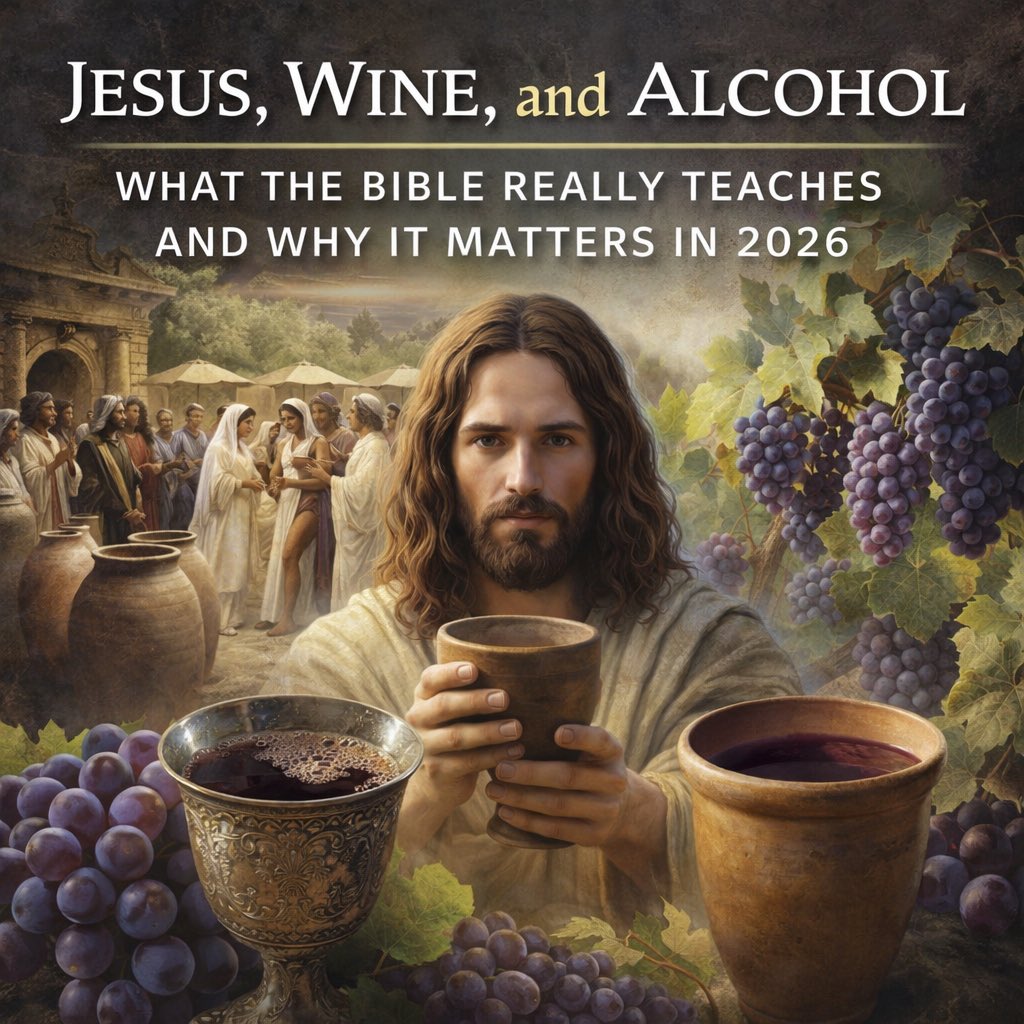
Jesus, Wine, and Alcohol: What the Bible Really Teaches and Why It Matters in 2026
Main Passages: John 2:1-11; Matthew 26:27-29; Proverbs 20:1; Proverbs 23:29-35; Ephesians 5:18
Introduction
People keep asking the same question because the word “wine” in the Bible is used in more than one way, and modern Christians read the Book like it was written yesterday in a liquor store aisle. That is a setup for confusion. You open the Scriptures and you see warnings that sound like God is waving a red flag over the whole subject, “Wine is a mocker, strong drink is raging: and whosoever is deceived thereby is not wise” (Proverbs 20:1). Then you see passages where “wine” is associated with blessing, harvest, joy, offerings, and even a little medicinal use, and folks think the Bible is contradicting itself. It is not. The contradiction is in the reader, not the text. The Bible is precise, but you have to let it define its own terms and you have to stop assuming that every time you see the word “wine” it means modern, bottled, fermented alcohol.
The second reason people ask is because the most common arguments are emotional and tradition-driven. Somebody will say, “Jesus turned water into wine, so He approved drinking.” Somebody else will say, “Paul told Timothy to use a little wine, so it must be fine.” Then somebody else points out that drunkenness is condemned and tries to split the difference with a so-called moderation doctrine. But the Bible does not treat intoxicants as a harmless hobby that only becomes sinful after an invisible line is crossed. Scripture repeatedly frames alcohol as a deceiver, a corrupter of judgment, a danger to the weak, and a destroyer of families, ministries, and testimony. When God says, “Look not thou upon the wine when it is red, when it giveth his colour in the cup, when it moveth itself aright” (Proverbs 23:31), that is not a love letter to moderation. That is a warning aimed at the very nature of the thing.
The third reason this matters is because 2026 is not ancient Israel. We live in a culture that markets intoxication as personality, therapy, sophistication, and “self-care.” The alcohol percentage is engineered. The access is constant. The social pressure is relentless. The damage is measurable, and it shows up in broken homes, wrecked purity, wrecked finances, wrecked testimonies, wrecked nerves, wrecked minds, and wrecked churches that will rebuke everything except the “respectable” sins that sit at the table on Saturday night and sing in the choir on Sunday morning. So I am going to answer the question the way the Book answers it, not with excuses, not with loopholes, but with Scripture, common sense, and honest history.
1. What Does “Wine” Mean in the Bible?
The first key is simple. The Bible uses the same word for the product of the vine in different stages and forms. English does it, too. People say “cider” and they might mean sweet or hard. People say “wine” and they might mean fresh juice, fermented drink, or something in between. The Bible languages have the same range. That matters because a man can build a whole theology on one lazy assumption, and the most popular lazy assumption is that Bible “wine” always means fermented alcohol. It does not. That one assumption is the engine behind most moderation preaching, and once you pull that engine, the whole car stops.
The Bible itself gives you a definition that should settle a lot of the noise. “Thus saith the LORD, As the new wine is found in the cluster” (Isaiah 65:8). New wine in the cluster is not a bottle of booze. It is the fresh product of the grape. The Book also shows grapes being squeezed directly into a cup. The butler said, “Pharaoh’s cup was in my hand: and I took the grapes, and pressed them into Pharaoh’s cup, and I gave the cup into Pharaoh’s hand” (Genesis 40:11). That is not a distillery. That is not a fermentation lecture. That is the vine’s fruit, fresh and direct, and Scripture
🚨‼️Most Christians say they love the cross, but they don’t love the book that explains it. They shout about Calvary and skip Leviticus like it’s a phone book. But God put Leviticus in the middle of the Torah because the cross sits in the middle of redemption. If you don’t understand burnt offerings, sin offerings, and the Day of Atonement, you don’t understand what Jesus was doing on that hill outside Jerusalem. You’ve got a sentimental Savior instead of a sacrificial Lamb. Leviticus is the dictionary of Calvary, and a Christianity that ignores it is speaking a language it doesn’t understand.
Modern religion wants a bloodless gospel with a smiling Jesus who never offends anybody. Leviticus ruins that fantasy. It tells you that before there was singing, there was slaughter, before there was fellowship, there was fire, and before there was peace, there was death. God didn’t start worship with a praise band. He started it with a knife and an altar. Every drop of blood in that book was preaching that sin is expensive and holiness is not a hobby. You can decorate a church with lights and fog, but you can’t decorate away the fact that God demands blood.
The reason Hebrews makes so many Christians dizzy is because they never learned Leviticus. They don’t know why there was a mercy seat, why the high priest went in once a year, why there were two goats, why fat belonged to God, why strange fire killed priests. So when Paul says Christ is our High Priest and our once-for-all sacrifice, they nod without knowing what they’re nodding at. Leviticus is not Jewish trivia; it’s New Testament oxygen. Tear it out and you suffocate the gospel.
A Christianity that skips Leviticus ends up with a plastic Jesus and a paper cross. It produces churches that talk about surrender without sacrifice, worship without obedience, and grace without holiness. God put that book there to keep us honest. If you can walk through Leviticus and still treat sin lightly, you didn’t read it, you skimmed it. The cross is not a necklace. It’s an altar, and Leviticus proves it.
Why Do Christians Still Struggle with the Flesh After Being Saved?
Introduction
A man gets saved and expects everything inside him to line up like soldiers at inspection. He thinks the moment he trusts Christ, the old desires will pack their bags, the bad habits will evaporate, the temper will vanish, and the mind will suddenly sound like a hymnbook. Then the first real temptation hits, and he finds out his old nature did not die quietly. It is still there, still loud, still stubborn, and still capable of making a fool out of him if he lets it. That shocks a lot of people because they were sold a fantasy version of Christianity where salvation is presented like a complete personality transplant. The Bible never promises that. The Bible promises a new birth, not an instant glorification.
The truth is that salvation is real, complete, finished, and perfect in Jesus Christ, but God did not save your flesh. He saved you, and the “you” that got saved is the inner man, the soul that trusted the Savior, the spirit that was dead and is now made alive. “And you hath he quickened, who were dead in trespasses and sins” (Ephesians 2:1). But the body you live in is still the same body with the same appetites and the same weaknesses. Paul said, “Now if I do that I would not, it is no more I that do it, but sin that dwelleth in me” (Romans 7:20). He did not say it to excuse sin. He said it to explain the war.
So the question is not whether a Christian should struggle. The question is why the struggle exists and how God expects you to deal with it. The Bible answers that plainly, and it answers it in a way that preserves assurance without excusing sin. God will not let you pretend that grace means you can live like the Devil. But He also will not let the Devil convince you that every battle proves you were never saved. The struggle is real, the warfare is normal, and the victory is available, but it is never found by trusting your flesh. It is found by trusting God’s word and yielding to God’s Spirit.
1. Salvation Changes Your Nature, Not Your Flesh
When you got saved, you did not get a new body. You got a new birth. Jesus told Nicodemus, “That which is born of the flesh is flesh; and that which is born of the Spirit is spirit” (John 3:6). That verse alone crushes a mountain of confusion. The flesh produces flesh, and it stays flesh. The Spirit produces spirit, and that is where the new life begins. You were not renovated. You were regenerated. God did not improve your old nature. He gave you a new one.
That is why the Bible speaks of “the new man.” “And that ye put on the new man, which after God is created in righteousness and true holiness” (Ephesians 4:24). That new man is real, and it is created “after God,” not after your upbringing, not after your church background, and not after your personal discipline. But the Bible also speaks of “the old man.” “Knowing this, that our old man is crucified with him” (Romans 6:6). The old man is judged at Calvary, and in God’s record that old man has been sentenced. But the presence of the flesh means you still carry around the old ways, the old reflexes, and the old cravings, and you will have to learn, by practice, to live out what is already true in Christ.
A saved man therefore lives with two realities at once. He is complete in Christ and still capable of sin in the flesh. He is accepted in the Beloved and still has to mortify the deeds of the body. He is a child of God and still has a body that wants to act like a hog in a slop trough. That is why Paul can say, with full confidence, “There is therefore now no condemnation to them which are in Christ Jesus” (Romans 8:1), and in the same Bible he can also warn believers, “For if ye live after the flesh, ye shall die” (Romans 8:13). One is your standing. The other is your walk.
2. God Did Not Save the Body Yet, and He Told You So
A Christian struggles with the flesh because the redemption of the body is