As Treasuries, funds, private credit, and stocks move onchain, a recent @Citi report examines how Aave could become the financing layer for all of them.
Morpho’s fee switch can take up to 25% of the interest borrowers pay. Once it’s on, protocol dynamics change.
The detail most people miss: the fee is set at the market level, not the vault level. It comes out before curators or lenders see a dollar.
Quick napkin math on a market at 6% borrow APY and 90% utilization, with the fee at max:
• Lender supply yield: 5.4% → 4.05%
• Curator earning a 10% performance fee: 0.54% → 0.41% of AUM
• Lender yield net of curator fee: 4.86% → 3.65%
Everyone takes the same 25% haircut on their interest-derived revenue, while curators still bear the full cost of risk management. That’s the margin squeeze @StaniKulechov is pointing at.
If the switch flips, do curators cut their fees to stay competitive, or does capital move to @Aave V4 where curators own the market economics?
Kling 4.0 is live on Venice.
Built for long takes, Kuaishou's latest video model creates 30-second takes from up to 15 reference assets, 10 keyframes, and stereo audio with accurate lip-sync.
Available anonymously.
Morpho’s fee switch can take up to 25% of the interest borrowers pay. Once it’s on, protocol dynamics change.
The detail most people miss: the fee is set at the market level, not the vault level. It comes out before curators or lenders see a dollar.
Quick napkin math on a market at 6% borrow APY and 90% utilization, with the fee at max:
• Lender supply yield: 5.4% → 4.05%
• Curator earning a 10% performance fee: 0.54% → 0.41% of AUM
• Lender yield net of curator fee: 4.86% → 3.65%
Everyone takes the same 25% haircut on their interest-derived revenue, while curators still bear the full cost of risk management. That’s the margin squeeze @StaniKulechov is pointing at.
If the switch flips, do curators cut their fees to stay competitive, or does capital move to @Aave V4 where curators own the market economics?
if you've been sleeping on @NEARProtocol, here's the short version of why people keep bringing it up.
Near is a layer 1, but what's actually pulling people in right now is near intents. you say what you want, like swap this token on this chain for that one, and it handles the routing across 35+ chains. no bridging five times, no juggling gas on every network.
illia said intents volume went from about $2b to $34b in a year and bitwise also launched the first us near etf.
The ai angle is real too, near's whole pitch lately is being the chain where ai agents can transact across networks, and they've got private ai inference through near ai cloud.
Your account is just a readable name like yourname.near instead of a long 0x string, which honestly makes onboarding way less scary for normies
if you're new, start small. get a near wallet, grab a little near, and try one swap through intents so you can see how it works.
There’s some noise right now too, dfinity is accusing near of copying its cryptography. worth reading both sides, but it doesn't change how the product feels to use.
NFA, just think it's one the utility to look up right now.
Yeah a breakout to the upside would reallllllly suck here.....I mean, we're all bearish now, right???
Get it together guys. The bull market is just starting.
Accumulate your desired % of networks. Spot only. Zoom way out.
This is the way.
It hasn't only been Zcash and HYPE.
The barbell strategy. Store of value on one end, onchain revenue on the other.
Right next to it, the AI privacy trade.
@NEARProtocol ran from $0.97 to $5.33 on our watch.
We've been covering winners all year.
And the real bull hasn't even started. Tune in.
near:native $ZEC $HYPE
Bitcoin is not going much lower.
Max pain is up. People are sidelined and scared as we near the completion of the first multi-week pullback in a fresh crypto bull market.
Leading tokens are consolidating in very bullish ranges.
Do not let them shake you out. Do not get bearholed. Never go full doomer.
Bull market to continue.
What he forgot to mention is that Morpho can charge fees at the market level, allowing it to capture the economic value created by curators without bearing the cost of risk management.
This means markets are neither neutral nor ownerless. Curators invest in building liquidity and managing risk, but Morpho retains the ability to extract a share of the revenue, compressing curator margins and accelerating competition toward zero profitability.
This creates a fundamental misalignment: either Morpho monetizes and competes for the economics generated by curators, or it doesn't and must sustain its business through other revenue sources once incentives run out.
Curators should own their market economics and capture fees from both lending and borrowing. Otherwise, they're building businesses on infrastructure that can tax away their margins. Full stop.
This is why Paul is spooked about Aave V4.
Aave doesn't need to find its next million users. Coinbase, Circle and Lido are bringing them.
That's the real idea behind Aave V4. Instead of one lender building every market itself, V4 is a platform. There's one shared pool of money, the Hub, and separate lending markets, the Spokes, that plug into it. Each Spoke has its own collateral and risk rules, but they all draw on the same liquidity.
Now here's where it gets interesting. Every partner that plugs in brings its own users, and those users tap money that's already sitting in the pool. Lido, EtherFi, Ethena and Tether's gold token are live. Coinbase's tokenized stocks on Base, like Apple, Nvidia and Tesla, can now be used as collateral to borrow USDC. Circle went live on its own chain, Arc, in September.
In other words, Aave doesn't have to build each market from scratch. Partners bring the users, and the shared pool gets deeper with every one that joins. That's the flywheel.
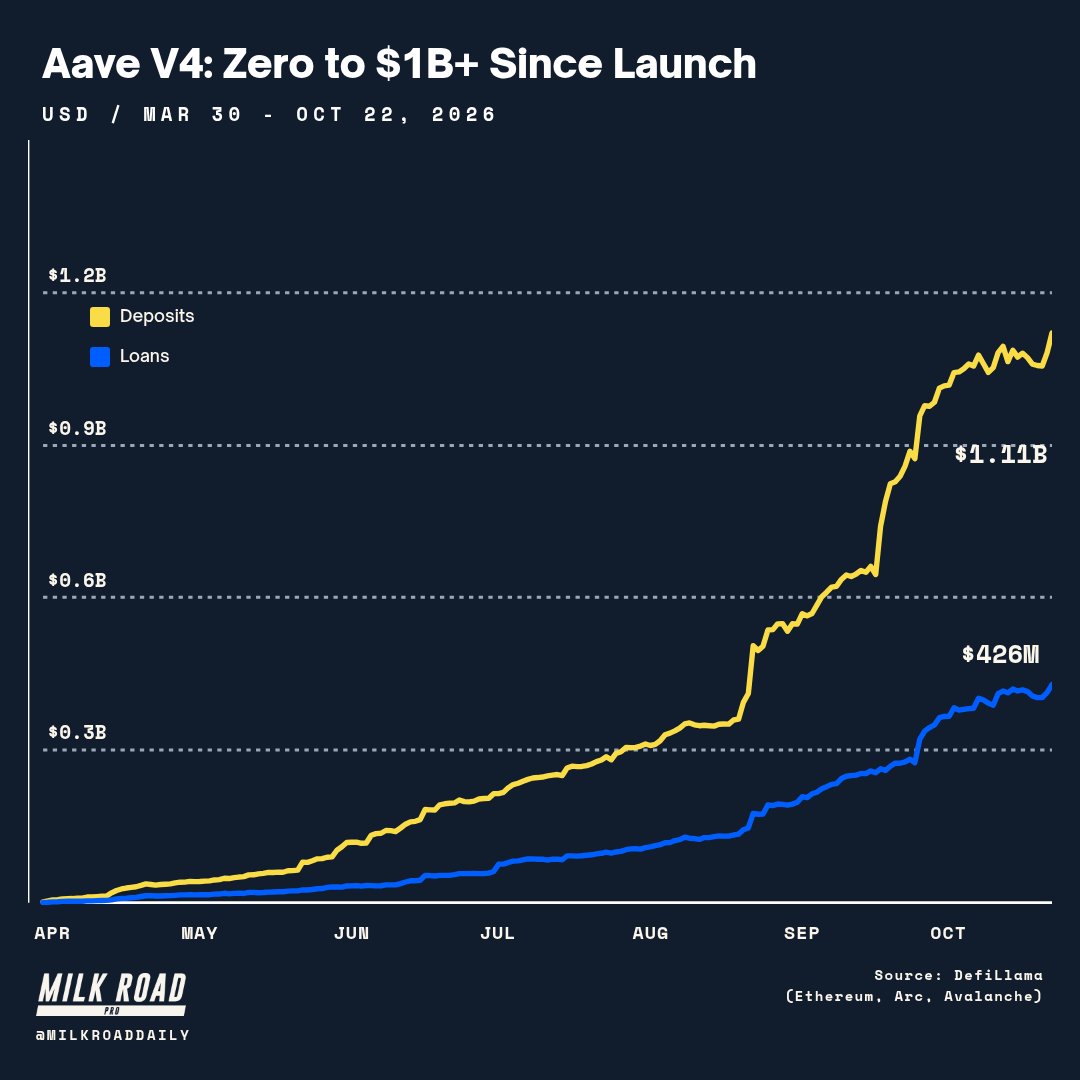
And it's working. V4 went from zero at launch in March to over $1.1B deposited and about $426M borrowed. In the last month alone, deposits grew about 30% and loans about 50%.
To be fair, there are real catches. This isn't open to everyone: each new Spoke needs an Aave DAO vote, while Morpho lets anyone create a market. Rewards are still being used to kick-start some markets. And V4 is still a small slice of Aave.
On risk, each Spoke carries only the risk it signs up for: its own collateral, its own limits, its own liquidation rules. The Hub gives every Spoke a capped credit line, so a bad market can't empty the whole pool.
I’m excited to see V4 keep scaling. This feels like Aave’s next big growth lever. Tokenized equities could be a compelling adoption wedge too, since they will likely be lent out for yield in the end, value that brokers mostly capture today.
Follow me @m0xt_ for more market updates.
$AAVE already has about 30% market share, and Milk Road analyst Martin thinks tokenization hands it a lot more
"The bull case for AAVE is just easy to make"
His logic: as stocks, treasuries, even houses move onchain, people lend them out, and "liquidity begets liquidity"
Revenue isn't there yet. He has Aave around breakeven today
If that future plays out, he sees a "tens of billions company" in no time
FT @m0xt_@KyleReidhead@BitcoinJesusETH
Gemini quietly listed NEAR. The public API has had a NEARUSD spot pair with status "open" since Oct 23, with live quotes and test trades. The website still says the token is not offered.
What the announcement could bring beyond the spot pair:
> NEAR as a cashback option on the Gemini credit card. Every coffee buys NEAR.
> NEAR in Gemini Earn: staking for US retail that never opened a wallet.
> Gemini Custody for NEAR. One more regulated custodian ahead of the Bitwise ETF decision.
> A Zcash angle. Gemini is the loudest institutional ZEC backer right now, and NEAR Intents is the main rail moving ZEC across chains.
Gemini is one of the most careful exchanges in the US on listings. Their lawyers said yes.
$36B+ volume on @near_intents and climbing.
Confidential Intents already over $3.5B in volume.
37 chains, 200+ assets, fees flowing back into $NEAR buybacks.
This is what product-market fit looks like.