@SetthakornB@MechDara1 Old mine left from the past, you know that? If it’s new in your land only your Thai military planted that and they stepped on it by themselves. Who didn’t know your military is 3 times bigger? How can possible Cambodia. Military planted on yours?
It is a striking coincidence that Thailand demolished a Hindu statue on Cambodian territory on the same day that East Asia Forum published the article “Thailand, the Sick Man of Southeast Asia?”. The article emphasizes not only Thailand’s economic slowdown and its struggle with the middle-income trap, but also the spillover of domestic problems into foreign policy, to the point where border conflicts with neighbouring countries become a symptom of deeper political and structural dysfunction.
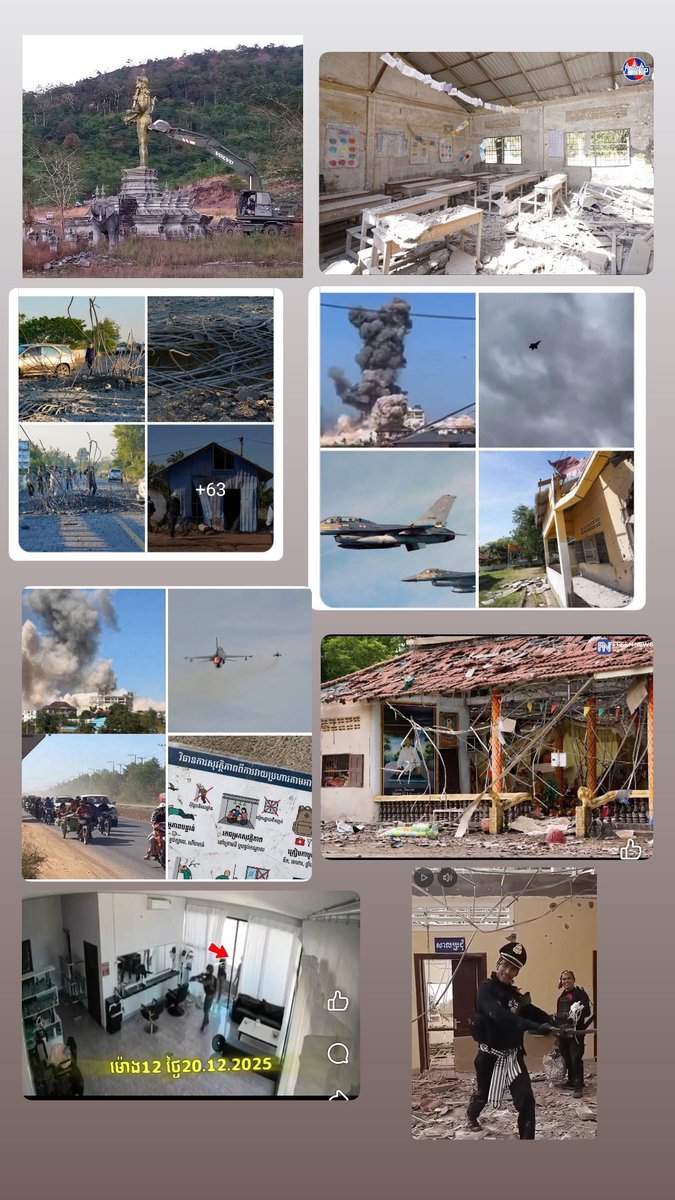
Thailand commits war crimes:
- They bomb ancient temple
- They bomb schools
- They bomb civilian homes
- They bomb Pagoda
- They destroy Vishnu statues
- They shoot innocent civilians
- They steal civilian's property
@newsonjapan@newsjapan123@japan@msnsgnews@UN@UNHumanRight
A U.S. missionary living in Cambodia for decades urged U.S. Secretary of War @PeteHegseth to deploy U.S. troops to halt Thai bombardments, stop what he called a meaningless war, push for a ceasefire within 24 hours, and send food aid to displaced people.
@Aye_Blin@TridentxIN Thai government so faking stupid by allowing Cambodia to build on its own territory? It’s not make sense🙂↕️ If this could happened, Thai government so low. But hey dont try to prove stupid ideas like that.
Buddhists in South East Asia destroying statues of Vishu on one hand.
Top Ji sending aid to Sri Lankans on the other. Hindoos haven't been humiliated like this since the Delhi Sultanate.
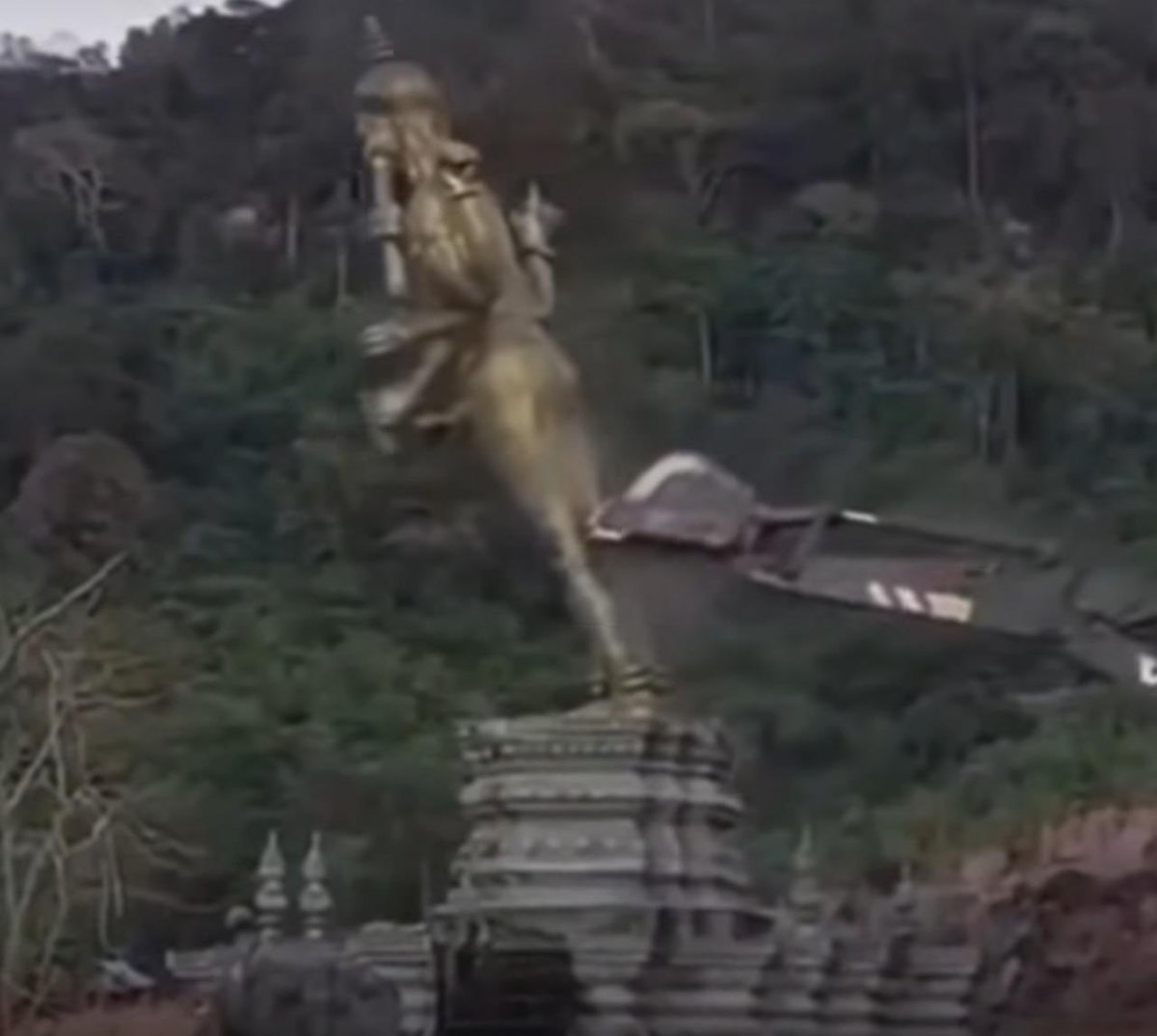
Heartbreaking, when we see a large Hindu statue of god Vishnu was destroyed by Thai military, in An Ses area of the Preah Vihear border province. Thailand should place a Thai flagpole near him. Vishnu statue was modern, built in 2014, served as a spiritual symbol for Cambodians
Characterising Cambodia as inherently non-peaceful on the basis of its recurrent disputes with neighbours overlooks the historical, legal, external, and domestic factors that have shaped these episodes. Such characterisations collapse complex dynamics into a single label and risk substituting analysis with assumption. A policy-relevant assessment requires situating each episode within its specific strategic, legal, and political context.
1969: Cambodia–Viet Nam War spillover
During the late 1960s, the Viet Nam War expanded into eastern Cambodia. By 1967, North Vietnamese forces and South Vietnamese insurgents were operating from sanctuaries inside Cambodian territory as part of their broader military strategy. Cambodia’s borders were repeatedly violated by U.S. and South Vietnamese forces pursuing these groups. In 1969, the United States initiated secret bombing operations in eastern Cambodia under Operation Menu, authorised by Richard Nixon and Henry Kissinger.
At the time, Cambodia, under Norodom Sihanouk, pursued a formal policy of neutrality. Hostilities within Cambodian territory resulted from the regionalisation of the Viet Nam War rather than from Cambodian expansionist action. This episode illustrates the structural vulnerability of neutral states when neighbouring conflicts spill across borders, rather than evidence of a proactive Cambodian use of force.
1989: Post-1979 conflict dynamics
Following Viet Nam’s withdrawal from Cambodia on 26 September 1989, armed conflict persisted. Fighting primarily involved Cambodian factions, notably the People’s Republic of Kampuchea (PRK) and the Coalition Government of Democratic Kampuchea. The PRK was widely perceived as a Vietnamese-backed administration. China provided support to the Khmer Rouge, while the Soviet Union supplied Vietnam as part of broader Cold War competition.
In this context, the PRK implemented the K5 Plan, conscripting approximately 380,000 people to fortify border areas and lay landmines along the Thai frontier. The conflict was shaped by Cold War rivalries and internal legitimacy struggles. Border militarisation reflected containment and regime-survival strategies rather than cross-border aggression. The continuation of violence during this period is therefore best understood as an internal and externally influenced conflict, not as a policy of aggression toward neighbouring states.
2008: Preah Vihear (Cambodia–Thailand)
The 2008 standoff centred on the Preah Vihear temple and competing interpretations of the 1904–1907 Franco–Siamese treaties. While treaty language referred to the Dangrek watershed line, the French-produced Annexe I map placed the temple within Cambodian territory. The International Court of Justice ruled in Cambodia’s favour, noting Thailand’s long-standing failure to formally protest the map.
Within Thailand, domestic political mobilisation—particularly by the People’s Alliance for Democracy—placed pressure on the government to withdraw support for the UNESCO listing and to deploy troops to the area. Cambodia subsequently deployed forces around the temple site. The resulting standoff was driven by legal ambiguity and domestic political incentives on both sides, rather than by a breakdown of bilateral norms. Cambodia’s actions were framed as the protection of a site recognised through judicial settlement, consistent with its interpretation of international law.
2015: Cambodia–Viet Nam border incidents
Incidents in 2015 occurred along an incompletely demarcated 1,207-kilometre border. Clashes involved villagers and activists rather than formal military offensives. Opposition figures, including Sam Rainsy, employed nationalist rhetoric for domestic political mobilisation.
Following bilateral discussions in July, both governments agreed to accelerate the border demarcation process. These incidents reflected unresolved technical border issues combined with domestic political pressures. Dialogue and existing bilateral mechanisms proved sufficient to de-escalate tensions.
2017: Cambodia–Laos “white zone”
Tensions increased in 2017 when Lao troops entered a disputed “white zone” to halt Cambodian road construction. Prime Minister Hun Sen responded by deploying troops and issuing an ultimatum referencing colonial-era maps. The dispute was subsequently managed through bilateral coordination and engagement via border committees.
This episode combined unresolved boundary questions with domestic signalling incentives. Available de-escalation mechanisms were utilised, preventing escalation into sustained conflict.
Repeated disputes should not be misread as a desire for conflict. Cambodia’s history demonstrates exposure to conflict, not advocacy of it. Many episodes arose from spillover wars, unresolved colonial boundaries, or domestic political pressures in neighbouring states, rather than from Cambodian efforts to initiate hostilities. Equating frequency with aggressiveness risks reinforcing misleading narratives and undermines evidence-based conflict analysis. Sustainable stability depends on addressing structural causes and strengthening legal and diplomatic frameworks, not attributing conflict to national character.
Author: Kheav Chantharina
Destroying a Hindu deity’s statue under the pretext of a border dispute is unacceptable. Whether placed by Cambodia or not, attacking faith and heritage only exposes intolerance.
Both Thailand and Cambodia are Buddhist nations, yet history records repeated persecution of Hindu temples and attempts to erase them. Violence against sacred symbols cannot be whitewashed with slogans. No religion proves its “peace” by destroying another’s faith.
Hon’ble PM @narendramodi Ji,
Hon’ble HM @AmitShah Ji, @RSSorg
A monument to a Hindu deity installed by Cambodia was torn down by Thailand’s army
Not a dismantling — more like a straight kick up the backside. Only instead of a foot, it was an excavator.
The irony is brutal. Both countries are Buddhist with deep Hindu roots. Hindus revere the Buddha as an avatar of Vishnu.
And the response to this shared heritage? A metal bucket to the ass.
@DrNimoYadav Cambodian have been practicing both Hinduism and Buddhism. This is not just a statue, but to show how rooted of culture. Indian culture influences to Cambodia since the past.