A woman drove 8 hours to a shelter to pick up her dog. It turned out that her ex-husband had cruelly brought the dog to the shelter as an act of revenge after their breakup.
When the dog saw his owner, he became incredibly excited: barking happily, running around, whining with joy, wagging his tail nonstop, and jumping into her arms over and over again.
The shelter staff said they had never seen a dog show such intense emotions before — a clear sign that he had missed her deeply and felt heartbroken after being abandoned 💖✨
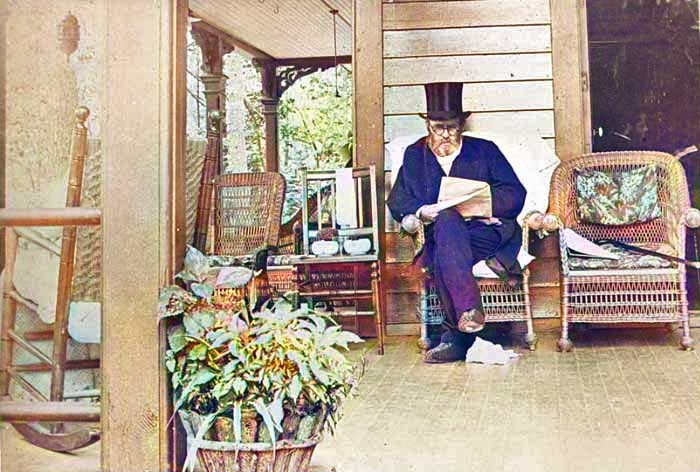
In 1884, Ulysses S. Grant was dying of throat cancer and was dead broke.
His money was wiped out by a swindler who stole his fortune.
Desperate to leave something for his wife, he agreed to write his Civil War memoirs and was close to signing a contract for a meager 10% royalty.
Mark Twain stepped in, called the deal robbery and offered Grant 70% of the profits through his own publishing company.
Grant raced death to finish the book, completing it just days before he died in July 1885.
It became one of the greatest memoirs ever written.
The royalties left his widow nearly half a million dollars, about $16 million today, and the book has never gone out of print.
By 1900, ornithologists were writing the wood duck's obituary. "Becoming scarce, likely to be exterminated," one wrote in 1901.
Market hunting had decimated them for decades, fashionable hats being the primary culprit, and the clear-cutting of bottomland hardwood forests had stripped out the old trees with cavities they needed to nest.
The Migratory Bird Treaty Act of 1918 stopped the hunting. But the trees were still gone. Wood ducks nest in cavities and they can't make their own. By the 1930s the population was recovering but slowly, bottlenecked by the simple fact that there was nowhere to raise young.
In 1937, two biologists designed an artificial nest box sized for wood ducks. They put up 486 of them at a refuge in Illinois. The ducks moved in immediately. Word spread. Private landowners started building them and nailing them to trees above swamps and ponds across the country.
It took no federal program or coordinated campaign. Just people who knew wood ducks needed a box and had a free afternoon.
Today there are an estimated 3.5 million wood ducks across North America. The recovery is considered one of the great success stories in wildlife management, and it runs almost entirely on nest boxes built by ordinary people.
The box you nail up this weekend is the same intervention that pulled this species back from the edge.
Thank guys for taking the time and having a heart to save the Sea Lions..thank you SO MUCH!!
Why do people throw trash out in waters where nature will be hurt.
WAKE UP!!!!
🔥 A juvenile jack fish wears a jellyfish like a helmet immune to its sting, it uses the jellyfish for protection while drifting in the open ocean at night.
Some plant scientists have suggested a provocative idea: that the world around us may contain far more “aware” life than we usually assume.
Plants obviously don’t have brains, nerves, or thoughts in the way animals do. But they are far from passive organisms. They constantly detect and respond to their environment, light, gravity, touch, water, chemicals, injury, and even the presence of other living things. Inside their tissues, they use electrical and chemical signalling systems to coordinate responses, defend themselves, and compete for resources.
One well-known example comes from the sensitive plant Mimosa pudica, which folds its leaves when touched. In experiments where the plant was repeatedly dropped without causing harm, it initially reacted by closing its leaves but over time, it stopped responding to the same stimulus, suggesting a kind of simple “learning” or habituation that persisted for weeks.
Other studies have found that substances like anaesthetics can temporarily suppress key plant movements, such as the snapping action of Venus flytraps, by interfering with their electrical signalling.
Plants also appear to communicate. When some trees are under attack, they can release airborne chemicals that warn nearby plants, prompting defensive changes. Beneath the soil, root systems and fungi can form extensive networks that transfer nutrients and chemical signals between plants across entire ecosystems.
None of this is taken as proof that plants are conscious in the human sense. Many biologists argue these behaviours can be fully explained through evolution, biochemistry, and stimulus-response mechanisms without any need for awareness.
Still, the findings raise an intriguing possibility: if consciousness exists at all, could it come in many forms, some of them slow, distributed, and nothing like animal minds?
Source idea inspired by reporting in Popular Mechanics on research discussing the possibility of plant awareness.
"We May Be Surrounded by Trillions of Conscious Beings, Research Suggests-And They Aren't Human."
In 1987, Costa Rica was 21% forest. Today it's 57%.
In the 1990s, Costa Rica passed a law that pays landowners directly for the ecosystem services their forest provides: carbon storage, watershed protection, biodiversity, soil stability. The payments are funded by a tax on fossil fuels.
Keep your trees standing and the government cuts you a check. Clear them and you lose the income.
Nearly a million hectares have been protected or restored under the program. Species that had retreated or disappeared from large parts of the country are recovering. The forest came back because the incentive structure changed, not because people were told to care more.
But it crashed the economy, right? Not at all.
Costa Rica became the top per capita agricultural exporter in Latin America. Tourism built around its forests and biodiversity became one of its largest industries. The economy didn't absorb the cost of keeping the forest. The forest became part of what grows their economy.
This is the version of the story most people never hear, the one where protecting nature and economic growth pointed in the same direction because we humans designed it that way.
It's not forests or the economy and it never had to be.