What If Earth Had TWO Suns? What would happen if our planet orbited wildly different stars across the cosmos?Imagine waking up under alien skies — where one sun is a dim red ember, another a blinding blue inferno, or twin suns blazing overhead like cosmic twins. Some would turn Earth into a frozen wasteland locked in eternal ice. Others would scorch it into a glowing, lifeless desert. In this stunning cinematic space infographic, we explore how Earth would transform around five completely different stellar powerhouses: Red Dwarfs — Dim, long-lived, and volatile. Earth would huddle close for warmth… but face deadly flares that could strip away our atmosphere. White Stars (like hotter versions of our Sun) — Brighter and hotter. Days would blaze with intense light, pushing Earth toward a runaway greenhouse effect. Blue Giants — Massive, ferocious, and short-lived. Their searing ultraviolet radiation would cook the surface and shred the ozone layer in years, not eons. Neutron Stars — Tiny, ultra-dense remnants of dead stars. Even from a safe distance, their gravity and radiation would create hellish tidal forces and lethal particle storms. Binary Star Systems — Two suns dancing across the sky. Seasons would become chaotic, with endless daylight, sudden darkness, and wildly swinging temperatures.Each star paints a radically different sky, climate, and destiny for humanity. Some worlds become glittering ice planets . Others transform into molten hellscapes . The universe is full of stars far more extreme and dangerous than our gentle Sun — and Earth might only thrive under one very specific stellar https://t.co/Yqz4LGJvVk long would humanity last under these alien suns? The answers are as beautiful as they are terrifying.
One continent. Infinite stories.From the cradle of humanity to the beating heart of our shared future — Africa, seen from space in all her breathtaking glory. A single, sweeping view that captures vast golden deserts, lush emerald rainforests, snow-capped peaks, and sapphire coastlines stretching thousands of kilometers. This is the mother continent, where every river, mountain, and savanna holds millions of years of human https://t.co/9Ni6Kw6qKv borders visible from above — just raw, untamed beauty and endless possibility. Africa isn’t just a place on the map.
She’s the origin story of us all. (Perfect for that stunning satellite view!)
NASA Just Dropped the Sharpest True-Color Image of the Moon Ever Captured! Forget the dull grey rock you’ve seen in every textbook and photo. NASA has released a stunning new true-color mosaic of the Moon that reveals its real face — a vibrant, mineral-rich world painted in rusty browns, deep blues, pale golds, and subtle reds.This isn’t an artistic rendering. It’s the highest-resolution, most accurate color view of the lunar surface ever made publicly available.What the colors actually mean:Bluish patches = Titanium-rich mare basalts (some of the most valuable resources on the Moon)
Reddish-orange and brown tones = Iron-rich soils and ancient feldspar highlands
Pale golds and whites = Pure anorthosite crust from the Moon’s early magma ocean
Every shade is a 4.5-billion-year-old chemical fingerprint telling the story of volcanic eruptions, massive impacts, and the Moon’s fiery birth.Key Highlights: Highest-resolution true-color image of the entire Moon to date
Reveals mineral composition visible to the naked eye (if you were standing on the surface)
Combines decades of orbital data into one breathtaking global portrait
Proves the Moon is far more geologically diverse and colorful than we’ve been taught
We’ve been staring at the wrong version of our nearest neighbor for centuries. The real Moon isn’t monochrome — it’s a swirling canvas of cosmic chemistry, just three days away by spacecraft.The era of serious lunar exploration just got a lot more beautiful.
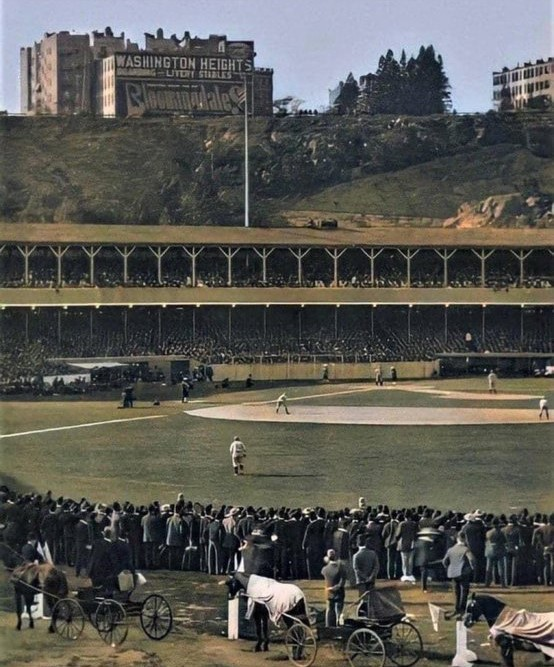
"Like the team itself, the Polo Grounds is an absurd and lovely thing.
It is the only ball park built against a cliff, "Coogan’s Bluff", so that a patron could walk downhill to his seat.
It had a crazy name and crazy dimensions. In shape, it was closer to a bowling alley than a ball field.
Straightaway sluggers loathed the field because a really noble smash to center, good for a homer in any other park, only amounted to a loud and discouraging out.
I liked it best when we came into the place from up top, rather than through the gates down at the foot of the lower-right-field stand.
You reached the upper-deck turnstiles by walking down a steep, short ramp from the Speedway, the broad avenue that swept down from Coogan’s Bluff and along the Harlem River, and once you got inside, the long field within the horseshoe of decked stands seemed to stretch away forever below you, toward the bleachers and the clubhouse pavilion in center.
Everything about the Polo Grounds was special, right down to the looped iron chains that separated each sector of box seats from its neighbour and could burn your bare arm on a summer afternoon if you weren’t careful.
Far along each outfield wall, a sloping mini-roof projected outward, imparting a thin wedge of shadow for the bullpen crews sitting there:
They looked like cows sheltering beside a pasture shed in August."
Roger Angell.
"The Polo Grounds."
Thousands of generations of humans lived and died never knowing what a sunset looked like anywhere but Earth.
You're in the first generation that doesn't have to.
This is a sunset on Mars.
140 million miles away from us.
This is the night sky on Mars—raw, unfiltered, untouched by a single streetlight.The atmosphere is so thin that every star slices through like a diamond on black glass. No haze, no glow, just infinite clarity.140 million miles from home, our little rover sits beneath a ceiling humanity has never truly seen: a universe stripped of Earth’s comforting blur.Close your eyes and stand there with it. Suddenly the cosmos stops feeling edited for our comfort. It feels brutally honest. And in that vastness, you feel perfectly, gloriously small.
One galaxy.
Two completely different versions of reality. On the left, Hubble shows us the Whirlpool Galaxy the way our eyes have always seen the cosmos — elegant spiral arms glowing with newborn stars, brilliant clusters, and those dreamy pink nebulae stretching across millions of light-years.On the right, the James Webb Space Telescope tears the veil away.With its infrared vision, Webb cuts straight through the thick curtains of cosmic dust and reveals the raw, hidden truth beneath: a violent, intricate web of glowing filaments, collapsing clouds, and countless invisible stellar nurseries where new stars are igniting right now.This is M51 — the Whirlpool Galaxy, 31 million light-years away.Same galaxy.
Two radically different universes.Hubble captures the visible light we’re used to.
Webb shows us the secret architecture of creation itself.For the first time, humanity isn’t just admiring the surface of the cosmos.
We’re seeing through the dust… to the universe as it truly is. Credits: NASA / ESA / CSA / STScI
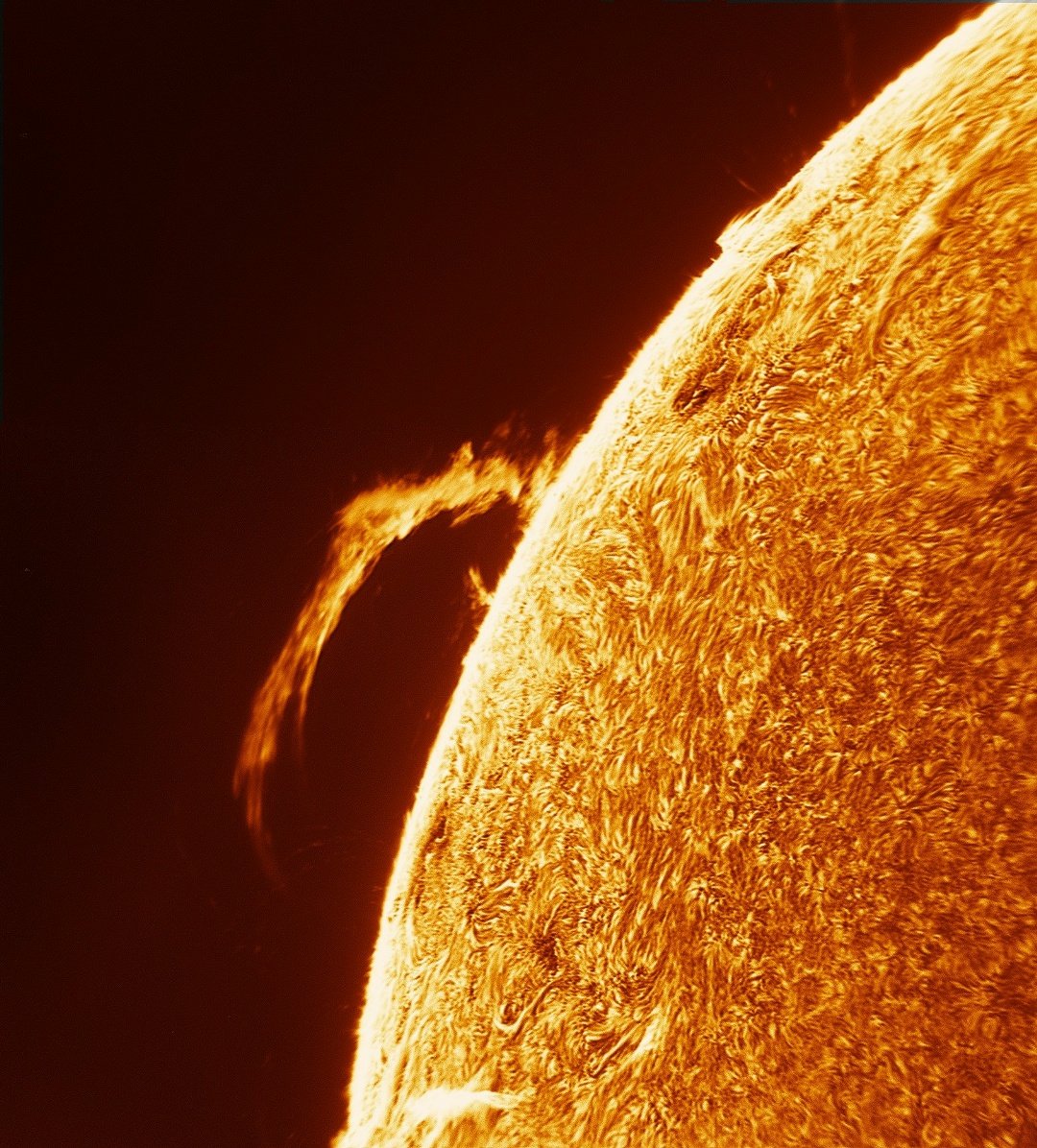
People don't realize how big the Sun actually is.
The orange wall is the Sun's surface. The arc rising from it is a prominence — a single loop of plasma, lifted off the Sun's surface by magnetic forces.
Each blue dot in that arc is the size of Earth.
Not the size of a country. Not the size of a continent. The size of our entire planet.
The Sun isn't a star.
It's an entire universe of fire we happen to orbit.
📸 Andrew McCarthy
After 9 years… and 3 BILLION miles… we finally met Pluto For decades, Pluto was nothing more than a faint, blurry speck in our telescopes — a lonely mystery at the frozen edge of our Solar System.Then, in July 2015, NASA’s New Horizons spacecraft screamed past at 30,000 mph… and completely changed everything. What we saw blew our minds: Towering ice mountains rising 11,000 feet high — as tall as the Rockies, but made of frozen nitrogen and methane
Heart-shaped plains of smooth, young ice that look eerily like Earth’s polar regions
A hazy blue atmosphere with drifting hazes and possible snow
Active geology, possible subsurface ocean, and even dunes made of methane iceThis isn’t a dead, cratered rock.
Pluto is a dynamic, colorful, living world — one that still surprises scientists years later. The wildest part?
Every single pixel of these jaw-dropping images had to travel 3 billion miles back to Earth… taking over 4 hours just to arrive.From a distant dot in the sky to one of the most fascinating worlds we’ve ever explored.That’s the absolute magic of space exploration. What surprised you most about Pluto?
by 1994
NASA just shared the most detailed view of Moon in its true & natural color and breaking the internet.
Just look at the detail here, this whole view is over 705 GB.
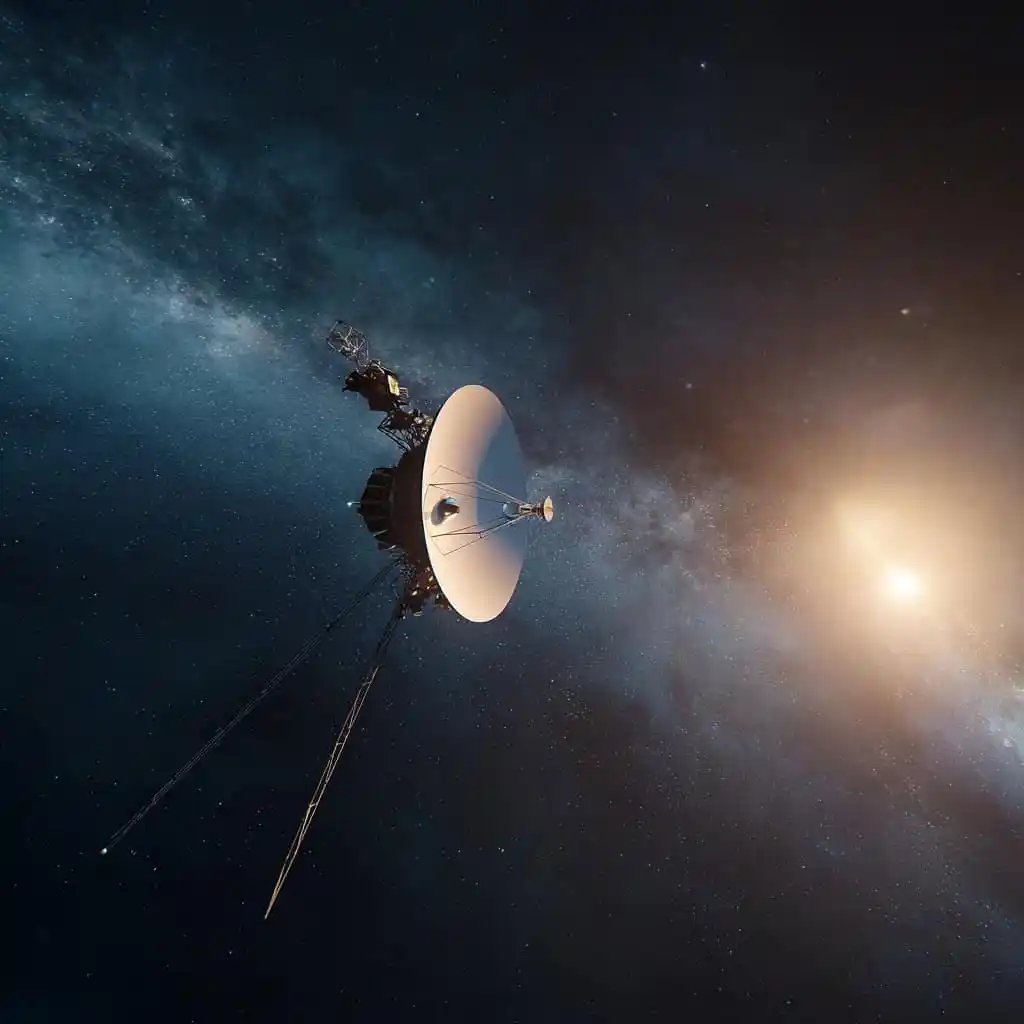
Voyager 1 is about to cross the line no human creation has crossed.
One light-day from Earth. 16 billion miles of cold nothing.
49 years of real travel for what light does in 24 hours.