iOS developer based in Brighton. Swift and Objective C. Recent clients include The Rolling Stones and World Health Organisation. I am a freelancer & contractor
@Shoseki I understand your frustration but feel it is misdirected. you could always borrow money and buy one. Sadly there’s a cost to tying capital up in a building when it could be invested in other things
Also if you get own a house you will realise that they cost a bit to be maintain
@DonnyWals Maybe if you are doing an example, make surer it works / runs or use it to show people how to understand why it doesn’t work. Sadly given up at that point in your video
@historyinmemes In no way doing him down but a factor to consider is that he will weigh quite a bit less! It is his lower body that has to gain the most height. Again this is in no way dimishing the achievement but helping to comprehend it from my comfortable office chair!!
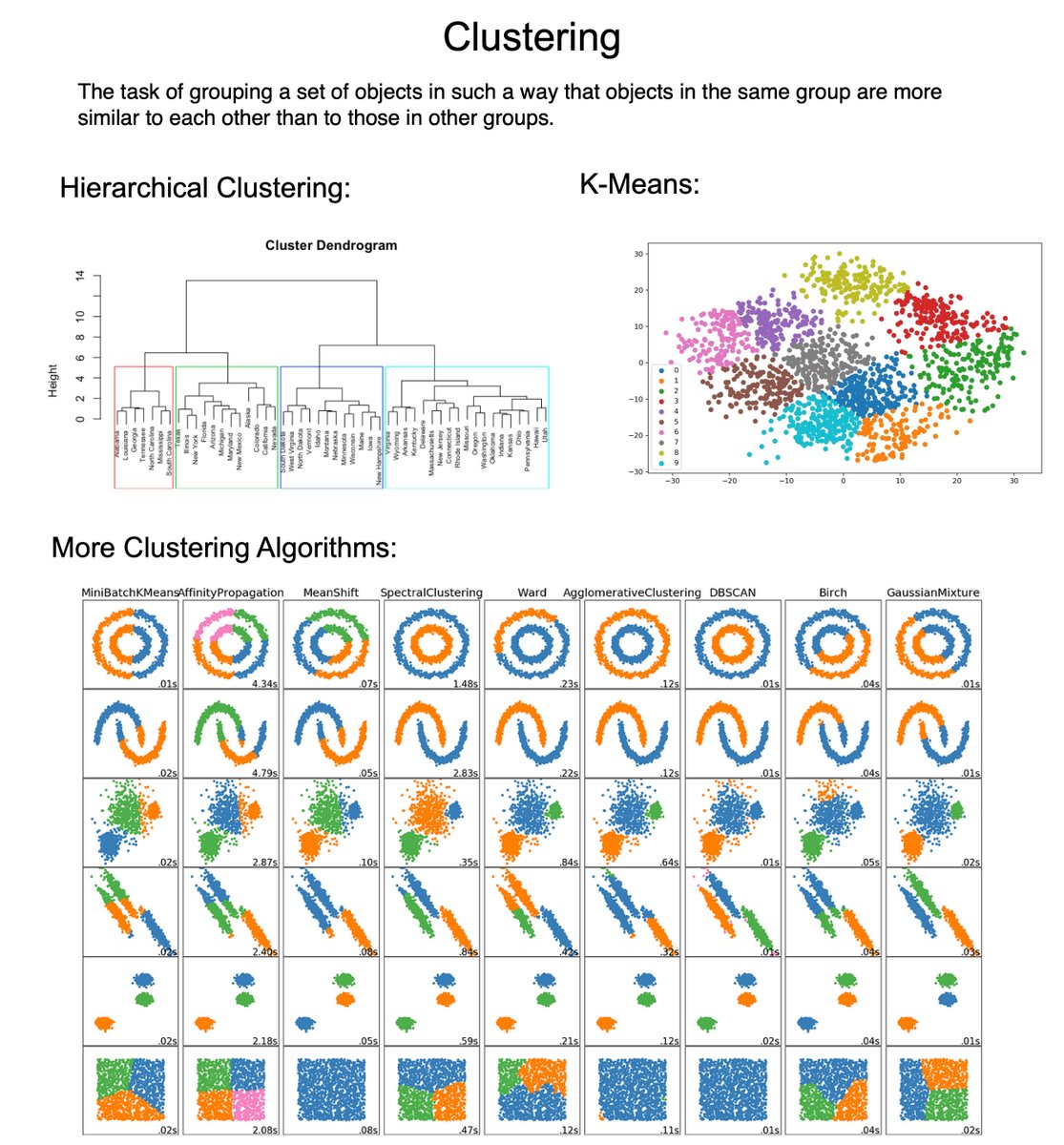
The 10 types of clustering that all data scientists need to know. Let's dive in:
1. K-Means Clustering: This is a centroid-based algorithm, where the goal is to minimize the sum of distances between points and their respective cluster centroid.
2. Hierarchical Clustering: This method creates a tree of clusters. It is subdivided into Agglomerative (bottom-up approach) and Divisive (top-down approach).
3. DBSCAN (Density-Based Spatial Clustering of Applications with Noise): This algorithm defines clusters as areas of high density separated by areas of low density.
4. Mean Shift Clustering: It is a centroid-based algorithm, which updates candidates for centroids to be the mean of points within a given region.
5. Gaussian Mixture Models (GMM): This method uses a probabilistic model to represent the presence of subpopulations within an overall population without requiring to assign each data point to a cluster.
6. Spectral Clustering: It uses the eigenvalues of a similarity matrix to reduce dimensionality before applying a clustering algorithm, typically K-means.
7. OPTICS (Ordering Points To Identify the Clustering Structure): Similar to DBSCAN, but creates a reachability plot to determine clustering structure.
8. Affinity Propagation: It sends messages between pairs of samples until a set of exemplars and corresponding clusters gradually emerges.
9. BIRCH (Balanced Iterative Reducing and Clustering using Hierarchies): Designed for large datasets, it incrementally and dynamically clusters incoming multi-dimensional metric data points.
10. CURE (Clustering Using Representatives): It identifies clusters by shrinking each cluster to a certain number of representative points rather than the centroid.
There you have it- my top 10 types of clustering every data scientist needs to know.
The next problem you'll face is how to apply them to data science to business.
I'd like to help.
I’ve spent 100 hours consolidating my learnings into a free 5-day course, How to Solve Business Problems with Data Science. It comes with:
300+ lines of R and Python code
5 bonus trainings
2 systematic frameworks
1 complete roadmap to avoid mistakes and start solving business problems with data science, TODAY.
👉 Here it is for free: https://t.co/YXG4pL97ZN