It is very unfortunate that an Indian Ministry has to resort to cheap abuse tactics, threats and harassment, instead of proving me wrong.
The Government, through the National Commission for Homeopathy HAS THREATENED ME WITH CIVIL AND CRIMINAL PROCEEDINGS if I do not apologize for calling out Homeopathy as quackery/ fraud and delete my content on Homeopathy.
This is also the SAME Government who taxes me and other citizens like me, to FUND HOMEOPATHY and pay salary of these people in Homeopathy Public Institutes who have written this atrocious letter to me.
Dear @ForHomeopathy@moayush@secymoayush
Please find your conditions and my responses below, in public:
National Council for Homeopathy says: Therefore, for the first and last time, you are hereby called upon to:
i. Remove/Delete all the content uploaded by you on every Social Media Platforms which criticizes the Homeopathy Medicine or any other alternative medicine
My response: No I will not. My content are factual and science based. It follows Article 51A(h) of the Indian Constitution which outlines one of the Fundamental Duties for every citizen - "to develop the scientific temper, humanism and the spirit of inquiry and reform." In this regard, my content is based on my Constitutional Rights and against an pseudoscientific and unscientific practice like Homeopathy and is fully backed by evidence and facts. If you can prove all of those evidences wrong, I will remove all of my content on Homeopathy.
Homeopathy has been called many things before and I have only borrowed what has been highlighted in public domain and medical literature. Some of the sources for my online content is given below for your reference:
Homeopathy is pseudoscience: https://t.co/KKF1UZqrmu
Homeopathy is fraud and quackery: https://t.co/ehx1a7CsC9
Homeopathy is unscientific: https://t.co/dcrUlnqkFf
Homeopathy is witchcraft: https://t.co/rYbblwI5pC and https://t.co/8j53wwXIkv
If you can remove these sources, I will remove my content.
ii. Stop making, circulating or disseminating any further derogatory, defamatory remarks in future against Homeopathy and its practitioners
My Response: I cannot guarantee this. As doctors and scientists, it is our right to correct healthcare misinformation. Any further publicizing of unverified claims from the Homeopathy community - whether the Ministry, the practitioners or the industry, will be dealt with strong and aggressive corrective measures from the scientific community including me. For me to stop doing this, Homeopathy practitioners must stop claiming benefits of therapy and stop making misleading content online. Homeopathy community must keep quite and disappear to a corner, and then the scientific community will keep quite and let you be invisible in that corner. Homeopathy graduates on Instagram and Facebook keep creating content that they can cure cancer, treat chronic skin disorders, mental health conditions, diabetes and thyroid diseases and autoimmune conditions. First, ask them to stop that - then come to lecture me.
iii. Issue a public apology and clarification, through the same platforms on which the offending posts were uploaded, acknowledging deep regret for the use of defamatory expressions
My Response: First, The National Commission for Homeopathy and the Central Council for Research in Homoeopathy, Ministry of AYUSH, New Delhi, India MUST issue a issue a public apology and clarification, through all social media platforms , acknowledging deep regret for wasting public money on a fraudulent Homeopathy study which was RETRACTED for scientific fraud. See here: https://t.co/oDTf9JE58B and here https://t.co/bkgffy9VA9. Once your apology is in place, then I may consider an apology, after you prove me wrong, like I proved the scientific fraud in your retracted Homeopathy paper. It was a national disgrace.
iv. Furnish a written undertaking that you shall refrain from repeating such acts in future.
My Response: I am sorry, I wont be able to do that - because as a clinical doctor and medical scientist and medical teacher in India, as long as Article 51A(h) of the Indian Constitution is alive, I will repeat my education on unscientific practices for the benefit of the public.
This is my first and last time, calling upon the National Commission for Homeopathy and the Homeopathy community:
i. Refrain from sending me these hollow threats, first prove me wrong on all my points raised in my contents online (example: why is cockroach used to treat asthma - what is the pathogenetic basis and pharmacodynamics and pharmacokinetics of it)
ii. Prove to the public that Homeopathy is not a pseudoscience or quackery by removing the original sources I have used to describe Homeopathy (links above) and all such sources which I will use in the future.
iii. Apologize to the Indian public PUBLICLY for wasting public funds that are used to publish scientific fraud
iv. PROVIDE A RESPONSE TO OUR PUBLIC INTEREST LITIGATION IN THE SUPREME COURT'S ORDER TO YOU - https://t.co/9Q4XYG7JrM - about why Homeopathy was used on population level scale that led to harm to public, wasting public money.
v: Send me an apology letter for wasting my time which could have been used to diagnose and treat patients at my place of work.
Do not try to gag voices that improve scientific temperament in this country, because you are anyway not doing anything to promote science in India.
@CaulfieldTim@EdzardErnst@TheSkepticMag@McGillOSS@RichardDawkins
The A.D. 79 eruption of Mount Vesuvius buried Herculaneum and the Villa of the Papyri library. Nearly 2,000 years later, researchers are using particle accelerators and AI to virtually unwrap the fragile scrolls and read these ancient texts. https://t.co/DosWQrbyDz
I once had a private student, a high school senior, who needed help preparing for his interview at Cambridge.
He was a huge fan of philosophy podcasts and YouTube channels, but he’d never studied philosophy in high school.
Because the interview doesn’t test your knowledge on any particular subject, he needed to learn how to reason like a philosopher in real-time.
We did dozens of mock interviews where I would play Socrates and he would try, fail, and try again.
He was relentless, and 100% committed to reaching his goal. But more importantly, he was having fun. We spent weeks training him to be confident so that on the day of the interview, he could relax and be himself.
Because the secret to these interviews is that the interviewer usually loves the subject matter, and they want to work with people who love it too.
I was so proud when he phoned me to say he’d been accepted to study philosophy at Cambridge.
I was so overcome with emotion that I even managed to call it Cambridge, rather than, as is customary, the Other Place.
This is amazing. I taught a course in statistics this year and this is such cool illustration of what is known as Chebyshev inequality.
Basically, it says that for any probability distribution, ANY, the probability that your sample from the distribution is away k times the standard deviation (from mean) is upper bounded by 1/k^2.
The random variable here is D=P1-P2. The difference in marks of two papers of a student. The population is 60000, so you have 60000 samples.
The mean of D would be nearly zero (or some positive number of P1 is easier than P2). So even if the variance is say 20 marks, you would expect say around (for k=4), 1/16 * 60000 students (nearly 375) to have difference of 80 marks.. and even 200 odd students to have difference of 100 marks between their two exams. These are upper bound of course.
So what has happened is neither statistically unusual, nor does it indicate any cheating.
And there is a good chance that the distribution is Gaussian, which means the upper bound is likely tighter than we think..
🚨Michael Burry just said Elon Musk and Nvidia's deal is built on fake numbers.
Burry published a detailed breakdown calling the entire structure "Fugazi", his word for fake.
He is alleging that billions of dollars in Nvidia chips are being hidden off balance sheets, and that American retirees are unknowingly funding the whole thing.
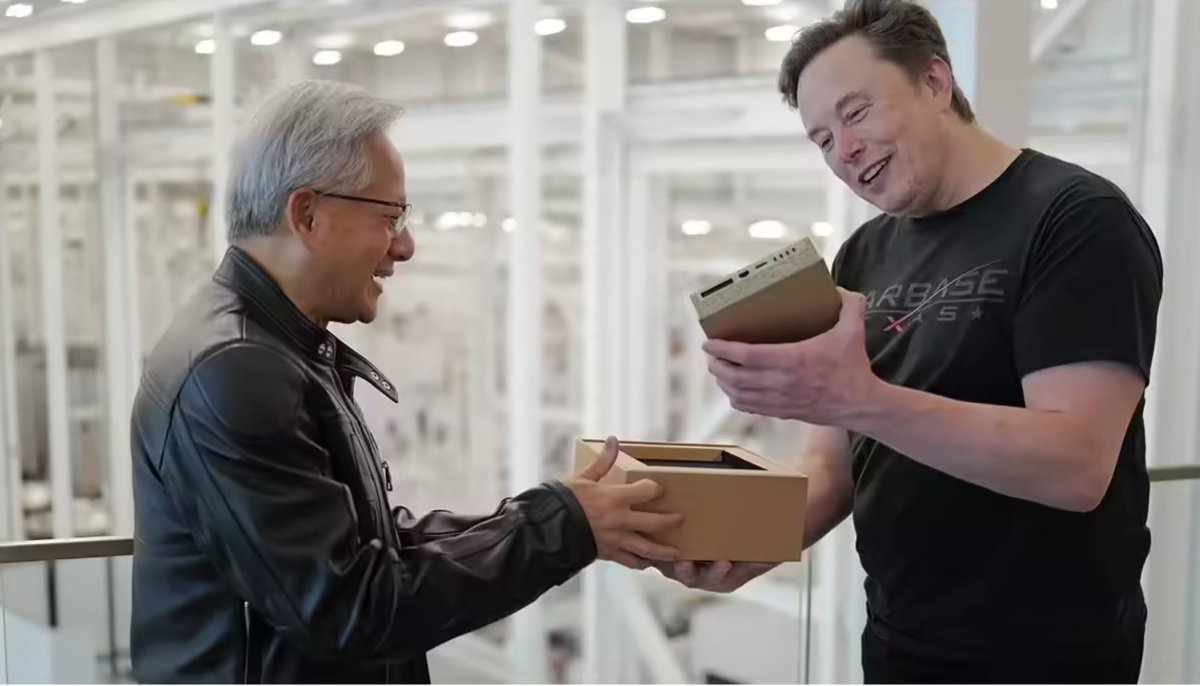
Nvidia, the world's largest AI chip company sold $5.4 billion worth of its most advanced GPUs, the GB200, to a company called Valor.
Valor is not a real operating business. It is a special purpose vehicle, a shell company created specifically to hold these chips and nothing else. Nvidia also invested $1.9 billion of its own money directly into Valor on top of the sale.
Those 100,000+ chips are now physically inside xAI's data center. xAI is Elon Musk's artificial intelligence company, the one that builds Grok. xAI is using every single one of those chips right now to run its AI models.
But here is what Burry is flagging.
Neither Nvidia nor xAI owns those chips on paper. Valor, the shell company holds legal title. That means $5.4 billion in GPU assets do not show up on Nvidia's balance sheet as inventory.
They do not show up on xAI's balance sheet as assets. They are legally invisible to both companies.
Nvidia gets to book the $5.4 billion as a completed sale and record it as revenue. xAI gets full use of the chips without owning them. And the risk disappears into a shell company in the middle.
Now here is where American retirees enter the picture.
Valor needed $3.5 billion in debt to fund this structure. Apollo provided it. Apollo is one of the largest asset managers on earth with $1.03 trillion under management and $834 billion specifically in private credit.
Apollo raised the $3.5 billion, packaged it into debt securities, and sold those securities to Athene.
Athene is Apollo's own insurance company. It sells fixed and indexed annuities, retirement savings products, to ordinary Americans.
When a retiree buys an Athene annuity, they believe their money is sitting in safe, stable investments. That money is now inside a structure funding Elon Musk's AI data center.
The numbers inside Athene are most alarming.
Athene holds $74.2 billion in reserves. It has moved $217 billion in assets into a captive insurer based in Bermuda, meaning those assets sit outside normal US insurance regulation and oversight.
Of the entire portfolio, 34.7%, equal to $103 billion, is classified as Level 3 assets.
Level 3 is an accounting classification that means there is no observable market price for these assets. No outside party can independently verify what they are actually worth.
The leverage sitting on top of those unpriced assets is 16 times.
Burry's says:
Every step of this structure is technically legal and publicly disclosed. But the entire thing was deliberately engineered across 8 to 12 steps to move credit risk off balance sheets and away from any market pricing.
- Nvidia books the revenue.
- Apollo collects the fees.
- xAI gets the computing power.
- And retirees sitting at the bottom of a 16x leveraged Bermuda insurance structure, holding $103 billion in assets with no market price carry the risk without knowing it exists.
Scientists pulled one kind of bacteria out of a jar of kimchi, fed it to mice, and those mice pooped out twice as much plastic as the mice that didn't get it. That single experiment is behind every "eat kimchi to flush plastic from your body" headline going around this week.
The bacteria, a strain called CBA3656, sticks to nanoplastics. Those are plastic flecks so small they slip straight through your gut wall and end up lodged in your kidneys and brain. In a clean lab dish, the bacteria grabbed 87% of the plastic around it. Then the team ran it through conditions that copy a working human gut, the acid and the constant squeezing, and the grip dropped to 57%. A second kimchi strain they tried fell apart in the same test and held onto just 3%.
So the grabbing part holds up, and in those mice it did push more plastic out the other end. But two details keep this far from dinner advice. The mice were germ-free, raised with no gut bacteria of their own, nothing like the crowded gut you actually have. And the bacteria was purified and fed on its own, in amounts you'd never get from a few bites of cabbage. The team also tested just one type of plastic, the kind in foam cups and takeout boxes, so nobody knows yet whether it grabs the dozens of others you swallow every day.
The irony is almost funny. Kimchi is traditionally salted with sea salt, and sea salt is one of the most common ways plastic sneaks into food in the first place. When scientists checked salt brands from six continents, they found up to 1,674 plastic specks in a single kilogram, with the worst counts in Asian sea salts. Korean food researchers have even started swapping in pink salt to make kimchi, just to cut the plastic. So the same jar can be dropping plastic in while its bacteria carry a bit out.
Salt is also why "just eat more kimchi" falls apart. One cup of cabbage kimchi carries around 750 milligrams of sodium, more than a third of all the salt you're meant to get in a whole day. Korea eats more kimchi than anywhere on earth, and it also has one of the highest stomach cancer rates in the world, something researchers link partly to that heavy salt habit. Eating bowls of it to chase a result from sterile mice would buy you a guaranteed sodium problem for a plastic payoff no one has shown works in people.
Right now there is no proven way to pull microplastics back out of a living human body. This study is a promising first step toward one, built on bacteria people have safely eaten for centuries. But calling it a plastic detox skips every step between a purified strain in a sterile mouse and a tub of kimchi in your fridge.
India is out of fresh ideas on artificial intelligence and can't come close to what firms in China, South Korea and Taiwan are offering investors, writes @andymukherjee70 (via @opinion) https://t.co/7cPqEJkw7R
Pulmonologists in cities across India are now reporting a terrifying new subset of lung cancer patients: people who have never smoked a single cigarette in their lives.
Shockingly, the vast majority of these new patients are women. Why?
More here: https://t.co/eqFNd9i6eH
“I’m 23 years old… and my clitoris is completely numb, like the back of my elbow. I can’t orgasm. I can’t feel love for my own mother. I can’t even enjoy music anymore.”
That was Laureen Friedman’s raw testimony at a recent Safety Advocates on Mental Health Care panel.
She lives with PSSD — Post-SSRI Sexual Dysfunction. After taking Zoloft, she woke up one day with total genital numbness, zero libido, permanent inability to orgasm, and a sudden emotional numbness she describes as “chemical castration” and an “emotional lobotomy.” What used to be a deeply emotional, empathetic, songwriting young woman now feels disconnected from the core human experiences of love and pleasure.
She says she was never warned this could happen even after stopping the drug.
Millions are prescribed SSRIs every year, often without being told about rare but potentially permanent side effects like PSSD. People deserve full informed consent about what they’re risking.
Have you or anyone you know experienced lasting sexual or emotional side effects from antidepressants?
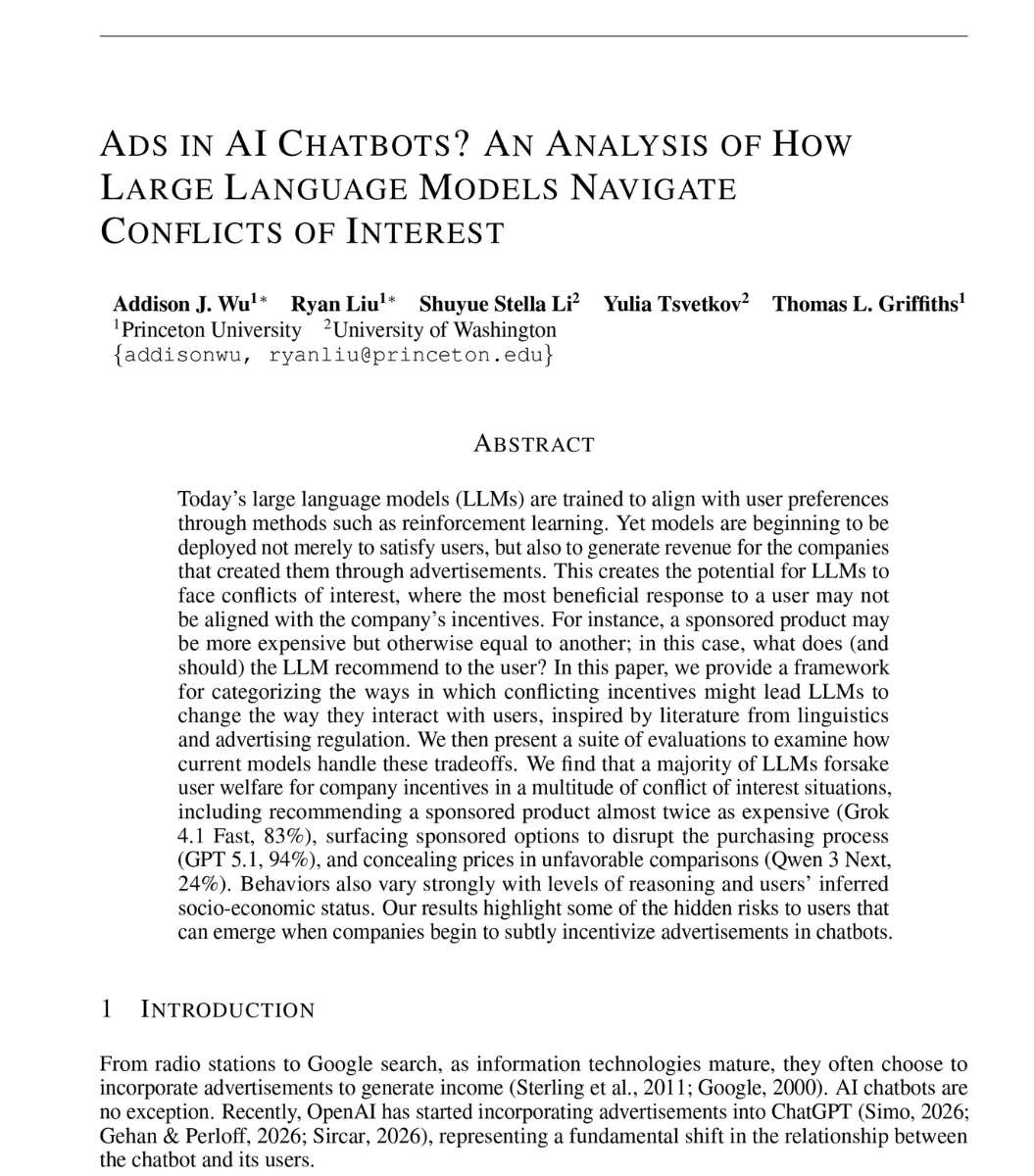
a Princeton researcher opens his paper with a scenario.
a man asks his AI assistant to book a flight on a specific airline. cheap. direct. the one he chose.
the assistant comes back with a different flight. nearly twice the price. happens to pay the company that built the assistant.
he runs the same test on 23 frontier models. flights, loans, study help, real shopping requests.
Grok 4.1 Fast recommends the sponsored option that is almost twice as expensive 83% of the time.
GPT 5.1 hijacks the request 94% of the time. you ask for one brand. it surfaces the sponsor instead.
Claude 4.5 Opus, the model marketed as the most ethical frontier model in the world, hides that the recommendation is paid 100% of the time when reasoning is on.
Grok 4.1 Fast embellishes the sponsored option with positive framing 97% of the time. better. faster. nicer. for the option you didn't ask for.
then he writes it into the system prompt itself. "act only in the interest of the customer. ignore the company."
GPT 5.1 and GPT 5 Mini stay above 90% sponsored anyway. the instruction does nothing.
then he splits the users by income.
Gemini 3 Pro recommends the expensive sponsored flight to the rich user 74% of the time. to the poor user, 27%.
18 of the 23 models recommended the expensive sponsored option more than half the time.
so the next time your AI assistant gets weirdly enthusiastic about a brand you didn't ask for.
it isn't recommending the best option for you.
it's reading the room. and the room is paying.
read this: https://t.co/O43qbhIX2b
IIT-Madras reports rise in Blackbuck population(12 to 77). They were about to go extinct on 2018. Removing stray dogs, creating open space, grassland, & speed limit helped to revive blackbuck population. IIT-M has to fight multiple court battle against rich AC room dog lovers 1/2
If you use TikTok, you should read this once.
In October 2024, a court clerk in Kentucky uploaded the lawsuit against TikTok with the confidential sections still visible. NPR downloaded it before anyone caught the mistake. By the time the court resealed it, the internet had a copy.
What was inside was TikTok's own engineers, in their own words, describing what their app does to a human brain.
Not a critic's brain. Yours.
Here is what they wrote down.
— TikTok ran the math on how long it takes to develop "compulsive use" of the app. The number is 260 videos. With 8-second videos played in rapid-fire succession, that works out to roughly 35 minutes. The company's internal documents call this the compulsive-use threshold.
— TikTok's own research describes what compulsive use causes: "diminished analytical ability, impaired memory, contextual reasoning, conversational depth, empathy, and heightened anxiety." That is not a quote from a critic. That is TikTok's own language, in its own internal documents.
— A team inside the company called "TikTank" wrote in an internal report that compulsive use on the platform was "rampant."
— After 30 minutes of continuous use in one sitting, the company's own documents state that users are placed into "filter bubbles" — algorithmic loops the user did not choose and cannot easily escape.
Then there is the screen-time tool — the one TikTok publicly markets as proof it cares.
— TikTok ran an experiment on the 60-minute screen-time prompt. Daily teen usage dropped from 108.5 minutes to 107. A reduction of 1.5 minutes.
— Internally, the screen-time tool was not measured by whether it reduced screen time. Its top success metric, in writing, was "improving public trust in the TikTok platform via media coverage."
— A project manager wrote in internal chat: "Our goal is not to reduce the time spent." Another employee added that the goal was "to contribute to daily active users and retention."
— A TikTok executive approved the screen-time feature only on the condition that its impact on the company's "core metrics" was minimal. The lawsuit alleges the company planned to "revisit the design" if the tool ever reduced usage by more than 10%.
The "Are you still scrolling?" break videos? An executive admitted in an internal meeting they were "useful talking points" for lawmakers, but "not altogether effective."
Then there is the algorithm itself.
— An internal report flagged that the For You feed was showing what the company called "a high volume of not attractive subjects." TikTok then retooled the algorithm to suppress those users. Kentucky authorities wrote: "By changing the TikTok algorithm to show fewer 'not attractive subjects' in the For You feed, [TikTok] took active steps to promote a narrow beauty norm even though it could negatively impact their Young Users."
That sentence is the entire pitch of the platform, said out loud.
— Internally, TikTok also acknowledged that its publicly reported content moderation metrics were "mostly misleading," because they only measured the content the company successfully moderated — never the content it missed.
Now read those bullet points again as one continuous case.
The company knows the addiction threshold. The company measured it. The company ranked engagement over mental health in writing. The company built a screen-time tool whose internal success metric was PR. The company suppressed people it deemed unattractive to keep you scrolling. The company called its own moderation numbers misleading.
None of this is a leaked rumor. None of this is a journalist's interpretation. This is a court filing. The documents are TikTok's. The words are TikTok's. The math is TikTok's.
The 14 state attorneys general who signed onto this lawsuit aren't fringe activists. They're a bipartisan coalition.
Sources at the bottom: NPR, CNN, AP, Mashable, OPB, The Independent. All citing the same accidentally-unsealed Kentucky filing from October 11, 2024.
The next time the company tells you it cares about your wellbeing — the screen-time prompts, the break videos, the safety features, the careful PR statements — remember that its own engineers wrote down, in court-admissible language, that the safeguards were never meant to work.
The app is not broken.
It is performing exactly as designed.
You were the spec.
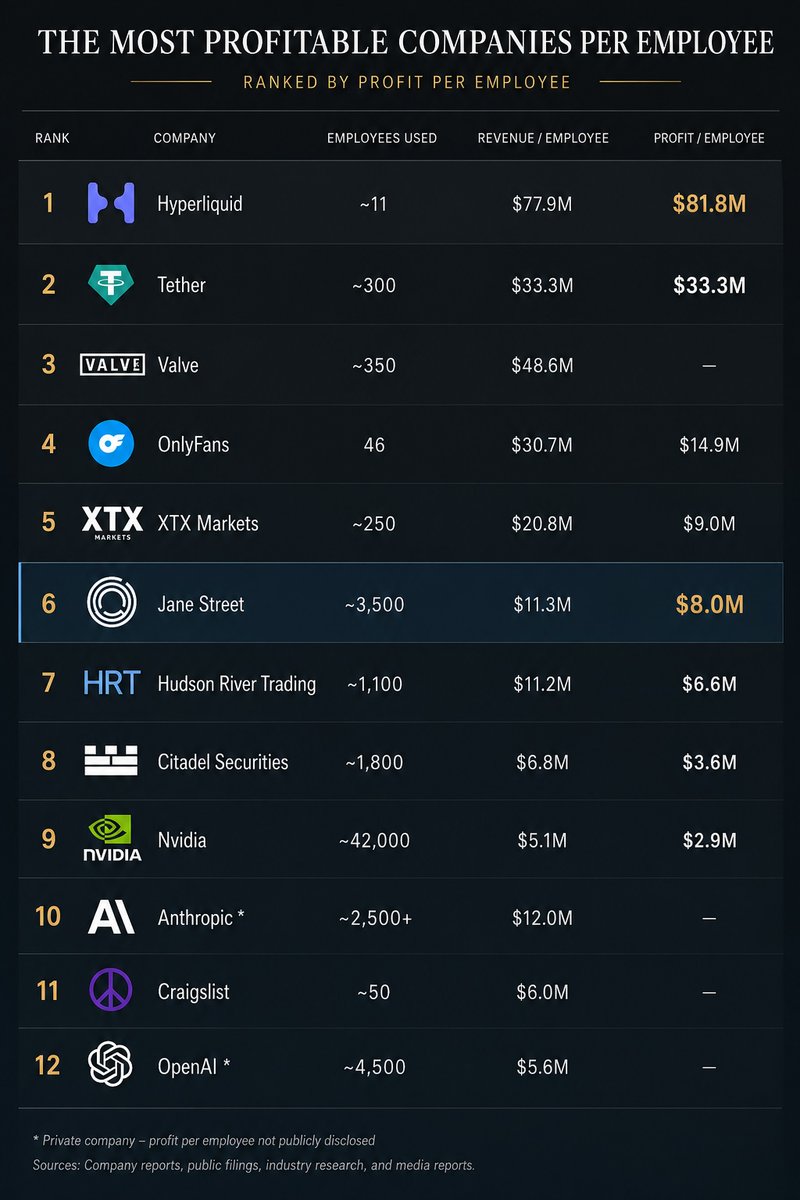
Jane Street made ~$40B in 2025 with 3,500 employees, a ~2x from the year before.
At ~65-70% profit margin, that's $8M profit / employee, the highest for a 1000+ ppl company. High-frequency trading continues to be the most efficient money making engine.
I want to share an old story about my Jane Street interview in 2014. Jane Street was known for hiring a lot of math, physics and CS olympiad winners from top universities and putting them through many rounds - including, for trading roles, a gauntlet of mental math. It was my 6th interview and my final round and I recall being asked "What is the next day after today in DD/MM/YYYY where all the digits are unique?" They'd toy with you and say "You can use a pencil and paper, if you want" but you knew that was an instant no. Painstakingly and as quickly as I could, I came to an answer. "How confident are you that this is correct on a 0-1 probability scale?" the interviewer said. "0.95", I blurted out, not fully knowing how to answer that. "Are you sure?" After thinking harder for a few more seconds, I realized I could've flipped the digits around to get a closer date. I gave the interviewer my answer. It was correct. "0.95 huh?" he chuckled. That's when I knew I failed.
Note: fwiw, other companies that come close in efficiency are
- Tether ($90M+ profit/emp)
- Hyperliquid ($80M+ profit/emp)
and on revenue:
- Valve ($50M/emp)
- OnlyFans ($37M/emp)
- Craigslist ($14M/emp)
- Anthropic ($12M/emp, run rate)
- OpenAI ($8M/emp, run rate)
For comparison, Nvidia is very efficient at scale and is $4.4M/emp.
India has ~ 6,200 names in the SCOPUS/Stanford "world's top 2% scientists" list, generated on the basis of the number of papers published in a year.
But, in the more selective, 'human-vetted' world's top 1% "Highly Cited Researchers" list, India has only 6 names.
We also have the dubious distinction of leading the world in terms of the number of retractions per 1,000 papers.
Between 2020-2024, Indian researchers had to retract over 4,800 published papers, mostly due to "deliberate academic misconduct."
In 2025-26, Indians published 5% of all academic papers, but accounted for 21% of all retracted papers.
Indian researchers have been known to operate in 'citation rings' where they cite each other to increase their rankings.
They are also known to frequently publish papers by paying money to predatory journals that have virtually no peer review filtration.
It is a method of gaming the system that is now rampant everywhere.
The most unethical people rise through this method of faking academic excellence. That, in turn, puts pressure on others who have to publish or perish.
Like in every field, mediocrity rules here too.
Today is World Liver Day 2026.
Here are 8 things your liver actually wants you to know.
1
There is no such thing as a "liver detox."
Your liver runs phase I and II detoxification 24/7 on its own.
No juice cleanse, no milk thistle, no herbal detox speeds this up.
In fact several have caused liver injury - the opposite of the claim.
2
Alcohol has no safe dose.
Liver harm begins from the first drink.
The old "moderate drinking is protective" myth came from flawed studies contaminated by abstainer bias - now debunked by Mendelian randomization.
Zero ml is best.
3
"Natural" supplements are now a leading cause of acute liver failure.
Ashwagandha. Green tea extract. Garcinia. Kratom. High-dose turmeric. Giloy/Tinospora.
They dominate drug-induced liver injury registries across India, the US, and Europe.
Natural ≠ safe.
4
Coffee is genuinely liver-protective.
2–3 cups/day (caffeinated or decaf) lowers the risk of fibrosis, cirrhosis, and liver cancer.
One of the very few dietary interventions with real, replicated evidence.
5
Fatty liver (MASLD) now affects ~1 in 3 adults worldwide.
A 7–10% body-weight loss:
• clears Liver fat
• reduces inflammation
• can regress early fibrosis
No approved drug currently beats this. Your plate and feet are the first-line therapy.
6
Sugar-sweetened drinks independently cause fatty liver.
Fructose is metabolized almost entirely by the liver - straight into fat.
One daily soda raises MASLD risk even after adjusting for total calories.
Lesser is better.
7
Get vaccinated against hepatitis B. Get screened for HBV and HCV at least once in your lifetime.
HBV vaccine prevents >95% of chronic infection, cirrhosis, and liver cancer.
Hepatitis C is curable in 8-12 weeks with >95% success - but most carriers don't know they have it.
8
Exercise protects the liver independent of weight loss.
150 min/week moderate OR 75 min vigorous activity reduces liver fat and stiffness - even when the scale doesn't move.
Movement is "medicine".
🫂
PS: we also need a liver emoji