"We don't get hired for the floor" says chairman of Kirkland & Ellis, investing $500M building a custom legal AI.
So I went down the rabbit hole on who else builds custom large scale automation for past many decades:
Car factories across the world.
There are handful of robots manufacturers (instead of 100s). But...
Car design is a competitive advantage means every factory will have unique process.
Car factory is a layered architecture. No one vendor can address all layers.
Multi vendor/supplier is a deliberate strategy to avoid lock-in and process protection.
Regulatory ensures there are local first strategy across the supply chain.
Loved this note on Incumbents and it is a very well articulated thesis but I'm still on the fence on bunch of assumptions. Horizontal vs vertical, build va buy, service vs consult. Everything is still up for grabs.
it's just too early!
🎉 Super excited to share our labor of love! 75 pages of it 😍
95% of GenAI pilots never reach production. AI models are not the problem. The gap between pilot and production is the process. The processes we had to build traditional software or buy SaaS are now obsolete.
🏁 Announcing our new e-book 🏎️
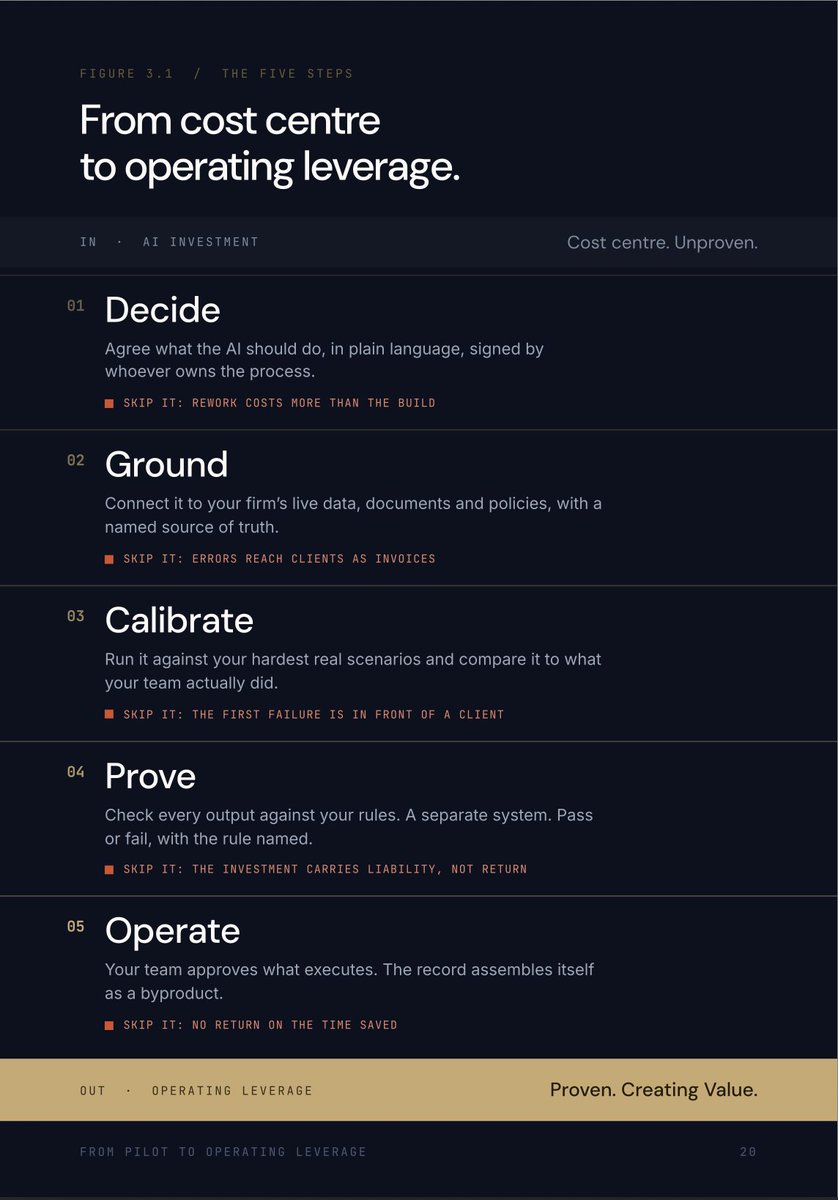
"The AI Discipline Playbook: Five Steps to Governed AI"
We need a new systems thinking on how we build and operate AI keeping in mind costs, outcomes & risks. We wrote this book to set out the discipline that lays the foundation for new systems and process for Agentic AI. It reimagines a new way of buying and building with AI technology.
It is not a product pitch. The discipline works regardless of who builds it.
Five steps each one removing a specific cost or risk from your business.
Five steps combined delivers a method to drive Agentic AI outcomes.
When writing this book, our team has ensured we contrast our decades of experience with our accelerated learning in the AI era.
But I will be direct. We built PitCrew because we believed this discipline
needed a machine behind it, not just a book about it. If you want to see
what it looks like running on real accounts, the last chapter tells you how.
Free access: https://t.co/RU2tVXp63w
@GoPitCrew@TweetSamG@rameshmay@arnavgoel_
No one likes to say it, "we ship our org chart." But it's true!
If you truly understand the nature of how you build & what you ship, your culture is your product.
Here is what we understand deeply at @GoPitCrew :
AI Agents are 2 hops from the end user!
Agents we use:
Internal harness X Claude Code
Us: product managers & engineers who read traces and recover
"No, retry with X" and it recovers
Human in the loop absorbs every error
Reliability bar: 1X
Agents our Agents build:
PitCrew harness in buyers' hands
Builders with no view into our harness internals
Our errors silently become their defaults
Our assumptions looks like a bug in their agent
Reliability bar: 10X
Agents our Agents ship
Service bots, workflow agents
End users who leave on the first failure
No fallback, no patience, no debugging
Our gap arrives amplified for every customer
Reliability bar: 100X
Everything we do at work everyday is keeping in mind those hops and its impact on product reliability.
We built a culture & org around this understanding of agents. And that's what we ship!
#Harness #Agents #EnterpriseSoftware
@sv_cloud_expert@rishikulkarni@rameshmay Chat UX is simply a convenience. When executing a workflow there’s also a choice needed on where existing tools versus LLMs need to play. And that’s another layer where handoff definitions are important.
Saas was fun! @TweetSamG , @rameshmay and I have spent over a decade building and scaling software led businesses. We operated in a broad software category called System of Record (SoR), a central repository designed to store business data (customer info, employee records, or vendor contracts). We designed user experiences over these system of record which were opinionated (this is the only way you access customer data or this is right way to collaborate on a contract). These designs forced job functions like Sales or Marketing or People Ops to revolve around the silos of CRM or ERP or HRIS.
For us the UX was the product. We created stickiness by enforcing data hygiene, promoting shared vocabulary and training muscle-memory around the usage of the product. We always assumed that the glue that connected these silos of systems of record is the human element. We saw first hand that organizational structures being built or evolve specifically to manage the boundaries of these static systems. (we are not proud of the frictions at these boundaries!)
What made building business software hard was the maintaining of the workflows and scaling of the data model. These got harder over time as we had to solve for collaboration-based edge cases in growing organizations. New team or experts would bring in new requirements for approvals, governance, interactions, or newer systems of records. If we were to pin point one single thing which broke the camels back of business software: it was building and maintaining workflows.
That changes now with AI Agents.
Based on the battle scars we have building business software we believe AI agents will dismantle the need for human gatekeeping (“collaboration”) between systems of record. AI agents act as navigators that transcend silos, guided not by rigid data model or opinionated workflows but by intent, goals, and guardrails. Unlike traditional software, AI agents stitch together context on the fly, accessing the specific records they need across multiple systems, and apply language model reasoning to deliver an outcome. This shift makes the legacy boundaries of SoR redundant (strong opinions in workflows don’t matter) as the agent focuses on the completion of the objective rather than the management of the record.
Intent is to the system of work what data model is to the system of record. If the two key pillars of business software were: Data model and Workflows then the key pillars of System of work are: Intent, Goals and Guardrails.
We at @GoPitCrew have designed and build a harness platform that can be configured to suite the goals environment, we enabled a intent capture system that guides the user to define the intent and guardrails. We have agent execution environment which complies to the guardrails and delivers measurable outputs. The outputs are then verified against specified goals.
The idea of intent is not new, it’s like specifications or SoP’s. But communicating Intent for agents is not intuitive, in fact large models make it hard (perhaps by design to drive excessive token usage). Agents need to know the jobs to be done but also need to be made aware of the guardrails. Unlike human work, agents could claim goals achieved as judged by AI models, but the as judged by humans it could fall short, as judged by governance lens they can definitely mess up. The goals measuring systems need rubrics, evals and loops which ensure the goal is really achieved. Goal systems also ensures Agents operate within guardrails configured through governance policies, training loops, IP boundaries, compliance demands.
Looking back at the systems we’ve spent the last decade building, we see the limitations of the boundaries we once defended. Looking forward, we see the potential for something far more dynamic. As builders, our role is evolving: we are no longer just the architects of data, but the stewards of intent. It is time to leave the frictions of static systems behind and embrace a future where our software is as adaptable and intelligent as the people it serves.
The Tokens of Playfulness: This the culture building exercise and the there is no way out of it than "Tokenmaxxing"
No doubt tokens are being wasted in some of the experiments but then are no easy ways to guardrail and enforce token budget while adopting a new learning curve at scale.
This is very first-principles practitioner notes. Thank you!
"system of verifier" is perhaps a key piece to enable system of action and system of coordination.
In our own thesis we have categorised the knowledge base or SoR into 3 buckets:
AI-native (cli, headless),
AI-friendly (api, openness to access), and
Anti-AI (no schema, no access, FTP servers)
The convergence layer to these 3 buckets is: Verification i.e. How do we know an agent completed the task at hand correctly?
This could jumpstart the entire work of reverse engineering workflows into automations to autonomous agents. Instead you invest in Intent capture and outcome verifiers.
Experts, trusted technical partners, or "Forward deployed Experts" are perhaps the best option for buyers to start investing in verification infra.
PS:
The pace at which every piece in the AI stack is moving there are no technical buyer. There are just "wait and watch"-ers.
@mcuban@rajeshsawhney Judgment is extremely critical! Here’s something I wrote about that recently. This judgment is why the labor arbitrage assertion is flawed
@brettdash_ If you want to build something, chat makes a good starting point. Allows ideation and iteration.
But to run something, chat is least optimal. That’s when access control, environment, and triggers are more important
Something we baked in to https://t.co/GgkiJy2mde
@Appyg99 Interaction models are still evolving. Chat is one starting point for human-machine interaction. In the world of AI there’s a lot more. What’ll be the harness, what are the underlying rules and guardrails, where is the context? Where is the run?
More at https://t.co/GgkiJy2mde
@hvpandya Empty rooms are always a problem. Whether it is chat, analytics, draw, build or consume. Everybody needs some inspiration and guidance.
A build UX is also very different from an operate UX, different sides of a coin.
See more of this in action at https://t.co/GgkiJy2mde
@aakashgupta Need to separate the build from the run!
Chat interaction is great to ideate, iterate, build. But after that the agent needs to operate in the background. Triggers (manual, automatic, event-based) control that operation.
See this in action at https://t.co/GgkiJy2mde
@rabi_guha@rishikulkarni UX implies human to computer interaction! With agents that’s also in question. How much of the erstwhile human-machine interaction move to machine-machine interaction? That will further influence the types of interactions
@rishikulkarni@nbobba While true that “Mid-market and SMBs will not self-serve their way into a system of intelligence”. There are mixed signals from industry at large with fear-mongering mixed in.
With @GoPitCrew agentic platform, we’re offering both options - DIY and DFM, to build, deploy, operate
Builders could go from idea to working application in hours instead of weeks. The framework handles the infrastructure; humans handles the interesting problems.
Agent harness are ready for the same intervention.
What do most agentic systems need?
@TweetSamG@rameshmay
PitCrew agents co-plan with you to build a Kanban board for your workflow, Pitcrew orchestrates and monitors the work and spawns agents to handle the tasks. The agents gets the work done, provides proof of work, and runs evals against the proof.
@TweetSamG@rameshmay@rishikulkarni