I agree, I don't understand the issue against manufacturing or chip making. It is when you make that you accidently or pointedly discover what more can be made. Just moving defence imports to local manufacturing helped us make much more in drone and other equipment.
We already have people that can design chips. Then make them too, it's a leap that's taken much capital in the past and for the first time we have adequate domestic capital.
We need to make things. Not import 95% of our umbrellas. Or all our sewing machines. Just reducing imports by making more means so much more.
We need to explore our oil reserves. Our gold reserves. Make thorium work for us. Change energy to mostly self sourced, make things for India and so on.
We do need to reduce red tape and allow for more labour reform, etc. And cut corruption much more.
This could be a terrific research paper.
Raghuram Rajan should personally stuff some chips where the sun doesn’t shine, demonstrate how smuggling can be done - taking inspiration from gold smuggling techniques.
He can then write a detailed paper about his experiences. It would be a highly inspirational work by a global scholar-practitioner.
In one stroke, he can prove that India’s semiconductor manufacturing efforts are unnecessary. A new jugaad technique created by him can meet India’s needs. Ties in perfectly with his strong arguments against India growing its manufacturing sector. Why make semiconductor chips when other pathways exist? It’s so logical.
Friends of Raghuram Rajan on this platform, please send him this research idea. My compliments!
The greatest central bank governor to ever grace god's green earth says we shouldn't build Semiconductor fabs in India because instead of building, we can just smuggle the chips for much cheaper.
@RuhiTewari There are many rebuttals from people with better credentials than him. Garg has a history with this govt.
This is JUST ONE. I can point you to many, many more.
https://t.co/SNWBu0ok7Y
If India’s real GDP growth were just 2.6%, credit expansion, corporate earnings, and trade metrics would reflect severe stagnation. The IMF and World Bank would have flagged it immediately. Calling standard MoSPI base-year revisions “data manipulation” is peak economic illiteracy. Subhash Chandra Garg must be taking economics lessons from Jairam Ramesh.
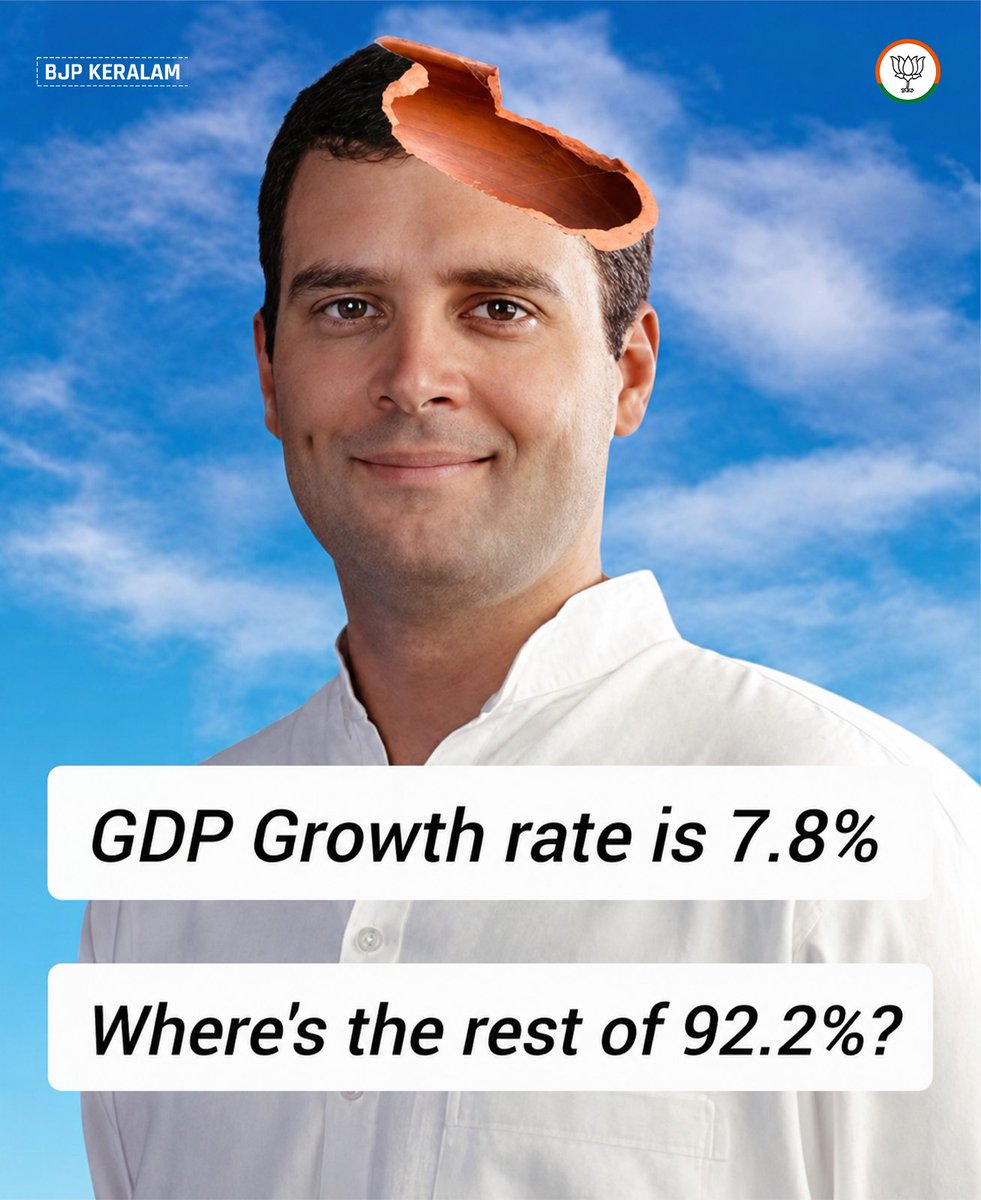
2/ He says India's "real" growth is 2.6%, not 7.8%. How? ₹88.27 lakh cr (Q1 FY27, new 2022-23 base) ÷ ₹86.05 lakh cr (Q1 FY26, old 2011-12 base).
Numbers from different series are divided. And announced on national TV as fact!
Meet the three monkeys of Rahul Gandhiji. Raghuram Rajan, Arvind Subramanian & Subhash Chandra Garg. All kicked out by Modi because of poor performance. Now crying on television every quarter.
These people are so corrupt, Garg is comparing two different GDP series to claim lower %.
Imagine these bastards ruled us.
This is the same Subhash Chandra Garg, who is trying to discredit the GDP growth
He has an axe to grind against Modi Govt because he was shunted out from his Finance Secretary position to Power Ministry which then made him opt for voluntary retirement one year before his service was to officially end
He hasn’t been able to digest the demotion & since then has been barking like a mad dog trying to discredit India’s growth story
The entire propaganda around the 75,443 restored votes falls apart when placed against the actual numbers.
BJP and TMC+ have a massive 31,76,584-vote gap. Even if every single one of those 75,443 restored votes were hypothetically added to TMC+, the BJP would still retain a 31 lakh vote lead.
The BJP’s landslide win in Bengal was so massive that even adding all the restored votes to TMC+ leaves the difference above 31 lakh votes. The numbers simply do not support the narrative being pushed.
Furthermore, the loud rhetoric around "91% of restored votes" is statistically dishonest. This number needs context.
That 91% represents 75,443 restorations out of 82,782 appeals disposed of by the tribunals, a very small subset of the overall electoral-roll exercise.
In fact, the restoration rate can just as reasonably be read as evidence that the ECI had a functioning mechanism for hearing grievances and restoring the names of people whose claims were found genuine.
What the narrative deliberately ignores are the tens of lakhs of illegal entries purged from the electoral rolls who didn't even bother to file for correction. Their silence and total absence from the appeal process confirm that these phantom electors were illegally sitting on the rolls for years, a stark reality the opposition now finds impossible to confront.
Ever since he was removed from the Finance Ministry amid questions over his performance, Subhash Chandra Garg has turned into a full-time doomsayer on the Indian economy.
His latest half-baked “2.6% growth” analysis is yet another reminder of why his economic assessments deserve to be taken with a large pinch of salt.
First, a basic lesson in reading GDP data: 7.8% is real growth. Inflation has already been removed. Official nominal GDP grew 10.3%, from ₹80.00 lakh crore to ₹88.27 lakh crore, while real GDP grew 7.8%. Subtracting 5–6% CPI inflation from an already inflation-adjusted figure is double-deflation, an elementary error that should embarrass a first-year economics student, let alone a former finance secretary. CPI is not even the GDP deflator. (https://t.co/yyRTLcujeP)
Second, the “base was quietly downgraded” allegation is fraudulent comparison. The earlier 7.8% belonged to the old GDP series; 6.9% belongs to the rebased 2022–23 series. In fact, the latest new-series revision increased Q1 FY26 growth from 6.8% to 6.9%. Revisions occur both upward and downward as fresh data arrive. That is standard benchmark-indicator methodology followed internationally, not a conspiracy invented in Garg’s imagination.
Third, he has even read the “discrepancy” backwards. The constant-price discrepancy changed from positive ₹1.37 lakh crore last year to negative ₹1.06 lakh crore this year. It reduced the latest GDP figure. Excluding discrepancies, expenditure components grew approximately 11.2%, not 2.6%. His supposedly devastating argument collapses upon reading the actual table.
And where exactly is Garg’s imaginary 2.6% collapse visible?
* Listed-company profits rose 16%, while revenue grew 18.4%, the fastest in 15 quarters.
* Passenger-vehicle dispatches rose 34.3%; actual retail sales rose 19.1% to their best-ever July level.
* Tractor retail sales jumped 28.1%, another July record.
* Gross FDI reached a 15-year high of $30.7 billion.
* Non-food credit grew 18.3% in June, the strongest Q1 reading since 2012, and accelerated to 19.1% in July.
* Coal India’s supplies rose 18.38% to its highest-ever July offtake.
* Merchandise exports jumped 19.6% to a record $44.24 billion.
* July IIP grew 6.7%, manufacturing 7.3% and capital goods 16.1%.
* Forex reserves reached an all-time high of $729.33 billion.
No single indicator calculates GDP. But this broad expansion across production, investment, credit, consumption, exports and corporate performance completely demolishes Garg’s fantasy of an economy growing at only 2.6%.
India has genuine challenges. Those should be debated honestly. But unemployment slogans and political bitterness cannot replace national-accounting methodology.
Garg has exposed his own inability to read comparable data and demonstrated the same half-baked incompetence that got him out of the Finance Ministry.
The only fictional number here is Garg’s 2.6%.
Woke journalist:
Noted Ex-Mathematician has said 2+2 =5, this is a sensational disclosure. Someone from the inside, has made this revelation. Yet to receive any denial from the govt. Listen to Revathi for the details.
The 2.6% vs 7.8% "debate" is funny
Arithmetic says 7.8%
No, you cant divide the new series numerator by the old series denominator
On the other side are students from arts background who think arithmetic is matter of opinion
They see the rules of arithmetic as "fascism"