@Dhairya__tweets I’d love your thoughts on the AI workspace we’ve built for accounting firms, called OCTA Flow.
https://t.co/RfnmzVCSUB best agent out there for accounting workflows & automations. @Dhairya__tweets
@jasononfirms We’ve built one stop destination for all accounting work that firms can do in place, it’s called OCTA Flow: https://t.co/RfnmzVCl53
If any accounting firm owner is reading this, would love to chat.
What made Shreyas Iyer’s catch so special was not just the athleticism, but the awareness behind it.
He had to judge the speed of the ball, the height, where the boundary rope was, how close he was to stepping on it, and get his jump absolutely perfect.
Then, while still in the air, he caught the ball and released it to a teammate before landing, all the while knowing exactly where that fielder was positioned.
To process all of that in a split second takes unbelievable awareness, timing, fitness, and composure.
@ShreyasIyer15 got everything spot on. One of the best catches I’ve ever seen live!
@IAmLilRico This guy is pretty much alive.
Here’s his Instagram, his name is Smil King, notorious for making such videos: https://t.co/TnyRrNISf4
Influencers should take responsibility and do some basic check before promoting such vids just to get some pity views.
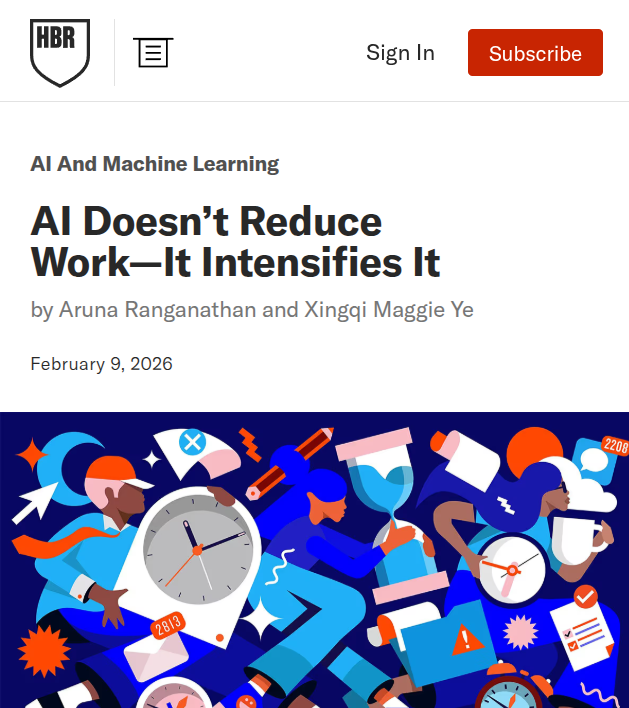
Powerful new Harvard Business Review study.
"AI does not reduce work. It intensifies it. "
A 8-month field study at a US tech company with about 200 employees found that AI use did not shrink work, it intensified it, and made employees busier.
Task expansion happened because AI filled in gaps in knowledge, so people started doing work that used to belong to other roles or would have been outsourced or deferred.
That shift created extra coordination and review work for specialists, including fixing AI-assisted drafts and coaching colleagues whose work was only partly correct or complete.
Boundaries blurred because starting became as easy as writing a prompt, so work slipped into lunch, meetings, and the minutes right before stepping away.
Multitasking rose because people ran multiple AI threads at once and kept checking outputs, which increased attention switching and mental load.
Over time, this faster rhythm raised expectations for speed through what became visible and normal, even without explicit pressure from managers.