What do 𝘠𝘰𝘶 think Chelsea Women are really worth??
📣 New episode out : 𝙋𝙪𝙩𝙩𝙞𝙣𝙜 𝙤𝙪𝙧 𝙈𝙤𝙪𝙩𝙝 𝙬𝙝𝙚𝙧𝙚 𝙎𝙤𝙢𝙚𝙤𝙣𝙚 𝙀𝙡𝙨𝙚’𝙨 𝙈𝙤𝙣𝙚𝙮 𝙞𝙨 (𝙬𝙞𝙩𝙝 Christina Philippou)
https://t.co/224JhY6fEA
We dive into a case study on the value of Chelsea Women, using a financial model built by @Denzera , based on the sale of a majority stake in Lyon Women to Michele Kang.
With returning guest and football finance expert @C_Philippou , we ask:
⚽️ What did Kang pay for Lyon—and how was the purchase structured?
⚽️ What makes Chelsea more (or less) valuable than Lyon?
⚽️ And should the Lyon deal be a blueprint for future investment in women’s football teams affiliated with men’s teams?
Plus, we talk World Sevens buzz and Val’s distressing merch purchase. Enjoy!
We have a new MCO kid on the block 👶 !
Welcome to the 'hood, 𝗕𝗮𝘆 𝗖𝗼𝗹𝗹𝗲𝗰𝘁𝗶𝘃𝗲!
Backed by private capital firm 𝗦𝗶𝘅𝘁𝗵 𝗦𝘁𝗿𝗲𝗲𝘁 (majority owner of @NWSL side @wearebayfc ), Bay Collective’s mission is to invest in “premier women’s football clubs across the globe” and its intends to create value across its group of clubs by providing “world-class playing, training and performance infrastructure, professional development, brand visibility, data science, analytics 📊 and coaching and technical staff.”
Sixth Street will have undoubtedly been tracking developments with Michele Kang’s 𝗞𝘆𝗻𝗶𝘀𝗰𝗮 𝗦𝗽𝗼𝗿𝘁𝘀 (owner of @washspirit, @OLfeminin and @LC_Lionesses 🦁) and Mercury/13 (owner of F.C. Como Women) who recently onboarded Avenue Sports Management as an investor to accelerate its acquisition of additional women’s teams in Europe.
With Sixth Street’s deep pockets 💵, vast expertise in the sports & entertainment industry ⚽🎭, and flexible investment timescales, it's a brave person who bets against them making a success of Bay Collective.
But what are the benefits of MCO in women’s football, and why pursue such a strategy? 🤔
Each MCO group focused exclusively on women’s football will have its own vision of success and strategy for achieving it, but the general MCO investment thesis is to create value by:
✅ Limiting financial risk by diversifying across different markets;
✅ Managing the (increasingly expensive) recruitment of talent (on and off the pitch) in a holistic way;
✅ Building a global brand in order to attract and supersize commercial deals & partnerships; and
✅ Managing costs through efficient headcount and economies of scale.
MCO investors diving into the European women’s football market today are banking on:
📈 Recent increases in fandom and revenues in the women’s game continuing to climb exponentially, and
⚖️ Being able to rein in costs that (currently) seem to be outpacing revenues.
While investors in men’s elite football have ever-increasing international media dollars to feed their equity appreciation fairies 🧚♂️💰🧚♂️, there’s no such luxury in women’s football. In the near term, owners have to graft to eek more value out of matchday and commercial.
If it so happens that broadcast deals explode in the next 5-10 years, well, that will be icing on the cake 🎂 for investors who jumped in first.
But how do/will fans feel about MCOs in the women’s game? 👀
Perhaps there'll be less resistance because supporters seem to be less tribal, less emotionally tied to the history and traditions of the badge?
But surely ALL fans want THEIR team to be number one🥇and not simply there to facilitate the success of another club. Can MCO owners love their children equally?
Inarguably women’s professional football needs more investment 💸 . So, is MCO a “necessity" for getting more investors through the door? Do the positives outweigh the negatives? 🤨
@_DavePowell@Denzera #womensfootball #footballfinance #footballbusiness #womensfootballfinance
🎙️⚽ New Year, New Insights! https://t.co/224JhY5HP2
𝗧𝗛𝗘 𝗪𝗼𝗺𝗲𝗻'𝘀 𝗙𝗼𝗼𝘁𝗯𝗮𝗹𝗹 𝗙𝗶𝗻𝗮𝗻𝗰𝗲 𝗣𝗼𝗱𝗰𝗮𝘀𝘁 is back and kicking off 2025 with a brand new episode! Join us for a good 'ol chinwag with football finance expert Christina Philippou who shares her knowledge of the football club valuation process and how it works differently for women's football teams in Europe, where so many of the sides are affiliated with men's football teams.
Plus you'll get Val, Dave and Steve's take on the 𝗡𝗪𝗦𝗟 free agency stampede, the 𝘶𝘯-𝘯𝘢𝘮𝘪𝘯𝘨 of BOS Nation and Santa's 🎅 𝗪𝗦𝗟 Panini sticker book generosity 💸.
📈 Whether you’re a women's football fan, a business enthusiast, or both, this episode is packed with insights you don’t want to miss. Tune in now! 🎧
@C_Philippou@Denzera@_DavePowell@Twffpod
#WomensFootball #WomensFootballFinance #SportsBusiness #FootballFinance
What’s needed is more investment in the middle tiers to accelerate the professionalisation curve and make teams more competitive with the professional teams.
But with WSL and WC operating costs continuing to rise and outpace revenues, who is brave enough to bet £ on being able to push a Tier 3 or 4 women's team up to the summit?
Ever wondered what the operating budgets look like a bit further down the English women’s football pyramid 🤔❓ Say, in Tiers 3 and 4 where @LUFCwomen and @NFFCWomen play against clubs like @GwaliaUnited ? Read on for some little-known figures.
As the WSL and Championship gain more and more exposure over the coming years, will more money trickle down to the lower tiers of the pyramid to allow it to put down firmer roots and provide a better platform for growth?
Perhaps. But that will certainly be a slow journey.
We look forward to what follows this season in the @aleaguewomen , and what it might mean for player wages, CBA talks, broadcast deals, and other signals that follow the big one - fans through the door. Tune into our pod to hear more about important stories in the business of women’s football!
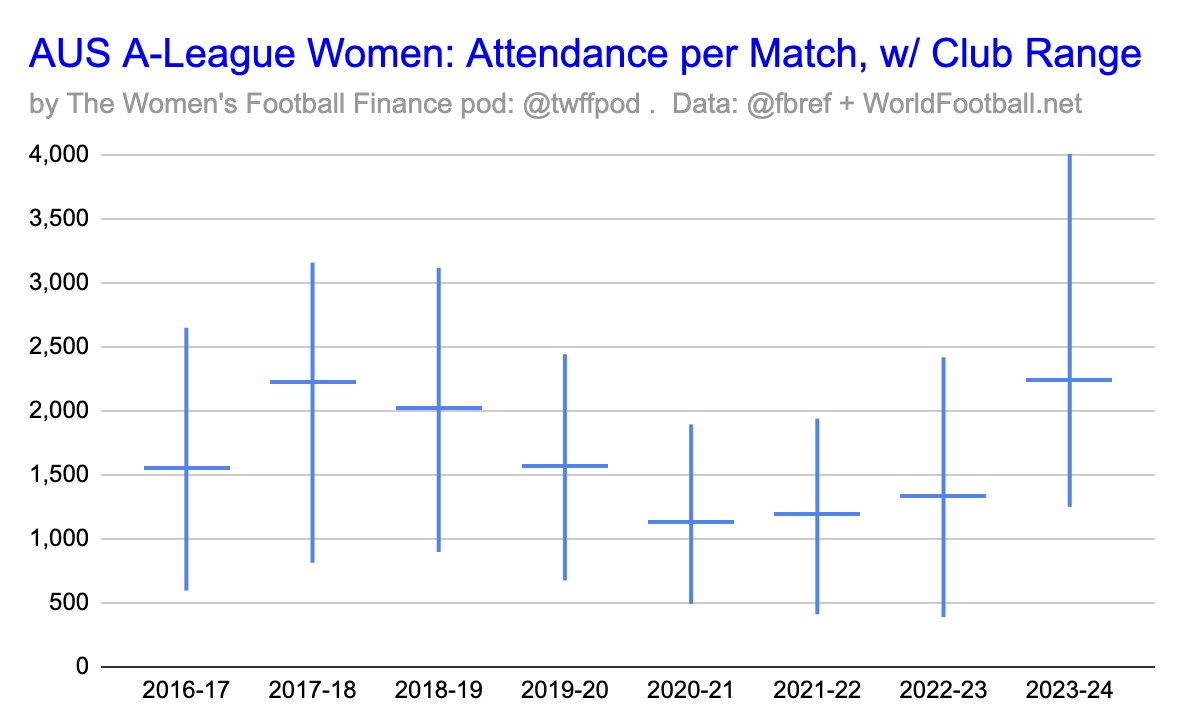
But less-well-supported teams also saw very strong gains, led by Western Sydney, which went from 3,500 fans in 22-23 up to 22,000 in 23-24, an over 6x jump. In fact, all but 1 team brought in over 1,500 fans per game, most well over 2,000, led by Sydney FC at 4,383 per home game.
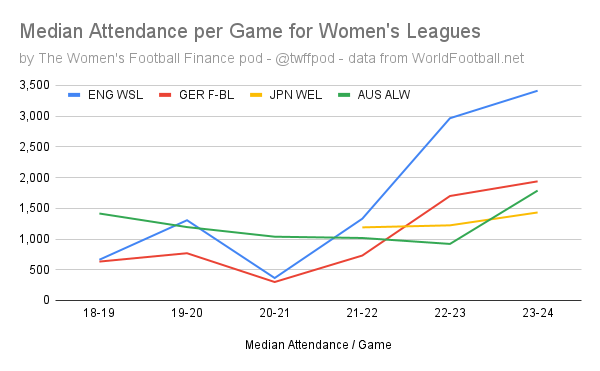
This jump in attendance puts the ALW as the 5th-best-attended women’s football league in the world, and closing on the 🇩🇪 Frauen-Bundesliga for 4th. More importantly, the bigger crowds made a more fun atmosphere to be at and to watch, and made the clubs more financially stable.
This was helped by the (re-)introduction of a 12th team, the Central Coast Mariners, which added fixtures for all teams, and whose first season saw them put the 2nd-most fans through the gates of any team - over 35,000 of them.
⚽️ Attendance Watch: 2023-2024 Australian A-League Women (ALW)
For our update this week, let’s go down under and see the surprising progress the @aleaguewomen made as a league last season!
In 2023-2024, its 16th season, the ALW (formerly the W-League) posted over 312,000 attendance (in 139 regular-season and playoff matches). That more than doubled the prior season’s 137,600 (in 103 matches), a 127% rise!
🎙️ New episode alert ‼️ (🔗 https://t.co/224JhY5HP2)
Val, Dave, and Steve huddle up with @jennyhaskel Jennifer Haskel, Knowledge and Insights Lead at the @Deloitte 𝗦𝗽𝗼𝗿𝘁𝘀 𝗕𝘂𝘀𝗶𝗻𝗲𝘀𝘀 𝗚𝗿𝗼𝘂𝗽, for a look at Deloitte's market-leading research and projects on women's football finance, including:
📚 @FIFAcom's Women’s Football Benchmarking Report
💸 Deloitte's Women’s Football Money League
📈 Deloitte's Annual Review of Football Finance
Women’s football is experiencing incredible growth and momentum globally and Jennifer’s team is leading the charge with financial data and analysis that’s helping shape its future.
Be sure to have a listen 🎧 !
@_DavePowell@Denzera@hannahgowen_@WomeninFootball@BarclaysWSL@womeninsoccerus@NWSL
#footballfinance #womenfootballfinance #footballmoneyleague
So even if NWSL per-game attendance didn’t rise in 2024, by increasing the number of matches (total attendance +41%), and a reported ~49% rise in average ticket price (per Vivid Seats), matchday revenue likely doubled from 2023. Making it a Merry Christmas for the league! 8/END
⚽️ Attendance Watch: 2024 NWSL Recap!
@NWSL ’s just-concluded season posted a big jump in total attendance, to 2.2M (including playoffs), up from 1.5M in 2023 and 1.0M in 2022. But are the underlying numbers that rosy, too? Let’s dive in! 🧵 1/
To put that in context, the NWSL’s nearest competition, the @BarclaysWSL , had a median attendance of around 3,400 last season. Australia’s @aleaguewomen held more steady through the pandemic, but still is around 1,800. We lack firm data for Mexico but believe they're ~2,200. 7/