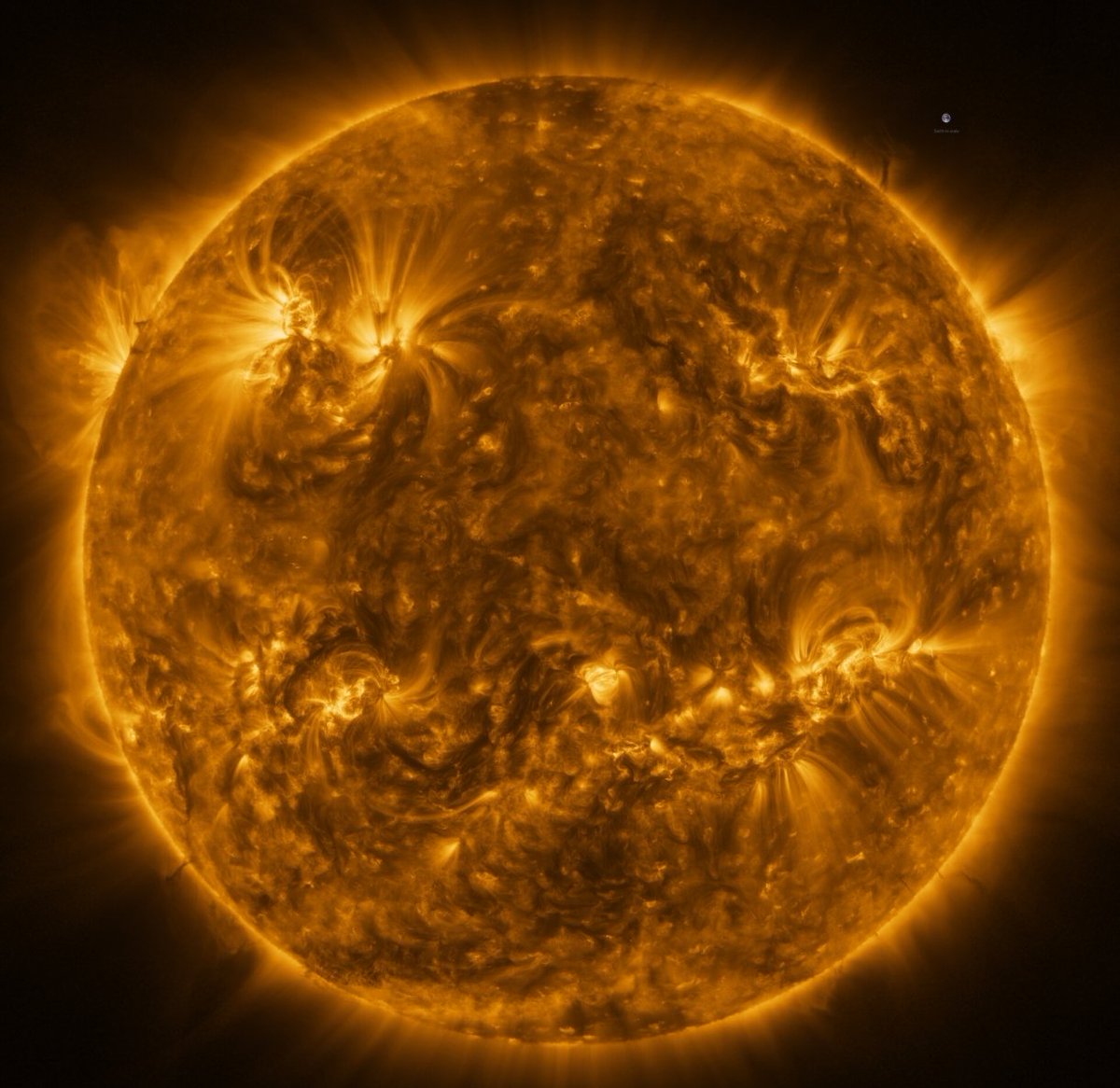
The Sun does rotate on its axis, but it does not behave like a solid spinning sphere. Instead, because it is made of hot, ionized plasma, different parts of the Sun rotate at different speeds.
This phenomenon, known as differential rotation, means that the equatorial regions complete a full rotation faster than the higher latitudes.
When measured relative to distant stars, the Sun’s equator rotates once roughly every 25 days, while regions closer to the poles take significantly longer, often exceeding 30 days and in some cases approaching 35 days.
In short, the Sun is a twisting, fluid mass. The apparent rotation period can also depend on how it is measured.
From Earth, we observe a slightly longer rotation period because our planet is orbiting the Sun at the same time. This Earth-based, or synodic, rotation period is closer to 27 days.
Early astronomers inferred this motion by tracking sunspots as they crossed the solar disk and reappeared after disappearing over the limb. In the 19th century, Richard Carrington carefully quantified this motion, and his work led to what is now known as the Carrington rotation period.
More than a historical footnote, this reference frame is still used today by heliophysicists to label and track solar features over time.
Modern observations go far beyond surface tracking. Techniques such as Doppler measurements and helioseismology allow scientists to probe how rotation changes beneath the Sun’s visible surface, revealing that differential rotation extends deep into the convection zone, while the inner radiative zone rotates more uniformly.
These internal rotation patterns are not just a curiosity; they play a central role in shaping the Sun’s magnetic field. Differential rotation stretches and twists magnetic field lines, powering the solar dynamo that drives sunspots, solar flares, and the roughly 11-year solar activity cycle.
Understanding how fast the Sun rotates, and how that rotation varies with latitude and depth, is therefore essential to understanding why the Sun behaves the way it does, and how its activity affects the entire solar system.
@debrajsaunders@reviewjournal "It’s all good. The kids will learn independence and autonomy and understand how important their lives are. They will see that they are not broken souls from birth, destined to be eternally damned in a lake of fire." #hailsatan#afterschoolsatan
@DarwinAwards are you still up and running for submissions on your website or are you BO? Haven’t seen any updates from u or the mods etc… U alive ???#darwinawards
@BesapLilly When one or two people own the lions share of the org for gain it’s a cult. That’s the deciding factor, otherwise it’s a organized crime syndicate. Lol