T5 claims are notorious for how hard it is to successfully make a claim of bad faith
However, the odds drastically improve when a landlord *very foolishly* puts the property on the market less than a year after the eviction, shifting the burden of proof onto the landlord
This 92-year-old was evicted during a Toronto heat wave last summer. Now his former home is for sale — and he wants the landlord to pay him damages https://t.co/G9lWeGViVC
NEW: A secret report on the financial stability of the ROM suggested selling off artifacts to make up for a post pandemic drop in visitors.
The Ford government refuses to release the report and says no such sale was ever considered.
https://t.co/AixBglcoWC
#onpoli
For example, the case Eric references regarding considering immigration as a factor in ruling had to do with a spouse being deported if the charged person was.
Should someone be asked to pay the price for someone else's crime?
While I sympathize with where Eric comes from in principle, I believe it lacks the nuance needed in discussing the law.
To keep it simple: We are trying to adapt a black and white justice system for application in a shades of grey world.
I’m often asked if I am a “tough on crime” Liberal. It’s the wrong question.
What I do believe is that we’ve lost an important principle in Canadian justice:
🇨🇦 The law should apply equally to all, without discrimination 🇨🇦
I don’t think many disagree. But what do I mean?
When it comes to justice, I believe verdicts/sentencing should be be based on three simple factors:
1) The crime committed
2) The harm done to the victim
3) The future risk to society
That’s it.
Factors specific to the criminal such as:
- Social determinants (income, education)
- Mental health or addictions
- Cultural, religious, or ethnic identities
- Immigration status
Shouldn’t be considerations in sentencing, as they result in discriminatory application of the law.
This is obvious to most people!
Now, they could matter for where a sentence is carried out (eg, asylum/rehab for those whose mental health or addition issues led to criminality). But they should not result in reduced sentencing.
Also, frankly, our tolerance level for non-citizen criminality should be zero.
In fact, I find recent cases of reduced sentences due to deportation risk on the criminal to be highly prejudiced; as if there are not millions of good people who live in the countries they would return to.
Ontario/Canada is not a charity, our standards for creating new citizens should be high!
Furthermore, I do think we should take cases of recurring public nuisance and repeat offending much more seriously.
Why? Because public safety, and perceptions of it (such as on transit or in the ER) are hugely important for social trust to invest in great public systems.
For example, in April, the Globe and Mail reported the arrest of a troubled man in Toronto with over 125 convictions in 30 years! 10 days after release from a 20 month sentence.
That is obviously a terrible outcome for justice and public safety. Repeat offenses, even for petty crime, should result in far stricter sentencing given the risk to the public. Common sense!
Many of these individuals also deserve dignity, treatment, shelter, and care.
There are some people who can’t function on their own in society and we should help them. It would benefit everyone and cost less than the status quo.
In 1965 we had nearly 230 mental health/asylum beds per 100K people.
Today it’s closer to 30 (1/7th).
It’s okay to admit we were wrong in unwinding this system so much and invest more in mental health and rehab beds as part of our health system.
Look, I use transit nearly every day, so I share the frustrations people have for how frequent and visible disorder has become. It’s a real problem that only seems to get worse each year!
And look, I still align with many progressives who think we should prioritize prevention and mitigation against crime through understanding social factors behind it, and invest in mitigation. But it’s not one or the other, it’s yes, and!
I don’t think any of this is “tough” or “weak” on crime, just common sense.
That’s what we need to see return to criminal justice. And this will guide my approach, if I am ever elected.
Mike makes good points here, but I feel the strongest is the one he makes about Toronto-centred governance.
Failing to base growth around the whole province and focusing solely on Toronto is a constantly missed opportunity we see throughout our history.
This whole Billy Bishop expansion is being driven by an American bank that won't even disclose its role in the lobbying campaign. Doug Ford is destroying Toronto's waterfront to help out American bankers at our expense.
Two Ontario Liberal MPPs are drawing a line in the sand, insisting that the next leader of the third-place party needs to have a seat in the provincial legislature in order to effectively hold the Ford government to account.
https://t.co/lYYvQnmB2p
#onpoli
What saved the LPC in 2025 was not just some bland economic speak: Carney built a vision that painted a picture for voters.
I have not seen that yet from anyone in the OLP. We are in a vision "drought" that I hope does not last another leadership
🧵-
The @OYLorg are a backbone of the @OntLiberal. Our members, many aged 14-17, are dedicated to building a better Ontario.
As someone who voted in her first leadership race at 17, I’m frustrated by discourse about changing the voting age to exclude part of our membership.
Jordan makes a great point here while also showing that the grassroots of the OLP are well aware of the issues.
The problem is that the party no longer belongs to the grassroots (if it ever did).
The #OLP doesn't just need a new strategy. It needs a deeper reset in how it thinks, organizes & connects with people.
Renewal will not come from branding or leadership cycles. It will come from culture, trust & real grassroots empowerment.
Read here: https://t.co/zMAgoljNbg
@MobyDickSpoiler Not excusing the behaviour, but to be fair, Rob and Eric's event was explicitly a YLC suite. Would have been a little odd for her to be there
Among the many other things we need from the next OLP ldr, we need someone who is well acquainted with the internal mechanisms of the party and how to fix them.
Without that knowledge it becomes far too easy for leadership to be undermined from within.
"Congratulations, anti-Nate Liberals, you win. All it’s cost you is the credibility of the party and any appearance that it’s ready to win an election." — @jm_mcgrath#onpoli https://t.co/7E0VIM4Y0o
"Congratulations, anti-Nate Liberals, you win. All it’s cost you is the credibility of the party and any appearance that it’s ready to win an election." — @jm_mcgrath#onpoli https://t.co/7E0VIM4Y0o
@PJforTO "Now it's my turn" is a great summary of the state of the OLP
It's not about your ideas, it's about waiting your turn (as long as they approve)
I conducted my first interview with a global political figure at age 11. Six years and 500+ interviews later, including sit-downs with Justin Trudeau, Hillary Clinton, Kamala Harris, Gavin Newsom, Nancy Pelosi, and RFK Jr. — I’m building something the media landscape has been missing out on.
Today, I am announcing the launch of The Sharpe Exchange, with the goal of bringing back serious conversation in an era of performative outrage. The program brings together senior political leaders and high-profile commentators from across the United States and Canada, with a focus on the Gen Z perspective.
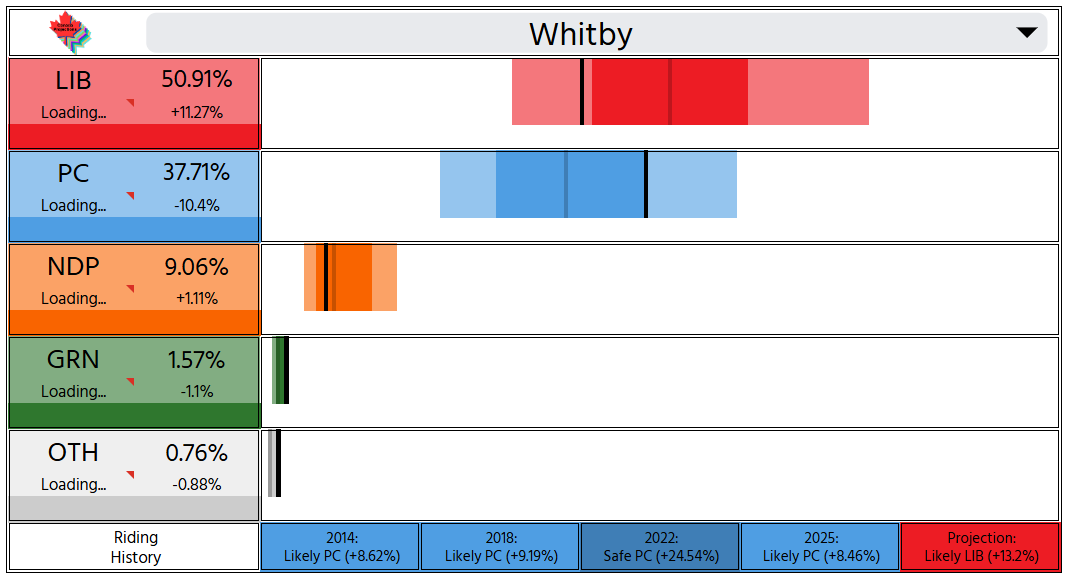
For those interested, this is a riding that's been held by the PCs since 1995, and hasn't been won by a Liberal since 1987.
Whitby was once a PC stronghold that is now getting tired of being left behind by Doug Ford's government