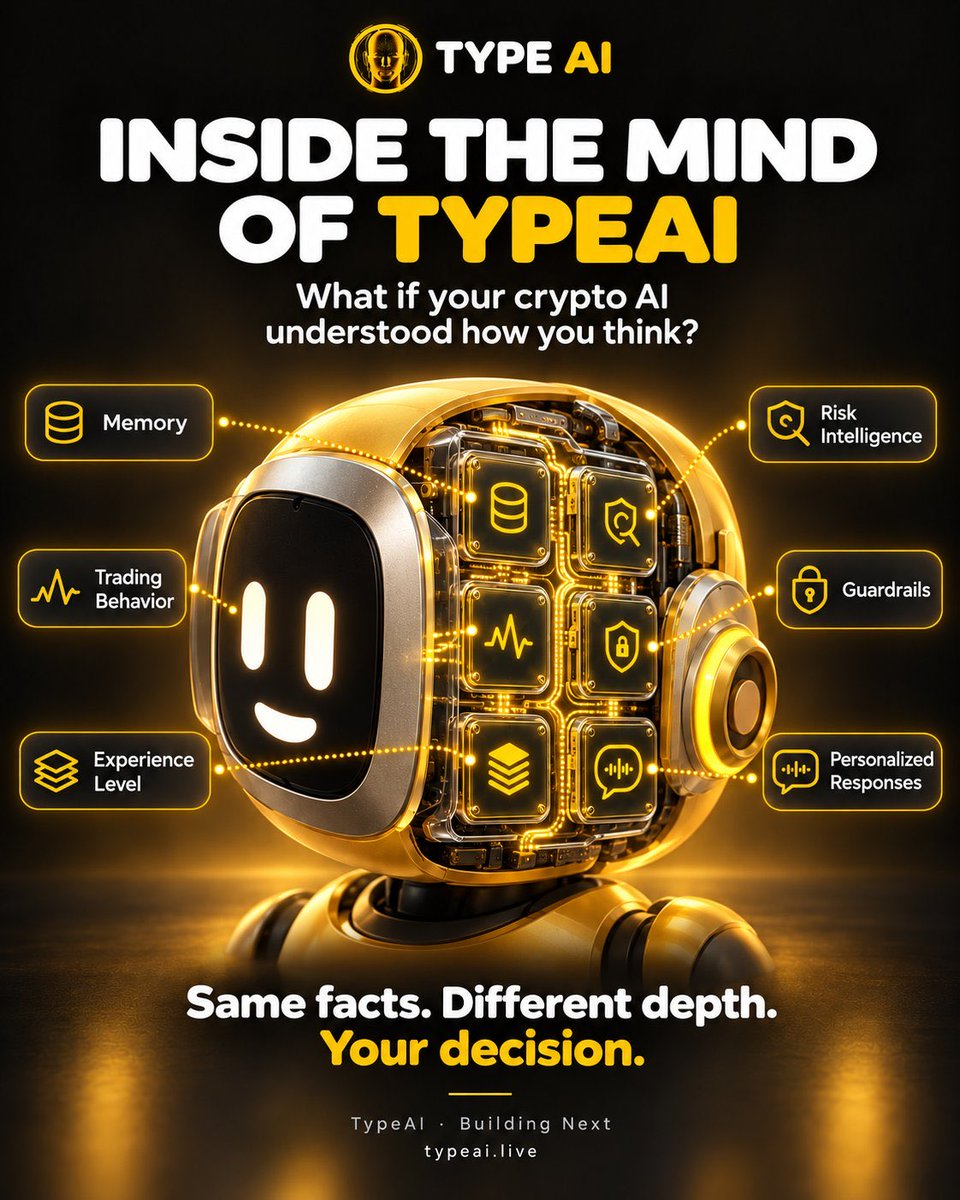
Meet the TypeAI Companion: an AI trading assistant designed to learn how you trade.
We're building a more personalized trading experience that adapts to your knowledge, habits, and research workflow.
Here's what's coming:
• Adaptive AI: Explanations tailored to beginners, intermediate, and advanced traders.
• Personalized research: Learns which checks matter to you and how you approach tokens.
• Proactive safety checks: Analyzes contract permissions, honeypot risks, taxes, liquidity, and holder concentration before you trade.
• Transparent risk data: Shows verified findings and unknowns instead of misleading safety scores.
• Full user control: You decide what to trade and approve every transaction.
• Claude MCP integration: Bringing the same companion experience across TypeAI and compatible AI assistants.
Not another trading bot giving everyone the same answers.
An AI companion that learns how you trade, without trading for you.
Day 1019: Building the TypeAI Companion, an AI trading assistant that learns how you trade and adapts to your experience.
Most trading bots give everyone the same information, whether they're buying their first token or analyzing hundreds of contracts.
We're building something different.
Here's how the TypeAI Companion will work:
- A trading profile that evolves with you. TypeAI will learn from your questions, research habits, and trading activity, including which safety checks you run, how quickly you enter positions, your position sizes, and how long you hold assets.
- Experience-level detection. The companion will gradually estimate whether you're a beginner, intermediate, or advanced trader using multiple signals over time. One basic question won't change your level, and you'll always be able to review or adjust it.
- Adaptive explanations. Everyone gets the same underlying contract checks, but the explanation changes based on experience.Beginner: "The owner can still create new tokens, which could dilute your holdings."Advanced: "mint: enabled · owner: EOA · not renounced."Same facts. Different depth.
- Proactive token research. On fast chains like Elysium, waiting until someone asks for a safety check can mean missing important information. We're building the companion to analyze tokens you're researching ahead of time, including honeypot simulations, buy/sell taxes, owner permissions, unlocked liquidity, and holder concentration.
- Evidence over predictions. TypeAI won't label tokens as guaranteed safe or scams. It will show actual findings, clearly separate verified information from unknowns, and let users make informed decisions.
- Built-in trading guardrails. The companion won't decide what you should buy or hold your private keys. Every transaction will still require your approval.
- One companion across platforms. We're working toward bringing the same personalized experience to the TypeAI app and Claude through our MCP integration, with consistent risk checks and user controls.
The bigger idea:
A beginner shouldn't need to understand contract bytecode to identify important risks.
An advanced trader shouldn't have to read lengthy explanations for checks they already understand.
And on fast chains, research should start before the user reaches for the buy button.
We're not building another chatbot that responds the same way to everyone.
We're building an AI trading companion that learns how you work, adapts to your experience, and keeps you in control of every decision.
TypeAI Companion. Building now. 🛠️
TypeAI is building an AI-powered bridge bot for Elysium.
We're expanding TypeAI's capabilities to make cross-chain transfers as simple as sending a message.
Imagine typing: "Bridge 50 USDC to Elysium."
Here's what we're working on:
AI-powered bridging: Convert natural-language requests into structured cross-chain transactions.
Smart route discovery: Identify supported bridge routes, token mappings, network fees, and estimated transfer amounts.
Automated transaction preparation: Handle token allowance checks, bridge contract interactions, and transaction construction.
Cross-chain tracking: Follow transactions from source-chain confirmation through destination settlement.
Security checks: Validate token contracts, destination networks, recipient addresses, and bridge routes before execution.
Non-custodial execution: TypeAI prepares transactions, while users review and approve them through their own wallets.
Claude MCP integration: Bring bridge research, route discovery, and transaction preparation into compatible AI assistants.
Our goal is to bring bridging, token discovery, safety analysis, and AI-powered trading into one conversational experience.
One prompt. Multiple chains. Full user control.
Day 1015: Building a cross-chain bridge bot for Elysium with TypeAI.
We're expanding TypeAI beyond token discovery and trading. The next piece is bridging: moving assets between supported networks through a simple conversation with AI.
Elysium is built on the Arbitrum Orbit stack and settles to HyperEVM. Since TypeAI already supports Robinhood Chain, another Orbit-based network, we have an existing EVM-compatible foundation to build on.
The challenge isn't just preparing a bridge transaction. It's handling route discovery, token compatibility, approvals, network fees, execution, and settlement without making users navigate multiple interfaces.
Here's what we're working on:
1. Natural-language bridge intents.Instead of opening a bridge interface, connecting a wallet, selecting two networks, and configuring a transfer, users should be able to say:"Bridge 50 USDC to Elysium."TypeAI will interpret the request, identify the source network, destination network, asset, amount, and recipient address, and determine what additional information is needed before preparing a transaction.
2. Network and token resolution.The bridge bot needs to understand chain IDs, RPC endpoints, token contract addresses, decimals, and supported asset mappings.USDC on one network isn't automatically the same contract or representation on another.We're designing the integration to verify supported routes and token representations rather than assuming that matching tickers mean matching assets.
3. Bridge route discovery.The next component is finding a supported path from the source chain to Elysium.That means evaluating available bridge infrastructure, supported token pairs, expected fees, settlement requirements, and route availability.The bot should be able to present a valid route or clearly explain when no supported route exists.
4. Transaction preparation and approvals.Once a route is selected, TypeAI will need to determine whether an ERC-20 token allowance is required, prepare the appropriate approval transaction, and construct the bridge transaction.Users should see exactly which contract they're interacting with, how much they're authorizing, and what they're expected to https://t.co/JN70FtIfzS unnecessary unlimited token approvals by default.
5. Fee and destination-amount transparency.Bridging involves more than the transfer amount.Depending on the selected route, there may be source-chain gas, bridge fees, destination execution costs, and a difference between the amount sent and received.Our goal is to show these details before users sign:• Source and destination networks
• Token and transfer amount
• Bridge contract and route
• Estimated fees
• Expected destination amount
• Estimated completion time, where available
6. Non-custodial execution.TypeAI prepares transactions, but users remain responsible for approving and signing them through their connected wallets.The bot doesn't need custody of private keys or the ability to move assets independently.We're keeping that same transaction-approval model as we extend TypeAI into bridging.
7. Cross-chain transaction tracking.A successful source-chain transaction doesn't necessarily mean funds have arrived at their destination.We're planning transaction tracking that distinguishes between source confirmation, bridge processing, destination settlement, and completed transfers.That also means accounting for delayed settlement, failed operations, and cases where a transaction needs additional attention.
8. Security checks and guardrails.Before preparing a bridge transaction, TypeAI should validate the destination chain, token contract, recipient address, and supported bridge route.Unknown routes and unverified token mappings shouldn't be treated as safe.The goal is to help users understand the transaction before signing, not hide important risks behind an AI-generated response.
9. MCP integration for AI agents.We also want to extend this workflow through TypeAI's MCP server.A compatible AI assistant could request bridge routes, inspect fees, check transaction requirements, and prepare transactions through TypeAI's tools.Actual asset movement would still require the user's approval.
10. Bridging as part of a larger workflow.Bridging is only the beginning.We're working toward a flow where users can move assets to Elysium, discover tokens, run safety checks, and prepare trades without switching between multiple https://t.co/KHj7maFbkh conversational interface for multiple onchain operations.
Where we stand:
We're building the bridge bot architecture and Elysium integration. Supported bridge routes, complete transaction execution, and end-to-end settlement still need validation before we can call the feature live.
The next milestone: completing a testnet bridge flow from transaction preparation to confirmed destination settlement.
@IncomeSharks@kevinxu Yo Shark, you still keeping an eye on @TypeAI2 ?
Team is refreshed and still building. Some solid updates in the last few days, with much more to come 🔥
Day 1013: building TypeAI on Elysium to make crypto trading simpler and safer with AI.
We're working on bringing TypeAI to Elysium, making it easier to discover, research, and trade tokens through simple conversations with AI.
Here's what we're building:
- Discover new tokens as they launch. We're developing a pool monitoring system for Elysium to track newly created liquidity pools across supported launchpads and DEXs. The goal is to help users find new tokens and review potential risks before trading.
- Check contracts before buying. TypeAI is being adapted to examine token permissions, including minting, blacklisting, transfer restrictions, hidden taxes, and upgradeable contracts. Users will be able to see potential red flags and information that couldn't be verified.
- Detect potential honeypots. We're working on buy-and-sell simulations that test whether a token can actually be sold before preparing a swap. If the exit simulation fails, the planned system will block the trade rather than let users proceed blindly.
- Understand liquidity and holder risks. TypeAI will examine unlocked liquidity, major holder concentration, creator holdings, and liquidity relative to market cap. Clear information to help users understand the risks behind a token.
- Trade on Elysium by talking to AI. Imagine typing "Buy 0.1 HYPE of this token." TypeAI would find the token, check its risks, prepare a swap route, and show the transaction details before approval. Your keys stay in your wallet, and you control every transaction.
- Bringing Elysium to Claude via MCP. We're planning to extend TypeAI's MCP tools to Elysium, allowing compatible AI assistants to discover tokens, perform risk checks, analyze market data, and prepare transactions using natural language.
- Exploring HyperCore integration. We're also looking at bringing HyperCore market data into TypeAI, helping users compare available prices and understand differences between trading venues.
Why Elysium?
TypeAI already supports Robinhood Chain, another Arbitrum Orbit network. That gives us an existing EVM-compatible foundation to build on rather than starting from scratch.
Our mission remains the same:
Make crypto as easy as sending a message, with risk information available before every trade.
Fast chains need better tools to help users understand what they're trading.
https://t.co/7TlzrnDocz