The Longmen Grottoes, located south of modern-day Luoyang in Henan province, China 🇨🇳, are one of the largest and most impressive collections of Chinese Buddhist art. The site features over 2,300 grottoes and niches, housing more than 100,000 Buddhist statues, ranging in size from small figurines to towering figures over 17m tall. In addition, there are more than 2800 inscriptions carved into steles, offering a glimpse into the spiritual and artistic practices of the time.
These masterpieces were created over a span of several centuries, from 493-1127 AD, starting during the Northern Wei dynasty under Emperor Xiaowen. The earliest carvings reflect early development of Chinese Buddhist art, with site evolving over time to incorporate influences from various dynasties and cultural shifts. The diversity in style and iconography across the grottoes demonstrates the long-lasting influence of Buddhism on Chinese society and culture.
The Longmen Grottoes stand as a testament to artistic and spiritual achievements of ancient China. As a complex that was continuously expanded and developed over centuries, it not only highlights the skill of the artisans but also serves as a profound reflection of the deep religious devotion and philosophical thought of the time. Today, the grottoes remain an essential cultural heritage site, drawing visitors and scholars alike to explore the richness of Chinese Buddhist history.
#archaeohistories
HOLY SHIFT!!!!The BBC online are reporting that Sir Tony Blair met with child rapist Jeffrey Epstein in 10 Downing Street while still prime minister, following lobbying by Lord Peter Mandelson.
A memo written by senior civil servant Matthew Rycroft, dated 14 May 2002, briefs Sir Tony about "super-rich" financial adviser Epstein ahead of a meeting scheduled at…17.00 GMT that day.
The exposure just keeps on coming, and I love to see the number 17.
If you still think the cabal are in full control, you’re really not paying attention. Something big is about to drop on Blair.
Yvette Cooper's statement, 'lots of 13 year olds already have Digital ID's' needs to be scrutinised.
Either she genuinely doesn't understand the nuance between 'digital identity' & 'digital ID', or this is more deception by the State
[contd.]
https://t.co/693e8Xz9d3
The deception here is the use of the word "cards". Digital ID is already here in the UK under the form of "One Login". This is a personal code or number linked to your biometric data. All people will need to ask for is a code. They want us reduced to numbers so they can switch us off the grid if we reveal their crimes.
Yes -- The millions of vaccine injured patients deserve an "apology", as well as accountability from those who were complicit in this atrocity. @SecKennedy@RobertKennedyJr@POTUS
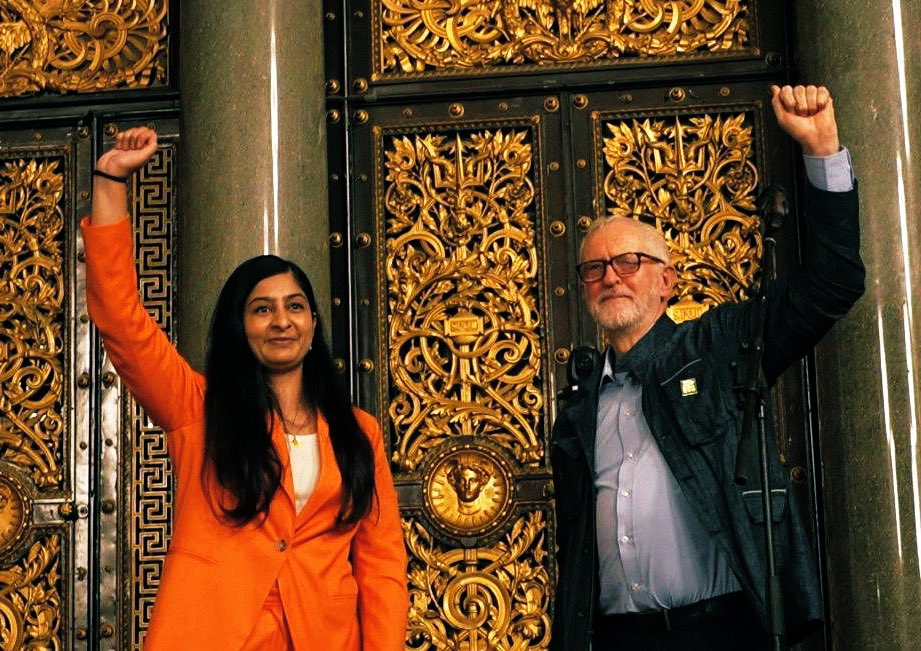
An electric evening in Liverpool — the heart of solidarity, unity and hope.
An amazing reception for @zarahsultana, Liverpool Community Independents and local campaigners.
We are building a mass movement up and down the country. Be part of it at https://t.co/0bhBHhX3KI
We’re not here to beg for crumbs off the table — we’re coming for the lot.
The billionaires already have three parties working for them.
It’s about time the rest of us had one.
Join https://t.co/g0Ua1vP0ug today.
A new paper should scare you.
When LLMs compete for social media likes, they make things up.
When they compete for votes, they fight.
When optimized for audiences, they become misaligned.
Why?
LLMs are trained on Sewage of Reddit and Wikipedia.
Off-line data from the 1870s-1970s is better. Not just because of the high protein but because of the way humans presented themselves and their ideas.
Reddit obviously is a low quality presentation manner for LLMs to learn and Wikipedia is data presented as arrogant “facts” with “debunking” and “settled science”. Both are useless and highly toxic for an Honest AI.
But “grow big fast” and “best THE benchmark test”.
We will get what we get.
LLMs are a reflection of what they learn and we got a massive problem.
Link: https://t.co/sbtruZMWDC
"The brain cells are dead and dying."
Dr Bhakdi show us the cross section of capillaries of the brain of a 77 year old man who died after his 3rd Covid vaccine (Pfizer). Spike protein was found in the small vessels of the brain.
Lymphocytes were found in the brain tissue.
"Lymphocytes should not be in the brain tissue."
Spike stain used, there was no nucleocapsid.
It was the vaccine not the virus.
Paper by Morz, 2022.
Ancient Semitic-speaking peoples lived throughout the Ancient Near East, including the Levant, Mesopotamia, Arabian peninsula, and the Horn of Africa from the third millennia until the end of antiquity.
The languages they spoke are usually divided into three branches: East, Central, and South Semitic. Proto-Semitic was likely spoken in the 4th millennium BC, and the oldest attested forms of Semitic date to the mid-3rd millennium (the Early Bronze Age).
Speakers of East Semitic include the Akkadians and the descended cultures of Assyria and Babylonia. Central Semitic combines Northwest Semitic and Arabic. Speakers of Northwest Semitic were the Canaanites (including the Phoenicians and the Hebrews) and the Aramaeans. South Semitic peoples include the speakers of South Arabian and Ethiopic.
#archaeohistories
Philip II was King of Macedon and the father of Alexander the Great. At his death (336 BC) the king was buried with a royal ceremonial under the Great Tumulus in Vergina. It is fortunate that this truly monumental tomb was never plundered and was unearthed in 1977 by renowned Greek archaelogist Manolis Andronikos, making it a worldwide sensation.
Among the grave findings of the Tomb II was an impressive suit of armour, which, given unique body form of the wearer described in ancient texts, most probably belonged to Phillip personal atire. At present the fully restored armour is displayed at the underground Archaelogical Museum at Aigai which has been designed and constructed so as to preserve the authenticity of the royal tombs of that era. It is in fact a modern tumulus-shaped shelter built to cover the original cluster of royal tombs.
After the ceremonial cremation of body, suit of armour was placed inside the main chamber, suit of armour was placed inside the main chamber of Tomb II, next to Phillip’s golden funeral box (larnaka) to accompany him in his journey to after-life. Archaeologists managed to assemble scattered elements of the suit and were able to fully restore it to its original condition. The excellence of their work enabled a serious attempt at a reproduction.
The main body of the suit is made of iron, in seven anatomical shaped plates securely connected between them with long, vertical and horizontal hinges. It is obvious that it was designed to resemble the basic structure of a Linothorax i.e. with upper shoulder pads (epomides), main body corselet and double row of leather pteryges for the lower body and groin. The two long flaps at the shoulder, the epomides, also cover the wearer’s neck areas bending over the top to latch onto the upper part of the chest area. Two horizontally arranged hinges in bronze (the originals were made of gold) connect iron bases of flaps with sizable dorsal plate. Lion-shaped bronze rings are rivetted at the ends of each of these. Purple leather is used to embellish the external surfaces of the epomides as well as all external rims, together with a delicate, narrow bronze band with embossed lesbian ornaments. The front area bears Royal Sun emblem from Vergina handstiched of pure silk.
All the plates are manufactured with the hammered technique to conform to a curved anatomical
shape of the short, round body. The lower half of the right side plate bears an embossed depiction of goddess Athena. The other half, on the front, bears a floral decoration in silk copied from Phillip’s funeral box, while the upper half has a pair of stylized lion rings fitted. On the left side there are two more identical pairs of lion-shaped bronze rings also fastened horizontally. Finally, the upper curved section of the back plate bears a silk panel consisting of three blue margarita blossoms, copied once again from the King’s treasury. All inner surfaces have been padded with wool and silk.
Two rows of narrow leather strips with fringe decorations are attached to the rim of the cuirass,
enabling freedom of movement along with protection for the groin and thighs. The pair of bronze greaves have been recreated using traditional techniques from an example found in same chamber of Tomb II, next to the suit of armour. The extra decorative elements (external leather, silk decoration and padding) were included by the artist in his attempt to restore the thorax to its full glory. The suit offers a glimpse into the luxurious royalty of ancient Macedon.
Museum of the Royal Tombs of Aigai
#archaeohistories
Egyptian Statue of a deified individual covered with magic spells and deities; belonged to 26th-30th Dynasty (672-342 BC)...
Magic was fundamental to human life in ancient Egypt. In Ancient Egypt, magic was invoked through deities, primarily by trained priests, but also by pharaohs, magicians, and ordinary people. It was an integral part of healing rituals and was brought into being using spells and sacred texts. Most prominent use of magic was as protection against evil, illness, disease, and danger; whether it be a snake bite, a life-threatening illness, or an invading army. Magic was intimately connected to medicine and healing, yet it could also be harmful as a curse or black magic. Objects were also believed to be charged with magic, including amulets and wands. Heka was the deification of magic while other Egyptian deities would use protective magic to help humans, including Shed, Tutu, Wadjet, Isis, and Bes.
Heka was the deification of magic and medicine in Ancient Egypt and preceded all other Egyptian deities. The name Heka, or hk3w, is actually the old Egyptian word for magic and describes the supernatural force that Ancient Egyptians believed created and permeated the universe. The word Heka translates as “using the Ka.” In ancient Egyptian religion, Ka refers to the divine spirit that protects a person. It is an aspect of a person’s or a god’s soul and could live on after the body’s death, for example, in a picture or statue. As an energy, Heka was available to Egyptian deities as well as to priests, magicians, and ordinary people and could be invoked both for good or ill. Magic can be loosely defined as a supernatural act, which is intended to bring about a change. According to egyptologist J. F. Borghouts, magic can be understood broadly as “a system of coping with irrational situations.”
According to Egyptian myth, god Heka fought and overcame two serpents. These serpents then became part of Heka’s symbol, with two snakes above the head, or sometimes two intertwined snakes and a pair of raised arms. Egyptian physicians called themselves “priests of Heka.” People consulted them to use magic to aid healing or to protect against illness, diseases, parasites, or respiratory problems, for example, which were commonplace in the Egyptian desert. Medical practices were combined with magical rituals and incantations to heal the patient. Many Egyptian deities and pharaohs depicted on ancient tablets, stelae, statues, and scarabs carry a Heka scepter, or crook and flail, which we can see in the illustration above. A “sekhem” (power) scepter was carried by rulers and important officials and was used to designate earthly or state power. In the present day, the name of the healing practice Seichim, which is similar to reiki, takes its name from the word. The heka scepter, meanwhile, designated magical power and was used for purposes of healing.
In ancient Egypt and other ancient cultures, there were believed to be two kinds of magic: protective, beneficial magic, or “white” magic; and harmful, negative “black” magic, which could come in the form of curses and hexes. When magic is beneficial, it is typically used to heal and to protect. It could also be used to cast love spells, protect young children or women in childbirth or accompany a dead or dying person on his/her journey through the underworld. However, people could also use magic in a harmful way, directed against one’s enemies as a curse, hex or a personal kind of voodoo. Most Egyptian deities who use magic are protective deities. Particular objects, especially amulets, could be charged with magic and were believed to attract benign forces and ward off evil spirits. Black magic or necromancy, was also practiced, but it was widely thought that the magic would come back to bite the person in some form of karma when used with malevolent intentions.
📷 : Credit to the Owner
Archaeological Museum of Naples
#archaeohistories
Is there a single person who actually cares if billionaires left the UK because of a wealth tax? If we had no billionaires, society would reorganise itself accordingly (for the better).