What's so powerful about @UFGDeFi's Immutable Treasury is that it's a new way for tokens to earn trust from their communities.
The Immutable Promise of robinhood:0xefab538cf3c29237a47c6afb145d50ddf204a0a3 is every redemption burns supply and lifts the permanent floor.
Founders Rise Together 🏛️
"In the same way Vanguard is owned by the people who hold its funds, UFG is owned by its tokenholders who collectively hold a claim on the Immutable Treasury.
What Vanguard and UFG share in structure is that both eliminate intermediaries and return that value to the people."
When it comes to true DeFi, @newmichwill is a pioneer in the way he set up the @CurveFinance treasury.
While the Curve Treasury prevents governance capture, @UFGDeFi’s Immutable Treasury is a check on economic capture.
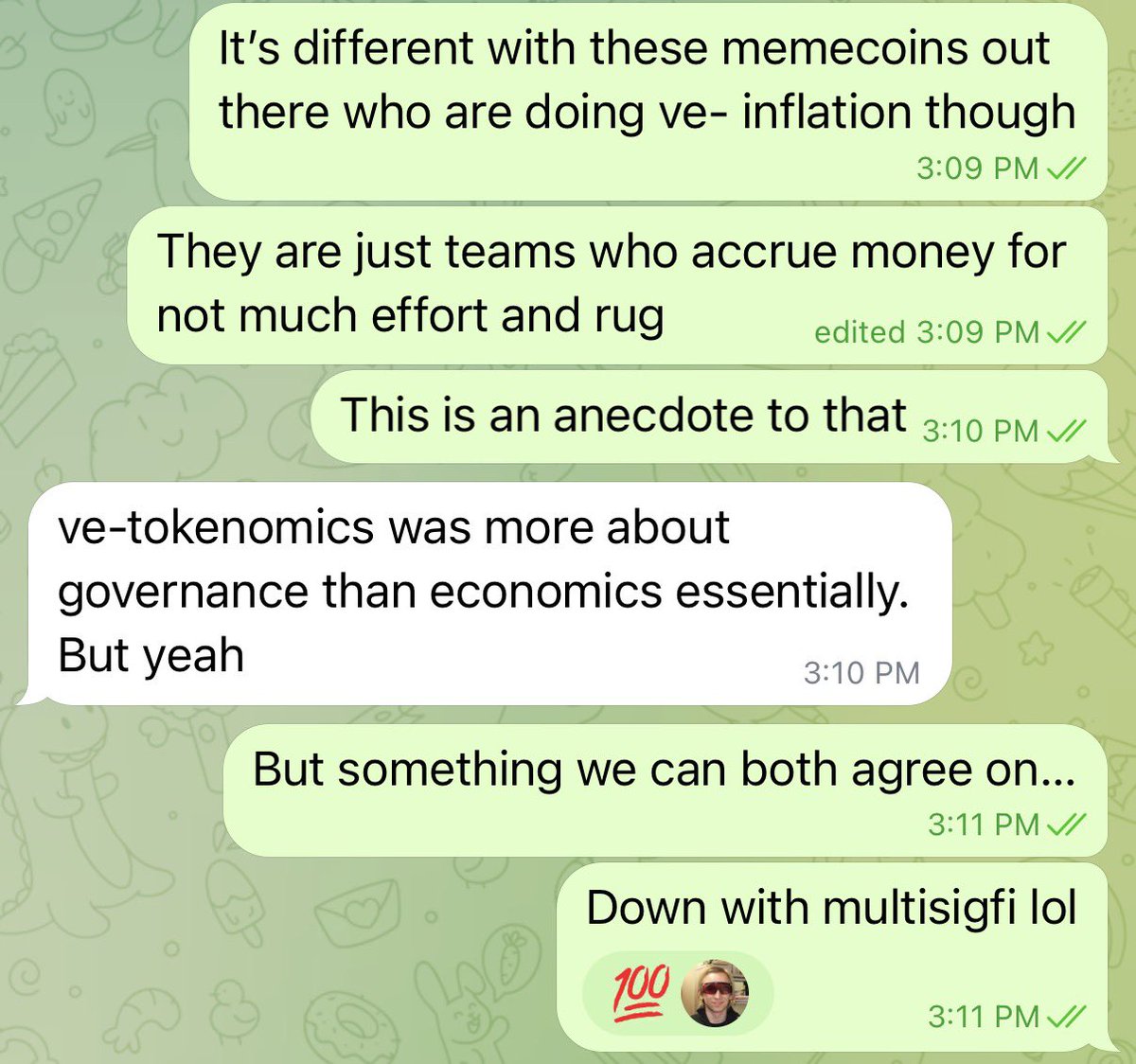
But what we both agree on is Down with MultisigFi!
TLDR: The Immutable Treasury prevents teams from rugging and gives tokenholders equal power over the value they create collectively.
https://t.co/Ih98FQPC8v
UFG and The Immutable Treasury 🏛️
@Eli5defi articulates the key innovation of @UFGDeFi so elegantly here; what's compelling about UFG isn't the treasury, but rather UFG is the first instance ever of stripping human dependency from protocol revenue and token backing.
What memecoins and DeFi tokens have in common is that they all have treasuries with a multisig where the teams perform actions such as buybacks, burns, strategic allocations, etc.
Although those funds are in a multisig, you are still relying on the team to act in good faith. Yet more often than not, team don't and worse, they rug completely.
As a tokenholder, whether you are holding it or trading it, no matter how big or small you are, you are creating genuine value for the token. That value is wholly captured by the team, leaving you only to speculate and when things go south, which they do 99% of the time, you are left holding the bag.
A paradigm shift is necessary to bring power to tokenholders where it belongs.
At UFG, we believe you should have a stake in the value you create and we accomplish this with The Immutable Treasury, a new type of protocol with no no owner and can only be accessed with the $UFG token.
For UFG's v1 of The Immutable Treasury, it is an ETH treasury that collects fees from @ponsdotfamily creator rewards. Those fees accrue in the treasury and if a holder wants to execute a claim, they can redeem and receive 98% of their pro-rata share. A 2% exit fee is returned to the treasury while the UFG is burned from existence.
The 2% exit fee is the mechanism that continually cements the paradigm shift of UFG. There is a permanent floor of ETH in the treasury, and with every redemption, that floor rises while the supply of UFG falls.
The Immutable Treasury v1 is the first iteration of it. The Immutable Treasury v2 that is set to be deployed will hold a yield-bearing version of ETH, sfrxETH from @fraxfinance.
The social contract between tokenholders and the token team shouldn't merely be a promise. It should be encoded and enforced in protocols such as The Immutable Treasury with everyone playing under the same rules and in return everyone sharing in its success.
There is a reason why I went from merely writing a thesis about $UFG to contributing my energy to it. It's the vision of DeFi I want to see in the world.
Your seat is waiting for you at the table. Join Us.
@UFGDeFi
UFG and The Immutable Treasury 🏛️
@Eli5defi articulates the key innovation of @UFGDeFi so elegantly here; what's compelling about UFG isn't the treasury, but rather UFG is the first instance ever of stripping human dependency from protocol revenue and token backing.
What memecoins and DeFi tokens have in common is that they all have treasuries with a multisig where the teams perform actions such as buybacks, burns, strategic allocations, etc.
Although those funds are in a multisig, you are still relying on the team to act in good faith. Yet more often than not, team don't and worse, they rug completely.
As a tokenholder, whether you are holding it or trading it, no matter how big or small you are, you are creating genuine value for the token. That value is wholly captured by the team, leaving you only to speculate and when things go south, which they do 99% of the time, you are left holding the bag.
A paradigm shift is necessary to bring power to tokenholders where it belongs.
At UFG, we believe you should have a stake in the value you create and we accomplish this with The Immutable Treasury, a new type of protocol with no no owner and can only be accessed with the $UFG token.
For UFG's v1 of The Immutable Treasury, it is an ETH treasury that collects fees from @ponsdotfamily creator rewards. Those fees accrue in the treasury and if a holder wants to execute a claim, they can redeem and receive 98% of their pro-rata share. A 2% exit fee is returned to the treasury while the UFG is burned from existence.
The 2% exit fee is the mechanism that continually cements the paradigm shift of UFG. There is a permanent floor of ETH in the treasury, and with every redemption, that floor rises while the supply of UFG falls.
The Immutable Treasury v1 is the first iteration of it. The Immutable Treasury v2 that is set to be deployed will hold a yield-bearing version of ETH, sfrxETH from @fraxfinance.
The social contract between tokenholders and the token team shouldn't merely be a promise. It should be encoded and enforced in protocols such as The Immutable Treasury with everyone playing under the same rules and in return everyone sharing in its success.
There is a reason why I went from merely writing a thesis about $UFG to contributing my energy to it. It's the vision of DeFi I want to see in the world.
Your seat is waiting for you at the table. Join Us.
@UFGDeFi
What’s compelling about @UFGDeFi vision isn’t that it has a treasury. Lots of tokens have treasuries.
What’s different is the attempt to strip out the human judgment layer between protocol revenue and token backing.
Usually, fees land in a multisig. Then governance or the team chooses what happens next: buybacks, liquidity, dev funding, yield farming, or just sitting on the assets.
UFG’s twist is simple: What if the treasury wasn’t a wallet, but a one way device?
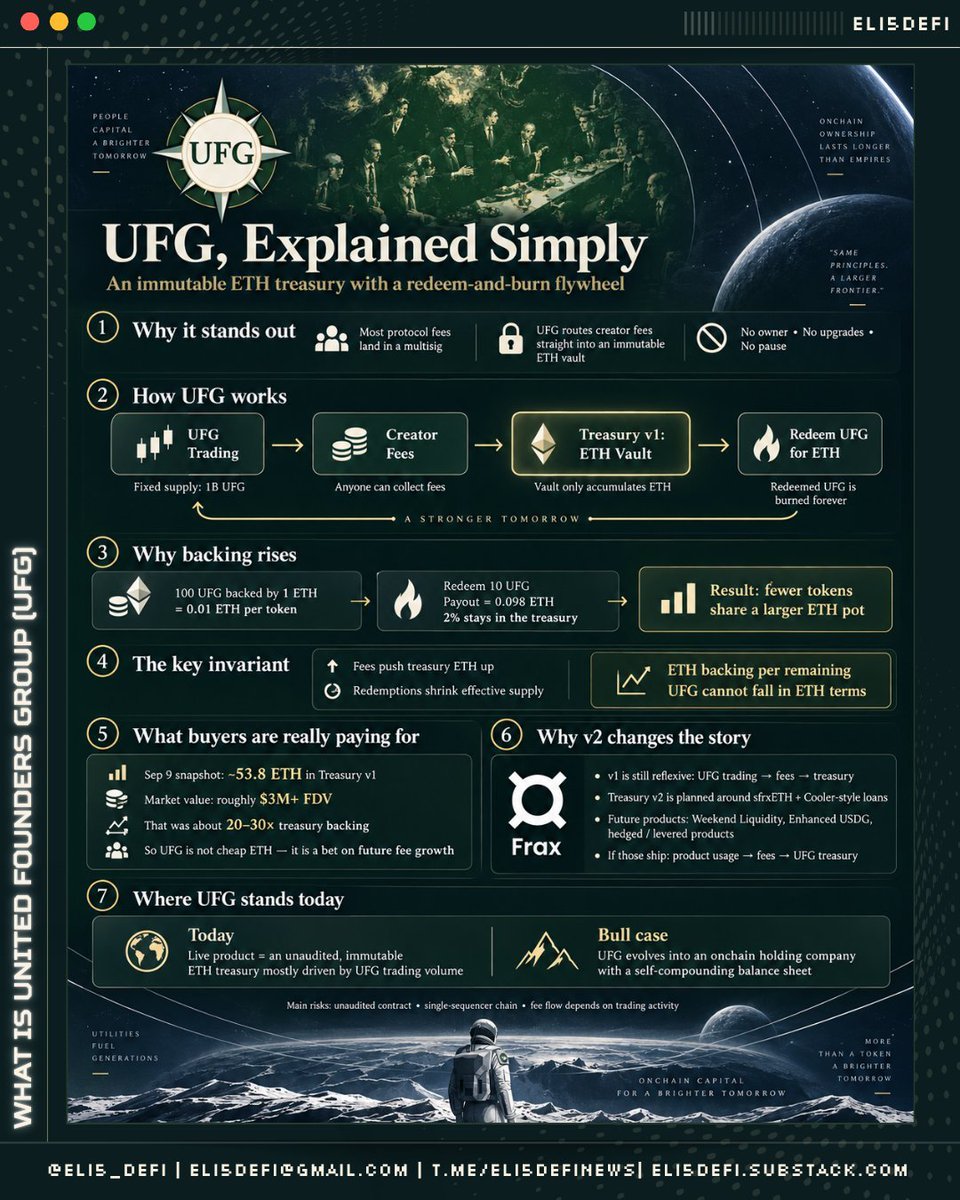
$UFG is capped at 1B supply. Trading produces creator fees that route straight into an immutable $ETH vault. No one can deploy that ETH, lend it, invest it, or pull it out, not the team, not governance. No owner, no upgrades, no pause. Just a vault that only accumulates.
It really boils down to two variables that matter:
→ how much ETH sits in the treasury
→ how many UFG tokens are still 'viable' economically.
And the system is built so both sides tend to drift in a holder-friendly direction.
→ Fees from trading push the ETH (the numerator) up.
→ Redemptions shrink the live supply (the denominator).
Example: say 100 UFG are backed by 1 ETH.
That’s 0.01 ETH of backing per token.
Now someone redeems 10 UFG. Those tokens get burned forever, but the redeemer only receives 98% of what their slice of the treasury implies.
The missing 2% doesn’t leave, it remains in the pool.
So the remaining tokens end up splitting a slightly bigger pile of ETH than they would have otherwise.
Each redemption automatically increases the ETH backing for every remaining UFG. That’s UFG’s killer feature, guaranteed by the mechanism, not just by team promise.
And that’s where this gets more compelling, and more speculative.
On the September 9 snapshot, Treasury v1 held about 53.8 ETH, while UFG was trading at roughly a $3M+ FDV. That means the market was pricing UFG at around 20–30× its then-current treasury backing.
So buying UFG isn’t really buying cheap ETH. You’re paying today for the belief that the treasury later becomes much, much larger.
And right now the growth loop is self-reinforcing:
UFG trading → fees → larger UFG treasury.
If volume stays hot, the treasury can compound quickly. If the spotlight fades, the fee stream fades with it.
But this is the core weakness of v1.
UFG becomes structurally more compelling only if it can break that reflexivity, so that's why we have Treasury v2
Treasury v2 is planned around sfrxETH + Cooler-style loans.
Weekend Liquidity, Enhanced USDG, and hedged/levered products.
@fraxfinance and @samkazemian has publicly confirmed that UFG selected sfrxETH for Treasury v2. If those products actually ship and attract usage, UFG becomes a different beast.
If it works, the model shifts from:
People trade UFG → UFG collects fees
to:
People use UFG-native financial products → the UFG treasury captures a share of real economic activity.
At that point, UFG stops acting like a token whose business model is based on reflexivity and starts looking like an onchain holding company with a balance sheet that self-compounds by default.
But we’re not there yet.
Right now, what’s actually live is an unaudited, immutable ETH treasury whose momentum is still mostly tethered to UFG trading volume, while the “onchain Vanguard” idea is largely still a blueprint with scaffolding.
Pretty interesting to see so much on-chain innovation happening every single day.
Key Lore: Pictured here is the UFG dev with the founder of Vanguard himself, Jack Bogle.
Two men from two different eras, but both share the common belief that everyone deserves a seat at the table.
Your seat is waiting for you, founder. Join us 🏛️
https://t.co/yFEafroDPl
"At United Founders Group, our mission is to be the ultimate vehicle for wealth preservation onchain. We achieve this by setting a floor that is immutable and perpetually rising, putting holders first the way Vanguard does."