The Accessibility Observatory at the University of Minnesota. Measuring access to destinations for transportation analysis, performance mgmt, and planning.
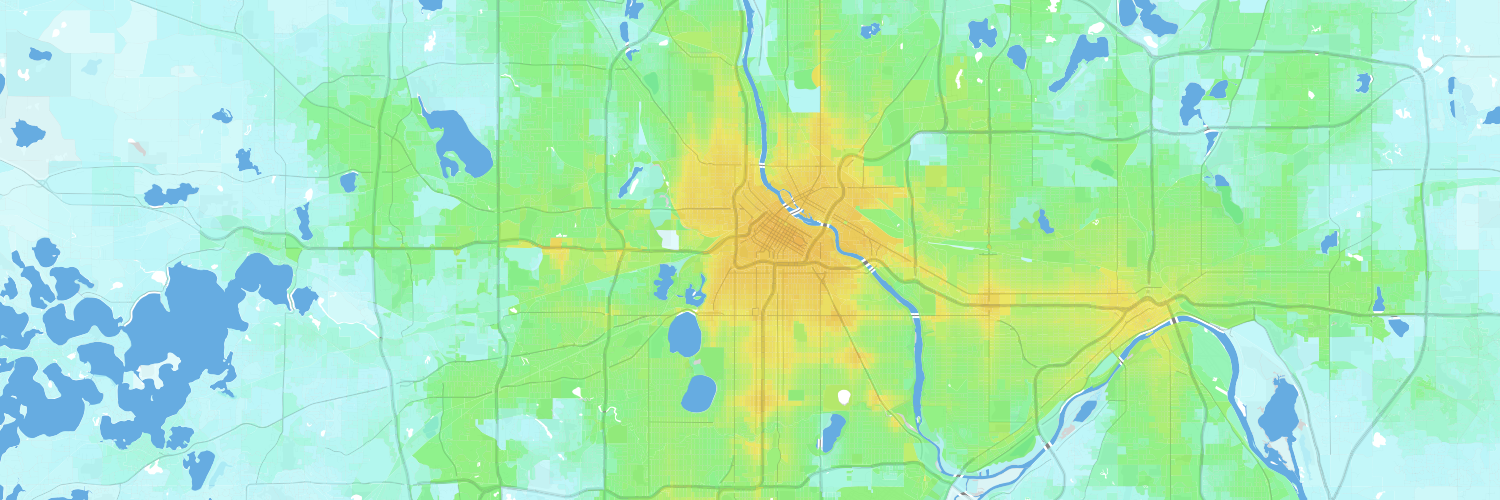
Transit agencies: Want to attract more riders? Offer better access to jobs.
In Portland, OR: "Daily boardings could increase by 1.8%- 2.1% for every 10% increase in accessibility {# of jobs reachable in 30 min from the bus stop by public transport]."
https://t.co/it8nA3KDiC
Accessibility is a better, broader measure of how well the transportation system meets people’s needs. It's not how fast you go, but what you can reach — for work, shopping, school or other activities. https://t.co/BG42o1oqP4
@UMNAccOb@UMNews@UMNresearch#destinationaccess
Five new transitways planned for the Twin Cities will improve access to grocery stores, health care facilities, & high schools for tens of thousands of people from diverse demographics, according to @UMNAccOb research: https://t.co/Kl0lgzjs9D @UMNresearch@MetroTransitMN
Next week we’ll begin reviewing applicants for our two(!) open Researcher positions. If you want to work on implementing and advancing national-scale measurement of multimodal destination access (and, seriously, who doesn’t?) then apply here!
https://t.co/DOfRP9SKH8
JOB ALERT! We have openings for two full-time researchers to support our National Accessibility Evaluation and other projects. Big networks, big maps, big data.
Details & application links: https://t.co/DOfRP9SKH8
CTS is looking for two full-time researchers to join our Accessibility Observatory team! Positions will assist with @UMNAccOb research, outreach, & management. Resume review begins Sept. 20: https://t.co/mNDjDL2Yts @UMNresearch
“[Access] may be the single most important thing we should be measuring about our transport systems — but that we usually don’t.”
https://t.co/YtT29YYeko
Measuring access to destinations helps make wise, cost-effective transportation system investments that best serve public needs as they evolve in an increasingly uncertain future, says @UMNAccOb director Andrew Owen. @UMNews@UMNresearch#destinationaccess
https://t.co/7vAnVlR5Jj
This spring we’re launching Phase II of our National Accessibility Evaluation project, which will expand our access data beyond jobs to include new destination types like education and healthcare
https://t.co/RdF8sigrrM
Register to attend our free March 2 webinar to hear from @UMNAccOb researchers about their work evaluating accessibility to jobs by automobile, transit, and bicycle across the US: https://t.co/8oHpRiyu0e
Somehow I missed this @StreetsMN article on the E Line aBRT (coming to @EdinaMN in the next 3-ish years). It will provide access to a *lot* of jobs.
All the while, *reducing the need* for cars & car infrastructure (car lanes, turn lanes, parking, etc.)
https://t.co/dQvXEEz0UN
@greg_shill @trnsprtst We have access to jobs by driving, transit, biking, and walking for the whole US. And this spring we’re kicking off a new project phase that will expand to additional destination types. https://t.co/VF0GeqyBwc
Though it's uncertain when pandemic will end and riders return to transit, building network of fast, reliable, and efficient transportation is one of the most worthwhile investments we can make now, says @UMNAccOb director Andrew Owen. @UMNews@UMNresearch https://t.co/qnyFNdhUVN
New research from @UMNAccOb ranks and compares year to year the 50 largest US metros for connecting bike commuters with jobs. This data helps guide investments in biking routes to improve access to jobs in your city. https://t.co/sgqgMJSTvR @UMNews@UMNresearch#biking#cycling
This is a major advancement in the application of accessibility measures in transport. It is the go to document for any student or professional. Amazing leadership by @trnsprtst and @dk2475 to put this together with contributions from many around the world.
Access to jobs by transit increased in half of largest U.S. metros in 2019, says @UMNAccOb. Phoenix +8.1% and LA +6.0% due to transit investments and land use. Raleigh +6.8% from job growth and changes in job locations. https://t.co/vQydEH6PYN @UMNews@UMNresearch#transit






![DavidZipper's tweet photo. Transit agencies: Want to attract more riders? Offer better access to jobs.
In Portland, OR: "Daily boardings could increase by 1.8%- 2.1% for every 10% increase in accessibility {# of jobs reachable in 30 min from the bus stop by public transport]."
https://t.co/it8nA3KDiC https://t.co/BbZcufYpz9](https://pbs.twimg.com/media/FJ4tNnoX0AwGA6a.jpg)


