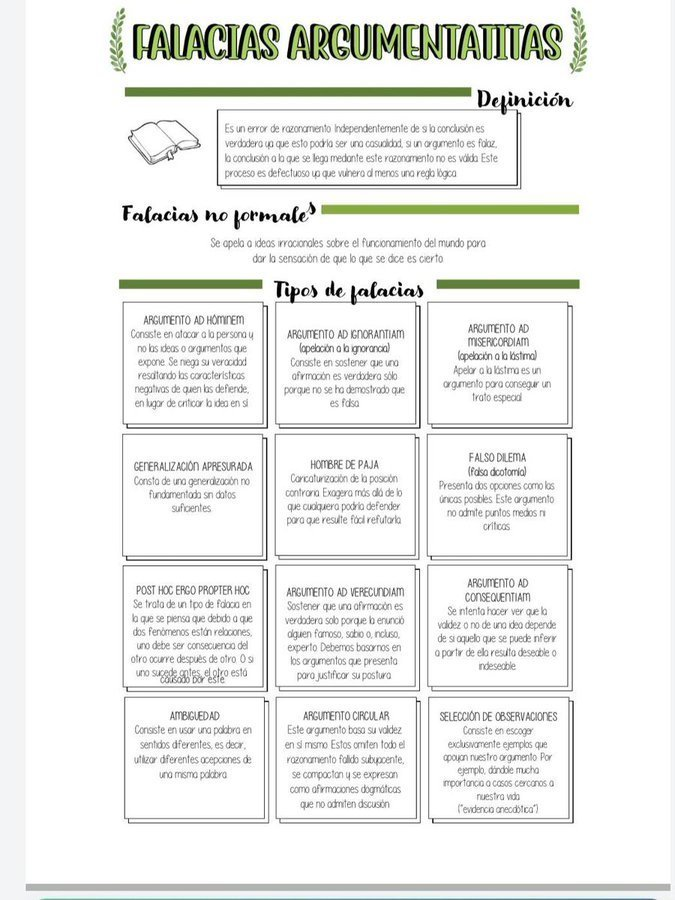
Vivimos rodeados de opiniones que no gozan de un razonamiento lógico y una base fundada
Se trata de las falacias: argumentos sin validez reconocibles por su carencia de cualquier tipo de lógica
Guía para identificarlas
In the 1920s, a Stanford psychologist tracked genius children for 50 years.
Malcolm Gladwell breaks down what he discovered:
Rich families → successful. Poor families → failures.
Not average. Failures. Genius-level IQs that produced nothing.
He spent 60 minutes at Microsoft explaining why we're wrong about success:
The psychologist was named Terman. He gave IQ tests to 250,000 California schoolchildren.
He identified the top 0.1%. Kids with IQs of 140 and above.
His hypothesis: these children would become the leaders of academia, industry, and politics.
He tracked them. And tracked them. For decades.
The results split into three groups:
The top 15% achieved real prominence. The middle group had average, moderately successful professional lives.
And the bottom group? By any measure, failures.
The difference wasn't personality. Wasn't habits. Wasn't work ethic.
It was simple: the successful geniuses came from wealthy households. The failures came from poor families.
Poverty is such a powerful constraint that it can reduce a one-in-a-billion brain to a lifetime of worse than mediocrity.
There's a concept called "capitalization rate."
It asks a simple question: what percentage of people who are capable of doing something actually end up doing that thing?
In inner city Memphis, only 1 in 6 kids with athletic scholarships actually go to college.
If our capitalization rate for sports in the inner city is 16%, imagine how low it must be for everything else.
Here's something stranger.
Gladwell read the birth dates of the 2007 Czech Junior Hockey Team:
January 3rd. January 3rd. January 12th. February 8th. February 10th. February 17th. February 20th. February 24th. March 5th. March 10th. March 26th...
11 of the 20 players were born in January, February, or March.
This isn't unique to the Czechs. Every elite hockey team in the world shows the same pattern. Every elite soccer team too.
Why?
The eligibility cutoff for youth leagues is January 1st.
When you're 10 years old, a kid born in January has 10 months of maturity on a kid born in October. That's 3 or 4 inches of height. The difference between clumsy and coordinated.
So we look at a group of 10 year olds, pick the "best" ones, give them special coaching, extra practice, more games.
We think we're identifying talent. We're just identifying the oldest.
Then we give the oldest more opportunities, and 10 years later they really are the best.
Self-fulfilling prophecy.
The capitalization rate for hockey talent born in the second half of the year? Close to zero.
We're leaving half of all potential hockey players on the table because of an arbitrary date on a calendar.
Kids born in the youngest cohort of their school class are 11% less likely to go to college.
11% of human potential squandered because we organize elementary school without reference to biological maturity.
Now here's the part about math.
Asian kids dramatically outperform Western kids in mathematics. The gap is enormous and consistent across decades of testing.
Some people say it's genetic. It's not.
It's attitudinal.
When Asian kids face a math problem, they believe effort will solve it.
When Western kids face a math problem, they believe the answer depends on innate ability they either have or don't.
Here's the proof.
The international math tests include a 120-question survey. It asks about study habits, parental support, attitudes.
It's so long most kids don't finish it.
A researcher named Erling Boe decided to rank countries by what percentage of survey questions their kids completed.
Then he compared it to the ranking of countries by math performance.
The correlation was 0.98.
In the history of social science, there has never been a correlation that high.
If you want to know how good a country is at math, you don't need to ask any math questions. Just make kids sit down and focus on a task for an extended period of time.
If they can do it, they're good at math.
Why do Asian cultures have this attitude?
Gladwell's theory: rice farming.
His European ancestors in medieval England worked about 1,000 hours a year. Dawn to noon, five days a week. Winters off. Lots of holidays.
A peasant in South China or Japan in the same period worked 3,000 hours a year.
Rice farming isn't just harder than wheat farming. It's a completely different relationship with work.
There's a Chinese proverb: "A man who works dawn to dusk 360 days a year will not go hungry."
His English ancestors would have said: "A man who works 175 days a year, dawn to 11, may or may not be hungry."
If your culture does that for a thousand years, it becomes part of your makeup.
When your kids sit down to face a calculus problem, that legacy of persistence translates perfectly.
Now consider distance running.
In Kenya, there are roughly a million schoolboys between 10 and 17 running 10 to 12 miles a day.
In the United States, that number is probably 5,000.
Our capitalization rate for distance running is less than 1%.
Kenya's is probably 95%.
The difference isn't genetic. The difference is what the culture values and where it spends its attention.
Here's the most fascinating finding.
30% of American entrepreneurs have been diagnosed with a profound learning disability.
Richard Branson is dyslexic. Charles Schwab is dyslexic. John Chambers can barely read his own email.
This isn't coincidence. Their entrepreneurialism is a direct function of their disability.
How do you succeed if you can't read or write from early childhood?
You learn to delegate. You become a great oral communicator. You become a problem solver because your entire life is one big problem. You learn to lead.
80% of dyslexic entrepreneurs were captain of a high school sports team. Versus 30% of non-dyslexic entrepreneurs.
By the time they enter the real world, they've spent their whole life practicing the four skills at the core of entrepreneurial success: delegation, oral communication, problem solving, and leadership.
Ask them what role dyslexia played in their success and they don't say it was an obstacle.
They say it's the reason they succeeded.
A disadvantage that became an advantage.
Here's what Gladwell wants you to understand:
When we see differences in success, our default explanation is differences in ability.
We forget how much poverty, stupidity, and attitude constrain what people can become.
We refuse to admit that our own arbitrary rules are leaving talent on the table.
We cling to naive beliefs that our meritocracies are fair.
The capitalization argument is liberating.
It says you don't look at a struggling group and conclude they're incapable. It says problems that look genetic or innate are often just failures of exploitation.
It says we can make a profound difference in how well people turn out.
If we choose to pay attention.
@IleanaP_ gracias a tu video cuando veo a alguien que se acerca con huevos lo centro y lo envío al mas allá, así me he librado de cometer los 3 errores
¿Tú con quién estás? ¿Con Harari o con Henrich?
Joseph Heath critica en este artículo el relato de la evolución humana que presenta Yuval Noah Harari en Sapiens por ser anticientífico y obsoleto. Lo contrasta con la teoría mucho más sólida y actual, según él, de Joseph Henrich (The Secret of Our Success), que invierte completamente el orden explicativo.
Heath identifica cuatro capacidades únicas que diferencian a los humanos:
-Inteligencia superior (incluyendo razonamiento abstracto y matemático).
-Lenguaje complejo y gramatical.
-Cooperación ultrasocial (con no parientes).
-Cultura acumulativa (transmisión y mejora continua de conocimiento y artefactos).
Cualquier teoría seria debe explicar cómo evolucionaron estos rasgos en un tiempo evolutivo muy corto (Homo erectus apareció hace unos 2 millones de años o así).
La secuencia de Harari sigue el orden clásico: Inteligencia → Lenguaje → Cooperación → Cultura. Pero Heath le ve muchos problemas:
-El cerebro grande es muy costoso (energía y mortalidad en el parto). No está claro qué beneficio compensatorio habría tenido en la sabana.
-El lenguaje como “mutación casual” (Tree of Knowledge) tiene problemas graves: el primer mutante no tendría con quién hablar (problema de arranque).
-Sin cooperación previa, el lenguaje sería “cheap talk” (habla barata) y poco creíble.
-La cooperación no surge fácilmente de la inteligencia (teoría de juegos y dilema del prisionero lo demuestran).
-La cultura no es solo “más gente trabajando junta”; es evolución cultural acumulativa.
Así que Heath prefiere la secuencia que propone Henrich (siguiendo a Boyd y Richerson): Cultura → Cooperación → Lenguaje → Inteligencia. La historia sería más o menos lo siguiente. El ajuste inicial que lo arranca todo fue una mayor capacidad de imitación fiel: los humanos copian comportamientos complejos con gran precisión, incluso sin entenderlos del todo, a diferencia de los chimpancés. Esta capacidad permitió el surgimiento de la evolución cultural acumulativa, es decir, que las herramientas, técnicas y conocimientos mejoren y se transmitan de generación en generación. La imitación conformista (“haz lo que hace la mayoría”) y la tendencia a imitar a los más exitosos aumentaron la homogeneidad cultural dentro de los grupos, lo que potenció la selección entre grupos: aquellos más cooperativos culturalmente dominaron a los demás, favoreciendo el surgimiento de normas prosociales. Esto, a su vez, desencadenó un proceso de auto-domesticación, en el que los individuos más agresivos eran marginados reproductivamente, haciendo a los humanos más prosociales por naturaleza. Con mayor cooperación, el lenguaje se volvió útil y creíble. Finalmente, la inteligencia (incluido el cerebro grande) fue impulsada por la explosión cultural: valía la pena invertir en mejor memoria y cognición porque permitía absorber y aprovechar una cultura cada vez más compleja.
En resumen, el artículo es una defensa clara de la co-evolución gen-cultura.
@pitiklinov Con ambos y con ninguno.
La evolución difícilmente fue algo lineal.
Alguna vez se comportaría como dice Harari, y otras, como dice Henrich.
Otras veces debió tomar rumbos aleatorios.
Quizás nunca sepamos el orden correcto del proceso.
‼️SE FILTRA VIDEO DONDE ENRIQUE INZUNZA Y ROCHA MOYA ESTAN EN UN FIESTA DE NARCOS EN BADIGUARATO‼️
No que no tronabas pistolita!!!! Rocha Moya @rochamoya_ y Enrique Inzunza @InzunzaCazarez en un vídeo en una fiesta de Narcos!!! Pero los Chairos seguirán creyendo que son los bueno!!!
¡Qué historia!
Si te llega a tu casa una corona fúnebre con un mensaje de “te vamos a matar” preocúpate porque el gobierno de @Claudiashein se hará como que no vio ni escuchó porque la víctima es @PaolaGarateV que no pertenece a su movimiento morenista donde solo le brinda protección a Rubén Rocha Moya que convirtió al estado de Sinaloa en territorio de Los Chapitos y aliados guinda.
Paola es diputada local por el PRI, y ha sido una de las voces más fuertes en denunciar a los narco políticos de Morena que Estados Unidos detectó por la información que capos de la droga le dieron en su calidad de informantes.
Paola lo que ha contado es lo que vivió cuando en 2021, en plena elección en Sinaloa, fue secuestrada para que no participara y dejara libre el camino a los candidatos morenistas.
Hoy Paola vive con la incertidumbre de no saber si la amenaza, con el simbolismo de la corona fúnebre, será ejecutada porque no cuenta con la protección que ha pedido a Sheinbaum y a @OHarfuch.
Insisto: la situación de Paola es muy similar a la de Carlos Manzo que por más que exigió ayuda y hasta presagio su asesinato no fue escuchado por quien constitucionalmente tiene la obligación de garantizar la vida, en este caso de Paola, sin importar si es del PRI o PAN o cualquier otro partido político.
Paola ya vivió el miedo de ser secuestrada. ¿Por qué el gobierno federal se resiste a brindar protección a una joven mujer que duerme intranquila sabiendo que hay alguien en la clandestinidad observándola y apuntándola con coronas fúnebres?
He escuchado sus entrevistas. Sus declaraciones después de que el gobierno de @realDonaldTrump hizo público que pidió la extradición de Rocha y subordinados, fueron revivir su experiencia en 2021.
Y no, no serán Los Chapitos quienes atenten contra la vida de Paola, sino políticos morenistas incómodos que quieren silenciarla.
¿Qué espera señora Sheinbaum para proteger la vida de Paola?
Una familia se reunió para ver el Mundial pero acabaron descubriendo que el abuelo tenía un montón de páginas porno guardadas en el televisor
JAJAJAJAJAJA
Su jeta de desprecio cuando le cuestionan de las marchas.
Ésta mujer es tan asquerosamente soberbia y déspota, que ni siquiera disimula su odio en contra de todo lo que signifique un cuestionamiento a su gobierno.
Qué vergüenza y que ceguera de la gente que aún la apoya.
Hasta que les toque...
Fuera morena!
@LuisCardenasMx@juanjosearredo2 Es un porro, resentido, COBARDE, que vengan por El…. Que le haga compañia a Su Compañero Nicolás Maduro 🇺🇸 basta de injerencismo, ha hecho, mucho daño 🤬