What lies at the center of our galaxy? In Jules Verne's science fiction classic, A Journey to the Center of the Earth, Professor Liedenbrock and his fellow explorers encounter many strange and exciting wonders. Astronomers already know of some of the bizarre objects that exist at our Galactic Center, including vast cosmic dust clouds, bright star clusters, swirling rings of gas, and even a supermassive black hole. Much of the Galactic Center is shielded from our view in visible light by the intervening dust and gas, but it can be explored using other forms of electromagnetic radiation. The featured video is actually a digital zoom into the Milky Way's center which starts by utilizing visible light images from the Digitized Sky Survey. As the movie proceeds, the light shown shifts to dust-penetrating infrared and highlights gas clouds that were recently discovered in 2013 to be falling toward the central black hole.
Video Credit: ESO/MPE/Nick Risinger (https://t.co/lDyVYODSVh)/VISTA/J. Emerson/Digitized Sky Survey 2
1 WEEK LEFT UNTIL THE WINTER WORKSHOP APPLICATION DEADLINE!
🚀 Calling All STEM Undergrads! Ready to Launch Your Research Journey? 🌌
Join us during this year's Winter Workshop!
@UMDscience@UMDPhysics
Just WOW. An intense fireball captured by @SubaruTelescope’s Live Cam above our telescope domes ☄️ Maunakea’s views never cease to amaze - so humbled by the awe and wonder of this special place ✨ https://t.co/MDCzBfAu8C
UMD @GRADMAP is now accepting applications for our winter workshop! The winter workshop is a free, week-long virtual workshop to build programming and research skills for physics and astronomy.
Workshop Dates: Jan 6-10, 2025
@UMDscience @UMDAstronomy
1/4
We have a telescope!🤩
Last week, summit staff successfully installed Rubin Observatory's combined primary/tertiary mirror.
With all three mirrors & the commissioning camera in place, we officially—for the first time in 15 years of construction—have a complete telescope!🥳
🧵
📢 Breaking news! ESO's #VLT has discovered a planet around the closest single star to our Sun! 🪐🔭
https://t.co/xepUlivtiV
At just 6 light years away, Barnard b is also one of the few known exoplanets with a mass less than that of Earth.
Illustration: ESO/M. Kornmesser
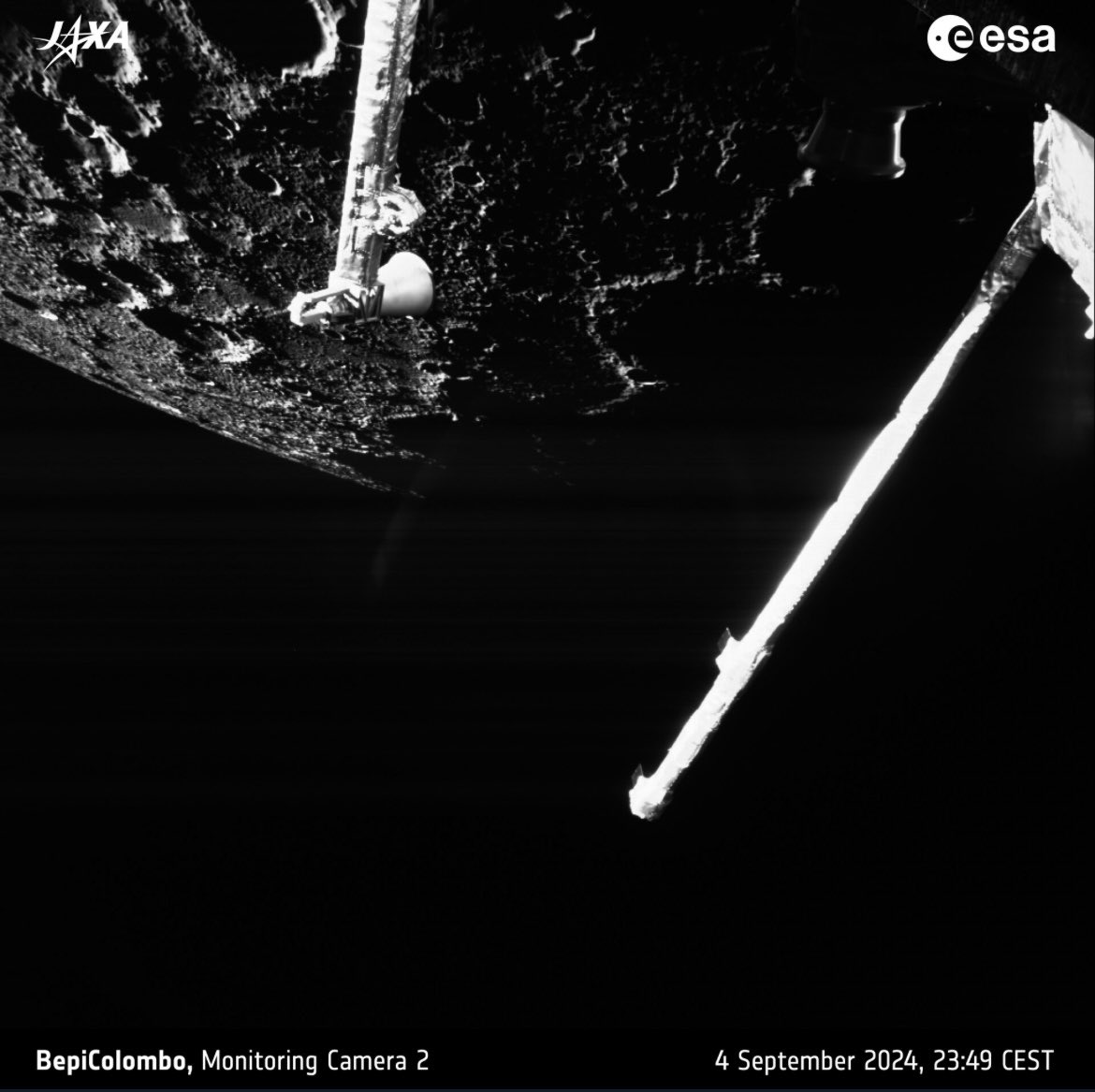
🚨🛰️: NEW MERCURY PHOTOS JUST DROPPED! The magnificent ESA/JAXA mission @BepiColombo (which ultimately aims to get into orbit around Mercury) just made another extremely close flyby of the innermost planet.
It’s an impact crater-filled paradise. Look at this weird world! 💥
SARAO 2025 Graduate In-Training Opportunities
The South African Radio Astronomy Observatory is recruiting bright and enthusiastic Engineering and Science-Honours graduates for its Graduate-In-Training programme.
Learn more ⬇️
https://t.co/haaC3qgkRc
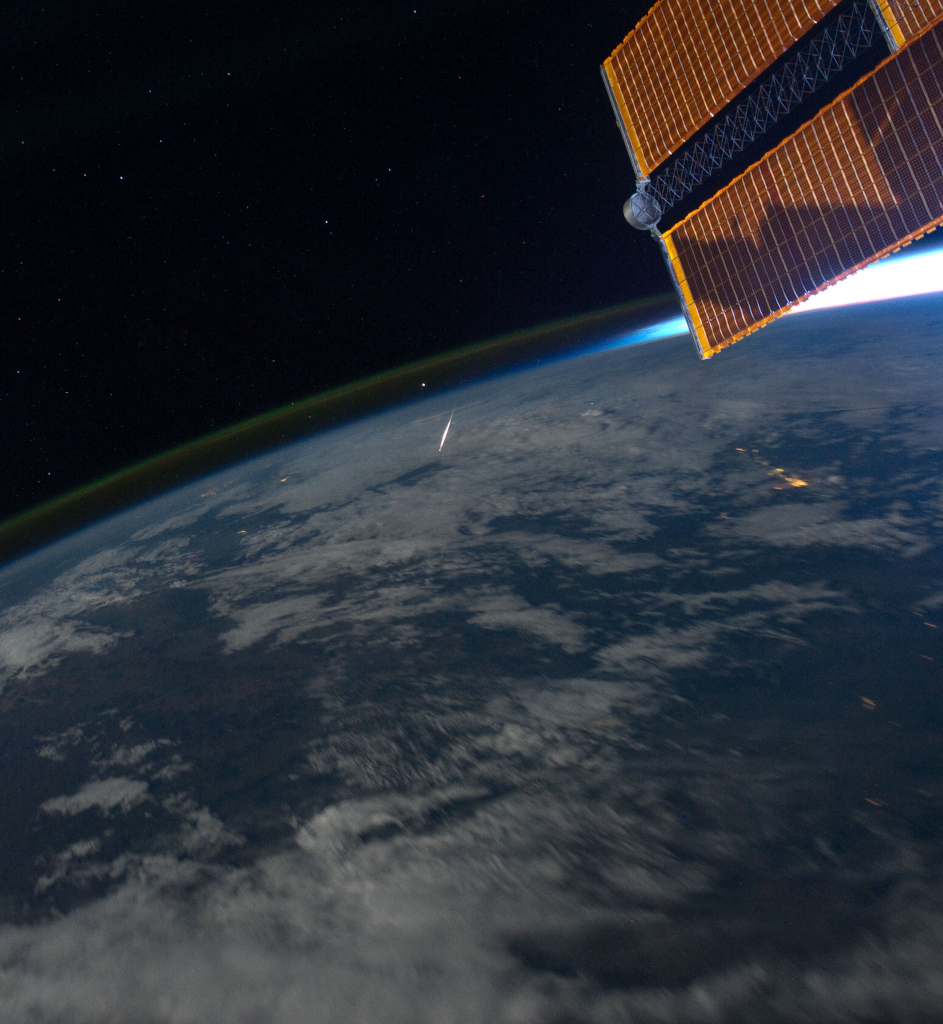
Denizens of planet Earth typically watch meteor showers by looking up. But this remarkable view, captured on August 13, 2011 by astronaut Ron Garan, caught a Perseid meteor by looking down. From Garan's perspective on board the International Space Station orbiting at an altitude of about 380 kilometers, the Perseid meteors streak below, swept up dust from comet Swift-Tuttle. The vaporizing comet dust grains are traveling at about 60 kilometers per second through the denser atmosphere around 100 kilometers above Earth's surface. In this case, the foreshortened meteor flash is near frame center, below the curving limb of the Earth and a layer of greenish airglow, just below bright star Arcturus. Want to look up at a meteor shower? You're in luck, as the 2024 Perseid meteor shower is active now and predicted to peak near August 12. With interfering bright moonlight absent, this year you'll likely see many Perseid meteors under clear, dark skies after midnight.
Image Credit: Ron Garan, ISS Expedition 28 Crew, NASA
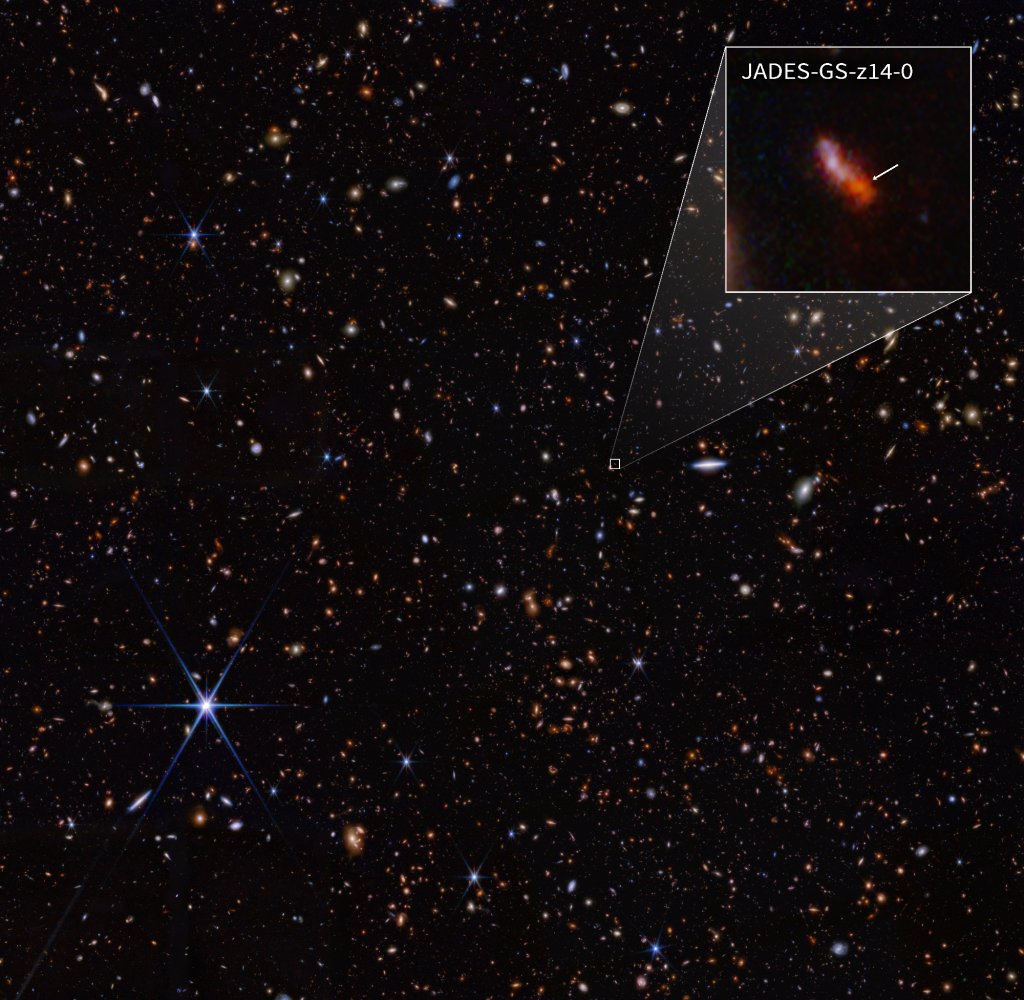
Yowza, JWST 🔭! The redshift of galaxy "JADES-GS-z14-0" is z = 14.32 (+0.08/-0.20), making it the current record-holder for the most distant known galaxy. This corresponds to a time less than 300 million years after the big bang. https://t.co/VRSqtEI8Li
It's back. The famous active region on the Sun that created auroras visible around the Earth earlier this month has survived its rotation around the far side of the Sun -- and returned. Yesterday, as it was beginning to reappear on the Earth-facing side, the region formerly labeled AR 3664 threw another major solar flare, again in the highest-energy X-class range. The featured video shows the emerging active region on the lower left, as it was captured by NASA's Earth-orbiting Solar Dynamics Observatory yesterday in ultraviolet light. The video is a time-lapse of the entire Sun rotating over 24 hours. Watch the lower-left region carefully at about the 2-second mark to see the powerful flare burst out. The energetic particles from that flare and associated CME are not expected to directly impact the Earth and trigger impressive auroras, but scientists will keep a close watch on this unusually active region over the next two weeks, as it faces the Earth, to see what develops.
Video Credit: NASA, Solar Dynamics Observatory
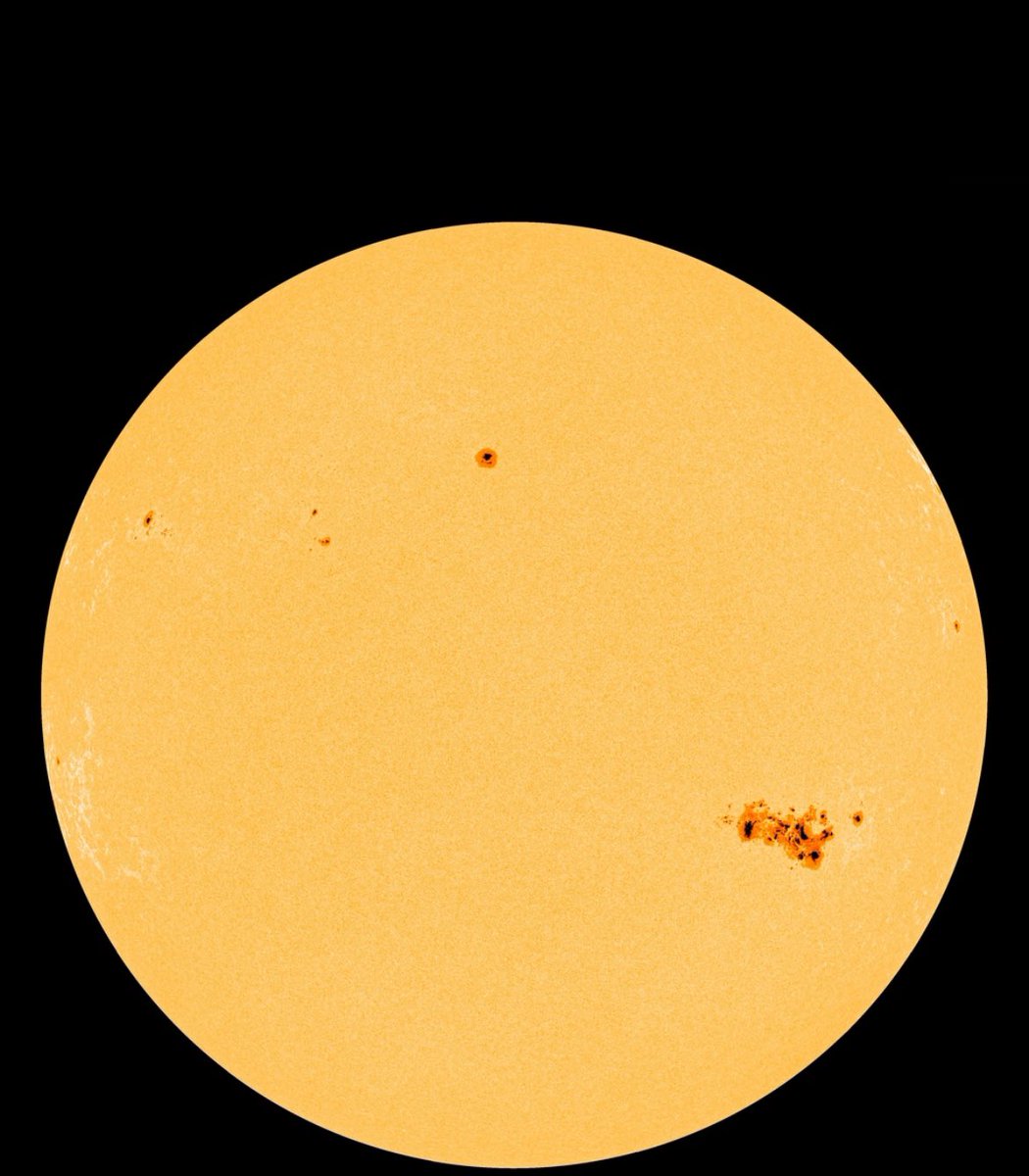
Thought I would summarise why there is so much excitement in the space weather community right now. There’s a monstrous sunspot group on the Sun that’s massive enough to be visible to the naked eye (please use eclipse glasses) 🌞 👓 (1/n)