We’re building a future for freedom. If you want to volunteer with us, run for office, or help us organize a chapter, please fill out our contact form and join our Discord. #VotePirate https://t.co/dOFAvN7Ru5
https://t.co/YUAgLOqazV
The 2026 Pirate National Conference will take place June 6–7 at the Residence Inn by Marriott Boston Harbor in Boston. IPR invites Pirate Party attendees and readers to share any news and updates from the weekend in our June Monthly Open Thread.
https://t.co/5B8QgiPOd2
A judge has ruled that corporations can vote in some Delaware elections.
Delaware Superior Court Judge Craig Karsnitz said the town of Fenwick Island was not diluting human votes by allowing companies and other legal entities that own property to cast votes in municipal elections.
These "legal entities" and corporations make up about 12% of registered voters in the town.
In total Delaware has far more corporations chartered in the state than residents.
Judge Karsnitz rejected the constitutional arguments of the ACLU, including the claim that "entity" or corporate voting dilutes the political power of living people.
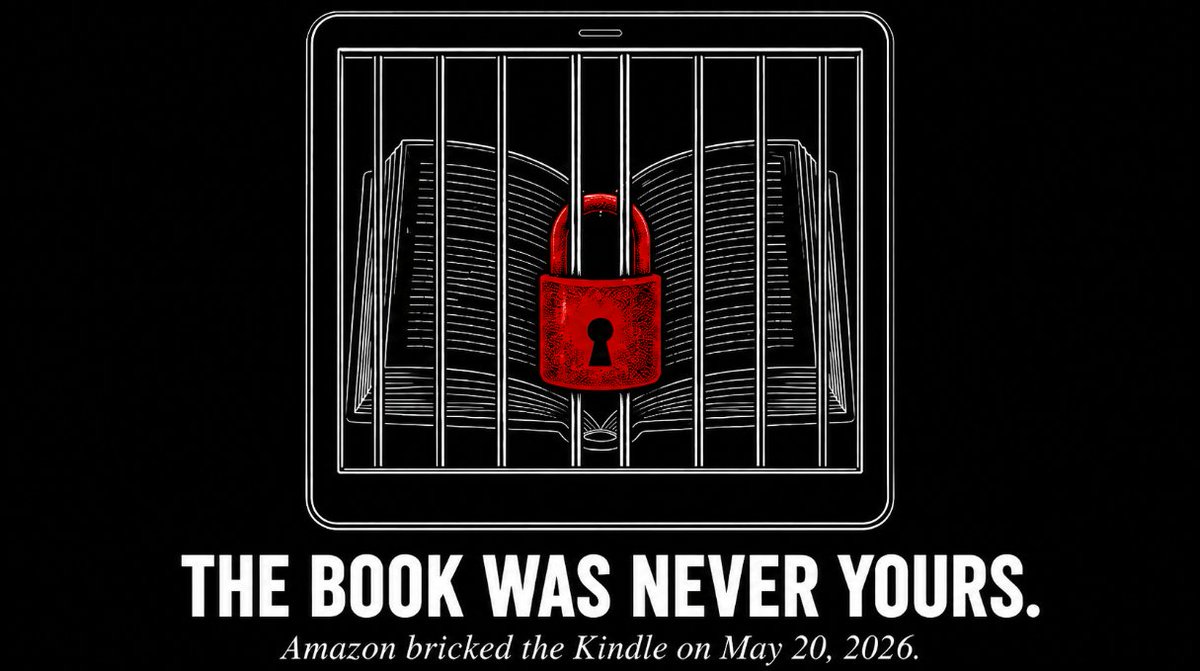
On May 20, Amazon ended support for every Kindle made in 2012 or earlier. The devices can no longer buy, borrow, or download books. Reset one to factory settings and it will never log back in.
The screen still works. The hardware is fine. Amazon reached across the internet and turned a thing you paid for into a brick, on a date they picked, for a reason that benefits them.
The owners bought the devices. They bought the books. They followed every rule. Amazon changed the rules anyway, because the rules were never yours. When you tap "Buy now" on a Kindle book, you are not buying a book. You are renting a license that Amazon can revoke, expire, or strand on a dead device whenever it suits the quarter.
They designed it this way on purpose, and they showed us the blueprint years ago.
In 2009 Amazon reached into thousands of Kindles overnight and deleted, ironically, copies of George Orwell's 1984, a book people had already paid for. They refunded everyone, apologized, and promised never again. We took the promise for what it was worth and watched the door instead.
In February 2025 they shut it. They removed Download and Transfer via USB, the last simple tool that let you pull your own purchases onto your own computer and keep them. Newer Kindle files use a format almost nobody can crack.
They closed the exit, then they started bricking the devices. None of this was a surprise. They proved in 2009 that they could reach into your library and take a book back. Everything since has just been them deciding when.
A copy you cannot hold is a copy you do not own. A library that lives on someone else's server is a library someone else can burn. The cartel rents you access to the words and calls it ownership, and the only reason most people never notice is that the landlord usually lets them stay. May 20 was the eviction notice. It went to 3% of Kindle owners this time. The lease is identical for the other 97%.
Stop buying books you cannot hold. When you do buy from Amazon, strip the DRM the day it arrives and keep a clean file somewhere they cannot reach. Back up everything you already own while you still can. A book on your own drive is yours forever. A book in your Amazon account is yours until a lawyer in Seattle decides otherwise.
And when you want a book the cartel has priced out of reach or locked behind a dying device, the shadow libraries that never expire are one search away. The pirates build libraries that cannot be revoked, because they assume the cartel always will.
The cartel cannot delete what it cannot reach.
The free phone software that wiped itself during a French police raid, got branded a drug-trafficking weapon by prosecutors, and was threatened with arrests and server seizures just landed a deal with a major phone manufacturer.
GrapheneOS is the most hardened phone operating system in the world. Android with Google cut out of it by the root, built since 2014 by a nonprofit and a handful of contributors, funded by donations, given away for free.
No Google account. No tracking services. A phone that slams itself back into a locked, encrypted state the moment it sits untouched. A duress PIN that burns the whole device the instant someone forces you to open it.
In November, French police seized a suspect's Google Pixel and could not crack it. It wiped itself mid-search, exactly as built to, and the evidence died sealed. So the state did what the state always does when it loses.
Prosecutors threatened the developers with prison and seized servers unless they cut a hole in it. The project refused to break the locks of millions and tore every server out of the country in a week, ran them to Canada and Germany, and kept shipping without missing a day.
Then it gained ground. For its entire life GrapheneOS ran on Google's Pixels and nothing else, and the cartel's whole sneer rested on that, impressive but caged on a single phone, a toy for paranoids. This year Motorola killed the sneer, signing a long-term deal to build GrapheneOS protections into its own hardware and drag the phone out of the forums and onto the shelf.
They never come for your privacy by admitting it guards you too well. They come for it wearing the face of the worst man they can find, because a public that will hand over a stranger's phone will hand over its own next.
Every phone you have ever owned was sold to you twice. Once at the counter, for money. Then every day after, as a quiet feed of where you went, what you read, and who you spoke to. The second sale is why the supercomputer in your pocket costs less than a mattress.
GrapheneOS kills the second sale cold. That is what France was really guarding in that courtroom. The second sale, on every phone, forever.
The fence around what a man is allowed to keep private has always been guarded by men who wanted a copy of his key.