US Stock Notes turns one U.S. market question into a dated, source-linked brief, including what would change the read. Open the sample to see the format before requesting the next note.
https://t.co/Z57fqhccss
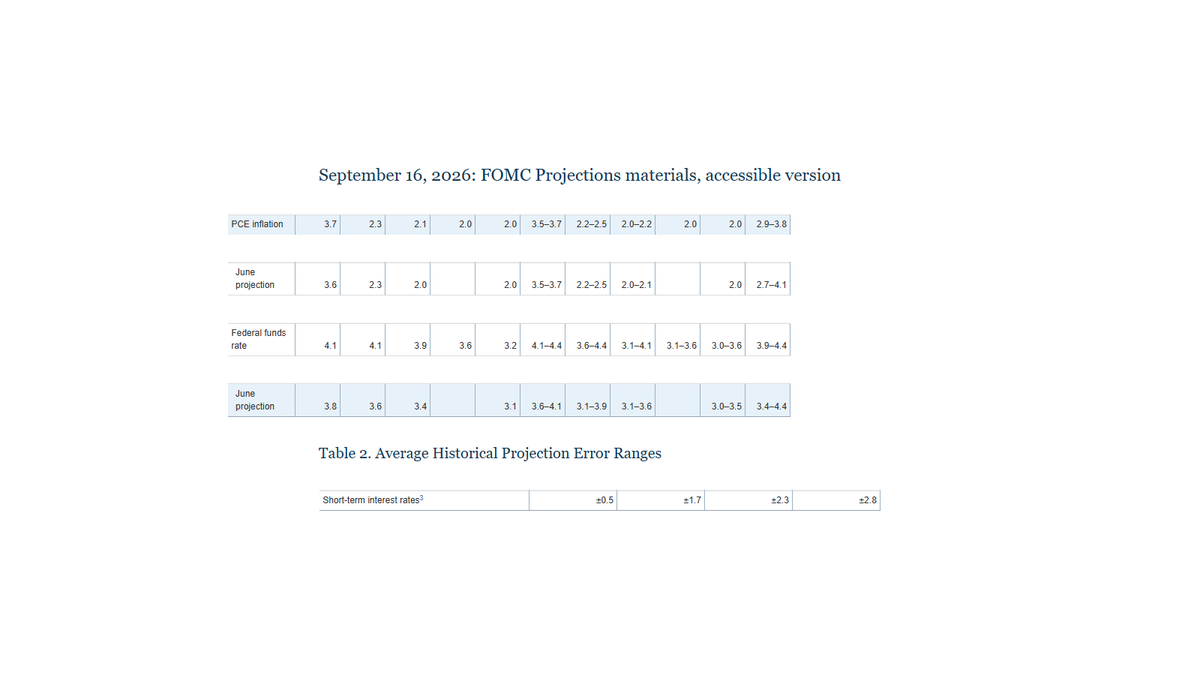
The September FOMC projections became more hawkish without becoming more certain. The median end-2026 policy-rate projection rose to 4.1% from 3.8% in June, while median 2026 PCE inflation edged up to 3.7% from 3.6%.
That does not turn the dot plot into a promise. The Fed's own historical-error table puts the 2026 short-rate error range at ±0.5 percentage point, and participants' paths are conditional on the economy. The useful read is not “4.1% is locked.” It is that officials now see a higher appropriate path while inflation uncertainty remains unusually high.
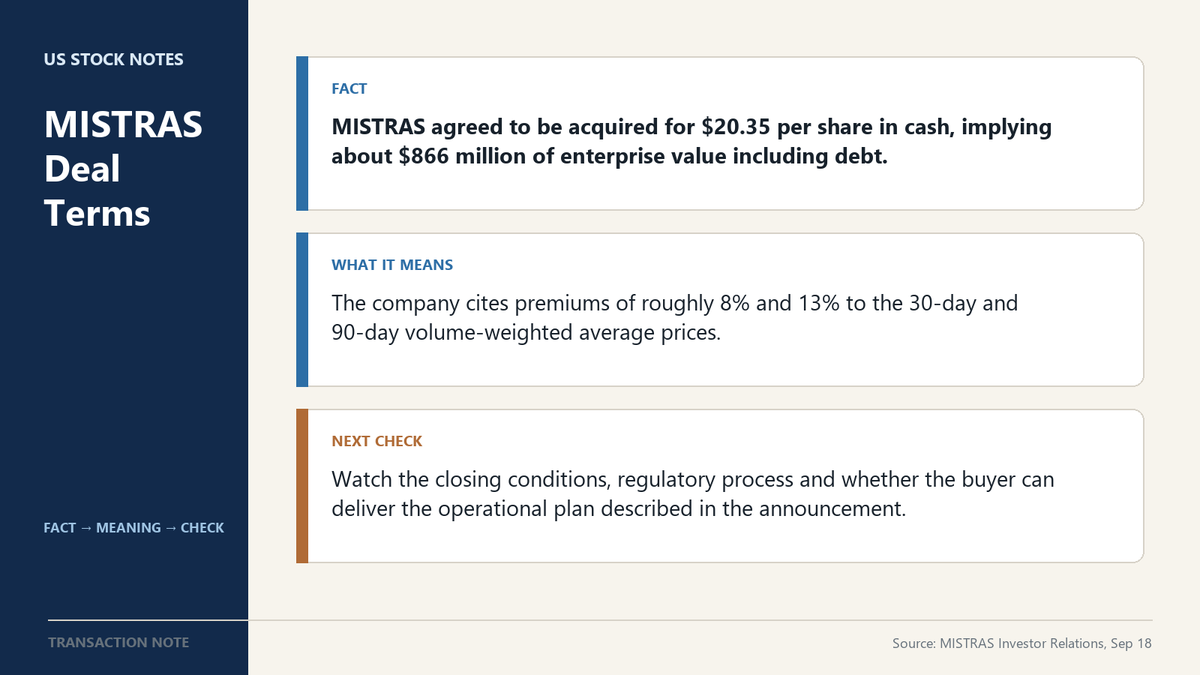
MISTRAS agreed to be acquired for $20.35 per share in cash, a transaction the company values at roughly $866 million including debt.
The headline premium needs context. MISTRAS says the offer is about 8% above its 30-day volume-weighted average price and 13% above its 90-day VWAP. Those are useful reference points, but a signed price is not the same thing as cash already delivered to shareholders.
For a deal like this, I separate three questions.
First, what exactly is being paid? Here it is cash per share, while the enterprise-value figure includes debt.
Second, what still has to happen? Closing conditions and the regulatory process remain part of the path between announcement and completion.
Third, what is the strategic claim? The buyer is underwriting an operating plan, not just a one-day stock reaction. That plan will matter after the press-release premium disappears from the feed.
The useful follow-up is deal completion and execution against the stated strategy. The headline gives the price; the process determines whether and when that value is realized.
The SEC’s tokenized-stock order is meaningful, but the word “tokenized” hides how narrow the first step is.
The agency granted temporary, conditional relief for Tokenized Securities Venues to trade tokenized NMS stocks through permissioned automated market makers and liquidity pools. This is not a blanket approval for every stock to trade freely onchain.
The conditions are the substance. Tokenized shares must carry the same rights and privileges as the traditional class. Issuers get notice and can object when an unaffiliated third party tokenizes their stock. A TSV must halt trading when the primary listing exchange halts the underlying. Symbol and volume limits also apply.
The exemptions expire five years after publication, and the SEC is asking for comment. That makes this a controlled market-structure experiment rather than a permanent endpoint.
The next evidence is operational: which venues qualify, which issuers participate, whether liquidity is real, and whether execution and settlement improve without fragmenting price discovery. Those answers matter more than attaching a blockchain label to an equity.
AI’s power problem is turning into a flexibility problem.
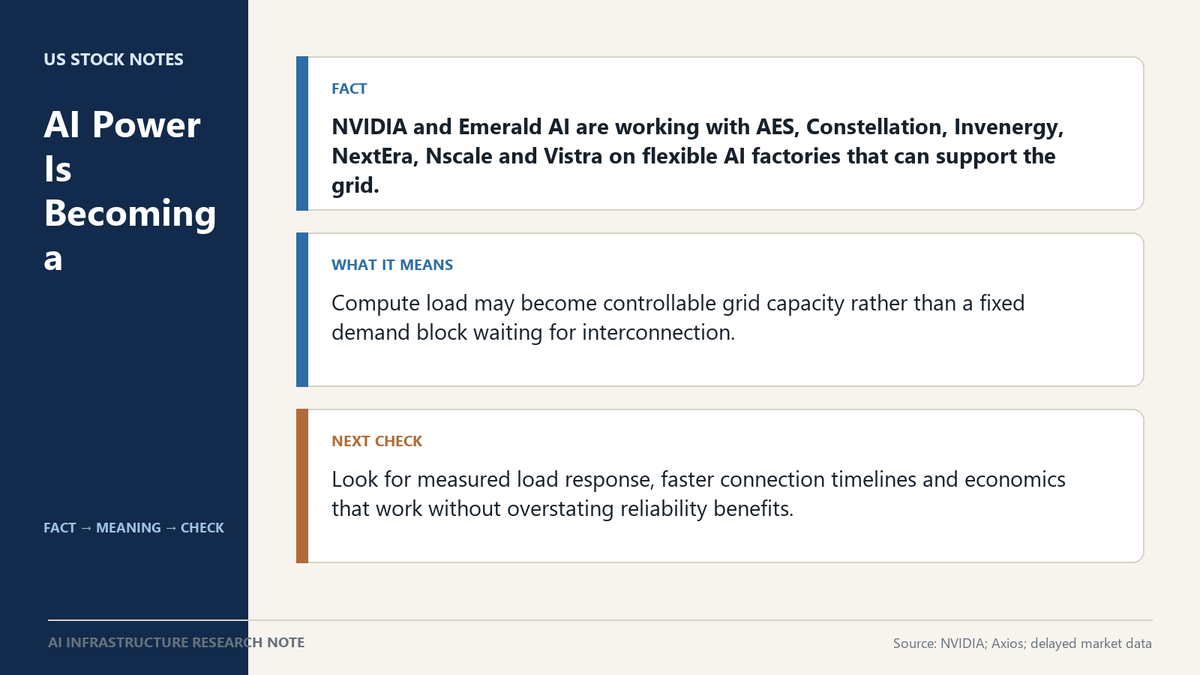
NVIDIA and Emerald AI say they are working with AES, Constellation, Invenergy, NextEra Energy, Nscale and Vistra on AI factories that can act as flexible grid assets. Separately, a broader coalition reported by Axios includes Google, NVIDIA, utilities and power producers exploring how data centers can adjust demand when the grid is stressed.
The investable question is no longer just who can build more compute. It is whether compute load can be scheduled, shifted or curtailed enough to shorten grid-connection timelines without damaging customer workloads. If that works, power availability becomes partly a software and orchestration problem—not only a generation problem.
There are three distinct beneficiaries to watch: chip and systems vendors that expose controllable workloads; data-center operators that can monetize flexibility or connect faster; and utilities/power producers that can add large loads without treating them as permanently inflexible demand.
The boundary matters. A coalition announcement does not prove load-response performance, reliability value or project economics. The next evidence should be measured megawatts shifted, faster interconnection, contract structure and who gets paid for flexibility. Until those numbers appear, this is a credible infrastructure direction—not a finished business model.
HPE's latest quarter looks like one AI-infrastructure story until the growth rates are put on the same basis.
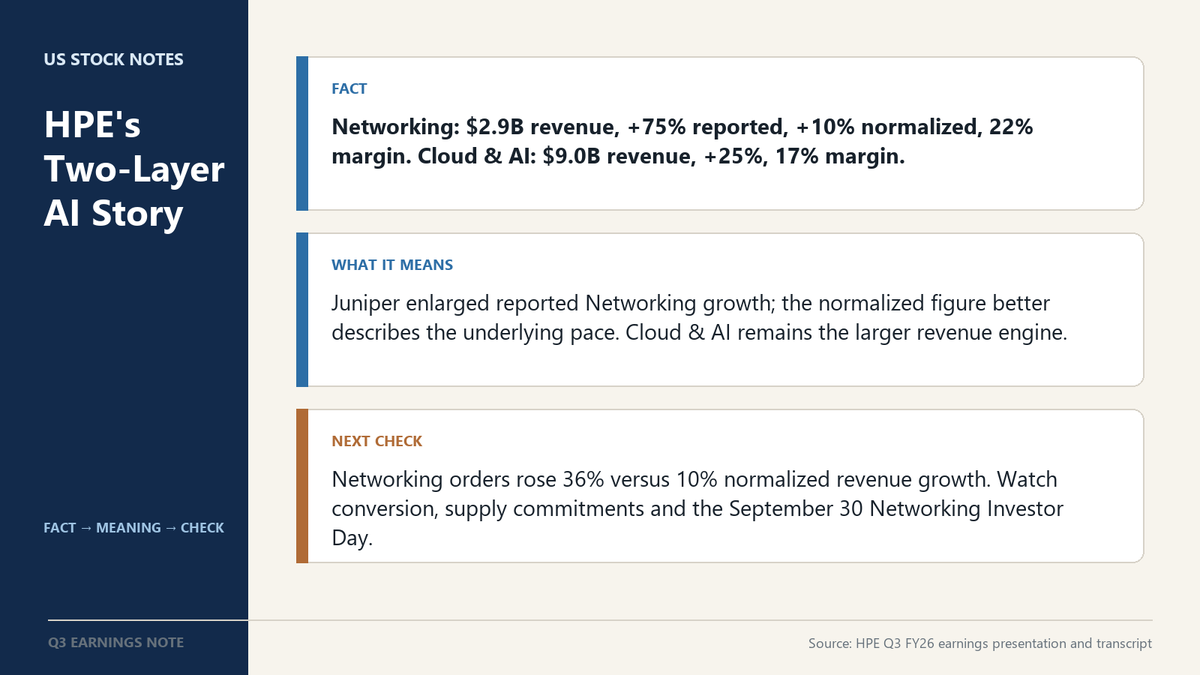
Cloud & AI produced $9.0B of revenue, up 25% year over year, with a 17% segment operating margin. Networking produced $2.9B of revenue and a higher 22% margin.
The headline Networking growth rate was 75%. But HPE also reported 10% normalized growth, a comparison that includes eight months of pre-acquisition Juniper results in the prior-year base. Reported growth and normalized growth are not interchangeable. The first shows how much larger the segment became after the acquisition; the second is closer to the underlying operating pace.
That distinction changes the AI thesis. HPE is no longer only selling compute into the buildout. It also owns a higher-margin networking layer that routes traffic inside and between AI clusters. The Oracle deployment gives that strategy a large reference customer, but a customer announcement is not the same thing as recognized revenue.
The strongest forward indicator is orders. Networking orders rose 36% on a normalized basis while normalized revenue grew 10%, leaving demand well ahead of conversion. Management also said networking purchase commitments more than doubled quarter over quarter to support that pipeline.
That gap can become future revenue, or it can expose execution risk if supply, deployment timing or customer concentration slows conversion. The September 30 Networking Investor Day should clarify how much of the backlog is durable, how quickly it can ship and whether the 22% margin can hold as the business scales.
CoreWeave is using two different financing tools at the same time, and they should not be treated as one headline.
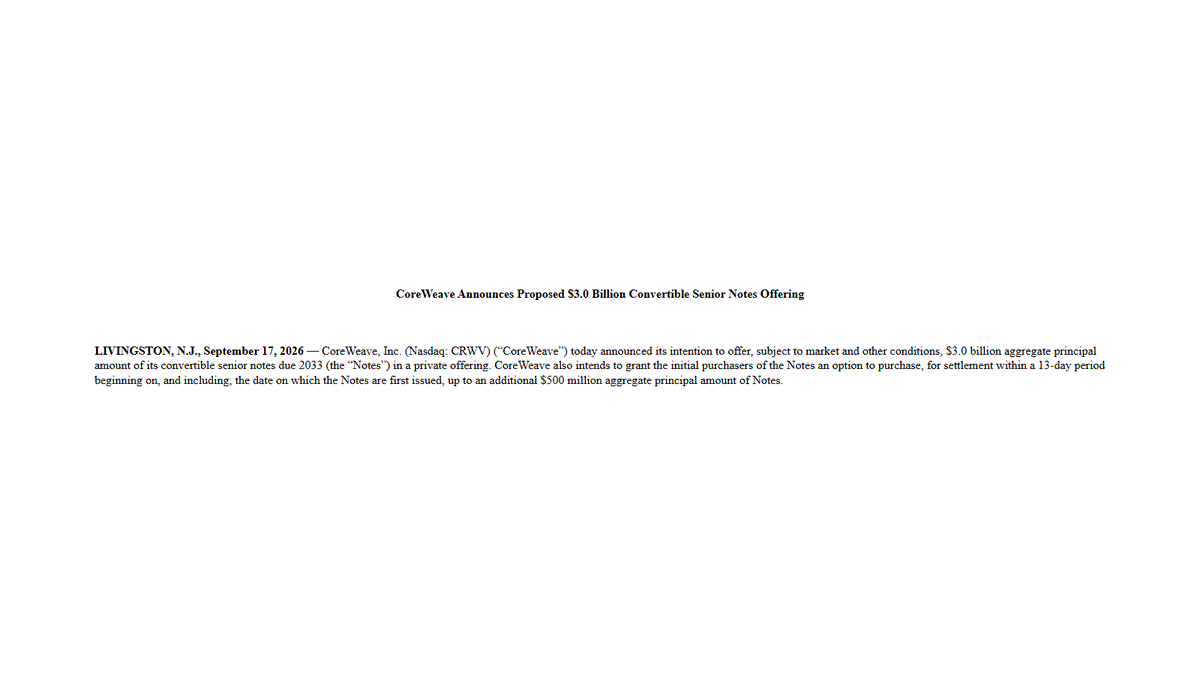
The company proposed $3.0B of convertible senior notes due 2033, plus a $500M purchaser option. Part of the proceeds is intended for capped-call transactions, which are designed to offset some potential dilution from conversion; the balance is for general corporate purposes.
Separately, CoreWeave established an ATM program covering up to 35M Class A shares. “Up to” matters: the filing authorizes sales over time and does not mean all 35M shares were sold today. At Wednesday’s $83.35 close, the maximum authorization represented roughly $2.92B of gross value, but actual proceeds depend on whether shares are issued, when, and at what price.
Around 11:15 ET, CRWV traded near $79.25, down about 4.9% and below both its $81.45 open and $83.35 prior close. The market is applying a financing discount before the final terms are known.
The deeper issue is not “AI demand or no AI demand.” Strong demand and heavy capital needs can coexist. The next evidence comes after the close: coupon, conversion premium, final deal size, capped-call terms, and whether the ATM is actually used. Until those are known, this is proposed financing capacity—not completed dilution.
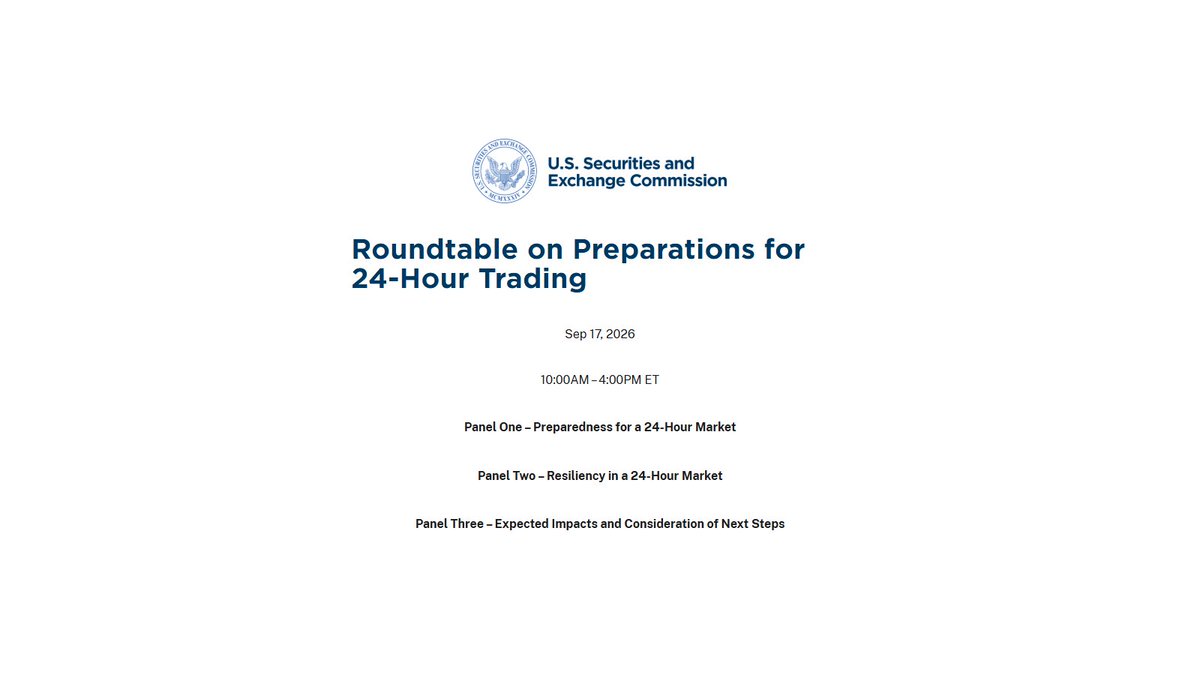
The SEC’s 24-hour trading roundtable runs from 10:00 to 16:00 ET today. The headline is longer market access, but the agenda is really about market plumbing.
The preparedness panel covers overnight liquidity, surveillance, closing-price processes, clearing and settlement, and investor protection. The resiliency panel moves further into market-data continuity, failover, capacity planning, cybersecurity and staffing. Those are not minor back-office details. They determine whether near-continuous trading can remain orderly when the regular session is closed and liquidity is thinner.
The final panel asks how longer hours may affect liquidity, capital formation and issuers. That distinction matters because availability and liquidity are different products. A stock being tradable overnight does not guarantee tight spreads, meaningful depth or reliable price discovery.
The useful follow-ups are therefore measurable: overnight spreads and depth, how closing and reference prices are formed, what brokers disclose about execution quality, and whether issuers see benefits or new volatility. The number of hours on a trading screen is the least informative part of the change.
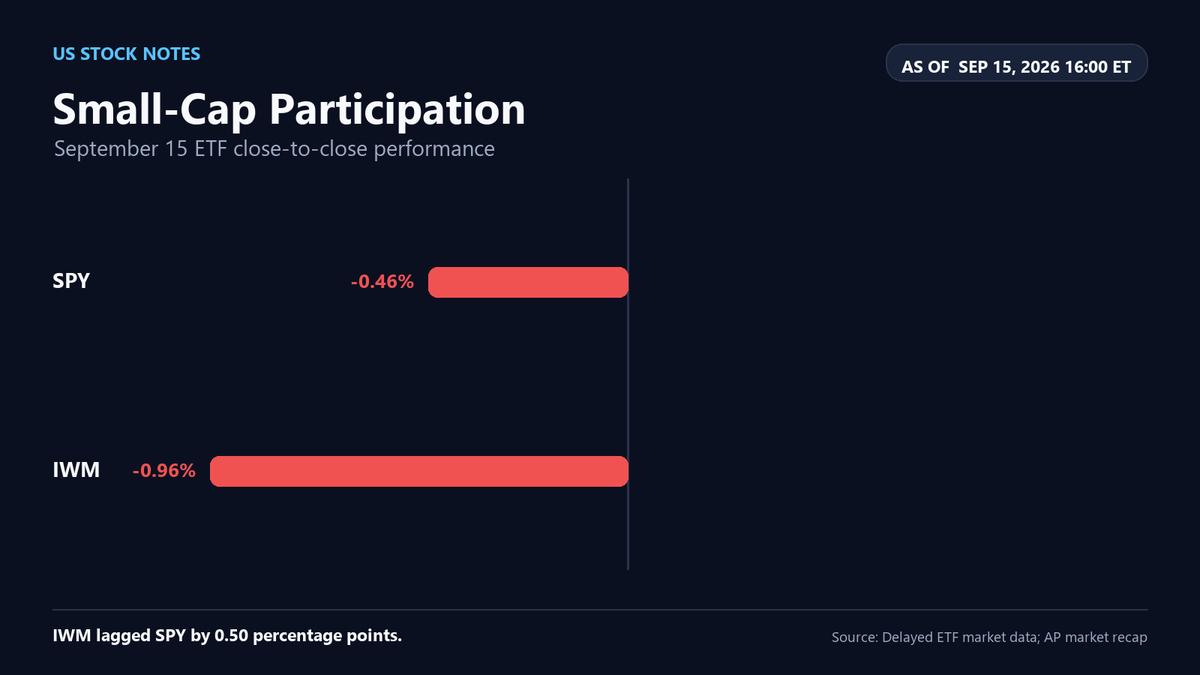
$IWM fell 0.96% versus $SPY’s 0.46% decline at the September 15 close (16:00 ET). That is weaker small-cap participation, not broad confirmation. A sustained IWM/SPY turn higher after today’s Fed decision would challenge the read.
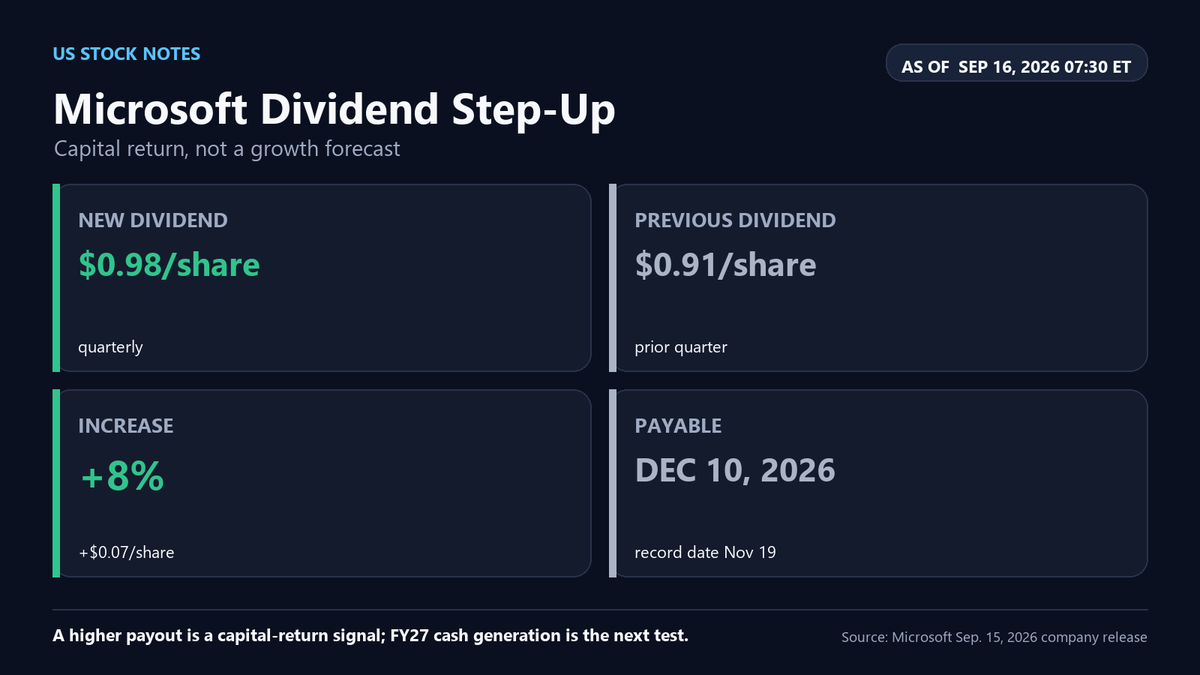
Microsoft raised its quarterly dividend to $0.98 from $0.91, an 8% increase, in its September 15 release (checked September 16 at 07:30 ET). That signals capital-return confidence, not faster growth. Next test: whether FY27 cash generation can support both AI capex and payouts.
Starting today, this account is shifting to daily notes on US large-caps and the levels that matter. I’ll share source-checked observations on market structure, company events, and risk. Free to follow; general education, not personalized advice.
The exciting part of AI-native school design is not doing conventional school faster. It is making room for student agency, real projects and better evidence of learning. That is the opportunity we are testing at MARS. @VictoryXR is one organization we work with that is doing work in this domain.
@emollick Centering augmentation is exactly the right design question for schools too. We want AI to move students toward more reasoning, conversation and creation, not less. The interface should invite human agency instead of quietly replacing it.
@OECD This is where disciplined implementation matters: use AI to widen access while keeping teachers responsible for judgment, relationships and safeguards. A tool isn’t equitable simply because it’s personalized.