#UUTwitter, We join Unitarian Universalists, Tribal Leaders, and people of faith and conscience to oppose the version of Permitting Reform being advanced in Congress as S. 5653, the Bipartisan American Affordability and Jobs Act (BAAJA) of 2026.
@FightFossils
Even though S. 5653, the Bipartisan American Affordability and Jobs Act (BAAJA) of 2026, was passed last week, your engagement is needed this week. The House could vote as early as Monday, November 30.
Call w/ @sideoflove's auto-dialer: https://t.co/wZqII85mZr
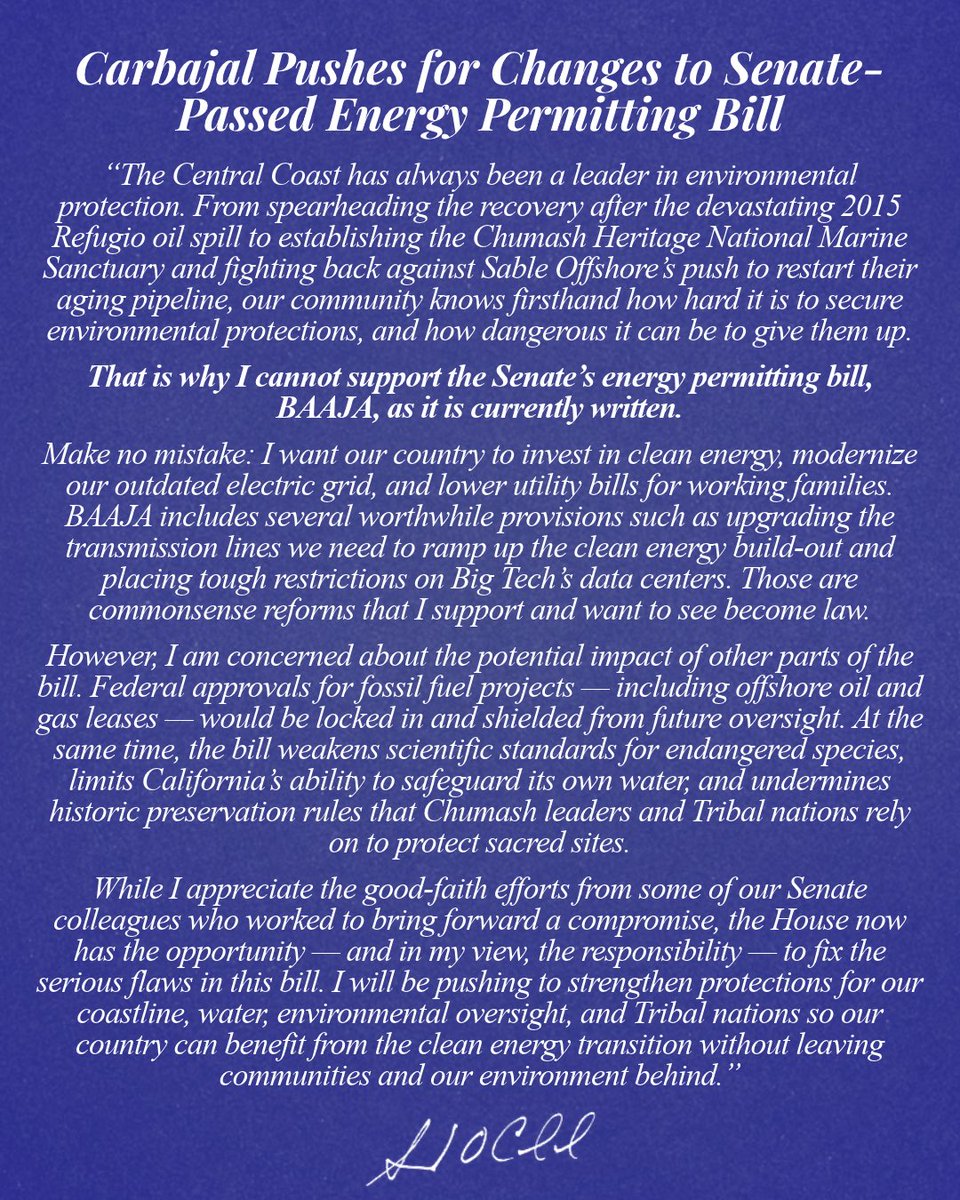
Although BAAJA includes some important provisions for our transition to clean energy, it is a deeply flawed bill and can hurt critical environmental protections the Central Coast depends on. Read my full statement on the Senate’s version of BAAJA.
I am a strong NO on the Bipartisan American Affordability and Jobs Act when it comes to the House.
Tribes, environmental organizations, and community groups appealed to the sponsors of the BAAJA, asking them to remove or modify provisions that would undermine Tribal sovereignty and roll back key environmental laws. The Senate-passed bill functionally addressed none of those concerns. This bill rolls back environmental protections, catastrophically undermining the Clean Water Act, and allowing new offshore drilling. This bill would also create ‘forever permits’ for data centers. Voters made their opposition to data centers clear and now is not the moment to let Donald Trump hand a blank check to developers who want to continue building these sites in communities across the country.
This bill completely disregards Tribal sovereignty. Especially in a moment of democratic backsliding, Tribal consultation and collaboration must remain a meaningful and enforceable component of federal decision-making. Protections for sacred sites are not bargaining chips to be traded. Democrats are ready to accelerate the clean energy transition — BAAJA is not how we reach that, though. I am proud to be one of 164 members who support the Energy Bills Relief Act, legislation that we should quickly pass next Congress.
Waiting until the next Congress to pass permitting reform would provide a real opportunity to negotiate that never occurred with the current bill. I urge my colleagues to vote NO on this bill and listen to the resounding call of voters across the country to fight for our agenda, not fold.
House Natural Resources Committee top Democrat Jared Huffman lays out five fixes that are “needed to earn his support” for BAAJA, the Senate permitting reform deal:
The Senate just passed BAAJA, a sweeping overhaul of how we permit energy projects. Now it's up to the House. After much deliberation, I can't support the bill as written. It asks us to give up protections we may never win back in exchange for gains we may never see.
I've spent my career fighting for clean energy, first as an environmental attorney and now in Congress. I want us to build power lines, solar, and wind faster, and parts of BAAJA would help. It would improve how we plan and build transmission lines, and it would require large data centers covered by the bill to pay their share of grid costs. Many of those ideas are also in the Energy Bills Relief Act that Sean Casten and I wrote, because families shouldn't have to pick up the tab for Big Tech.
I take the bird-in-the-hand argument seriously. BAAJA has already cleared the Senate with bipartisan support. If the House passes it up, we could wait years for another permitting bill that can get through both chambers and be signed into law.
Still, we have to weigh the whole trade.
BAAJA would limit how states protect their own water. It would give agencies less time to look at threats to endangered species. And it would make it much harder for courts to stop a project, even when an agency skipped the environmental review the law requires. By the time that review gets fixed, a wetland could be filled in or a Tribal sacred site destroyed, and that damage can't be undone.
The bill would also make it harder to change or pull back a permit once it's issued, even one that was issued illegally. Congress should make sure agencies can fix their mistakes and prevent serious harm before it happens.
Those limits would be written into law. The clean energy gains and lower bills, meanwhile, depend on what actually gets built, and on who's carrying out the law. Right now that's President Trump, and on clean energy, he can't be trusted. His administration has spent this year canceling offshore wind projects, and he has said he won't approve new wind turbines. Nothing in this bill stops him from slow-walking the clean energy side of the bargain while the rollbacks take effect right away.
Rhodium Group estimates that the provisions it modeled would cut the average household's annual electricity bill by $50 to $78 in 2040. I want those savings. But Rhodium didn't model the permitting certainty provisions, and it didn't assess what BAAJA would mean for water quality or Tribal consultation. Congress has to weigh those consequences too.
I've spent years fighting to keep new offshore drilling away from Southern California. When a federal approval threatens our coast, it matters whether a court can step in before the damage is done. I've also heard from hundreds of constituents about BAAJA, and among those who contacted me, opposition has run roughly two to one.
Here's what would get me to yes.
Keep the transmission reforms and make large data centers pay their share. Make sure the permitting certainty provisions can't block commonsense safeguards or keep a future administration from withdrawing an illegally issued permit. Preserve the ability of states to protect their own water. Keep endangered species decisions grounded in the best available science. Let courts halt projects when an agency skips required environmental or historic preservation review and the harm could be irreversible. And address the concerns Tribal nations have raised about sovereignty and the federal government's trust and treaty responsibilities.
If House and Senate leaders from both parties agree on those fixes, I'll be ready to vote yes.
As written, #BAAJA would let detention projects skip environmental and public reviews entirely, strip federal courts of the power to halt illegal construction, and lock in permits for years to come.
Call Your Representative at
(202) 224-3121, and Ask Them to Vote No on BAAJA!
Elections are a moment.
Advocacy is a practice.
This fall, millions of us voted our values. Voting was step one. Holding the new Congress to our values is the work that follows, and it starts now, #UUTwitter
Learn More: https://t.co/NFJSfhQsQg
The Afghan refugees who supported us during the 20-year Afghan War and are now residing in the U.S., need #UUTwitter's help. Please email your Representative. Ask them to join the discharge petition, H.R. 9899, the Afghanistan TPS Act.
https://t.co/M4JABO1dEs
The BAAJA permitting bill’s changes to the Clean Water Act will restrict state and Tribal authority to protect lakes, rivers, and wetlands. It takes a fast-tracked process meant for projects with minimal impacts like public boat ramps and applies it to pipelines, highways, and data centers.
https://t.co/IyxD30U6Vr
Contact your Representatives at (202) 224-3121 and ask them to #opposeBAAJA.
Check out this updated toolkit from our friends at People vs Fossil Fuels:
https://t.co/T1EOhkU8R4
#UUTwitter, We join Unitarian Universalists, Tribal Leaders, and people of faith and conscience to oppose the version of Permitting Reform being advanced in Congress as S. 5653, the Bipartisan American Affordability and Jobs Act (BAAJA) of 2026.
@FightFossils
On Transgender Day of Remembrance,
We honor the lives and legacies of those lost to anti-transgender violence.....
Their lives, stories, and humanity matter.
𝐻𝑎𝑣𝑒 𝑦𝑜𝑢 ℎ𝑒𝑎𝑟𝑑 𝑡ℎ𝑒 𝑛𝑒𝑤𝑠?
𝗡𝗘𝗧𝗪𝗢𝗥𝗞’𝘀 𝗻𝗲𝘄𝘀𝗹𝗲𝘁𝘁𝗲𝗿 𝗶𝘀 𝗼𝘂𝘁 𝘁𝗼𝗱𝗮𝘆! 📢📰
⠀
Our faith calls us to advocate for dignity, come together in solidarity, and build for the common good. From Capitol Hill to your neighborhood, our monthly Newsletter covers it all and helps you stay informed, get inspired, and learn ways you can make a difference for the common good.
⠀
Sign up for NETWORK’s Newsletter today and get it straight to your inbox!
🔗𝗟𝗶𝗻𝗸 𝗶𝗻 𝗯𝗶𝗼
#UUTwitter, Today, we joined Shared Future Action and other faith organizations to send a clear message to congressional leaders and incoming members: our communities deserve action.
Write Your Lawmakers about abusive ICE practices.
https://t.co/BzVE9G4NLf
Unitarian Universalists are invited to join Shared Future and many others for a press conference and rally at the Capitol in Washington D.C. on November 18, 11:00 am to ask the incoming members of Congress to focus on a pathway to citizenship.
#UUTwitter
#UUTwitter, the incoming Congress must include cash policies such as an expanded Child Tax Credit and Earned Income Tax Credit in any affordability plan.
Sign the Cash & Affordability Sign-On Letter:
https://t.co/DekqvUvjuc
@ESP_Action@NILC@CedarLaneUU@MAZONusa
Serious lawyers - and not just environmental advocates - people like Judge David Tatel and now Steve Vladeck - are sounding the alarm about BAAJA. If you won’t listen to us maybe listen to them. It’s a bad bill with serious long term consequences.
https://t.co/teQtWIQO9e
We are here to stand with Pueblo and Tribal leaders from across NM and the U.S. to oppose the bad parts of the Bipartisan American Affordability and Jobs Act (BAAJA).
Call your Members of Congress and tell them to vote NO! ⬇️
#UUTwitter, Please check out 106 Strong's video from last week's rally. https://t.co/RR7NwfEp0w
Please call your senators at 877-796-1949 tell them to oppose BAAJA
Thank you food and water action for sharing your Auto-Dialer with us.
Pictured Rep. Adalita Grijalva