@Crypto_Scient Lmao, who told you the crowd is waiting? The crowd is under water and whales will accumulate where they feel it’s cheap for them. It can be $20k, $30, $40 or $50k region, we don’t know.
@Sykodelic_@Roman_Trading You keep finding reasons to be bullish and market keeps humbling you, why not study the market you have and not impose what you think the market should be doing?
Remember men that women cannot do anything physically to you, so they have to use their what they have..
Manipulation, gaslighting and shame.
This is why you must become self validated instead of wife validated.
Answering to yourself and to God.
@Sykodelic_ Almost everyone believes in the three year bull market but when it comes to the one year bear market , majority disagree. Truly funny. Market will decide which path it chooses
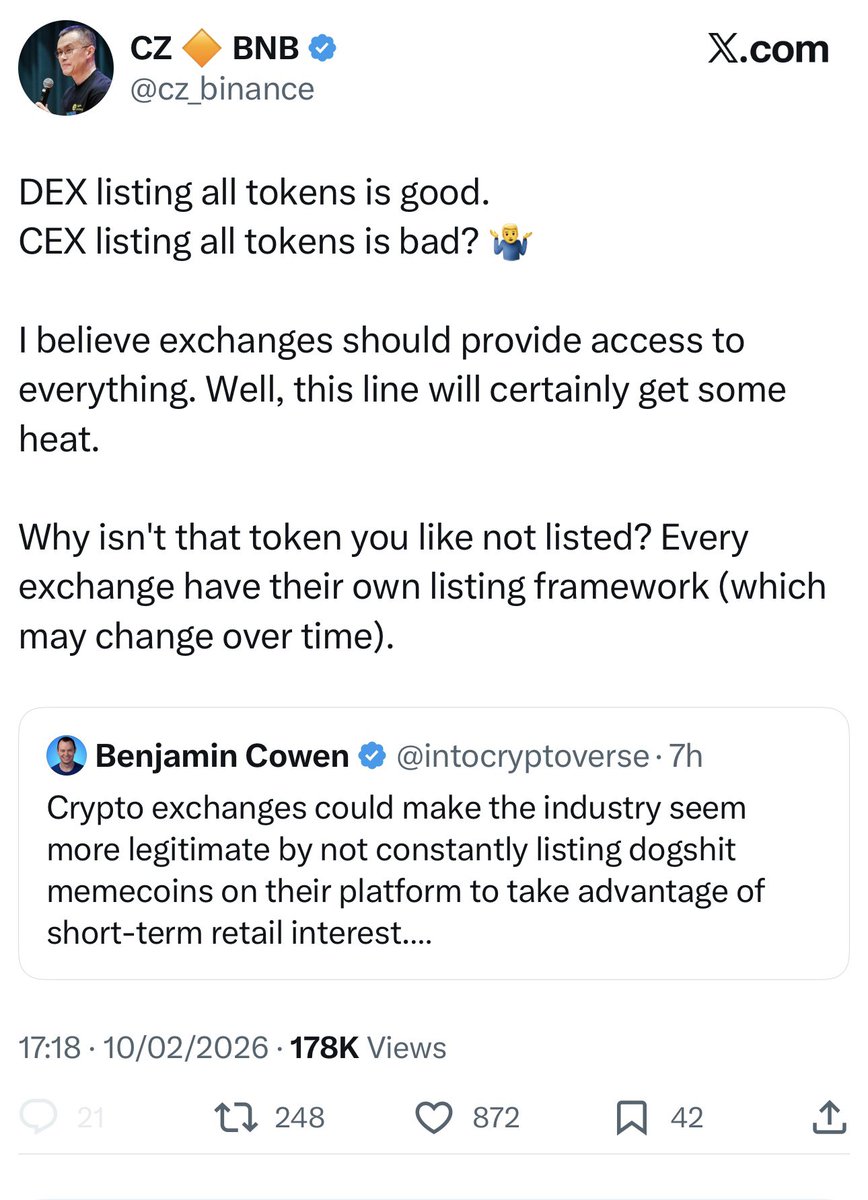
At first glance, this may sound reasonable—but it is actually a false equivalence.
DEXs and CEXs serve fundamentally different roles.
Open, permissionless access belongs to DEXs; responsibility, standards, and accountability belong to CEXs.
A DEX is a pure self-custody tool. The service provider is not an intermediary and does not control users’ funds. Users who interact with DEXs understand—or should understand—that they are using a tool and assuming full responsibility for their actions. As SEC Chair Paul Atkins has stated:
“The right to have self-custody of one’s private property is a foundational American value that should not disappear when one logs onto the internet.”
By contrast, CEXs custody users’ funds, much like banks. As a result, they carry clear obligations around AML, sanctions compliance, fraud prevention, and consumer protection. CEXs are not neutral pipes. They intermediate trust, hold operational responsibility, and therefore have a duty to protect users, not simply list everything that exists.
Conflating DEXs and CEXs is not openness.
It is an attempt to avoid responsibility.
This fundamental distinction reflects a long-standing difference in values between OKX and Binance.
After recent conversations with several leading market makers and VC partners, I’ve gathered some harsh but real takeaways to share with everyone:
1/ Altcoins are fading
A year ago, I mentioned that VCs had largely stopped investing in early-stage Web3 projects—now it’s even more pronounced. The Black Swan event on October 11 dealt a devastating blow to altcoins. Retail investors trading altcoins face a terrible risk-reward ratio.
Let’s be real—the alt season will not come in 2025 or 26.
Exceptions? Infrastructure projects with real-world resources, such as stablecoins, RWA, and payment solutions—but these types of projects likely won’t even issue tokens.
2/ The DAT bubble is deflating
There’s little genuine demand for long-tail Digital Asset Tokens (DATs). Recent deals have mostly been "in-kind" swaps—tokens for equity.
From the perspective of project teams, token holders, and financial advisors, raising DATs makes sense because it helps raise funds. But for investors—whether you're a private participant before a DAT goes live or buying in later in stock market—you’re likely to end up on the losing side.
3/ Current strategy: Know where we stand, proceed with caution
Trading isn’t easy right now. This isn’t like one or two years ago when you could “buy without thinking,” but it’s also not the peak of a bull market where you should “sell without thinking.” The real market top will arrive amid mindless euphoria—not in the current climate of fear. (NFA, DYOR)
▪️ Those holding cash: Some family offices have approached me, planning to allocate 5–20% to BTC. I think that’s reasonable—the BTC/gold ratio is at a relatively low level.
▪️ Those fully invested or using leverage: I’ve said it before—reduce leverage now and shift to a defensive stance.
▪️ Those partially invested: Stay patient, keep your positions steady, and wait for the right opportunities.
4/ Post-October 11 aftermath: The market needs time to heal
Weekly trading volume across CEXs has dropped by 20–40%. Market makers have also taken a hit—some major players even got liquidated after increasing leverage (I won’t name names here). Large capital is generally more risk-averse, and everyone needs some time to regroup and recover.
In summary:
Bull markets are born in despair and mature in doubt. We are currently in the "doubt" phase. Let go of get-rich-quick fantasies, above all - make sure you stay in the game.
@OtsukimiOtsu If you go by that logic, historically we always have three bullish years. There is always a first for everything and maybe this time we have two bearish years. Will be nice if it’s a bullish year
@m0xt_ I agree. People can’t even differentiate between revenue and profits these days. Have been seeing people talk about UNI $700m revenue and not the profit. It’s weird