Ages of Founding Fathers in 1776:
James Monroe, 18
Aaron Burr, 20
John Marshall, 20
Alexander Hamilton, 21
James Madison, 25
John Jay, 30
Thomas Jefferson, 33
Thomas Paine, 39
John Adams, 40
George Washington, 44
This nation was built by brilliant young men.
Originally called "Yankee Doodle", this is one of several versions of a scene painted by A. M. Willard that came to be known as The Spirit of '76. Often imitated or parodied, it is a familiar symbol of American patriotism.
@AmRevResurrect One idea runs from 30 ad to 1776 ad to now. We are not the property of those who took power over us - those individuals do not block our access to God and we don't need their permission to hear from or talk to God.
@jonharris1989 These and parallel ideas had sunk deep into the minds of founders' ancestors for well over a 100 years before the founders were born. These ideas were deeply ingrained before a word of debate at the continental congress, let alone before a word of the declaration was drafted
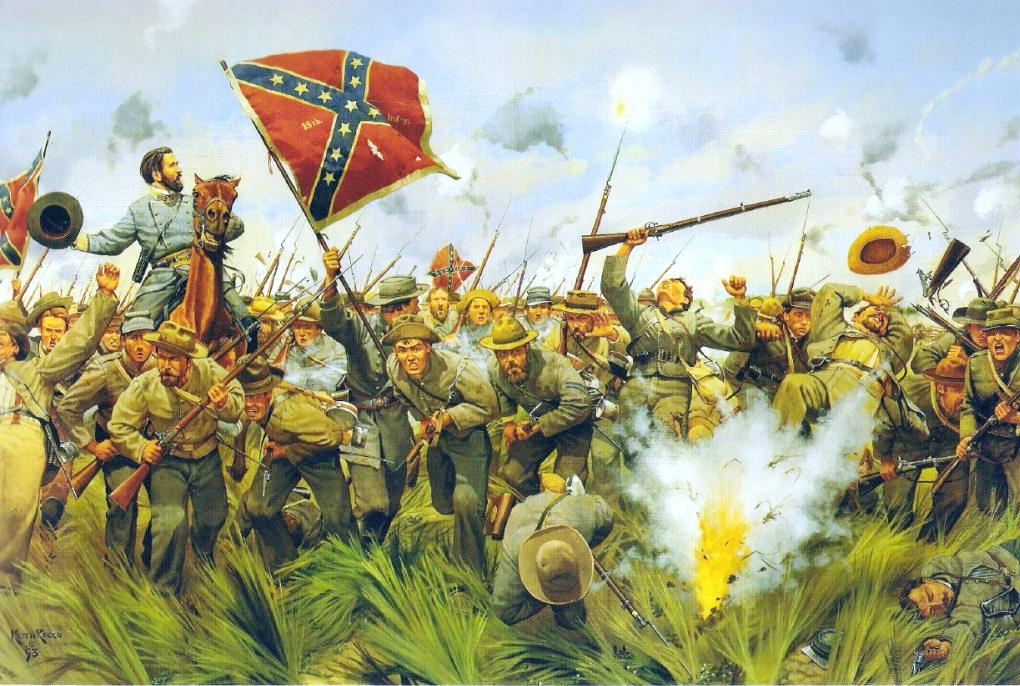
On this day in 1863, twelve thousand Confederates set out across three quarters of a mile of open Pennsylvania farmland, and the Union guns turned that field into one of the worst killing grounds of the whole war.
They came out of the trees around three in the afternoon in the heavy July heat, dressed their lines like a parade, and started walking. There was nothing to hide behind. Just gently rising farmland, a couple of fences, and at the far end a low stone wall on a ridge lined with cannon and riflemen waiting for them. The distance took something like fifteen or twenty minutes to cross at a walk. Fifteen or twenty minutes in the open, in range, the whole way.
The Union artillery started the killing while the Confederates were still far off. The big smoothbore Napoleons and the rifled guns threw solid iron shot that came bounding across the ground, and at that range a single ball could plow straight down the length of a marching file and take a dozen men with it, tearing off heads, ripping away arms and legs, cutting a man clean in half at the waist. The survivors would step over the wreckage, close the hole in the line, and keep walking in step. Officers rode up and down calling the ranks together, dress it up, close it up, and the men obeyed even as the shot kept combing through them.
Then the guns on the flanks got the angle. Union batteries off to the sides, up on the high ground, could fire straight down the length of the Confederate lines instead of at the front of them, and that is the worst thing that can happen to troops in the open. One shot fired down the length of a line doesn't kill one or two men, it kills ten or twenty, one after another. The men called that kind of fire a whirlwind. Whole companies came apart under it.
As the range closed, the cannon switched from long range shot to shell, iron balls filled with powder set to burst overhead and shower the men with hot jagged fragments, and then, when the Confederates got in close, to canister. Canister was a tin can packed with dozens of iron balls, and firing it turned each cannon into an enormous shotgun. At short range some crews double loaded it, two cans at once, and cut whole swaths out of the advancing mass. Men near those blasts weren't just killed, they were shredded, and the survivors were sprayed with the blood and flesh of the men beside them.
Partway across, the Confederates hit the Emmitsburg Road, and it ran along a low spot with stout rail fences on both sides. The lines had to stop, climb the first fence, cross the road, and climb the second, all while standing straight up in point blank fire. Men were shot to pieces hanging on those rails. Dead and wounded piled along the fences so thick that in places the living had to push the bodies aside to get over. The neat lines that had started the charge were gone now, broken into clumps and knots of men, but they kept pushing uphill toward the wall through smoke so thick they could barely see.
At the top waited the stone wall, at a bend in the Union line they call the Angle, right by a little clump of trees the whole attack had been aiming for. Here it became a close range slaughter. The Union infantry stood two and three deep behind the wall and fired into the packed Confederates at a few paces, so close the muzzle flashes scorched the men in front. A young Union artillery officer named Cushing, already wounded in the belly and holding himself together with his hand, ran his last gun down to the wall and fired it into their faces before he was shot dead. Men clubbed each other with musket butts, stabbed with bayonets, threw rocks, grabbed gun barrels with bare hands.
A few hundred got over the wall. Leading them was General Lewis Armistead, hat raised on the point of his sword so his men could see him in the smoke, and he reached a Union cannon and laid his hand on it before he was shot down beside it. For one moment there were Confederates inside the Union line at its very center. Then the Union reserves came pouring in from three sides and closed around them, and the men who had made it over were shot down, bayoneted, or forced to throw up their hands. The breach was gone as fast as it had opened.
And then it was just the field. The men who could still move turned and walked back the way they had come, back across that whole three quarters of a mile, and the guns fired into their backs the entire way. They stepped over their own dead and dying to get home, the wounded crawling and calling for help that couldn't reach them. Of the roughly twelve thousand who had stepped off, about half were killed, wounded, or captured in less than an hour. Some regiments came back with barely a handful of men. The grass they had crossed was carpeted end to end with the dead, and the charge that was supposed to win the war was over.
American Exceptionalism IX: The Federalist Papers
The World Before:
Most governments are born in force, fraud, or inheritance. Men seize power, then explain later why they deserve to keep it. The people are usually handed a system after the powerful have already decided its shape.
The American Answer:
The Federalist Papers did something rarer. They argued a nation into existence. Hamilton, Madison, and Jay took the machinery of the Constitution and defended it in public, piece by piece, before a people expected to judge it.
America did not hide its blueprint. It published the fight.
The Legacy:
The Federalist Papers proved the republic was not afraid of reason. It explained power before granting it, suspicion before trusting it, and liberty before risking it inside a stronger union.
The Constitution was the architecture. The Federalist Papers were the fire in the forge.
The Threat:
The enemies of this country hate persuasion because persuasion requires respect for the citizen. Every ideology of control prefers slogans, censorship, mobs, and institutional force.
The Federalist Papers remain an insult to all of them: a reminder that free men are not managed into obedience. They are argued into conviction.
Our founders' brilliance:
"The Constitution turned rebellion into machinery. It divided power because men are dangerous, limited government because liberty is fragile, and bound ambition against ambition so no faction could easily become a throne."
American Exceptionalism VIII: The Constitution
The World Before:
Revolutions are easy to begin and hard to survive. Most destroy the old order, then discover they have no architecture strong enough to hold the new one. Rage can topple a crown. It cannot govern a continent.
The American Answer:
The Constitution turned rebellion into machinery. It divided power because men are dangerous, limited government because liberty is fragile, and bound ambition against ambition so no faction could easily become a throne.
America did not trust angels to rule it. It built a system for men.
The Legacy:
The Constitution gave the Revolution a skeleton. It made freedom durable, scalable, and armed against the oldest disease in politics: power gathering itself into one set of hands.
That is why the American republic did not burn out like a fever. It endured.
The Threat:
The enemies of this country hate the Constitution because it slows them down. Every ideology of control requires speed, emergency, centralization, and obedient institutions. The Constitution was built to frustrate all of it.
It is not an obstacle to democracy.
It is the barricade that keeps democracy from becoming a mob with paperwork.
American Exceptionalism VII: E Pluribus Unum
The World Before:
Most nations were built from sameness. Blood, tribe, crown, church, language, and soil formed the old bonds of peoplehood. To belong, you usually had to be born into the story.
The American Answer:
America attempted something stranger and far more dangerous: a nation built from many peoples under one civic creed. Thirteen jealous colonies, divided by interest, region, religion, and habit, placed a Latin warning on their seal before the country was even secure.
Out of many, one.
Not because men were identical, but because they could be bound by something higher than ancestry.
The Legacy:
E Pluribus Unum became the American wager. A republic could absorb difference without dissolving, turn strangers into citizens, and make loyalty to an idea stronger than loyalty to blood.
That was not diversity as decoration. It was unity as conquest.
The Threat:
The enemies of this country hate the motto because it denies their favorite weapon. They survive by splitting people into tribes, teaching grievance as identity, and making unity feel like betrayal.
America’s answer was carved into its beginning.
Many origins.
One nation.
American Exceptionalism VI: Benjamin Franklin
The World Before:
Europe expected colonies to produce subjects, not statesmen. Civilization was supposed to flow from old capitals, old titles, and old bloodlines.
The American Answer:
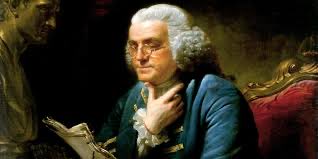
Benjamin Franklin ruined the theory. Printer, inventor, diplomat, revolutionary, and professional menace to dull men, he walked into the salons of Europe like the New World had sent its own weather system. He charmed France, mocked Britain, played kings and ministers against their own arrogance, and somehow found time to flirt like diplomacy was a contact sport.
The Legacy:
Franklin proved the American mind was not provincial. It could invent, bargain, seduce, persuade, and outthink older powers on their own ground. Before America became a superpower, Franklin made it impossible to dismiss.
The Threat:
The enemies of this country hate men like Franklin because they cannot be manufactured by systems or contained by class. He was talent without permission, genius without credential, and rebellion wearing spectacles.
American Exceptionalism V: Yorktown
The World Before:
Empires were not supposed to lose to colonies. Britain commanded fleets, armies, money, ports, and the confidence of a world that believed power belonged to those already holding it.
The American Answer:
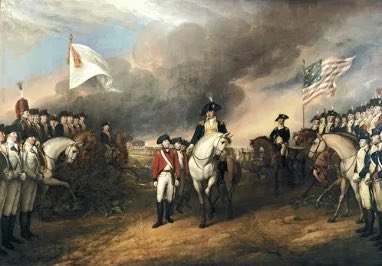
At Yorktown, that world cracked. Washington trapped Cornwallis against the sea, French guns closed the ring, and the empire that had crossed oceans to command America found itself surrounded on American soil.
The king’s army marched out defeated.
The Legacy:
Yorktown proved the Revolution was not a rebellion to be punished, but a nation to be recognized. The Declaration had named America. Valley Forge had tested it. Yorktown forced the world to see it.
A republic had survived the empire sent to strangle it.
The Threat:
The enemies of this country hate Yorktown because it reminds them that history does not always belong to the largest machine. Sometimes it belongs to the people stubborn enough to outlast it, bleed it, corner it, and make it kneel.
American Exceptionalism III: George Washington
The World Before:
Revolutions usually end with a strongman. The old ruler falls, the liberator takes his place, and the people learn too late that they only traded one master for another. History was crowded with men who claimed to free nations and then crowned themselves.
The American Answer:
George Washington had every ingredient required for power: an army that worshiped him, a nation that trusted him, and enemies too weak to stop him. He could have become king in everything but name.
Instead, he resigned his commission and went home. That decision did more than end a war. It taught the republic what power was for.
The Legacy:
Washington made restraint heroic. He proved that the greatest man in a republic is not the one who seizes power, but the one strong enough to lay it down. Every peaceful transfer of power in America lives in the shadow of that choice.
The Threat:
The enemies of this nation hate Washington because he exposes their hunger. Every ideology built on control eventually requires men who cannot release the machinery of power once they possess it.
Washington did.
That is why he remains dangerous.
American Exceptionalism II: The American Revolution
The World Before:
Rebellion was not new. Men had risen against kings before, usually to replace one master with another. Revolutions burned hot, promised justice, then hardened into new chains. Power changed hands. The throne survived under another name.
The American Answer:
The American Revolution was different because it was not merely a war against Britain. It was a war against the old architecture of obedience. Farmers, merchants, printers, lawyers, sailors, and militiamen took up arms against the greatest empire on Earth and insisted that government could be built from consent rather than command.
That was the danger. Not muskets or cannons. The idea that ordinary men could become citizens instead of subjects.
The Legacy:
The Revolution proved the Declaration was not poetry. It could march, bleed, freeze, starve, and still win. America did not inherit sovereignty. It seized it, then did something almost no revolution had ever done.
It built a republic instead of a throne.
The Threat:
The enemies of this nation hate the Revolution because it denies their favorite lie: that free people are too weak, too selfish, or too stupid to govern themselves. Every ideology that requires submission must first convince mankind that liberty is chaos and obedience is order.
The American Revolution answered that lie with gunfire.
American Exceptionalism I: The Declaration of Independence
The World Before:
For most of history, power descended at sword point. Kings inherited it, emperors seized it, priests blessed it, and subjects were expected to call obedience virtue. Liberty was not a birthright. It was a favor granted by the powerful and revoked the moment it became inconvenient.
The American Answer:
The Declaration was a political detonation. It announced that rights do not come from crowns, parliaments, parties, committees, or mobs. They belong to man before government ever enters the room, and any government that exists does so only to secure them.
That was not a request for reform. It was a notice of eviction served on empire.
The Legacy:
Britain lost thirteen colonies. The old world lost the presumption that rulers own the people beneath them. From that moment forward, every tyranny had to argue uphill against an American proposition written in Philadelphia: government is not master, but servant.
The Threat:
The enemies of this republic have always hated the Declaration because it leaves them nowhere to stand. Every collectivist faith requires rights to be conditional, managed, redistributed, or renamed into privileges. The Declaration allows none of it.
It remains what it was in 1776: a loaded weapon pointed at every ideology that demands mankind kneel.
The American Exceptionalism Series
I grow weary of the lack of celebration for our 250th birthday. The national attitude isn’t the way I thought it would be. So much division, hate, vitriol. If you love this country, chances are you’ll love what I’ll be writing about this weekend.
We will tell the story of this unique place. And we will amplify the stories of others doing the same. Until the sounds of America’s haters are drown out with the powerful and unbridled spirit of this place.
Every civilization leaves something behind. Most leave ruins. A few leave monuments. America left an idea, then proved it could build empires of innovation without becoming one, defend liberty beyond its own shores, and reshape civilization through the force of free men and free minds.
This series is a chronicle of that inheritance. It is a record of the documents, battles, inventions, leaders, and achievements that could only have emerged from the American experiment and forever altered the course of history.
There are those who dismiss this nation as an accident, a fraud, or a mistake. They inherit the freedom to make that argument from the very civilization they seek to diminish.
As America enters its next two hundred and fifty years, memory is as vital as strength. Nations endure because each generation chooses to carry the flame it inherited rather than curse the hands that lit it.
This IS American Exceptionalism.
Father’s Day is a very very difficult day for Dad’s who have been Parentally Alienated from their sons & daughters. Most Reviling Wives do this which is an evil form of child abuse. To all those Dads out there, don’t lose hope but keep crying out to our Good Father in Heaven for reconciliation with those children one day 🙏🏻🙏🏻📖