The specter of decline looms over Europe. The continent seems to be approaching the "Hour of Decision". One question remains, what form will European Caesarism take?
Spengler's Philosophy of Science-Epistemological Framework & the Second Religiousness:
In order to comprehend Spengler’s conception of second religiousness, it is necessary to borrow his method of historical analysis and draw analogies between the high-cultures. In Spengler’s morphology of world-history, a culture expresses a lifespan akin to plants and even humans. Thus, the birth of a culture in the spring phase is equated with childhood or a blossoming flower, yearning to actualize the full sum of possibilities, and, as it ages and fulfils all possibilities, “it suddenly hardens, it mortifies, its blood congeals, its force breaks down.” Analogous to an elder who mournfully reflects on his childhood and youth, the dying culture looks back to its springtime romantically and desires the spirituality apparent in the springtime, and thus the second religiousness emerges within it. A quick glimpse of the final centuries of Imperial Rome reveals the birth of various cults, namely, the cults of Isis, Sol, and Mithras; according to Spengler, this same pattern was apparent in all high-cultures. Spengler argued that there is no science without a precedent metaphysical presupposition, namely, that the scientific forms of all cultures emerge from their underlying belief structure. In his magnum opus, Spengler states “there is no distinction between the Catholic and the materialistic views of the world — both say the same thing in different words.” Just as how the primitive religion of the countryside exhausted its possibilities and reached the limit of its evolution, so too will the materialistic scientific outlook of the late autumn and winter periods be replaced by the world outlook of the second religiousness. Atheism, as “the expression of spirituality that has accomplished itself and exhausted its religious possibilities,” essentially an inorganic form of spiritual expression, preludes the second religiousness; it is the mechanistic, rather than the organic, form of expressing spirituality, and it fundamentally belongs to the city rather than the country. From this perspective, and since most cultures exhibit homological and analogical features, all past, present, as well as future, cultures experience their own form of atheism and second religiousness, albeit with a different design or composition. Stoicism, appearing alongside Caesarism and the emergent cults within the Classical civilization, were the Greco-Roman form of atheism — Aristotle, according to Spengler, was “an atheist unawares.” Buddhism was the Indian culture’s equivalent of atheism; as for the West, Spengler designated socialism as the ideological counterpart. The Nietzschean phrase “God is dead” could be equated with the Classical phrase “Gods who dwell in the holy places are dead”; however, the former (Western Faustian culture) is demonstrating that boundless space has become atheistic, whilst the latter (Classical Apollonian culture) is indicating that countless bodies have become atheistic —– each reflecting the soul or spirit of the respective culture. To Spengler, the metaphysical and religious picture of the early man of culture is what the late atheist confines to physics, one determined by wisdom and the other by pure intelligence.
In Spengler’s view, ideological beliefs and sciences, like cultures and organisms, experience the same cycles of birth and death. Like Arabian, Greek, and Indian sciences, Western science will one day fulfil itself and reach its logical conclusions. The 19th century was the great century of Western science, embodied by the works of Gauss and Humboldt. In all fields of Western science, the “great masters are dead”; what follows their demise is the arrangement, collection, and adjustments of their scientific theories and frameworks by their disciples and pupils. Be that as it may, before the will-to-victory of science is overthrown, there has to be, in the words of Spengler, “a morphology of the exact sciences, which shall discover how all laws, concepts and theories inwardly hang together as forms and what they meant as such in the life-course of the Faustian culture.” The unity of the sciences, ironically, will pave the way for Western science to fall on its own sword. Spengler argued that all the separate sciences are rapidly moving towards one another, and the result will be the fusion and merger of all the underlying theories. Spengler stated:
The retreatment of theoretical physics, of chemistry, of mathematics as a sum of symbols — this will be definitive conquest of the mechanical world-aspect by an intuitive, once more religious, world-outlook, a last master-effort of physiognomic to break down even systematic and to absorb it, as expression and symbol, into its own domain.
Spengler argued that, in the not so far future, one will not question how the laws of the various sciences function; instead, we shall establish a link between the various sciences unique to Western culture and their springtime myths. The theories and laws established in the sciences will be viewed as a re-embodiment of the myths and symbols of Western culture, albeit in a modern guise. Spengler believed that, after the fall of science, the central task will be to pursue the origins of the Western scientific form, why has Western culture received such forms, and the hidden meanings behind their emergence within the respective culture, in that specific arrangement and time. This imminent convergence of the sciences, according to Spengler, could already be witnessed by the interrelation between physics and chemistry; during the 19th century they seemed separate — yet today they cannot be divorced from one another. The same could be said about the relationship between chemistry and mathematics, as well as about that between physiology and calculus. All in all, the unification of the sciences will first shed light on the undistinguishable logical and numerical results of all the various fields; second, it will reveal the symbolic nature of the theories concealing the Faustian spirit through numbers. Every civilization manifests a materialistic world-outlook at one point during their journey through history. The phrase “knowledge is virtue” is espoused by Buddha, Socrates, and Confucius; however, the Western Faustian soul rephrases the saying and concludes that “knowledge is power.” This is what distinguishes the Western form of materialism from the rest of the cultures in world-history. Spengler stated that Western culture eliminates “all the forces that stand between the practical intelligence and nature,” and in turn paves the way for man’s domination of nature. This Western form of materialism permitted the development of the “machine-technics” in such an extreme manner, not seen in any former culture. Thus, to Spengler, the modern technics of the 19th and 20th century are innately Western and are byproducts of this specific culture alone. The rise of the machine and the mechanization of the planet will bring forth a precarious phase of tensity, poison the natural world, and replace it with an artificial world.
Paradoxically, a materialistic outlook necessitates the relaxation of collective intellectual tension by occasionally enjoying myths, the irrational, and the supernatural. This tendency is exemplified by the rise of Buddhist brotherhoods, the publicly ridiculed Isis cults of Rome, and the corresponding occultists and theosophists of European-American civilization. Although the initial re-emergence of religion is fraudulent, the arrival of a “shallow and dishonest” mock-religion, from a Spenglerian perspective, indicates that it is possible to witness a new and authentic religious spirit prepared to reveal itself, that of the second religiousness. The reason why this paper explores Spengler’s conception of the second religiousness, prior to submerging into his contribution on the concept of Caesarism, is precisely because he argued that the second religiousness is a crucial counterpart of Caesarism. The phenomenon of second religiousness brings with it deep piety, which we could witness today in the fascination of Western culture with Islam, China, and India. The foundation of the second religiousness is that of the earlier young religiousness, albeit with a different expression, as it commences with the gradual disappearance of rationalism. Almost without warning, the primitive religions of the spring stage come back to the forefront in the appearance of syncretism. Spengler believed that ages of enlightenment always proceed from an unrestricted megalopolitan confidence in reason, accompanied by unconditional skepticism. The sovereign waking-consciousness criticizes the illusory world, which it has eliminated from everyday experience, and “continues to do so till it has found the last and subtlest result, the form of the form — itself: namely, nothing.” Through this, physics as a mode of world-understanding is exhausted, and the culture yearns once more for a purely metaphysical world-outlook. It is not the intellect, nor the educated circles of the early religiousness, who have submerged themselves in literature, that paves the way for the second religiousness. Instead, according to Spengler, the source is “a naïve belief” that emerges almost spontaneously and that acknowledges the mystical constitution underlying reality. In the Classical culture, the death of rationalism started occurring about 150 B.C.; rationalism was essentially the religion of the educated men, scholarly philosophy belonged to the upper classes, whilst naïve superstition belonged to the masses. At first, philosophy, as in the 19th and 20th century West, submerged itself with the intellect; from then on it had interacted with the popular syncretism and slowly formed a new religiousness. Hence, myth belief and piety proliferated once more during that respective period of Classical history. The syncretism in the Classical, or Apollonian, culture was an amalgamation of the Phrygian, Syrian, and Egyptian myths, and Greek mysteries. Moreover, alongside the syncretism appears a return towards alchemy, astrology, and occultism, as illustrated by the emergence of such movements in China, during the syncretism that took place between Confucianism and Taoism. In Chinese culture, the gradual abandonment of Lao Tse’s rationalist doctrines occurred alongside the reemergence of religion. Whilst the Classical culture revived Orphism and imported Egyptian and Levantine myths, the Chinese absorbed Indian Mahayana Buddhism. In regard to Western culture, a glimpse of the dawn of the second religiousness and syncretism is given in Spengler’s Man and Technics, where he argued that the Western man is starting to despise the machines and the materialistic world-outlook embodied by the great cities. If the materialistic world-outlook aims to exploit, and demolish, nature, a return to religion necessitates an outlook that lives in harmony with nature. This, according to Spengler, has already been taking place within Western culture, as demonstrated by the rise of forms of life that are closer to nature, such as sports and nature getaways. Moreover, Spengler believed that the turn towards the second religiousness could be observed today in the creative talents that attempt to abolish practicality and sciences for a purely speculative approach. Spengler argued:
Occultism and Spiritualism, Hindu philosophies, metaphysical inquisitiveness under Christian or pagan coloring, all of which were despised in the Darwinian period, are coming up again. It is the spirit of Rome in the Age of Augustus. Out of satiety of life, men take refuge from civilization in the more primitive parts of the earth, in vagabondage, in suicide. The flight of the born leader from the machine is beginning.
Although Spengler’s work was popular at the time of its publication, it was gradually marginalized and ridiculed by mainstream academia. Yet, the stunning precision of his predictions continues to perplex many of his readers, as mentioned above. In accordance with Spengler’s forecasts, the Western equivalent of the Classical Cynics and Orphics arrived on the scene with the advent of the 1960’s counterculture. These movements practiced a form of Bohemianism, an unconventional form of life which proliferated around the second half of the 20th century. They displayed a temperament similar to that of Greco-Roman Cynics, quasi-religious groups and anti-establishment movements that emerged within many other cultures during the winter stage of their cultural development cycle. The voluntary vagabondage, poverty, and simple living associated with hippie movements are social phenomena that precede the reemergence of religion. Additionally, the beat generation and hippie movements displayed elements similar to the various groups, ideas, and temperaments prior to and during the emergence of a second or new religiousness. These range from the negation of prevailing norms to the rejection of materialism, vegetarianism, the pursuit of spiritual enlightenment, and the exploration of psychedelic drugs. Moreover, in terms of spirituality and religion, the 1960’s counterculture absorbed features from Taoism, Hinduism, restorationist Christianity, Buddhism, and Paganism — exhibiting a severe form of syncretism reflecting the nature of the Faustian spirit, that of extreme dynamism. Experimentation with psychedelic substances, a central practice within the hippie and beat movements, is analogous to Orphic cults, which revived the rituals of the Dionysian mysteries — well-known for their initiation through psychoactive drugs. The difference, however, was the method of initiation and the psychedelics used: the movements arising from the Western counterculture investigated LSD, Marijuana, and Psilocybin mushrooms, whilst their Apollonian counterparts, the Eleusinian mysteries, in particular, experimented with kykeon, a drink made up of barley infected with ergot, a fungus that produces psychedelic alkaloids. Alongside the spread of atheism, the West experienced a resurgence of religiosity embodied by the New Age movement and the spiritual beliefs that have emerged from it. The seeds of these movements were planted as early as the 19th century by Western esoteric groups, namely, the Theosophical and Anthroposophical societies. Jung, Steiner, and Blavatsky are some of the many architects who have built the foundation that would eventually accommodate the growing number of religious and spiritual movements to rise out of the West in the 1970s and 80s.
Azerbaycan’daki başörtüsü yasağı üzerinenden “Biz Türk’üz Müslüman değiliz. Araplaşmayacağız” diyerek İslam’a ve Müslümanlara saldıran tengriciler ve kemalistler şok. Başkurtistan’ın zirvesinde kar altında namaz kılan Türkler.
Thought-provoking!
"The Price of Time: The Real Story of Interest" by Edward Chancellor.
https://t.co/d7sf37ZglW
"In the beginning was the loan, and the loan carried interest. For at least five millennia people have been borrowing and lending at interest. The practice wasn’t always popular—in the ancient world, usury was generally viewed as exploitative, a potential path to debt bondage and slavery. Yet as capitalism became established from the late Middle Ages onwards, denunciations of interest were tempered because interest was a necessary reward for lenders to part with their capital. And interest performs many other vital functions: it encourages people to save; enables them to place a value on precious assets, such as houses and all manner of financial securities; and allows us to price risk. All economic and financial activities take place across time. Interest is often described as the “price of money,” but it is better called the “price of time:” time is scarce, time has value, interest is the time value of money."
William White (former Chief Economist, Bank for International Settlements): "I wish The Price of Time were the book that I had written."
https://t.co/d7sf37ZglW
"Why would someone who comes from a culture with freedom of thought and secular governance embrace this worldview?"
This reveals a deeply naive understanding of how liberalism and human nature works.
Liberalism, secular governance and "freedom of thought" are only relevant as long as the human tribalistic impulse (and what I mean by this, is how much humans have in group and out group characterization, as well as adherence to an elevating universal scripture) is weakened by the perpetual material progress, since the core ideological promise of liberalism and liberal modernity are to shape the material reality as being the ultimate Utopia for humans, without them basing or competing to prevail other utopias (in occurrence for Muslims, Jannah, but It's common across each religions and ideologies) that would justify dividing the world, as I said earlier, into an in and out group based on an adherence to an objective truth.
Now, this premise of liberalism has a lot of issues, because we have systematically seen across history liberalism, freedom of speech, and secular governance collapse when material and worldly conditions are no longer on the same track (for example what happened in many examples of democratic backslidings), which makes people undoubtedly revert to an earlier "pre-liberal" categorizations or political and social identities.
What we're seeing in the west currently is a plateau of liberalism as well as the faillure of both it's ideological and material promises, which is giving a strong return to identity based politics and civilizational rethoric.
There was always two tenets within the liberal tradition : the classical and western-based liberalism that justified "progress" on the basis of adherence to western identity and way of life (that was prominent from the 17th to mid-20th century), and the seconde one which treats liberalism as the "default" human nature that prevails without claiming any adherence to any specific civilization, the second one is justified by a secular understanding of the world that treats the "convergence" as natural, and anything that might seem going against this convergence (which would have been labeled treason for most of history) would be seen as a temporary setback to correct.
Now, what does this have to do with apostasy laws in Islam ? Well, as I said earlier, if both society's in and out identity defense mechanism aren't weakened in an institutional from, that universalism becomes a claim on the rest of the others rather than neutrality prevalent over anyone (as it is the case for Islam, Christianity, classical liberalism, communism, etc...), and that someone is considered as a traitor or having betrayed this covenant, than naturally, if the premise of temporary material progress and ideological convergence that might settled the penalty towards this person in "good times" doesn't exist (for the sake of prevalent neutral universalism), then the people, even if they claimed "univseralism", would have considered this person as a disruptor and agitator under a society that longer tolerates going against it's adoption of an objective truth that has a claim over all of humanity.
Which actually makes Muhammad's mission according to Eliade far more interesting—Even the Jews fell victim to this notion having YAWH as the supreme god with Baal and Asherah as the two lesser gods.
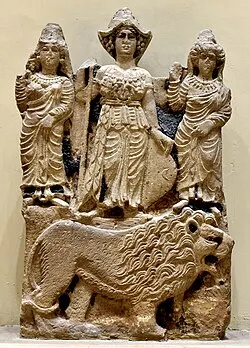
The Arabs as we know had Al-Lat with Al-Uzza and Manat being the lesser gods.