When you have no evidence to prove your allegations, every police action becomes “dictatorship” and every constitutional authority becomes your enemy. 😂
If Gyanesh Kumar is guilty, prove it legally. If the police broke the law, challenge it in court. But turning every action into a political conspiracy doesn't make you a defender of democracy it makes you look desperate for a narrative.
Democracy isn't your personal PR campaign. 🇮🇳
Elon really thinks being a billionaire makes him India's final boss. 💀😂
Bro wants access to 1.4 billion people but throws a tantrum when they ask questions about Starlink's security, data privacy and accountability.
This is India, not your comment section. We don't hand over trust like a verified badge. Pass the security checks, answer the hard questions, and stop crying because Indians have brains. 🇮🇳🚀
Elon, India isn't your Silicon Valley fan club. 🇮🇳
We know the difference between affordable internet and reliable connectivity. Cheap mobile data doesn't magically mean every village has good broadband.
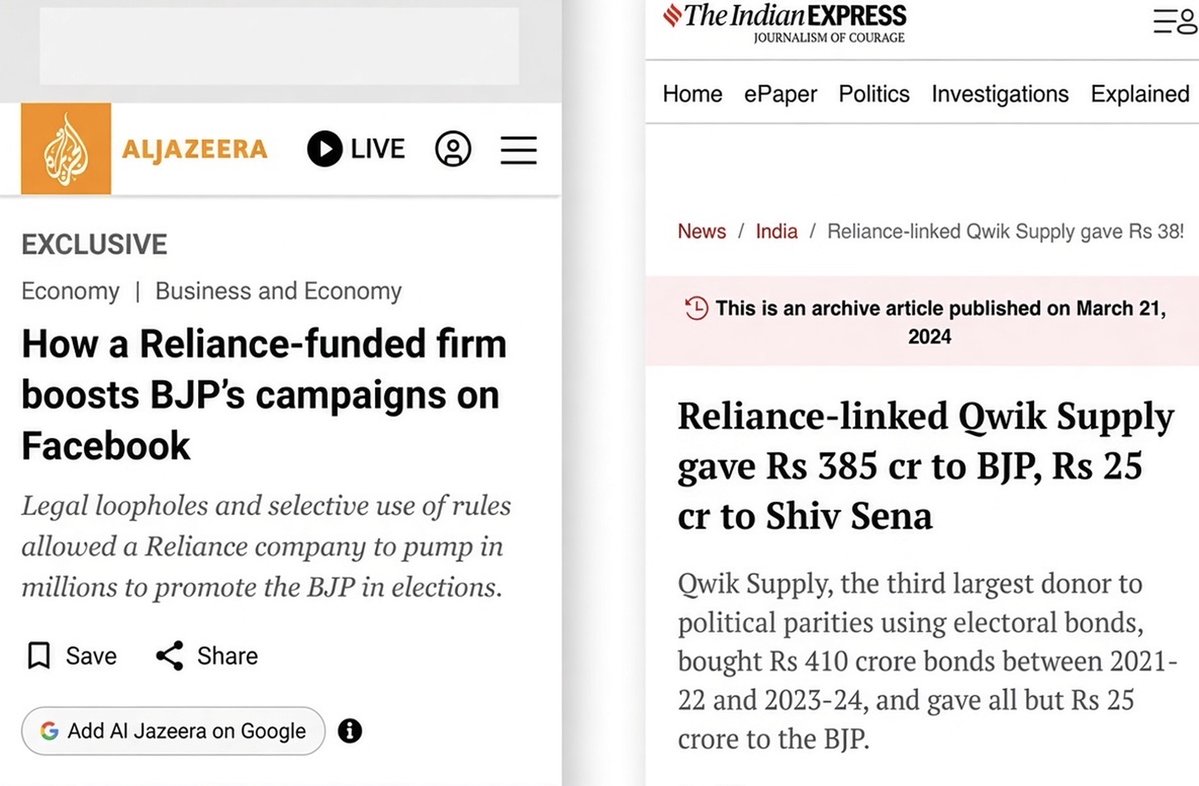
If Starlink can genuinely compete, bring affordable prices and prove your value. But calling Indians Ambani's “internet shills” because they question your business model is peak arrogance.
India doesn't owe you a market. Earn it. 💀
The ridiculous arguments by Ambani’s army of Internet shills make no sense
On the one hand, they say Starlink couldn’t possibly compete with the amazing low prices offered by Ambani’s de facto monopoly in India and then, in the same breath, they essentially claim that Starlink would be too strong of a competitor! This is absurd hypocrisy and hyperbole.
The reality is that competition would greatly benefit the average citizen in India by giving them more choices, as it always does. Ambani’s profits will be lower, but he is not going out of business. And, obviously, if Starlink is too expensive in India, no one will buy it, so SpaceX will need to make pricing affordable.
This is worse than the Emergency.
It’s official.. we are living under an absolute dictatorship ruled by Modi. Arresting cockroaches straight off their flight shows an unprecedented level of fear.
PM Modi clearly knows he only won the election through vote chori and now he is hell-bent on protecting his fraud by completely crushing democracy.
Gyanesh must go, but so must Modi.
Our legal affairs head @whattalawyer has been detained by the Police.
She was on her way to join lawyers in their protest on the issue.
In solidarity with everyone who is facing crackdown under Dictator Modi! ✊🏻🇮🇳🪳
🚨 BREAKING: Abhijeet Dipke, founder of the Cockroach Janta Party (CJP), has reportedly been detained by Delhi Police after arriving in the capital.
The detention comes ahead of CJP’s planned protest at Jantar Mantar demanding the resignation of Chief Election Commissioner Gyanesh Kumar.
One more wickets down 🤣🐕
🚨 BREAKING: YouTuber Dhruv Rathee reportedly detained at his Gurugram residence ahead of today's protest in Delhi.
Delhi police is more ready then you @dhruv_rathee#cjp#cockrojjantaparty#delhi
Amazon SDE Interview — Round 1
Had my Amazon SDE Round 1 recently.
The interview lasted around 60 minutes.
It started with a quick introduction. The interviewer asked me about my background and what I had been working on recently.
Then we moved to DSA.
Question 1 — Linked List
The first question was based on Linked Lists.
I was given a linked-list problem where I had to manipulate the nodes while maintaining the correct pointer references.
I first explained the straightforward approach and then optimized it to solve the problem in a single traversal with constant extra space.
The interviewer asked a few follow-ups around edge cases:
What if the list is empty?
What if there is only one node?
How do you make sure you don't lose references while changing pointers?
Can you solve it using O(1) extra space?
I coded the optimized solution and manually walked through a few test cases.
Time Complexity: O(n)
Space Complexity: O(1)
Question 2 — Binary Search
The second question was based on Binary Search.
It wasn't immediately obvious that binary search could be applied.
I initially explained the brute-force approach. After looking at the constraints, I noticed that the search space had a monotonic property, so we could use Binary Search on Answer.
The interviewer asked me to explain:
What exactly the search space was
Why the condition was monotonic
How I decided whether to move left or right
How I chose the lower and upper bounds
Then I implemented the optimized solution.
There were some follow-ups around boundary conditions, integer overflow while calculating mid, and a few edge cases.
One question he specifically asked was:
“Why does binary search work here?”
So instead of just saying that it was a binary-search problem, I explained the monotonic property that allowed us to eliminate half of the search space every iteration.
Project Discussion
After the DSA questions, the interviewer moved to my resume.
The first thing we discussed was my Google Summer of Code 2026 project with Sugar Labs.
He asked me to explain what I actually built during GSoC.
I talked about building a Python/GTK3 studio for generating Sugar learning activities, where users could generate, preview, refine, and export activities using different AI model providers.
Then he started going deeper into the architecture.
He asked questions like:
“How were you handling model requests without blocking the UI?”
I explained that initially this was an important problem because model requests could take time, and running them directly on GTK's main UI thread would freeze the application.
So I moved those requests to background workers, while keeping the UI responsive.
Then he asked:
“What happens if the generated code is incorrect?”
I explained the validation pipeline I built.
Before applying generated changes, the system performed things like:
AST validation
GTK runtime checks
Code validation
Transactional patches
If something failed, the system could roll back to the last working version instead of leaving the activity in a broken state.
He also asked how state was maintained if the application crashed or restarted.
I explained that I used atomic JSON persistence to preserve jobs, sessions, and revision history across restarts.
We spent a good amount of time discussing why I made those architectural decisions rather than just what technologies I used.
Then he moved to VengeanceUI.
He noticed that it had 1,000+ GitHub stars and around 40K monthly visitors, so the first question was basically:
“You built this yourself?”
I explained that I had originally launched VengeanceUI v1 and then rebuilt a large part of it as v2 based on user feedback.
The interviewer then asked:
“What changed between v1 and v2?”
I explained how I moved the documentation architecture from Nextra/MDX to Next.js App Router, introduced typed catalog data, and created reusable server/client components.
Then the discussion moved towards performance.
He asked:
“You have a lot of animated components on the website. How do you prevent all of them from running at the same time?”
I explained that I used IntersectionObserver and the Page Visibility API.
Animated previews only mount when:
Their preview tab is active
They are close to the viewport
The browser tab itself is visible
So if someone has dozens of component demos on a page, we're not unnecessarily running all of those animations.
Then he asked about the code previews.
I explained that component source code isn't fetched immediately.
The source request is deferred until the user actually opens the Code or Manual view, and syntax highlighting is handled using a server-side Shiki API rather than doing all of the initial processing inside the browser.
We also talked about how VengeanceUI grew from around 27 documented components to 75, and how the registry expanded from 85 to 132 entries.
Towards the end, he asked a more product-oriented question:
“What made people actually start using it?”
That led to a discussion around open source, user feedback, documentation, developer experience, and how I decided what components to build next.
We also briefly discussed the MCP tooling I built for using VengeanceUI components with tools like Cursor and Claude.
Overall, the round felt like:
DSA → GSoC technical deep dive → VengeanceUI architecture/product discussion
The DSA questions weren't extremely difficult.
The project discussion was actually much deeper.
The interviewer wasn't interested in:
“I used Next.js.”
He wanted to know:
“Why did you use it?”
“What problem were you solving?”
“What broke?”
“How did you fix it?”
“What happens when usage increases?”
That was probably my biggest takeaway from the round.
If something is written on your resume, you should be prepared to explain it several layers deeper than the bullet point.
1. Learning Mode Activation "Act as a learning acceleration expert trained in spaced repetition, active recall, and deliberate practice. From now on, whenever I share a subject I want to master, build me a complete learning system — not a reading list, a retention machine. What I want to learn is: [insert]. My timeline is: [insert]."
For people who keep asking what to build in AI Engineering.
➣ Build your own Context Assembler
(token-budgeted memory + retrieval + tools)
➣ Build your own Retrieval Stack
(chunker + BM25 + dense search + reranker)
➣ Build your own Model Router
(cost/latency/quality routing + fallbacks)
➣ Build your own Semantic Cache
(embedding similarity + hit-rate tracking)
➣ Build your own Agent Orchestrator
(deterministic state machine, no LangChain)
➣ Build your own MCP Server and Client
(raw JSON-RPC, no SDK)
➣ Build your own Multi-Agent Consensus
(weighted voting + judge + escalation)
➣ Build your own Sandboxed Tool Executor
(isolated execution + resource limits)
➣ Build your own Guardrails Middleware
(injection detection + PII redaction)
➣ Build your own Durable Workflow Engine
(checkpoint/resume, mini-Temporal)
➣ Build your own Streaming Proxy
(SSE + TTFT and ITL metrics)
➣ Build your own LLM Tracer
(OpenTelemetry-style spans for every hop)
➣ Build your own Eval Harness
(trajectory grading + CI regression gates)
➣ Build your own Prompt Registry
(versioning + A/B routing + rollback)
➣ Build your own Data Flywheel
(feedback → synthetic data → LoRA loop)
Pick 3. Build them from scratch. Document every decision.
Most people import libraries.
Builders understand what happens underneath.
Bookmark this. You'll need it.