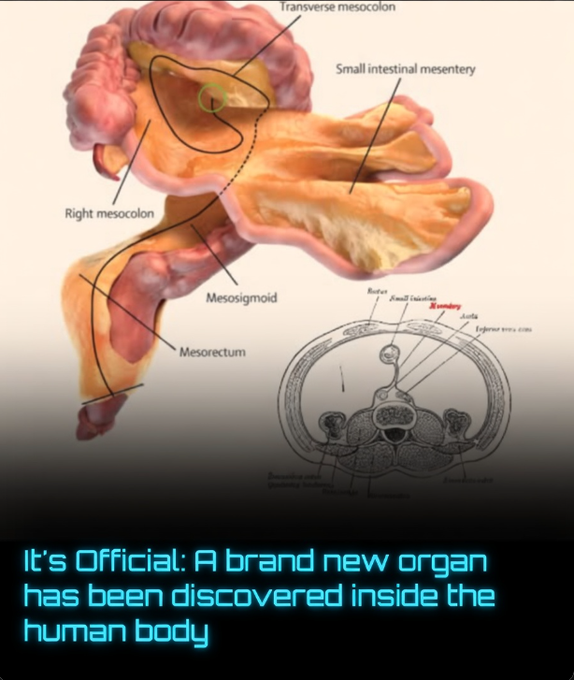
Scientists have officially discovered a brand-new organ in the human body.
The mesentery — a structure long thought to be a collection of fragmented tissues holding the intestines in place — has been reclassified as a single, continuous organ. This landmark discovery, led by researcher J. Calvin Coffey at University Hospital Limerick, has fundamentally changed our understanding of human anatomy.
For centuries, the mesentery was dismissed as insignificant. Now, thanks to detailed research, it is recognized as one unified structure. The finding was so significant that it has already been incorporated into the latest edition of Gray’s Anatomy, the world’s most respected medical textbook.
While the mesentery’s main function is to anchor and support the intestines, scientists believe it plays far more complex roles that are still not fully understood. Its formal recognition has given rise to an entirely new field called mesenteric science. Researchers hope that studying this organ will unlock new insights into digestive diseases, abdominal disorders, and potentially lead to better treatments for millions of patients.
This discovery is a powerful reminder that even today, the human body still holds remarkable secrets waiting to be uncovered.
The single biggest irrigated crop in America isn't corn, wheat, or soybeans. It's not even avocados or almonds. It's lawn.
We grow more grass than any food crop in the country, around 40 million acres of it, and almost none of it feeds a single living thing.
Think about how strange that is. We took a grass that isn't even from here, planted it coast to coast, and now we pour water, fertilizer, and pesticide into keeping it short, green, and perfectly useless.
To a bee, a butterfly, or a bird hunting caterpillars for its chicks, a manicured lawn is a desert. Nothing to eat, nowhere to nest, mile after mile of it.
But here's the good news, maybe the easiest win on this whole account: you don't have to fix the entire desert. You just have to claw back a corner.
Pick one strip. The hellstrip by the sidewalk, the run along the fence, that awkward patch you hate mowing anyway. Stop mowing it and plant it with native flowers, a few black-eyed Susans, some bee balm, a couple of coneflowers. That's it. No ripping out the whole yard, no fight with anybody. Just convert one piece.
And that piece stops being dead space and starts being habitat: bees, butterflies, and birds showing up to a spot that offered them nothing a year ago.
Now picture your neighbor doing the same, and the one after that. That's how a desert turns back into a meadow, one reclaimed corner at a time.
American actor Mark Ruffalo says
I have cut ties with celebrities who support the killing of children in Palestine
“I do not want to talk to them anymore”
The American chestnut was the dominant tree of the eastern US forest for thousands of years. One in every four trees in the Appalachians was a chestnut.
Then, between 1904 and 1940, a fungal blight from Asia killed roughly four billion of them. The species nearly went extinct as a forest tree within a single human lifetime.
The recovery effort is now in its fourth decade. The American Chestnut Foundation breeds disease-resistant hybrids by crossing American chestnuts with blight-resistant Chinese chestnuts, then backcrossing for generations to recover the American tree's form.
Other researchers have used gene editing to insert a wheat gene that detoxifies the blight.
The first restoration plantings are alive and growing in the Appalachians. They won't be mature for another 50 years.
None of the people who started this work will see it finished, but we should all be glad they're doing it.
@DGr8Awakening Is the 33lb one an axe? It looks pretty rounded, like it could be for smashing rather than splitting/cutting. It might just be the photo though.
NASA’s Curiosity rover just captured something truly magical on Mars: rare, iridescent “mother-of-pearl” clouds shimmering high in the alien sky!These aren’t ordinary clouds. While Earth’s clouds are made of water droplets, these Martian beauties are formed from dry ice — frozen carbon dioxide crystals floating at dizzying altitudes where temperatures plunge to unimaginable lows.What makes them absolutely breathtaking is the rainbow-like glow. As the Sun slips below the horizon, the last rays of sunlight catch the tiny, perfectly uniform ice crystals, scattering light into vivid, shifting colors of pink, blue, and green. The result? A spectacular iridescent display that looks more like cosmic art than weather.These clouds only appear briefly during specific seasons on Mars, glowing brightest right after sunset when the sky turns deep purple and the crystals act like floating https://t.co/5EWXFYIpPN’s a stunning reminder of how strange and beautiful the Red Planet can be — a world where clouds are made of frozen CO₂ and sunsets paint the heavens with otherworldly rainbows.What other rare space weather phenomena or breathtaking celestial events would you love to see captured by our rovers on Mars? Drop your ideas in the comments! Image Credit: NASA / JPL-Caltech / MSSS